Category: Current Affairs
Northern Virginia fact of the day
Data center developers in Northern Virginia are asking utility Dominion Energy Inc. for as much power as several nuclear reactors can generate, in the latest sign of how artificial intelligence is helping drive up electricity demand.
Dominion regularly fields requests from developers whose planned data center campuses need as much as “several gigawatts” of electricity, Chief Executive Officer Bob Blue said Thursday during the company’s first-quarter earnings call. A gigawatt is roughly the output of a nuclear reactor and can power 750,000 homes.
Electric utilities are facing the biggest demand jump in a generation. Along with data centers to run AI computing, America’s grid is being strained by new factories and the electrification of everything from cars to home heating.
Here is more from Josh Saul from Bloomberg. As I have been telling people, be long power generation…
My Conversation with the excellent Coleman Hughes
Here is the audio, video, and transcript. Here is part of the episode summary:
Coleman and Tyler explore the implications of colorblindness, including whether jazz would’ve been created in a color-blind society, how easy it is to disentangle race and culture, whether we should also try to be ‘autism-blind’, and Coleman’s personal experience with lookism and ageism. They also discuss what Coleman’s learned from J.J. Johnson, the hardest thing about performing the trombone, playing sets in the Charles Mingus Big Band as a teenager, whether Billy Joel is any good, what reservations he has about his conservative fans, why the Beastie Boys are overrated, what he’s learned from Noam Dworman, why Interstellar is Chris Nolan’s masterpiece, the Coleman Hughes production function, why political debate is so toxic, what he’ll do next, and more.
Here is one excerpt:
COWEN: How was it you ended up playing trombone in Charles Mingus Big Band?
HUGHES: I participated in the Charles Mingus high school jazz festival, which they still do every year. It was new at the time. They invite bands from all around to audition, and they identify a handful of good soloists and let them sit in for one night with the band. I sat in with the band, and the band leader knew that I lived close by in New Jersey, and so essentially invited me to start playing with the band on Monday nights.
I was probably 16 or 17 at this point, so I would take the NJ Transit into New York City on a Monday night, play two sets with the Mingus Band sitting next to people that had been my idols and were now my mentors — people like Ku-umba Frank Lacy, who is a fantastic trombone player; played with Art Blakey and D’Angelo and so forth. Then I would go home at midnight and go to school on Tuesday morning.
COWEN: Why is the music of Charles Mingus special in jazz? Because it is to me, but how would you articulate what it is for you?
Here is another:
COWEN: If I understand you correctly, you’re also suggesting in our private lives we should be color-blind.
HUGHES: Yes. Broadly, yes. Or we should try to be.
COWEN: We should try to be. This is where I might not agree with you. So I find if I look at media, I look at social media, I see a dispute — I think 100 percent of the time I agree with Coleman, pretty much, on these race-related matters. In private lives, I’m less sure.
Let me ask you a question.
HUGHES: Sure.
COWEN: Could jazz music have been created in a color-blind America?
HUGHES: Could it have been created in a color-blind America — in what sense do you mean that question?
COWEN: It seems there’s a lot of cultural creativity. One issue is it may have required some hardship, but that’s not my point. It requires some sense of a cultural identity to motivate it — that the people making it want to express something about their lives, their history, their communities. And to them it’s not color-blind.
HUGHES: Interesting. My counterargument to that would be, insofar as I understand the early history of jazz, it was heavily more racially integrated than American society was at that time. In the sense that the culture of jazz music as it existed in, say, New Orleans and New York City was many, many decades ahead of the curve in terms of its attitudes towards how people should live racially: interracial friendship, interracial relationship, etc. Yes, I’d argue the ethos of jazz was more color-blind, in my sense, than the American average at the time.
COWEN: But maybe there’s some portfolio effect here. So yes, Benny Goodman hires Teddy Wilson to play for him. Teddy Wilson was black, as I’m sure you know. And that works marvelously well. It’s just good for the world that Benny Goodman does this.
Can it still not be the case that Teddy Wilson is pulling from something deep in his being, in his soul — about his racial experience, his upbringing, the people he’s known — and that that’s where a lot of the expression in the music comes from? That is most decidedly not color-blind, even though we would all endorse the fact that Benny Goodman was willing to hire Teddy Wilson.
HUGHES: Yes. Maybe — I’d argue it may not be culture-blind, though it probably is color-blind, in the sense that black Americans don’t just represent a race. That’s what a black American would have in common — that’s what I would have in common with someone from Ethiopia, is that we’re broadly of the same “race.” We are not at all of the same culture.
To the extent that there is something called “African American culture,” which I believe that there is, which has had many wonderful products, including jazz and hip-hop — yes, then I’m perfectly willing to concede that that’s a cultural product in the same way that, say, country music is like a product of broadly Southern culture.
COWEN: But then here’s my worry a bit. You’re going to have people privately putting out cultural visions in the public sphere through music, television, novels — a thousand ways — and those will inevitably be somewhat political once they’re cultural visions. So these other visions will be out there, and a lot of them you’re going to disagree with. It might be fine to say, “It would be better if we were all much more color-blind.” But given these other non-color-blind visions are out there, do you not have to, in some sense, counter them by not being so color-blind yourself and say, “Well, here’s a better way to think about the black or African American or Ethiopian or whatever identity”?
Interesting throughout.
Are Hungarian pro-fertility policies failing?
Hungary-like fertility policies flatly don't work.
Hungary has dedicated major resources to this – no taxes for 3+ kids, debt forgiveness, major subsidies for homes. It's actually equivalent to ~5% of their GDP. The US military is 3.2%, so big spending.
Nothing happened. https://t.co/ICmu43cieu pic.twitter.com/VNWRctggwc
— Hunter!📈🌈 (@StatisticUrban) April 29, 2024
Or is it too soon to tell? Are we underestimating supply elasticities? Or are they truly low?
Trump and the Fed
That is the topic of my latest Bloomberg column, here is one bit:
Trump advisers have been drafting plans to limit significantly the operating autonomy of the Fed. The Trump campaign has disavowed these plans, but the general ideas have been spreading in Republican circles, as evidenced by the Heritage Foundation’s Project 2025 report. Trump himself has called for a weaker dollar policy, which could not be carried out without some degree of Fed cooperation. As a former businessman and real-estate developer, Trump seems to care most about interest rates, banking and currencies.
One concrete proposal reported in the Wall Street Journal would require the Fed to informally consult with the president on decisions concerning interest rates and other major aspects of monetary policy. That would make it harder for the central bank to commit to a stated policy of disinflation, since the ongoing influence of the president would be a wild card in the decision. Presidents would likely give more consideration to their own reelection prospects than to the advice of the Fed staff. Further confusion would result from the reality that the responsibility of the president in these matters simply would not be clear.
It’s important not to be naïve: Regardless of who is in the White House, the Fed already cares what the president and Congress think, as its future independence is never guaranteed. Still, explicit consultation would undercut the coherence of the decision-making process within the Fed itself and send a negative signal to investors. There is no upside from this approach.
There is much more at the link.
Will Japan have a financial crisis anytime soon?
The odds are against this, and most market prices are well-behaved, noting that the yen was hitting 160 to the dollar. More importantly, Japanese stocks have bounced back over the last two years, over the same time period that the yen has been weakening. That is one marker that this is a needed adjustment, rather than a pending collapse. Noah has a good post on the whole topic. Here are a few related observations:
1. When it comes to a mature, functional economy, do not bet on a financial crisis. Such crises are the exceptions. Furthermore, financial crises, by their very nature, are nearly impossible to predict in economies with functioning financial markets. If the prediction were a good one, the crisis already would be here.
2. That said, crises do occur, and economies can have hidden sources of leverage. The 1990s Asian financial crisis was not obvious in advance, and throughout South Korea had a strong long-run fiscal position, due to growing export potential. So talking about this is not a waste of time.
3. The real question is what Japan will do with all of its government debt, combined with a shrinking population. Note that the debt to gdp ratio is sometimes estimated at 260%, though much of this (half?) is held by the Bank of Japan. That said, I am not sure the relevance of the BOJ-held debt should be dismissed entirely. It still means the Bank is less solvent, and whether debt monetization/money printing is an automatic way to overcome that dilemma I consider in #4. Institutional barriers still do matter somewhat.
4. Japanese short-term interest rates are again very close to zero. So it is hard to inflate the debt away by an asset swap, as the “new money” might simply be saved and prove irrelevant. It is true that the Japanese central bank could try to credibly promise to keep inflating the actual paper currency until price inflation went up. But that kind of inflation is hard to predict and control, so perhaps such a promise would be a) not credible, and b) unwise. “We’re going to goose up the printing presses (literally, not metaphorically) until price inflation breaks double digits!” does not do wonders for a country’s credibility, fiscal or otherwise.
4b. It is hard to raise real interest rates, because the long-term fiscal position of the government is so difficult.
5. Japan as a whole has a very strong external position and foreign asset portfolio. Nonetheless the extent to which any of that can help Japan address its long-term solvency problem is an open question. Is the Japanese treasury going to start confiscating the Toyota plant in Kentucky?
In this regard I am somewhat less sanguine than are many of the optimists. A falling yen redistributes wealth from the Japanese consumers who buy imported food (directly), and energy (indirectly), and to Japanese MNEs holding dollars. But how much do one-time boosts in “corporate stock solvency” protect against longer-run growth unsustainabilities? I would not bet the house on that one.
6. Similarly, I am not so impressed by the strong dollar holdings of the Bank of Japan. In times of currency crisis, such reserves can be burned through quickly, as evidenced by South Korea right before the 1990s Asian financial crisis. Let’s say your total government debt is about $9 trillion, and the BOJ holds a trillion in USD. That is a nice cushion, but it is not going to save the day, especially since Japanese government debt will accumulate further with unfavorable demographics.
7. If you think about the political economy of the status quo, it is a bit worse than is being recognized. Inducing “austerity” through the exchange rate movement means that the redistribution from citizens goes to Japanese corporations, rather than to the government coffers, to pay off or retire debt. That makes tax hikes all the harder later on. You might rather have had the direct government austerity now in lieu of the exchange rate adjustment. How good a political message is the following?: “We know you’ve been hammered by higher prices for imported energy and food, but don’t worry, we’re going to take care of everything with a big tax hike.”
8. When push comes to shove, do markets believe that the Japanese government could see through a big tax hike? With the tax take currently at about 34% of gdp, well below western European levels, I’m still going to say yes. And if markets believe such a tax hike is possible, perhaps it is not anytime soon required. That is a core reason why I would bet against a financial crisis here.
9. Perhaps the true wild card is China, and the risk of contagion, no matter in which direction the contagion might run. Who really knows what is going on in the Chinese economy right now? I certainly don’t. It would however be a nightmare scenario if the world’s #2 and #3 economies, at the same time, had major financial troubles, including those of capital outflow.
False Necessity is the Mother of Dumb Invention
Recently, I have seen two innovations in retail, AI cashiers and human cashiers but working remotely from another country such as the Philippines and making much lower wages than domestic workers (examples are below). I fear that the AI cashiers will outcompete the Philippine cashiers leading to the worst of all worlds, AIs doing low-productivity work. In an excellent piece, People Over Robots, Lant Pritchett nails the problem:
Barriers to migration encourage a terrible misdirection of resources. In the world’s most productive economies, the capital and energies of business leaders (not to mention the time and talents of highly educated scientists and engineers) get sucked into developing technology that will minimize the use of one of the most abundant resources on the planet: labor. Raw labor power is the most important (and often the only) asset low-income people around the world have. The drive to make machines that perform roles that could easily be fulfilled by people not only wastes money but helps keep the poorest poor.
The knock on immigration has always been “we wanted workers, we got people instead.” But, with remote workers, we can get workers without people! Even Steve Sailer might approve.
At the same time, the use of AI for cashiers illustrates Acemoglu’s complaint about “so-so automation,” automation that displaces labor but with low productivity impact. AI cashiers are fine but how big can the gains be when you are replacing $3 an hour human labor?
It seems likely that at least one of these innovations will become common. Unfortunately, I suspect that US workers will object more to $3 an hour remote workers taking “their jobs” than to AI. As a result, we will get AI cashiers and labor displacement of both US and foreign workers. Doesn’t seem ideal. It’s not obvious how to direct technology to higher productivity tasks and tasks complementary to human labor but at the very least we shouldn’t artificially raise the price of labor to make AI profitable.
As Pritchett notes this is hardly the first time that cuffing labor leads to the creation of unnecessary technology.
In the middle of the twentieth century, the United States allowed the seasonal migration of agricultural guest workers from Mexico under the rubric of the Bracero Program. The government eventually slowed the program and finally stopped it entirely in 1964. Researchers compared the patterns of employment and production between those states that lost Bracero workers and those that never had them. They found that eliminating these workers did not increase the employment of native workers in the agricultural sector at all. Instead, farmers responded to the newly created scarcity of workers by relying more on machines and technological advances; for instance, they shifted to planting genetically modified products that could be harvested by machines, such as tomatoes with thicker skins, and away from crops such as asparagus and strawberries, for which options for mechanized harvesting were limited.
Necessity may be the mother of invention, but false necessity is the mother of dumb inventions.
Wendy’s AI.
Public Choice Outreach!
There are just a few spots left for the Public Choice Outreach Conference! This is a great opportunity to hear from excellent speakers including Garett Jones, Peter Boettke, Johanna Mollerstrom and more! The conference is a crash course in public choice. It’s entirely free. Indeed scholarships are available! More details in the poster. Please pass around. Applications are here!

Progress in Argentina?
Monthly inflation in Argentina could fall below 10% in April, a sign that the government’s policies are working, President Javier Milei said Sunday in a phone interview with LN+.
“Wages are already starting to beat inflation,” Milei said. “The fight against inflation is yielding results.”
Argentina’s monthly inflation slowed more than expected in March, cooling for the third consecutive time as Milei’s austerity policies affect consumer spending. Consumer prices rose 11% from February to March, less than economists expectations for 12.1%. From a year ago, inflation accelerated to 287.9%, the highest level since the country exited hyperinflation in the early 1990s.
Milei said that in the last two weeks there have been signs of deflation in food and beverages and highlighted that the benchmark interest rate has dropped to 60% from 133% when he took office.
Here is more from Manuela Tobias at Bloomberg. Here is a good short piece on whether the Milei disinflation is sustainable.
Apportioning the causes of the UK growth shortfall
Take the basic non-growth of the UK economy since 2008 (productivity, real wages, per capita gdp) and compare it to their peer countries (which are those?). If you had to assign the causes of that shortfall to various factors, how would you do it?
Recently I had lunch with a few well-informed Brits, and they were suggesting that NIMBY was responsible for at least half the problem. I thought I would give my mental estimates, and see what general opinion on the question looks like. Such an exercise never can be very accurate, but at the very least it is a good way to calibrate world views. Here goes!
1. The UK economy not specializing in making things that either foreigners or its own citizens want to buy. In other words, trends turned against the country. Its brand of European/global finance and business services just didn’t do that well. Where were the major tech companies? Was it in the right segments of manufacturing at the right time? (For part of that period, Germany was. The Netherlands still is.) Did it ride any boom in resource prices, as Australia and Canada did? No.
50 percent. Over the decades, I see growth rates move around so much, even when policies don’t change much, that this is usually my #1 culprit.
2. Brexit: 20 percent.
3. NIMBY: 15 percent.
4. Lack of cheap energy, energy building restrictions: 10 percent.
5. General decrepitude of some of the population somehow mattering more than before: 5 percent. Keep in mind we are trying to explain the recent growth gap here, not theorizing about levels. Otherwise it would be more.
Those are just guesstimates folx, what do you all think?
Culture splat (a few broad spoilers)
Challengers is a good and original movie. Imagine a 2024 rom com, except the behavior and conventions actually are taken from 2024, and with no apologies. The woman says the word “****ing” a lot, and no one treats this as inappropriate or unusual. There is bisexuality and poly. Society is feminized. Of course opinions will differ on these cultural issues, but the movie is made with conviction and so it is truly a tale of modern romance. Who in the movie is in fact the emptiest shell? Opinions will differ.
Zendaya dominates the screen — for how long has it been since we have had an actress this central and this charismatic?
Also, I quite like the new Beyonce album, and Metaculus estimates the chance of an H5N1 pandemic at about two percent.
The Prisoner’s Dilemma of Non-Competes
I agree with Tyler, that the FTC ban on non-competes is overly broad and not tailored to fields where the drawbacks outweigh the benefits. Additionally, the FTC’s authority to enact this rule, rather than Congress, is questionable.
Nevertheless, I don’t think banning non-competes is without merit. The reason is not the standard Twitter-econ view that non-competes are bad for workers. Indeed, some non-competes, so-called “gardening leave”, pay the worker during the non-compete period. Sounds pretty good! More generally, non-competes are just one item in the wage bargain like hours, health and pension benefits. As a result, the FTC is quite wrong to think that banning non-competes will raise wages–the most immediate effect will be to reduce wages. Indeed, more workers will be willing to work at lower wages precisely to the extent that non-competes were a burden. Can’t have it both ways. Instead of being bad for workers, my skepticism about non-competes is that they are bad for industry.
The problem with non-competes is that every firm wants non-competes on the workers it fires but no firm wants non-competes on the workers it hires. However, firms only control the terms on which they hire workers so it’s possible for each firm acting in its self-interest to create a situation which is in the interests of none. Or, to put it differently, firms may approve of the decision to ban non-competes because it’s a package deal, firms can’t restrict their own former employees but they gain the ability to recruit freely from competitors.
More generally, worker mobility often carries externalities. As I wrote earlier, ideas are in heads and if you don’t move the heads, often the ideas don’t move either. The innovation that results from mobility is a public good. Non-competes are a type of intellectual property, call it intellect property. Once again, firms want to lock up their intellectual property but they also want to use ideas from other firms. Firms only control the former decision not the latter so IP in general has a prisoner’s dilemma issue which is one reason IP in the US is too strong (see the Tabarrok Curve) and non-competes are part of that package. Ultimately, if the innovation effects are important, wages could rise but those effects would be for more or less all workers not specifically for those with non-competes.
Governments aren’t good at the fine details of optimizing IP so perhaps a heavy-handed approach is the best we can expect. Non-competes also aren’t a huge issue for most firms, even firms that use them, so given the above I am willing to give the experiment a try.
Tying the Knot
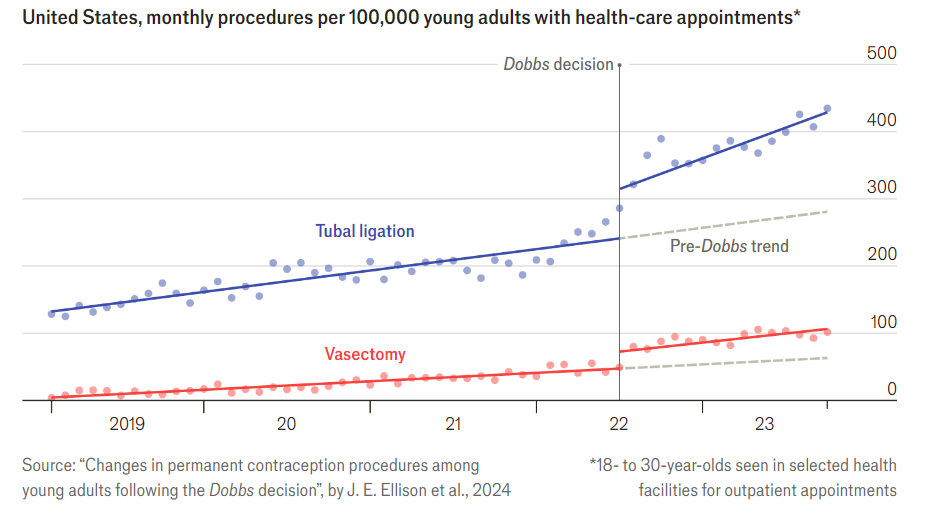
Dobbs, of course, was the Supreme Court decision saying that the constitution does not provide a right to abortion, thus leading to restrictions on abortion in many states. The pictures is from The Economist, the original paper is here.
Decoupling from China?
Maybe, but maybe not:
Amid the current U.S.-China technological race, the U.S. has imposed export controls to deny China access to strategic technologies. We document that these measures prompted a broad-based decoupling of U.S. and Chinese supply chains. Once their Chinese customers are subject to export controls, U.S. suppliers are more likely to terminate relations with Chinese customers, including those not targeted by export controls. However, we find no evidence of reshoring or friend-shoring. As a result of these disruptions, affected suppliers have negative abnormal stock returns, wiping out $130 billion in market capitalization, and experience a drop in bank lending, profitability, and employment.
That is from the NY Fed, by Matteo Crosignani, Lina Han, Marco Macchiavelli, and André F. Silva. Via RH.
Why a Housing Shortage Exists Despite More Houses Per Person
When I post about the skyrocketing price of housing and the need to build, commentators (include some of the most astute commentators on MR), will sometimes object by pointing to the increasing and historically high number of houses per capita. They question how this aligns with rising prices and wave vaguely towards factors like monopoly pricing, hedge funds, Airbnb, vacancies and so forth, implying that more construction isn’t the solution. The real explanation for rising prices amid greater homes per capita is actually quite simple, fewer kids. Kevin Erdmann has an excellent post on this going through the numbers in detail. I will illustrate with a stylized example.
Suppose we have 100 homes and 100 families, each with 2 parents and 2 kids. Thus, there are 100 homes, 400 people and 0.25 homes per capita. Now the kids grow up, get married, and want homes of their own but they have fewer kids of their own, none for simplicity. Imagine that supply increases substantially, say to 150 homes. The number of homes per capita goes up to 150/400 (.375), an all time high! Supply-side skeptics are right about the numbers, wrong about the meaning. The reality is that the demand for homes has increased to 200 but supply has increased to just 150 leading to soaring prices.
Now what do we do about this? One response is to blame people’s choices–immigrants are buying all the houses, hedge funds are buying all the houses, tourists are renting all the houses, everyone should want less and conserve more! Going down this path will tear the country apart. The other response is the American way, in the words of Bryan Caplan’s excellent new book, build, baby, build!
Here’s Kevin:
We are already 15 years into a cultural and economic battle that is so important, it turned the direction of adults per house upward for, likely, the first time since the start of the industrial revolution. Fifteen years in, by that measure, we have reversed economic progress by nearly 40 years. There is so much ground we have to make up. And, also, the reactionary position will have to continue to dig deeper and get worse – rounding up immigrants, blaming the homeless, stoking fear and distrust of financial institutions. I’m sorry if I’m sounding too shrill. It all happens in slow motion around us, so we adapt to the new normal. But the tent encampments in all the urban parks are a long way from what should be considered normal. We are already deeply into a cultural battle. And you can see that it is a cultural battle, because it is difficult to simply establish a plurality of support to admit obvious things.
If this continues, it will destroy the fabric of mutual trust that has managed to miraculously hold this country together for 250 years. The challenge is to open the eyes of enough victims of these policy choices that 50%+1 of the country can address it on the empirical level rather than the aesthetic level, and to stop this devolution before it gets worse.
Hat tip: Naveen.
U.S.A. fact of the day
Latin American immigrants are starting businesses at more than twice the rate of the U.S. population as a whole.
The jump in Latino entrepreneurship has driven up the overall share of new businesses owned by immigrants, who accounted for 36% of launches last year compared with 25% in 2019, according to a new analysis of Census Bureau data. New-business creation by white and native-born Americans has slowed in the past two years, following a broad surge early in the pandemic.
Here is more from the WSJ.