Category: Economics
The Indian School of Public Policy
India is changing very rapidly and launching new programs and policies at breakneck pace–some reasonably well thought out, others not so well thought out. Historically, India has relied on a small cadre of IAS super-professionals–the basic structure goes back to Colonial times when a handful of Englishmen ruled the country–who are promoted internally and are expected to be generalists capable of handling any and all tasks. The quality of the IAS is unparalleled, of the 1 million people who typically write the Civil Services Exam the IAS accepts only about 180 candidates annually and there are less than 5000 IAS officers in total. But 5,000 generalists are not capable of running a country of over 1 billion people and and India’s bureaucracy as a whole is widely regarded as being slow and of low quality. The quality of the bureaucracy must increase, deep experts in policy must be encouraged and brought in on a lateral basis and there needs to be greater circulation with and understanding of the private sector.
The Indian government has started to show significant interest in hiring people from outside the bureaucratic ranks. NITI Aayog, the in-house government think tank, which replaced the Planning Commission, has hired young graduates from the world’s top universities as policy consultants. The Prime Minister Fellowship Scheme is an interesting initiative to attract young people to policymaking. A range of government departments and ministries do hire young, bright graduates in various disciplines to engage in research and advisory services. In fact, in a marked departure from tradition, the Indian government recently recruited 9 people working in the private sector into their joint secretary level (senior bureaucrats). Nine people doesn’t sound like a lot but these are hires at the top of the pyramid and
[T]his is perhaps the first time that a large of group of experts with domain knowledge will enter the government through the lateral-entry process.
The demand for policy professionals is there. What about the supply? I am enthusiastic about The Indian School of Public Policy, India’s newest policy school and the first to offer a post-graduate program in policy design and management. The ISPP has brought academics, policymakers and business professionals and philanthropists together to build a world-class policy school. I am an academic adviser to the school along with Arvind Panagariya, Shamika Ravi, Ajay Shah and others. The faculty includes Amitabh Mattoo, Dipankar Gupta, Parth J. Shah and Seema Chowdhry among others. Nandan Nilekani, Vallabh Bhansali and Jerry Rao are among the school’s supporters.
The ISPP opens this year with a one-year postgraduate program in Policy, Design & Management. More information here.
Average annual change in total factor productivity between 1990 and 2014
Here are the estimates from Penn World Tables, only selected countries are presented:
Sri Lanka 2.48
China 2.40
Poland 1.70
Uruguay 1.61
Romania 1.61
United States 0.89
Brazil -0.12
South Africa -0.53
Mexico -0.82
Ukraine -1.20
A few points. First, I still believe Sri Lanka is an undervalued development story, in spite of recent developments. Second, the economy of Poland is not discussed enough. Third, other sources confirm similar numbers for Mexico, arguably because misallocations of capital and labor have increased due to the growing size of the informal sector. Fourth, there are far too many other nations in the negative column.
Those numbers are reproduced in “Productivity in Emerging-Market Economies: Slowdown or Stagnation?”, by José de Gregorio, in the new and interesting volume Facing Up To Low Productivity Growth, edited by Adam S. Posen and Jeromin Zettelmeyer.
From the comments, on work hours and spousal distribution
An Interview with the Retiring French Ambassador
An especially blunt and interesting interview with Gérard Araud, the French Ambassador, who is retiring (to America) from public life. Here’s one bit:
I don’t think that anything irreparable is happening in the U.S. I don’t know what would have happened in France if Marine Le Pen had been elected, because our institutions are much weaker.
Let’s look at the dogma of the previous period. For instance, free trade. It’s over. Trump is doing it in his own way. Brutal, a bit primitive, but in a sense he’s right. What he’s doing with China should have been done, maybe in a different way, but should have been done before. Trump has felt Americans’ fatigue, but [Barack] Obama also did. The role of the United States as a policeman of the world, it’s over. Obama started, Trump really pursued it. You saw it in Ukraine. You are seeing it every day in Syria. People here faint when you discuss NATO, but when he said, “Why should we defend Montenegro?,” it’s a genuine question. I know that people at Brookings or the Atlantic Council will faint again, but really yes, why, why should you?
These are the questions which are being put on the table in a brutal and a bit primitive way by Trump, but they are real questions.
Here’s another which reflects my own political arc watching the triumph and decline of more libertarian ideas. The tragedy is that the ideas worked as we said they would to make the world a much richer, more peaceful place but the ideas are being rejected anyway:
Bayoumy: Tell me about your memoirs.
Araud: My career had started with the election of [Ronald] Reagan, and my career is finishing with Trump. From Reagan to Trump you have, more or less, the neoliberal era—taxes were bad, borders were bad, and you have to trust the market. It’s also the period of the triumphant West … that the West was in a sense doomed to win. That sooner or later all the world will march triumphantly, to the triumph of the market. And suddenly the election of Trump and the populist wave everywhere in the Western world is for me, and I may be wrong, but for me means that this period is over.
Slavery is usually worse than you think
The men were allowed to come on deck night and day if they wished, but it was the rule to whip the Negro men if they went in the hold with the women. Aboard the Creole, sex was apparently (and, it turned out, wrong) deemed a greater threat than slave rebellion. Gonorrhea, according to slaveholding commonplace, was a disease “generally contracted among Negroes en route who are brought for sale.” A number of different traders had their slaves aboard the ship, and segregating them by sex was a way to keep one slaveholder’s slaves from diminishing the value of another’s by passing a disease — or starting a pregnancy.
That is from Walter Johnson, Soul By Soul: Life Inside the Antebellum Slave Market.
Did rising health care expenditures damage the U.S. savings rate?
Maybe so:
The U.S. saving rate declined by 8 percent between 1980 and 2009. We document that the decline can be explained by rising health expenditures. Using exogenous variation in medical expenses generated by FDA drug approvals, we document that a 1 percentage point increase in health expenditure generated a decline in saving rate of 0.9 percentage points. We then estimate a model of household decisions to evaluate the mechanisms behind the decline. We find that the rise in health expenses and drop in saving rate are driven by progress in health technology, reduction in co‐payment rates, and improvements in income processes.
That is by Yi Chen, Maurizio Mazzocco, and Béla Személy, via the excellent Kevin Lewis.
Chinese chieftain of the day
In a bid to enhance interaction and business with the Chinese in Kano State, the Emir of Kano, Emir Muhammadu Sanusi II has approved the appointment and instalment of a Chinese man, Mr Mike Zhang, as a chief and leader of the growing Chinese community in the northern Nigerian state.
Mr Mike Zhang, a Chinese trader in Kano will be referred to as “Wakilin Yan China” after his turbaning on April 25 at the Emir’s palace in Kano. He will be responsible for the proper management of the Chinese community and he would act as their representative in the Kano royalty in times of need.
There are photos at the link, via Tammy.
Robert Wenzel reviews *Big Business: A Love Letter to an American Anti-Hero*
Anecdotally, he provides us with this gem:
“How is this tweet, from “Dina,” for showing lack of gratitude toward business? “If you think about it. People with glasses are literally paying to use their eyes. Capitalism is a bitch.” Shortly after it was posted, it had accumulated 257,000 likes, surely with more to come.”
What to do?
What Cowen has done is write this very important book, taking on the charges against capitalism/big business.
There is more at the link.
Firefighting: A Plea for Discretion
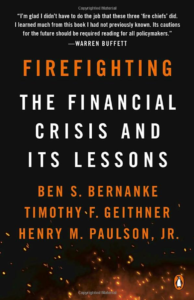 Firefighting, the new primer on the financial crisis by the all-star team of Ben Bernanke, Timothy Geithner and Henry Paulson (BGP), is a well written, short overview of the consensus position on the U.S. financial crisis. The book has a number of good lines:
…financial institutions, unlike other businesses whose success depends primarily on the cost and quality of their goods and services, are dependent on confidence. That’s why the word “credit” comes from the Latin for “belief,” why we say we can “bank” on things we know to be true, why some financial institutions are called “trusts.”
…the most damaging problem with America’s capital rules was not that they were too weak, but that they were applied too narrowly.
Risk, like love, will find a way.
Firefighting offers a summary, consensus view of the causes of the crisis:
…the basic problems were too much risky leverage, too much runnable short-term financing, and the migration of too much risk to shadow banks where regulation was negligible and the Fed’s emergency safety net was too inaccessible. There were also too many major firms that were too big and interconnected to fail without threatening the stability of the system, and the explosion of opaque mortgage-backed derivatives had turned the health of the housing market into a potential vector for panic. Meanwhile, America’s regulatory bureaucracy was fragmented and outdated, with no one responsible for monitoring and addressing systemic risks.
Consult Adam Tooze’s magisterial Crashed for a more European and global view of the crisis, Hetzel’s The Great Recession for an explanation of the crisis based on monetary rather than financial disorder and Larry Ball’s The Fed and Lehman Brothers: Setting the Record Straight on a Financial Disaster for an exhaustive and different accounting of the politics especially around the decision not to bail out Lehman.
Given that the book takes a consensus view and given that all three authors have written previous books on the crisis, one might wonder why BGP wrote Firefighting. The answer is in two parts. Most importantly, Firefighting is a plea for discretion. At one point BGP write surprisingly directly if euphemistically:
The Fed also reinterpreted its emergency lending authority in creative ways to avert catastrophic collapses of Bear Stearns and AIG…
In other words, the Fed broke the law. That, at least, is how many in Congress saw it after the fact which is why Congress asserted its authority over banking by rewriting the rules but also removed a lot of discretionary authority from the Federal Reserve and the Treasury.
Overall, while the United States has much stronger safeguards against the occurrence of panic than it had before the crisis, it has weaker emergency authorities for responding when a panic occurs. Its crisis managers lack the power to inject capital, guarantee liabilities, or purchase assets without going to Congress…the Fed has lost its power to rescue individual firms and faces new constraints on its lending powers, while the Treasury has lost its ability to use the Exchange Stabilization Fund for guarantees.
What Congress takes it can also give but BGP are not sanguine about the effectiveness of American democracy:
…when an epic crisis does arrive, Congress would have the power to undo the preemptive limitations it has placed on crisis managers. But that is easier said than done in a nonparliamentary democracy where legislative changes require support from the president, the House of Representatives, and a filibuster proof majority in the Senate…it’s hard to look at the bitterly polarized politics of modern America and feel confident that a bipartisan consensus for unpopular but necessary actions would emerge when it mattered most.
Thus, BGP come down solidly on the side of technocracy and discretion rather than democracy and rules.
I believe the second reason that Bernanke, Geithner and Paulson wrote Firefighting is that they want their account of the crisis to be the history taught to the next generation. To that end, Firefighting is indeed a useful guide for teaching the crisis and is particularly good on timelines, major events and policy actions. About a third of Firefighting is a series of standalone charts (which aren’t even referenced within the text). Oddly, however, the book never tells you that the charts are available online, neither does the book’s homepage, but a little Google sleuthing uncovers that the charts were produced in cooperation with the Brookings Institution and can be found here. Anyone wanting to teach the crisis will find what they need in the charts supplemented of course with the discussion of financial intermediation in Modern Principles and the MRU videos on the Great Recession and the various Business Cycle Theories.
Frank Lichtenberg and the cost of saving lives through pharmaceuticals
Humans are living longer, better lives thanks to innovations in prescription drugs over the past three decades, according to several new studies by Frank Lichtenberg, the Courtney C. Brown Professor of Business.
Every year, according to Lichtenberg’s research, drugs launched since 1982 are adding 150 million life-years to the lifespans of people in 22 countries that he analyzed. He calculated the average pharmaceutical expenditure per life-year saved at $2,837 — a bargain, he says.
“According to most health economists and policymakers, if you could extend someone’s life by a year for less than $3,000, that is highly cost effective,” says Lichtenberg, who gathered new data for these studies to cast a never-before seen view of the econometrics of prescription drugs. “People might be surprised by how cost-effective drugs appear to be in general.”
…To tease out the answer, the professor gathered data on drug launches and the age-standardized premature mortality rate by country, disease, and year. Drawing on data from the World Health Organization, the United Nations, consulting company IQVIA, and French database Theriaque, Lichtenberg was able to identify the role that pharmaceutical innovation played in reducing the number of years of life lost due to 66 diseases in 27 countries. (“Years of life lost” is an estimate of the average years a person would have lived if he or she had not died prematurely.)
Between 1982 and 2015, for example, the US saw the launch of 719 new drugs, the most of any country in the sample; Israel had about half as many launches. By looking at the resultant change in each country between mortality and disease, Lichtenberg calculated that the years of life lost before the age of 85 in 2013 would have been 2.16 times as high if no new drugs had been launched after 1981. For a subset of 22 countries with more full data, the number of life-years gained in 2013 from drugs launched after 1981 was 148.7 million.
Here is more from Stephen Kurczy, and here is previous MR coverage of Lichtenberg and his work. Given these estimates, do you really think we should be spending less on pharmaceuticals?
China fact of the day
China’s major commercial banks have a funding issue outside Beijing’s control: They’re running low on the U.S. dollars they need for activities both at home and abroad.
The combined dollar liabilities at the big four commercial banks exceeded their dollar assets at the end of 2018, their annual results show—a sharp reversal from just a few years ago. Back in 2013, the four together had around $125 billion more dollar assets than liabilities, but now they owe more dollars to creditors and customers than are owed to them.
Bank of China BACHY -0.66% is by far the greatest contributor to the shift. Once the holder of more net assets in dollars than any other Chinese lender, it ended 2018 owing about $70 billion more in dollar liabilities than it booked in dollar assets. The other three lenders actually finished the year with more dollar assets than liabilities, though Industrial & Commercial Bank of China IDCBY -0.33% had a deficit at the end of 2017.
In its annual report, Bank of China says that its asset-liability imbalance is more than addressed by dollar funding that doesn’t sit on its balance sheet. Instruments like currency swaps and forwards are accounted for elsewhere.
But such off-balance-sheet lending can be flighty. As the Bank for International Settlements notes, the vast majority of currency derivatives mature in under one year, meaning they are up for constant renewal and could evaporate during times of pressure.
Here is the full WSJ piece, via Christopher Balding.
Who should Trump pick for the Fed Board of Governors?
That is the topic of my latest Bloomberg column, here is the opener:
First, we should not forget that the Federal Reserve system is actually a private corporation of sorts, albeit one with a unique government-backed charter. So if you are on the board of the Fed, you are not just a figurehead — you are responsible for parts of the company. You could be in charge of the Fed’s pension and benefit plans, for instance, or its payments system.
To be sure, running monetary policy for the entire nation, and to some extent the entire world, is more important than the smooth internal workings of the Fed. Still, those managerial responsibilities will impinge on a board member on a regular basis. If he or she screws them up, it will be harder to have high status within the Fed, and harder to keep one’s confidence and emotional equilibrium. Alternatively, a governor might become completely dependent on aides to perform those internal practical functions. That is not conducive toward broader autonomy on monetary policy front, either.
The bottom line is this: A good candidate for the Fed should have at least some practical managerial experience. You don’t have to be the next Bill Gates or Steve Jobs, but you should be just competent enough to forestall internal crises of bad management and to avoid losing face. For a lot of potential candidates, that is actually a pretty tall order, especially if they come from academia or have unorthodox backgrounds unrelated to finance.
And:
Of course the next board member will also be expected to have well-informed views, however you might define them, on monetary policy and regulation. But it would be a mistake to start with a set of agreeable or required views, and then use it to build a short list of advocates. It bears repeating: For a board member to be effective, political and bureaucratic skills are paramount. Without them, a board member may well end up as counterproductive, even when correct.
Recommended.
Not Going Postal
Dueling declined as state capacity, measured by post offices, expanded:
Abstract: Scholars have long tried to understand the conditions under which actors choose to use violent versus non-violent means to settle disputes, and many argue that violence is more likely in weakly-institutionalized settings. Yet, there is little evidence showing that increases in state capacity lowers the use of violent informal institutions to resolve disputes. Utilizing a novel dataset of violence — specifically, duels — across American states in the 19th Century, we use the spread of federal post offices as an identification strategy to investigate the importance of state capacity for the incidence of violent dispute resolution. We find that post office density is a strong, consistent, and negative predictor of dueling behavior. Our evidence contributes to a burgeoning literature on the importance of state capacity for development outcomes.
Hat tip: Kevin Lewis.
Our three new hires at George Mason economics
Northwestern Ph.D, Brown post doc, Joel Mokyr student. Here is her job market paper:
Job Market Paper
The Political Economy of Famine: the Ukrainian Famine of 1933 Download Job Market Paper (pdf)
Abstract: The famine of 1932–1933 in Ukraine killed as many as 2.6 million people out of a population of approximately 30 million. Three main explanations have been offered: negative weather shock, poor economic policies, and genocide. This paper uses variation in exposure to poor government policies and in ethnic composition within Ukraine to study the impact of policies on mortality, and the relationship between ethnic composition and mortality. It documents that (1) the data do not support the negative weather shock explanation: 1931 and 1932 weather predicts harvest roughly equal to the 1925 — 1929 average; (2) bad government policies (collectivization and the lack of favored industries) significantly increased mortality; (3) collectivization increased mortality due to drop in production on collective farms and not due to overextraction from collectives (although the evidence is indirect); (4) back-of-the-envelope calculations show that collectivization explains at least 31\% of excess deaths; (5) ethnic Ukrainians seem more likely to die, even after controlling for exposure to poor Soviet economic policies; (6) Ukrainians were more exposed to policies that later led to mortality (collectivization and the lack of favored industries); (7) enforcement of government policies did not vary with ethnic composition (e.g., there is no evidence that collectivization was enforced more harshly on Ukrainians). These results provide several important takeaways. Most importantly, the evidence is consistent with both sides of the debate (economic policies vs genocide). (1) backs those arguing that the famine was man-made. (2) — (4) support those who argue that mortality was due to bad policy. (5) is consistent with those who argue that ethnic Ukrainians were targeted. For (6) and (7) to support genocide, it has to be the case that Stalin had the foresight that his policies would fail and lead to famine mortality years after they were introduced (and therefore disproportionately exposed Ukrainians to them).
Cultural economics and economic history, St. Gallen Ph.D, Harvard post doc, co-author with Joe Henrich.
Job market paper, “Catholic Church, Kin Networks, and Institutional Development“:
Political institutions vary widely around the world, yet the origin of this variation is not well understood. This study tests the hypothesis that the Catholic Church’s medieval marriage policies dissolved extended kin networks and thereby fostered inclusive institutions. In a difference-in-difference setting, I demonstrate that exposure to the Church predicts the formation of inclusive, self-governed commune cities before the year 1500CE. Moreover, within medieval Christian Europe, stricter regional and temporal cousin marriage prohibitions are likewise positively associated with communes. Strengthening this finding, I show that longer Church exposure predicts lower cousin marriage rates; in turn, lower cousin marriage rates predict higher civicness and more inclusive institutions today. These associations hold at the regional, ethnicity and country level. Twentieth-century cousin marriage rates explain more than 50 percent of variation in democracy across countries today.
Harvard Ph.D, assistant professor of economics at University of Toronto, he works in the new field genonomics and has co-authored with David Cesarini. Here is his presentation on GWAS of risk tolerance:
Here is his paper (with co-authors) “Genome-wide association analyses of risk tolerance and risky behaviors in over one million individuals identify hundreds of loci and shared genetic influences.”
I am very much looking forward to their arrival, they all seem like great colleagues, and I am honored to have played a role on the recruiting committee.
Compensating differentials
And even though [David] Crosby underwent a liver transplant in 1994, all four are active today. Does this mean we’ll see them together onstage again? [Graham] Nash stated in an interview not long ago that the band was offered $100 million to go on tour. But that’s not going to happen, he said, for one simple reason: “We don’t like each other.”
That is from David Kirby’s review of the other CSNY biography to have come out this month, also a good book.
That is from BC.