Category: Economics
Women’s liberation as a financial innovation
In one of the greatest extensions of property rights in human history, common law countries began giving rights to married women in the 1850s. Before this “women’s liberation,” the doctrine of coverture strongly incentivized parents of daughters to hold real estate, rather than financial assets such as money, stocks, or bonds. We exploit the staggered nature of coverture’s demise across US states to show that women’s rights led to shifts in household portfolios; a positive shock to the supply of credit; and a reallocation of labor towards non-agriculture and capital intensive industries. Investor protection deepened financial markets aiding industrialization.
That is from a recent paper by Moshe Hazan, David Weiss, and Hosny Zoabi, via Jennifer Doleac, who again has a new podcast series on law and economics.
The Great Reset, applied to Millennials
“Their economic fundamentals are fundamentally different,” said Christopher Kurz, an economist at the Federal Reserve.
Mr. Kurz and his colleagues last year analyzed income, debt, asset and consumption data to figure out how millennials compared at similar ages with Generation X, people born between 1965 and 1980, as well as baby boomers, those born from 1946 to 1964.
They found that millennial households had an average net worth of about $92,000 in 2016, nearly 40% less than Gen X households in 2001, adjusted for inflation, and about 20% less than baby boomer households in 1989.
Wages didn’t look much better. At the same ages, Gen X men working full time and who were heads of households earned 18% more than their millennial counterparts, and baby boomer men earned 27% more, when adjusting for inflation, age and other socioeconomic variables.
Among women, incomes were 12% higher for Gen Xers and 24% higher for baby boomers than for millennials, using the same measures.
That is from Janet Adamy and Paul Overberg at the WSJ. Note this too:
Millennials, as a group, are better educated than any generation before them. About four in 10 ages 25 to 37 hold at least a bachelor’s degree compared with about a quarter of baby boomers, and three in 10 Gen Xers when they were the same age.
You can see the problem, yes? Here is the original paper by Christopher Kurz, Geng Li, and Daniel J. Vine.
Anarchy is Worse than Socialism
Socialism is bad. I need no convincing. But the collapse of Venezuela is much worse than anyone would have predicted from socialism alone:
NYTimes: ….the drop in Venezuela’s economic output under Mr. Maduro has undergone the steepest decline by any country not at war since at least 1975.
By year’s end, Venezuela’s gross domestic product will have shrunk by 62 percent since the beginning of the recession in 2013.
Venezuela has lost a tenth of its population in the past two years as people fled, even trekking across mountains, setting off Latin America’s biggest ever refugee crisis.
Venezuela’s hyperinflation, expected to reach 10 million percent this year according to the I.M.F., is on track to become the longest period of runaway price rises since that in the Democratic Republic of Congo in the 1990s.
“This is essentially a total collapse in consumption,” said Sergi Lanau, deputy chief economist at the Institute of International Finance…
So what is causing the tremendous drop in economic activity? Ironically, it’s not too much government but too little. Outside of the capital, the government has practically abandoned its most basic responsibility of providing law and order. The result has been widespread looting. Ordinary theft is about stealing money or valuable “final” goods like diamonds or art works. In theory, the thief receives more or less what the owner loses. Looting, however, is a special kind of theft. Looting is theft plus destruction. The person who steals a candy bar is a thief. The person who breaks a store front window and steals a candy bar is a looter. Looters destroy intermediate goods and infrastructure and gain far less than owners lose. Looting is the worst kind of theft.
He said he lost his job at a hotel when looters ransacked it in March, ripping out even window frames and cable wiring. He now collects wild plums to sell for a few cents in the city’s parks. Most of his community’s diet now consists of wild fruits, fried corn pastries and bone broth, residents said.
Farther from the state capital, conditions are worse.
…The four stone quarries that are the island’s only industry have been idle since robbers stole all power cables connecting them to the grid last year. Local opposition activists estimate up to a third of the residents have emigrated from the island in the past two years.
“It used to be a paradise,” said Arturo Flores, the local municipality’s security coordinator, who sells a fermented corn drink from a bucket to local fishermen to round up his salary, which is equivalent to $4 a month. “Now, everyone is fleeing.”
On the other side of Zulia state, in the ranching town of Machiques, the economic collapse has decimated the meat and dairy industries that had supplied the country.
Power cuts have idled the local slaughterhouse, once one of the largest in Latin America. Armed gangs extort and rustle cattle from the surviving ranchers.
“You can’t produce if there’s no law,” said Rómulo Romero, a local rancher.
…“There’s no local, regional or national government here,” said José Espina, a motorbike taxi driver there. “We’re on our own.”
To say that socialism is better than anarchy is not to defend the rotten Chavez-Maduro regime. Instead I am pointing to the relevance of Mancur’s Olson’s model of the roving and stationary bandit. Olson explained why roving bandits evolve into stationary bandits:
Under anarchy, uncoordinated competitive theft by “roving bandits” destroys the incentive to invest and produce, leaving little for either the population or the bandits. Both can be better off if a bandit sets himself up as a dictator-a “stationary bandit” who monopolizes and rationalizes theft in the form of taxes. A secure autocrat has an encompassing interest in his domain that leads him to provide a peaceful order and other public goods that increase productivity.
The process is working in reverse in Venezuela. In Venezuela, the stationary bandit regime is collapsing and it is being replaced by a regime of roving bandits.
The incentives Olson identifies will eventually result in a new stationary bandit or, if Venezuela is lucky, maybe even less banditry and better institutions. The process is already underway. Consider this:
Local shopkeepers have pulled together to repair power lines and keep telecom towers running, to feed public workers, and to procure diesel for backup generators.
“We have practically taken on the functions of the state,” said Juan Carlos Perrota, a butcher who runs Machiques’ chamber of commerce.
Local shopkeepers are repairing power lines, feeding public workers and taking over the power of the state. Awesome! ¡Viva la maquinaria de la libertad!
The process of rebuilding governance, however, is slow and the destruction of wealth and human life costly. Indeed, it’s a surprise that Venezuela has gone so far down this path. Stationary bandits are usually replaced by other stationary bandits. Juan Guaidó seems far superior to Maduro on every score but the real puzzle is how Maduro has held off the generals even as anarchy looms. Don’t the generals see that that the goose is dying?
Dominick Armentano emails me about Standard Oil
Tyler,
Just watched your recent interesting exchange with Professor Wu on whether the Standard Oil divestiture made public policy sense.
Wu asserted that the decision was good public policy. You said you were not so sure since the evidence (on competition and consumer welfare) prior to divestiture may have been ambiguous. Wu had a near heart attack at that suggestion which showed me, of course, that he has never read the case, has never read the trial record (it’s 11,000 pages long and the State of Connecticut library in Hartford actually had a copy when I was researching this case back in 1970) and has never read any economist (such as myself) that has done some of that work so that professors such as Wu can be marginally smarter in policy debates.
This is one of the most misunderstood cases in antitrust history. (Even Bork, who gets much of the revisionist case history correct, totally flinches on this case; he does nearly nothing with it.)
The first misunderstanding in almost all of the law texts is that this is the first “rule of reason” antitrust case. That implies that the SC must have sifted through all of the conflicting facts and arguments presented at court and determined that Standard had acted “unreasonably.” Totally False. A modified rule of reason approach was articulated in the case by Justice White in 1911 but, of course, was never applied to the specifics in Standard.
As any antitrust lawyer can tell you this is a job for a lower court anyway, not for the SC; but this case was never remanded. The SC simply decided that the many mergers by Standard prior to 1890 constituted an attempt to monopolize in violation of the Sherman Act and, notice, divestiture follows logically from that reasoning. But whether Standard ever “restrained trade” (as we now understand the meaning of that phrase, i.e. able to reduce industry output and raise industry price) was NEVER determined. Thus whether Standard missallocated resources, charged monopoly prices, repressed innovation, etc…was never decided by the SC or any other court.
Which leaves totally open the question of what was actually going on in the oil industry between say 1880 and 1907 (aside from the many mergers). I determined that this industry (crude oil, transportation, refining, marketing was all very small ( this is pre-gasoline after all); that there were few if any legal barriers to entry and that business organizations entered and left with some frequency, typical of a young and innovative industry; that Standard, despite mergers, always had many rivals in refining (Texaco, Pure Oil, Associated Oil and Gas, Sun Oil, Gulf and many many others) and, of course, there were hundreds of firms in crude oil production and marketing which were never “monopolized”; that costs and prices decreased throughout the period of alleged monopolization (even Ida Tarbell admits this. Indeed I got much of my cost and price information from her “History of the Standard Oil Company”; that Standard’s market share decreased in the 10 year period prior to the antitrust suit (1907); and that, as John McGee argued long ago, that Standard probably did not engage in predatory pricing. There is much much more to this story and I tell a good share of that in “Antitrust & Monopoly.”
Perhaps Wu can make the case that the divestiture in 1911 produced a better result (in terms of all of the things that economists measure) than what would have happened if nothing dramatic had been done. That’s counter-factual so good luck with that!! All I know is that his knowledge of the actual history of the oil industry is quite stunning and I fear for the life of his more curious students.
Dom.
As I said in the Wu debate itself, I do not know enough about this case and I am agnostic on the question. Still, there is a perspective you don’t usually hear, and so I am passing it along.
Matthew Bishop at the NYT reviews *Big Business*
Here is the review, it is very smart and elegant (even if I don’t agree with everything in it). My favorite phrase: “Business may not be the face that launched a thousand ships, but it built them…”
Alice Rivlin, RIP, 1931-2019
My apologies for not having covered this earlier, but I have been traveling and relying on auto-published posts. You will find many fine tributes here on Twitter. I did meet and interact with her several times, and always found her the essence of both impressiveness and graciousness. Arnold Kling has written a nice appreciation.
It is the slacker writers who need agglomeration most of all
Do note the latter part of the last sentence, but the entire thesis is interesting:
This paper utilises a unique, purpose-built panel dataset on prominent authors in the UK and Ireland born 1700–1925 to estimate the productivity gains associated with agglomeration of an industry with few capital requirements and no apparent need to cluster geographically. I find the average author experiences productivity gains of 11.94% per annum when residing in London, the only major literary cluster – a gain not associated with living in any of the minor literary clusters. I find evidence of negative selection with respect to productivity, indicating the results are not driven by the self-selection of highly productive authors to London. I find heterogeneity of returns to living in London by birth cohort and Impact Index quartile (a measure of author quality) and that the cohorts who receive the greatest gains from locating in London are those for which there is the strongest evidence of negative selection with respect to productivity.
That is by Sara Mitchell in the Journal of Urban Economics, via the excellent Kevin Lewis.
The company that is Amazon
Let’s pause to reflect that the company that has made one-day shipping of tens of millions of items the industry standard is also the global leader in cloud computing services, owns the Whole Foods grocery stores (and is building a second chain), helps police departments identify criminals, is building its own air cargo fleet, has an $11 billion-a-year advertising business, is working on a plan to give everyone on Earth internet from space, has put always-on microphones in at least 1 in 10 U.S. homes, built an Oscar-winning film and TV studio from scratch, and is competing directly with UPS, FedEx, Google, Facebook, Apple, Microsoft, IBM, the entire book-publishing industry, Netflix, HBO, Disney, Walmart, Target, Costco, Kroger, CVS, Walgreens and countless startups.
I don’t like Alexa, and wouldn’t take one for free! Still, this is overall a remarkable record of both innovation and competition across many markets. That said, I wonder for how long Amazon can keep this up without becoming a bloated, inefficient conglomerate.
Here is more from Christopher Mims at the WSJ. You will note also that Walmart is several times larger in U.S. retail than is Amazon.
Identity Economics is Bad Economics
Identity economics is bad economics. The excellent Nick Rowe puts it well:
Animals can be divided into Carnivores and Non-Carnivores: A = C + NC. Therefore, if we add some wolves to an island of sheep, the number of animals on that island will increase.
It’s easy to see why that argument might not be right. Wolves kill sheep. But if you didn’t know that fact about wolves and sheep, the argument looks very appealing. But the equation A = C + NC tells us absolutely nothing about the world; it’s an accounting identity that is true by definition. The only thing it tells you is how I have chosen to divide up the world into parts. And I can choose an infinite number of different ways to divide the world up into parts.
Here are two more examples:
1. Y = C + I + G + X – M. Therefore an increase in Government spending will increase GDP.
2. Y = C + S + T. Therefore an increase in Taxes will increase GDP.
My guess is that you are much more uncomfortable with the second of those two examples than the first. You have probably seen the first argument before, but have probably not seen the second. But they are both equally correct accounting identities and are both equally rubbish arguments.
As Nick notes, the identities we write down frame our thinking. Write an identity in a different way to check whether the frame really fits.
Inegalitarian restaurants
Or maybe you’re a senior staffer for Steve Scalise, the second-ranking Republican in the House. The aide usually pings his usual server for one of his usual perches: table 10 in the main dining room. It’s the corner booth with a privacy curtain—the “rock-star table,” ever since Bono sat there. Only tonight he’d prefer a booth in the bar area. Trouble is it’s packed.
Not to worry. “A maître d’ always has a table in his back pocket,” Arnaud says. He adds the Hill staffer to the reservation system, and a bar booth with a reserved placard is his.
For these diners and the other VIPs on the books this evening—a congressman from Kentucky, a former media exec, a concierge from the W Hotel, a smattering of cherished regulars—the restaurant is extra-accommodating. Its maître d’s spot their special customers instantly, greet them by name, and immediately whisk them to their tables. Good cop, good cop…
First, the hierarchy. Because this is Washington, many restaurants naturally have a pecking order for their top clientele. All VIPs of Le Diplomate, the French brasserie in Logan Circle, are dubbed “PPX”—personnes particulièrement extraordinaires—and tracked in real time on a kitchen whiteboard as they dine. But some, such as a neighborhood regular, are classified as “TTA,” for Try to Accommodate. Others are “MA,” for Must Accommodate, including Jill Biden; Gérard Araud, the outgoing French ambassador; and Jim Abdo, the developer who basically rebuilt 14th Street. An MA commands a table, stat.
At Rare Steakhouse in downtown DC, former managing director Justin Abad categorized semiregular VIPs as “soigné,” French for “handled with care,” and those who came in three to five times a week or held multiple functions at the restaurant throughout the year as “super soigné.” The lower tier would often be treated to a complimentary Prosecco, while those handled with extra care—select media figures and lawyers, for instance—might be given a free shellfish platter on occasion.
Here is much more by Jessica Sidman. Have you ever wondered why at some places, and no I do not mean the old El Bulli, it is so hard to get a table at 7 p.m. on a Saturday night no matter when you try asking? Those tables are being rationed by status, or if you are a very regular (and lucrative) customer of some kind.
And yet almost everyone still seems to think that restaurants are super-cool, correctly or not.
Did the zero lower bound matter?
This is an article of faith in “Twitter economics,” but Scott Sumner, myself, and many others have been insisting for years that the arguments simply are not there and that the zero lower bound is not such a big deal. There is now a new NBER working paper by Davide Debortoli, Jordi Gali, and Luca Gambetti:
The zero lower bound (ZLB) irrelevance hypothesis implies that the economy’s performance is not affected by a binding ZLB constraint. We evaluate that hypothesis for the recent ZLB episode experienced by the U.S. economy (2009Q1-2015Q4). We focus on two dimensions of performance that were likely to have experienced the impact of a binding ZLB: (i) the volatility of macro variables and (ii) the economy’s response to shocks. Using a variety of empirical methods, we find little evidence against the irrelevance hypothesis, with our estimates suggesting that the responses of output, inflation and the long-term interest rate were hardly affected by the binding ZLB constraint, possibly as a result of the adoption and fine-tuning of unconventional monetary policies. We can reconcile our empirical findings with the predictions of a simple New Keynesian model under the assumption of a shadow interest rate rule.
In my somewhat jaded view, the zero lower bound arguments have been an excuse of sorts to move outside of “scarcity economics” and make politically convenient claims about the necessity fiscal stimulus. It is no wonder we ended up with MMT!
In the meantime, this evidence is the (current) final word, and I hope it will be heeded as such.
Who loses most from the U.S.-China trade war?
You are hearing claims, hints, implications, or outright statements that the full burden of the trade war is falling on American consumers. (Maybe some of the commentators are too wrapped up in the “Trump’s action have no merits whatsoever” game?) I strongly believe that is wrong, as outlined in my latest Bloomberg column. Here is one bit:
…there are well-done studies showing that the recent tariffs have translated into higher prices for U.S. consumers. I am not contesting that research. The question is whether those studies give sufficient weight to all relevant variables for the longer run.
To see why the full picture is more complicated, let’s say the U.S. slaps tariffs on the industrial inputs (whether materials or labor) it is buying from China. It is easy to see the immediate chain of higher costs for the U.S. businesses translating into higher prices for U.S. consumers, and that is what the afore-mentioned studies are picking up. But keep in mind China won’t be supplying those inputs forever, especially if the tariffs remain. Within a few years, a country such as Vietnam will provide the same products, perhaps at cheaper prices, because Vietnam has lower wages. So the costs to U.S. consumers are temporary, but the lost business in China will be permanent. Furthermore, the medium-term adjustment will have the effect of making China’s main competitors better exporters.
And:
China has an industrial policy whose goal is to be competitive in these [branded goods] and other areas. Tariffs will limit profits for these companies and prevent Chinese products from achieving full economies of scale. So this preemptive tariff strike will hurt the Chinese economy in the future, even if it doesn’t yet show up in the numbers.
Most generally:
In my numerous visits to China, I’ve found that the Chinese think of themselves as much more vulnerable than Americans to a trade war. I think they are basically correct, mostly because China is a much poorer country with more fragile political institutions.
I should note that I am not trying to defend Trump in this column, rather we need to get the economics right if we are to understand what is going on and why America can exert any pressure at all. On Twitter, Christopher Balding is one who is getting these matters right.
Returning to the bigger picture, to the extent you wish to criticize Trump’s policies, focus on what China may do as a result of its vulnerability, not America’s supposed lack of bargaining power in the struggle.
Why Do Experiments Make People Uneasy?
People were outraged in 2014 when Facebook revealed that it had run “psychological experiments” on its users. Yet Facebook changes the way it operates on a daily basis and few complain. Indeed, every change in the way that Facebook operates is an A/B test in which one arm is never run, yet people object to A/B tests but not to either A or B for everyone. Why?
In an important and sad new paper Meyer et al. show in a series of 16 tests that unease with experiments is replicable and general. The authors, for example, ask 679 people in a survey to rate the appropriateness of three interventions designed to reduce hospital infections. The three interventions are:
-
Badge (A): The director decides that all doctors who perform this procedure will have the standard safety precautions printed on the back of their hospital ID badges.
-
Poster (B): The director decides that all rooms where this procedure is done will have a poster displaying the standard safety precautions.
- A/B: The director decides to run an experiment by randomly assigning patients to be treated by a doctor wearing the badge or in a room with the poster. After a year, the director will have all patients treated in whichever way turns out to have the highest survival rate.
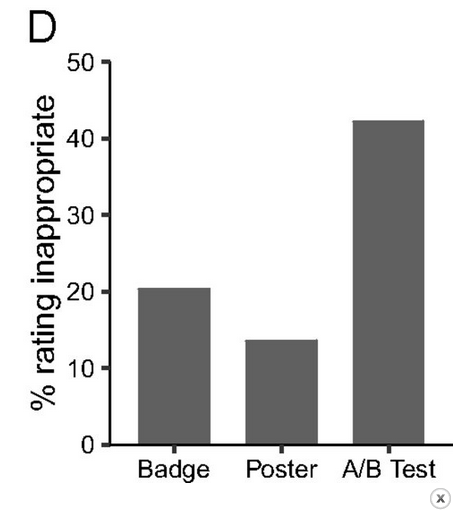 It’s obvious to me that the A/B test is much better than either A or B and indeed the authors even put their thumb on the scales a bit because the A/B scenario specifically mentions the positive goal of learning. Yet, in multiple samples people consistently rate the A/B scenario as more inappropriate than either A or B (see Figure at right).
Why do people do this? One possibility is that survey respondents have some prejudgment about whether the Badge or Poster is the better approach and so those who think Badge is better rate the A/B test as inappropriate as do those who think Poster is better. To examine this possibility the authors ask about a doctor who prescribes all of his patients Drug A or all of them Drug B or who randomizes for a year between A and B and then chooses. Why anyone would think Drug A is better than Drug B or vice-versa is a mystery but once again the A/B experiment is judged more inappropriate than prescribing Drug A or Drug B to everyone.
Maybe people don’t like the idea that someone is rolling dice to decide on medical treatment. In another experiment the authors describe a situation where some Doctors prescribe Drug A and others prescribe Drug B but which drug a patient receives depends on which doctor is available at the time the patient walks into the clinic. Here no one is rolling dice and the effect is smaller but respondents continue to rate the A/B experiment as more inappropriate.
The lack of implied consent does bother people but only in the explicit A/B experiment and hardly ever in the implicit all A or all B experiments. The authors also show the effect persists in non-medical settings.
One factor which comes out of respondent comments is that the experiment forces people to reckon with the idea that even experts don’t know what the right thing to do is and that confession of ignorance bothers people. (This is also one reason why people may prefer pundits who always “know” the right thing to do even when they manifestly do not).
Surprisingly and depressingly, having a science degree does not solve the problem. In one sad experiment the authors run the test at an American HMO. Earlier surveys had found huge support for the idea that the HMO should engage in “continuous learning” and that “a learning health system is necessary to provide safe, effective, and beneficial patient-centered care”. Yet when push came to shove, exactly the same pattern of accepting A or B but not an A/B test was prevalent.
Unease with experiments appears to be general and deep. Widespread random experiments are a relatively new phenomena and the authors speculate that unease reflects lack of familiarity. But why is widespread use of random experiments new? In an earlier post, I wrote about ideas behind their time, ideas that could have come much earlier but didn’t. Random experiments could have come thousands of years earlier but didn’t. Thus, I think the authors have got the story backward. Random experiments generate unease not because they are new, they are new because they generate unease.
Our reluctance to conduct experiments burdens us with ignorance. Understanding and overcoming experiment-unease is an important area for experimental research. If we can overcome our unease.
Do Pimples Pay? Acne, Human Capital, and the Labor Market
We use data from the National Longitudinal Study of Adolescent to Adult Health to investigate the association between having acne in middle to high school and subsequent educational and labor market outcomes. We find that having acne is strongly positively associated with overall grade point average in high school, grades in high school English, history, math, and science, and the completion of a college degree. We also find evidence that acne is associated with higher personal labor market earnings for women. We further explore a possible channel through which acne may affect education and earnings.
Here is the full piece by Hugo Mialon and Erik T. Nesson. For the pointer I thank Daniel Gross.
Price Regulation in Credit Markets
From Cuesta and Sepulveda’s Price Regulation in Credit Markets: A Trade-off between Consumer Protection and Credit Access.
Interest rate caps are widespread in consumer credit markets, yet there is limited evidence on its effects on market outcomes and welfare. Conceptually, the effects of
interest rate caps are ambiguous and depend on a trade-off between consumer protection from banks’ market power and reductions in credit access. We exploit a policy in Chile that lowered interest rate caps by 20 percentage points to understand its impacts. Using comprehensive individual-level administrative data, we document that the policy decreased transacted interest rates by 9%, but also reduced the number of loans by 19%. To estimate the welfare effects of this policy, we develop and estimate a model of loan applications, pricing, and repayment of loans. Consumer surplus decreases by an equivalent of 3.5% of average income, with larger losses for risky borrowers. Survey evidence suggests these welfare effects may be driven by decreased consumption smoothing and increased financial distress. Interest rate caps provide greater consumer protection in more concentrated markets, but welfare effects are negative even under a monopoly. Risk-based regulation reduces the adverse effects of interest rate caps, but does not eliminate them.
Hat tip: Matt Notowidigdo.