Category: Education
Should Harvard accept and enroll more students?
I don’t have a strong opinion on this topic, but I hear so much weak argumentation for the “yes” conclusion that the contrarian in me rebels.
Yes, I know it looks good and feels good that an exclusive institution for the wealthy might deign to confer some of its benefits on less wealthy (but still smart) students. It sounds like a kind of Progressive dream. How could you be for greater social justice and oppose opening the gates of Harvard to some more students, preferably lower income ones?
But why in fact should Harvard enroll more students? That probably would mean a lowering of standards, maybe not for the students, but for the faculty who would be hired to teach them. On average, those turned down for tenure at Harvard, or not considered, really are worse. A bigger school is a less cohesive school with lower standards for faculty quality stretching into the indefinite future, or at least that likely would be the case with Harvard.
Academic research is often a superstars market, where a relatively small number of people at the very top produce a disproportionate share of the value. We should keep their working conditions and environment as high quality as possible, no? Above all, that should apply to Harvard, MIT, Stanford, Caltech, and a few others too.
One not always-admitted little secret of our world is that a small bit of elitism goes a long way toward supporting a large amount of egalitarianism elsewhere in the economy.
And what about Harvard’s obligations? We would reject the premise that above-average institutions have an obligation to lower their quality to meet the average of a broader pool of institutions, simply to serve more students. That would imply a race to the bottom. I don’t have a clear account of why we should stop at one average-lowering decision margin and not another, but I suspect you don’t either. So maybe Harvard is OK to stay put at its currently high level of average faculty quality.
Keep in mind that enrolling those students at some other institution is a relevant alternative. If anyone should accept more students, it is the University of Virginia, no? They have fewer research superstars and furthermore it is a public institution, supported by state funds. And yet they turn away large numbers of Asians — among others — with very high test scores and apparently impeccable records.
Or look at it from an ethical point of view. You might believe we owe the less fortunate a “good education,” but surely you don’t believe we owe them a “Harvard education.” Or do you?
(NB: It is exactly the wrong response to simply blurt out: “But they all should accept more students!” It remains a question whether, under the preferred change, Harvard should be accepting any of the burden at all.)
Another policy alternative, which at least the committed egalitarian ought to consider, is to send that marginal Harvard student to the local community college rather than giving him or her an educational upgrade to Quincy Street.
Yes, I understand this is not the only side of the argument and yes I am undecided on this whole question. But if you wish to convince me that Harvard should take in larger classes, you will do this best by a) refusing to appeal to emotional, mood-affiliated yet insincere attacks on elites and elitism, and b) considering the least favorable comparisons for your arguments, such as letting more students into UVA instead. Surely the stellar faculty at Harvard have trained you to reason in exactly that manner…because they do it so well themselves…
Uber for private tutors
You do know that private tutors are the missing secret element in MOOCs, right? All sorts of internet learning will go better when private tutors are available on demand. Yet for the non-wealthy it does not always make sense to hire a private tutor on an ongoing basis. Still, you might have a few questions which can be cleared up in fifteen minutes or so, if only the person were available on relatively short notice.
Let’s bring private tutors into the sharing economy.
Recently I heard of a new Dutch start-up, Konnektid.com, which is trying to do exactly this. I am hopeful.
A tweet in the form of a blog post, with an addendum, #Paulson, #Harvard
Until “effective altruism” figures out what drives innovation, those recommendations simply aren’t that reliable.
Addendum: John Sterling just wrote this in the MR comments section:
I think Steven Landsburg made the definitive “pro-Paulson gift” argument in his classic Slate piece defending Ebenezer Scrooge. Paulson could have pulled a “Larry Ellison” and built himself a $200 mm yacht. He decided to forgo (some) of his conspicuous consumption and instead let the Harvard Management Company steward some additional capital.
I’ve sometimes wondered whether the Harvard endowment is the ultimate way to be an “effective altruist” for an Austrian-leaning type. If you believe, like Baldy Harper did, “that savings invested in privately owned economic tools of production amount to … the greatest economic charity of all.” then the Harvard endowment makes a pretty interesting beneficiary. I can’t think of another institution in the world today that is more likely to hold on to its capital in perpetuity than the folks in Cambridge.
I am not saying he is right, just don’t be so quick to conclude he is wrong. By the way, I do not in fact donate my own money to Harvard.
Did the Wisconsin state system just abolish tenure?
I don’t think so, not really. Here is one explanation:
The proposed changes would also remove tenure protections from state law. Darling and Harsdorf both said that Wisconsin is the only state that enshrines tenure in its statutes.
The GOP proposal puts the decision of whether to have tenure and how to define it in the hands of the Board of Regents.
“We believe in empowering the Board of Regents and the chancellors throughout the state of Wisconsin to be able to manage the System,” Nygren said. “I think this is a tool to enable them to do that.”
Cross and Board of Regents vice president Regina Miller pledged to uphold the tenets of shared governance and tenure in their policies.
For sure that is a decline in the relative status of tenure, but not an end to tenure itself.
By the way, I’ve seen so many criticisms of the $400 million Paulson gift to Harvard, almost making it sound worse than if he had kept the money for himself, as most people do with $400 million. Without a well-worked out theory of university endowments, and their importance and function (they do seem to matter), I don’t see a hard and shut case for condemning this gift. At the very least, it is likely to boost investment’ note that about 15% of Harvard’s endowment goes to private equity or venture capital. I do understand however that this gift sends an anti-egalitarian message about status relations and where investment should go.
The education myth?
Ricardo Hausmann has an excellent and provocative column, here is part of it:
In the 50 years from 1960 to 2010, the global labor force’s average time in school essentially tripled, from 2.8 years to 8.3 years. This means that the average worker in a median country went from less than half a primary education to more than half a high school education.
How much richer should these countries have expected to become? In 1965, France had a labor force that averaged less than five years of schooling and a per capita income of $14,000 (at 2005 prices). In 2010, countries with a similar level of education had a per capita income of less than $1,000.
In 1960, countries with an education level of 8.3 years of schooling were 5.5 times richer than those with 2.8 year of schooling. By contrast, countries that had increased their education from 2.8 years of schooling in 1960 to 8.3 years of schooling in 2010 were only 167% richer. Moreover, much of this increase cannot possibly be attributed to education, as workers in 2010 had the advantage of technologies that were 50 years more advanced than those in 1960. Clearly, something other than education is needed to generate prosperity.
As is often the case, the experience of individual countries is more revealing than the averages. China started with less education than Tunisia, Mexico, Kenya, or Iran in 1960, and had made less progress than them by 2010. And yet, in terms of economic growth, China blew all of them out of the water. The same can be said of Thailand and Indonesia vis-à-vis the Philippines, Cameroon, Ghana, or Panama. Again, the fast growers must be doing something in addition to providing education.
The piece is interesting throughout.
Where to travel, a reader bleg
R. asks me:
I’ve been reading your blog for years and it remains my favorite. I am an attorney planning to travel for 1-2 months in Eastern/Northern Asia and Europe this fall before starting work at a law firm. Since you are so widely traveled, I would love to read a post listing the most memorable places you’ve traveled or travel experiences you’ve had.
An answer to that could fill many books, but here is a simple rule to start: follow the per capita gdp. Perhaps my favorite travel experience of all time is Tokyo, but more generally I say master the area lying between London, Paris, Berlin, Rome, and Madrid, give or take. There are so many high quality sights and experiences to be had there you can chunk it many different ways.
If you wish to visit the United States, specialize in the eastern seaboard, Chicago, but most of all southern Utah down to the northern rim of the Grand Canyon, much better than the southern rim but book in advance. That latter part of the country has perhaps the world’s most compelling natural beauty, plus a good look at real American culture along the way. For all its fame, it remains oddly under-visited (thank goodness). Toss in San Francisco for good measure, and then drive through some godforsaken parts for a few days, the worse the better.
For the emerging economies, I say Beijing and Mumbai are good places to start, how can you not wish to be introduced to a country of a billion people or more? Mexico City is extremely underrated, especially if you live nearby in North America, just don’t expect English to be spoken. By the way, it is safer than you might think. Then spend some serious time in the countryside, almost any safe (or unsafe) emerging economy can serve this function.
Voila!
Self-constraint markets in everything
For most people, weight is a private issue. That looks like it could be a thing of the past for anyone who gets a WiFi Body Scale that has come to the market. It is set up to auto tweet, or auto post to Facebook each time you step on it. Is this designed to keep people accountable, or just plain stupid?
This scale is retailing for just under $150 by a company called Withings. Previous versions of this scale allowed you to track your weight and other data such as heart rate and body fat percentage from your Apple Iphone. I guess they needed to take it a step further and allow you to auto tweet or facebook your weight for the world to see.
There is more here, via Fred Smalkin.
Minority Report for Kiwi youths?
In 2012 economists at the University of Auckland published research establishing clear correlations between family circumstances and incidents of child abuse or neglect. “No one realized we were sitting on such rich data in terms of its predictive power,” says Rhema Vaithianathan, who led the research. “We can find children who are at considerably elevated risk, and we can find them at birth.”
And:
Using data from welfare, education, employment, and housing agencies and the courts, the government identified the most expensive welfare beneficiaries—kids who have at least one close adult relative who’s previously been reported to child safety authorities, been to prison, and spent substantial time on welfare. “There are million-dollar kids in those families,” English says. “By the time they are 10, their likelihood of incarceration is 70 percent. You’ve got to do something about that.”
Moving closer to home:
Jennie Feria, who oversees risk assessment for L.A.’s Department of Children and Family Services, says one idea is to rate families, giving them a number that could be used to identify who’s most at risk in the way lenders rely on credit scores to determine creditworthiness. “The way we may use it, it’s going to be like it’s a FICO score,” Feria says. The information, she says, could be used both to prioritize cases and to figure out who needs extra services. “It’s at the very early stages, because we don’t know how we’re going to use it yet exactly.”
It will be interesting to see how that one develops. The article is by Josh Eidelson.
Measuring the expertise of burglars
Here is a Schneier on Security post in toto, I won’t indent it once again:
New research paper: “New methods for examining expertise in burglars in natural and simulated environments: “preliminary findings“:
Expertise literature in mainstream cognitive psychology is rarely applied to criminal behaviour. Yet, if closely scrutinised, examples of the characteristics of expertise can be identified in many studies examining the cognitive processes of offenders, especially regarding residential burglary. We evaluated two new methodologies that might improve our understanding of cognitive processing in offenders through empirically observing offending behaviour and decision-making in a free-responding environment. We tested hypotheses regarding expertise in burglars in a small, exploratory study observing the behaviour of ‘expert’ offenders (ex-burglars) and novices (students) in a real and in a simulated environment. Both samples undertook a mock burglary in a real house and in a simulated house on a computer. Both environments elicited notably different behaviours between the experts and the novices with experts demonstrating superior skill. This was seen in: more time spent in high value areas; fewer and more valuable items stolen; and more systematic routes taken around the environments. The findings are encouraging and provide support for the development of these observational methods to examine offender cognitive processing and behaviour.
The lead researcher calls this “dysfunctional expertise,” but I disagree. It’s expertise.
Claire Nee, a researcher at the University of Portsmouth in the U.K., has been studying burglary and other crime for over 20 years. Nee says that the low clearance rate means that burglars often remain active, and some will even gain expertise in the crime. As with any job, practice results in skills. “By interviewing burglars over a number of years we’ve discovered that their thought processes become like experts in any field, that is they learn to automatically pick up cues in the environment that signify a successful burglary without even being aware of it. We call it ‘dysfunctional expertise,'” explains Nee.
See also this paper.”
The pointer is from the estimable Chug.
Canada fact of the day
The University of Toronto’s commercialization office states that it is “in a class with the likes of MIT and Stanford.” But Stanford has generated $1.3-billion (U.S.) in royalties for itself and the Massachusetts Institute of Technology issued 288 U.S. patents last year alone; U of T generates annual licensed IP income of less than $3-million (Canadian) and averages eight U.S. patents a year. Statistics Canada reports that in 2009, just $10-million was netted by all Canadian universities for their licences and IP. Even when accounting for universities that have open IP policies, this is a trivial amount by global standards.
That is from Jim Balsillie, and is interesting more generally, most of all on Canada and innovation. For the pointer I thank Scott Barlow. My previous post on this topic is here.
Why Manhattan children earn less when they grow up
I am late to covering this excellent piece by David Leonhardt, but it is worth your attention. The core result is this:
Low-income children who grow up in Manhattan make less money as adults than similar low-income children who grow up elsewhere…It’s just that affluent Manhattan children don’t grow up to be quite as affluent as affluent children elsewhere.
To make the case of the affluent child concrete, if the Manhattan parents earn 400k a year, the child at age 26 averages 50k a year, compared to an average of 55k for comparable non-Manhattan kids at that same age. David considers a few hypotheses:
1. That effect is possibly diminishing as Manhattan improves, but the changes doesn’t yet show up in the data.
2. Perhaps Manhattan parents, or Manhattan itself, teach that money is not so important. For one thing, you get interested in culture there. Or maybe you want to become famous more than you want to become wealthy.
3. People who grew up in Manhattan are less likely to be married at a particular age.
4. Manhattan schools are less than perfect.
I would add a few hypotheses (not claims) of my own:
5. Manhattan is a selection of the most ambitious, highest-achieving individuals from elsewhere, and thus if you grow up there ambition and achievement seem to be especially forbidding prospects. Better not to try too hard. Recall David Hume on the “posts of honour” appearing to be filled?
6. Manhattan is a bad place, and bad things happen in bad places.
7. Manhattan families are more likely to spoil their children, create problems of moral hazard by promising or implying future support, and have less of an internal aspirational culture.
8. If you grow up there, Manhattan appears to be the center of the known universe and you are less likely to leave it in pursuit of higher earnings. Fewer people from New Jersey feel this same way, and so they end up in the region with the highest potential earnings for them; that is sometimes but not always New York City. (This mechanism also means Manhattan children are more likely to remain near their parents, see #7.)
9. A lot of Manhattan wealth is linked to finance and entertainment, and other superstar markets, which are maybe “less heritable” in terms of income than that small Midwestern furniture factory.
What else?
Which students repay their student loans?
Fans of Game of Thrones know that “a Lannister always pays his debts.” So too do nearly all alumni from Notre Dame, Vassar, Harvey Mudd, and Brigham Young, at least when it comes to federal student loans.
There is more here, from Brookings, via Matthew C. Klein. Ahem…and for whatever reason, students from St. Johns do well too…
Jon Stewart Wrong on Education in Baltimore
“If we are spending a trillion dollars to rebuild Afghanistan’s schools, we can’t, you know, put a little taste Baltimore’s way. It’s crazy.”
–Jon Stewart, “The Daily Show,” April 28, 2015
The Fact Checker column at the Washington Post rightly awards Jon Stewart four Pinocchios for this howler. It’s not close to being true and even as hyperbole it lends support to the common misperception that foreign aid is a large percentage of the Federal budget.
Let’s forget the off-the-cuff comparison to Afghanistan, however, and focus on a more relevant comparison. Is it true, as Stewart suggests, that Baltimore schools are underfunded relative to other American schools? The National Center for Education Statistics reports the following data on Baltimore City Public Schools and Fairfax County Public Schools, the latter considered among the best school districts in the entire country:
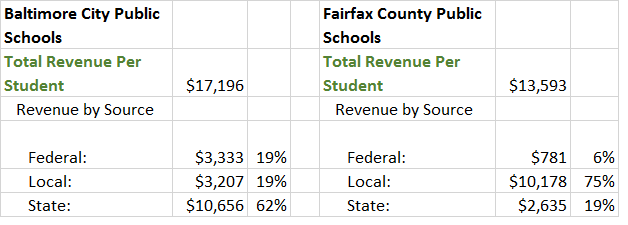
Baltimore schools spend 27% more than Fairfax County schools per student and a majority of the money comes not from the city but from the state and federal government. Thus, when it comes to education spending, Baltimore has not been ignored but is a recipient of significant federal and state aid.
Do people underestimate how much they will enjoy doing things alone?
Roberto Ferdman reports:
Ratner has a new study titled ‘Inhibited from Bowling Alone,’ a nod to Robert Putnam’s book about Americans’ waning participation in group activities, that’s set to publish in the Journal of Consumer Research in August. In it, she and co-writer Rebecca Hamilton, a professor marketing at the McDonough School of Business, describe their findings: that people consistently underestimate how much they will enjoy seeing a show, going to a museum, visiting a theater, or eating at a restaurant alone. That miscalculation, she argues, is only becoming more problematic, because people are working more, marrying later, and, ultimately, finding themselves with smaller chunks of free time.
Might part of the problem be narcissism?:
“The reason is we think we won’t have fun because we’re worried about what other people will think,” said Ratner. “We end up staying at home instead of going out to do stuff because we’re afraid others will think they’re a loser.”
But other people, as it turns out, actually aren’t thinking about us quite as judgmentally or intensely as we tend to anticipate. Not nearly, in fact. There’s a long line of research that shows how consistently and regularly we overestimate others’ interest in our affairs.
There is more here. For the pointer I thank Claire Morgan.
How will Canada be a part of the knowledge economy?
Me:
Some economic sectors are distributed everywhere, like every city has its dentist[s], and other sectors are quite clustered. Banking is pretty clustered — New York, London, Hong Kong. Tech has been evolving in a pretty clustered way; I don’t mean simple software support, which is more like dentistry, but big, grand projects — the next Google, the next Facebook, Uber. We see those come out of quite a small number of places, so Skype coming from Estonia is quite the exception. Even then, it was improved by people in the clusters.
I think any location, not just Canada, has to ask itself, ‘are we going to be one of those clusters or not’? And the correct answer may be ‘no’. It may also be the sector evolves so it’s less clustered and more like dentistry, and then everywhere including Canada would partake. But maybe the future is Canada will have a knowledge sector doing small-scale things like software design for local projects but not anything like its own Silicon Valley. I guess at this point that seems likely — that Canada will not be a huge innovative part of the knowledge economy.
That is from my interview with the excellent Eva Salinas, mostly about other topics, such as what a great egalitarian age we live in and also where the World Bank and IMF stand, among other issues. A few of the comments make more sense if you know that the interviewer is Chilean and we were discussing Chile before the formal interview started.