Category: History
Are work hours allocated justly and efficiently?
That is the topic of my latest NYT column for The Upshot. Here are some excerpts:
In short, most older people already enjoy a much better deal than Keynes had predicted for the entire work force. The 1930 Keynes essay “Economic Possibilities for Our Grandchildren” didn’t even mention retirement, perhaps because he was accustomed to a world in which so many people worked until they died or were seriously disabled.
Teenagers are also ahead of Keynes’s workplace predictions. Several decades ago, about 55 percent of teenagers had jobs, but lately only about 35 percent do. In addition, service sector jobs have been replacing jobs involving manual labor. While enormous disparities exist among teenagers of different races and income groups, over all, life has gotten easier for them.
And:
If people in all of these groups are working less, then someone must be working more. The answer, overwhelmingly, is women, who have taken on an Atlaslike role in supporting American economic growth.
There are reasons to believe that at least some of the growth in female work hours has been an unfair burden. It is well known, for instance, that men do not come anywhere close to fully sharing in the household chores or child rearing when their partners are working, and that often means more stress for women. Furthermore, the best available evidence, from Betsey Stevenson and Justin Wolfers, both professors of public policy at the University of Michigan (Mr. Wolfers is also a regular contributor to this column), suggest that overall female happiness in America has been declining, while age-adjusted death rates for middle-aged white women — though not for white men — have been increasing. Those troubling trends are perhaps another sign that the distribution of stress has been uneven.
Many men are working too little, and perhaps many women too much. But why isn’t there more smoothing of leisure over time?
On the other hand, many women do receive significant recompense in leisure time eventually — once they become older. Because women on average live longer than men, they are likely to have more years in retirement. Yet it is a strange society that disproportionately bunches much work and stress for so many women in the middle of their lives, and rewards them only much later with leisure. It is a kind of feast or famine for work, leisure and earnings.
Most economic models don’t account for these patterns, and instead assume that people engage in what is called smoothing behavior, in which leisure and work is evenly distributed across the years. Yet Americans as a whole are not experiencing that kind of moderation.
That is the real labor supply puzzle, and I don’t know of any consistent model which explains that along with other basic labor supply facts.
That was then, this is now
From 2012:
The Republican Party will continue to lose presidential elections if it comes across as mean-spirited and unwelcoming toward people of color, Donald Trump tells Newsmax.
Whether intended or not, comments and policies of Mitt Romney and other Republican candidates during this election were seen by Hispanics and Asians as hostile to them, Trump says.
“Republicans didn’t have anything going for them with respect to Latinos and with respect to Asians,” the billionaire developer says.
“The Democrats didn’t have a policy for dealing with illegal immigrants, but what they did have going for them is they weren’t mean-spirited about it,” Trump says. “They didn’t know what the policy was, but what they were is they were kind.”
Romney’s solution of “self deportation” for illegal aliens made no sense and suggested that Republicans do not care about Hispanics in general, Trump says.
“He had a crazy policy of self deportation which was maniacal,” Trump says. “It sounded as bad as it was, and he lost all of the Latino vote,” Trump notes. “He lost the Asian vote. He lost everybody who is inspired to come into this country.”
The GOP has to develop a comprehensive policy “to take care of this incredible problem that we have with respect to immigration, with respect to people wanting to be wonderful productive citizens of this country,” Trump says.
Muhammad Ali
 Muhammad Ali has passed away at the age of 74. Given the great love and honor shown to him since carrying the Olympic Torch at the Atlanta games in 1996 and being awarded the Presidential Medal of Freedom by George Bush in 2005 it is perhaps difficult to remember how reviled he was in the 1960s after he converted to Islam, changed his name, and refused to be drafted.
David Susskind, the well regarded television producer and talk show host, said this to Ali in a bitter exchange in 1968:
I find nothing amusing or interesting or tolerable about this man. He’s a disgrace to his country, his race, and what he laughingly describes as his profession. He is a convicted felon in the United States. He has been found guilty. He is out on bail. He will inevitably go to prison, as well he should. He is a simplistic fool and a pawn.
We should remember these things, however, because more than Ali’s courage in the ring, it was Ali’s courage in fighting the US government and much of the US public that made him a great American.
Open and Closed India
In an interview the LSE’s distinguished economic historian Tirthankar Roy was asked how his work on colonial India informs our understanding of contemporary India.
What was similar between the colonial times and the post-reform years? The answer is openness. The parallel tells us that openness to trade and investment is good for capitalism, whether we consider the colonial times or the postcolonial. The open economy did not deliver capitalistic growth in the same fashion in both eras. But there were similarities. In both the periods, not only commodities but also capital and labour were mobile, which encouraged freer flow of knowledge, skills, and technology, and created incentives for domestic producers to become better at what they were doing.
…It is necessary to stress the lesson that open markets and cosmopolitanism were good for the Indian economy, because the political rhetoric in India remains trapped in nationalism, which tends to blame global trade and global capital for poverty and underdevelopment. That sentiment started as a criticism of the British Raj, nurtured by the left, and the negativity persists. The pessimistic view of openness is based on a misreading of economic history. There were many things seriously wrong with the British Raj, but market-integration was not one of these. Influenced by a wrong reading of history, India’s politics remains unnecessarily suspicious of globalisation and cosmopolitanism.
For evidence of rhetoric trapped in nationalism look no further than the Indian government’s refusal to allow Apple to sell used iPhones in India.
Hat tip: Pseudoerasmus on twitter.
Against Historic Preservation
Larry Summers asks:
How…could our society have regressed to the point where a bridge that could be built in less than a year one century ago takes five times as long to repair today?
As I wrote in Launching:
Our ancestors were bold and industrious–they built a significant portion of our energy and road infrastructure more than half a century ago. It would be almost impossible to build the system today. Unfortunately, we cannot rely on the infrastructure of our past to travel to our future.
Summers alludes to the regulatory thicket as a cause of the infrastructure slowdown but doesn’t have much to say about fixing the problem. Here’s a place to begin. Repeal all historic preservation laws. It’s one thing to require safety permits but no construction project should require a historic preservation permit. Here are three reasons:
First, it’s often the case that buildings of little historical worth are preserved by rules and regulations that are used as a pretext to slow competitors, maintain monopoly rents, and keep neighborhoods in a kind of aesthetic stasis that benefits a small number of people at the expense of many others.
Second, a confident nation builds so that future people may look back and marvel at their ancestor’s ingenuity and aesthetic vision. A nation in decline looks to the past in a vain attempt to “preserve” what was once great. Preservation is what you do to dead butterflies.
Ironically, if today’s rules for historical preservation had been in place in the past the buildings that some now want to preserve would never have been built at all. The opportunity cost of preservation is future greatness.
Third, repealing historic preservation laws does not mean ending historic preservation. There is a very simple way that truly great buildings can be preserved–they can be bought or their preservation rights paid for. The problem with historic preservation laws is not the goal but the methods. Historic preservation laws attempt to foist the cost of preservation on those who want to build (very much including builders of infrastructure such as the government). Attempting to foist costs on others, however, almost inevitably leads to a system full of lawyers, lobbying and rent seeking–and that leads to high transaction costs and delay. Richard Epstein advocated a compensation system for takings because takings violate ethics and constitutional law. But perhaps an even bigger virtue of a compensation system is that it’s quick. A building worth preserving is worth paying to preserve. A compensation system unites builders and those who want to preserve and thus allows for quick decisions about what will be preserved and what will not.
Some people will object that repealing historic preservation laws will lead to some lovely buildings being destroyed. Of course, it will. There is no point pretending otherwise. It will also lead to some lovely buildings being created. More generally, however, the logic of regulatory thickets tells us that we cannot have everything. As I argued in Launching:
There are good regulations and bad regulations and lots of debate over which is which. From an innovation perspective, however, this debate misses a key point. Let’s assume that all regulations are good. The problem is that even if each regulation is good, the net effect of all the regulations combined may be bad. A single pebble in a big stream doesn’t do much, but throw enough pebbles and the stream of innovation is dammed.
It’s time to blow the dam. Creative destruction requires some destruction.
My worries about Singapore
Singapore is a well-run place by world standards, and has perhaps the world’s highest quality bureaucracy, yet right now the country faces a somewhat menacing constellation of silent risks, none of their own making:
1. It is possible that the role of the United States in the Pacific Ocean is rewritten rather suddenly. This could come about through either a Trump presidency, or a successful Chinese attempt to grab more in the South China Sea. Can you imagine a Singapore that had to court Japan and India rather than relying on the United States for protection? In this same world Japan is probably more militarized than in the status quo, and possibly even a nuclear power.
2. Singapore sovereign wealth funds and related institutions have been pulling in high returns since the 1970s. Yet the opportunities in both China and Singapore’s own real estate just aren’t there any more. They would be very lucky to pull in four percent a year looking forward. While fiscal risk is minimal, this will crimp expansion plans, especially if Singapore ends up needing to spend more on national defense.
3. It seems increasing pressure is being brought to bear on the Chinese currency yet again. China would like to lower rates to stimulate its economy, and the Fed is likely to raise rates at least once more this year. There is surely a chance that the renminbi simply snaps due to capital outflow. During the Asian currency crisis, the Singaporean dollar fell about twenty percent as a side effect of the turmoil elsewhere. Yet now China is much bigger than South Korea + Thailand + Indonesia were in 1997. Furthermore Singapore is much more of a financial and clearinghouse center. How insulated is Singapore from this China risk? Does anybody know? To what extent might a flow of capital into Singapore mitigate some of this risk?
4. Climate change could well lead to rising water levels for island nation Singapore. Investing in sea walls and other forms of protection could take what percent of gdp? The Dutch are already putting 0.5% of gdp a year into a fund for future water defense.
From this list, #2 and #4 are more likely problems, whereas #1 and #3 are more speculative, but by no means in the realm of science fiction. There is the possibility of a perfect storm from all four.
And yet think of how things must have looked in 1965. The Vietnam War was going badly, and most of the trends in Southeast Asia were negative. Chinese Communism was at its nadir with the Cultural Revolution. Indonesia had just massacred 500,000 citizens, many of them Chinese. Singapore itself had just been kicked out of Malaysia, an outcome which its key founders mostly opposed. There was not yet evidence that what later became “the Singapore model” was going to work, and even Japan was not yet an evident success. It was commonly believed that Singapore, Malaysia, or both might collapse into a kind of ethnic civil war. British military expenditures were about 20% of Singapore’s gdp, and it was widely understood that source of income would be going away. Somehow they managed, most of all with the aid of human capital and being in the right place at the right time.
Here is the Singapore Complaints Choir, one of my favorite music videos.
In any case, I am happy to be here once again. For dining, I recommend Sinar Pagi Nasi Padang, at Geylang Serai hawker centre, get the beef rendang. National Kitchen, in the new National Gallery is also very good for a more traditional kind of dining.
Do witchcraft beliefs hurt economic progress?
Maybe so, here is the latest:
Where witchcraft beliefs are widespread, American University Economics Professor Boris Gershman found high levels of mistrust exist among people. Gershman also found a negative relationship between witchcraft beliefs and other metrics of social capital relied upon for a functioning society, including religious participation and charitable giving.
It’s long been argued that witchcraft beliefs impede economic progress and disrupt social relations, and Gershman’s statistical analysis supports that theory. From a policy perspective, Gershman’s results emphasize the importance of accounting for local culture when undertaking development projects, especially those that require communal effort and cooperation. Gershman and other social scientists believe that education can help foster improved trust and decrease the prevalence of witchcraft beliefs.
Furthermore:
Parents in witchcraft-believing societies inculcate antisocial traits in children.
Second-generation immigrants from witchcraft-believing nations are less trusting.
Here is the summary statement, here is the full article. Here are related papers by Gershman. For the pointer I thank the excellent Samir Varma.
Where is freedom in the world contracting? Advancing?
Contracting:
America, China, Hong Kong, Russia, Ukraine, Austria, Hungary, Poland, Slovakia, Turkey, Syria, Libya, Iraq, Yemen, Kosovo, Afghanistan, Philippines, Venezuela, Nigeria, South Africa, Malaysia, and Brazil, though the latter may be in flux. Tunisia and Iran are problematic, but arguably hard to call. Saudi may be headed toward collapse, but I don’t think you can say they are less free just yet. Ethiopia is losing more political freedom, though still making very real economic progress.
Advancing:
Mexico and Colombia, if only by consolidating previous gains, and still there is a chance of a turnaround in Argentina at some point. Latvia? Where else? You could make a (modest) case for India and some of the smaller African countries.
Neutral:
Japan, South Korea, Canada, and much of Western Europe though many of these cases appear fragile to me.
Overall this is not a thrilling ledger. I haven’t listed most of the smaller countries, but in the longer run they often follow the lead of their larger neighbors.
File under Not Good.
Environmental lawsuits and the vengeance donors
There are so, so many environmental lawsuits, often brought by non-profits backed by philanthropists. These institutions, among other things, target polluting corporations and bring lawsuits against them for purposes of constructing a deterrent against yet more pollution. The Sierra Club and Greenpeace would be two examples, and of course a big chunk of the funds comes from the relatively wealthy. How is this for one example of many?:
On 7 October, Greenpeace filed a lawsuit in Superior Court for the District of Columbia against Dow Chemical, Sasol North America (owned by the South African State Oil Company), two public relations firms – Dezenhall Resources and Ketchum – and four individuals.
On top of that, it is easy enough to be an anonymous donor to these groups, and to stay anonymous. That said, I have heard tales — apocryphal perhaps — of donors who gave to environmental causes because they too earlier in their lives had suffered under the adverse effects of pollution. In back room whispers they are sometimes called “vengeance donors,” and it is suggested that because of the vengeance donors soon enough all companies will go out of business or at the very least be at the mercy of the whims of the wealthy.
Now, to be sure, many of these environmental lawsuits are excessive, or unfair, or would fail both a rights and cost-benefit test and we should condemn them, as indeed you see happening with equal frequency on the Left and on the Right. Many companies have gone out of business because of environmental lawsuits or the threat thereof, or perhaps the companies never got started in the first place because they couldn’t afford large enough legal departments. I can safely say that just about everyone sees the problem here.
But we shouldn’t condemn the good lawsuits, right? Right? Or is this whole philanthropic lawsuits business simply out of control and needs to be stopped altogether?
And oh, that Greenpeace lawsuit I linked to above? It actually wasn’t about environmental pollution at all, at least not directly. It was because Greenpeace felt it was under secretive and privacy-intruding surveillance. You should have seen my Twitter feed light up when the vengeance donors let on their role in that one.
Jinan and Qufu notes
Jinan is the second largest city in Shandong province, and a good place to see “normal China”; it is much more in the “concrete and motorbikes” mode than is Qingdao.
Qufu is the birthplace of Confucius, and a longstanding home of the Chinese nobility and Chinese scholars, with monument-building visits by various emperors. Reputedly the town is full of fine-featured individuals with very exact patterns of speech. In any case downtown is pleasant to walk and shop in, and has relatively few environmental problems.

The tomb of Confucius was my favorite site. There is a continuity of civilization (if not regime) for over 2500 years, and visiting the tomb drives this point home. Even the Cultural Revolution did not much damage this area of homage, in part because of loyalty to Confucius, itself a form of Confucian behavior.
Many of the flowers on the tomb were left by the national television station, perhaps as advertising and also signaling loyalty to Confucian ideals.
But that is not China’s oldest heritage, far from it:
This research reveals a 5,000-y-old beer recipe in which broomcorn millet, barley, Job’s tears, and tubers were fermented together. To our knowledge, our data provide the earliest direct evidence of in situ beer production in China, showing that an advanced beer-brewing technique was established around 5,000 y ago.
One local functionary said to me: “We think Trump will win. You always surprise us — he is the next surprise.”
What the hell is going on?
Donald Trump may get the nuclear suitcase, a cranky “park bench” socialist took Hillary Clinton to the wire, many countries are becoming less free, and the neo-Nazi party came very close to assuming power in Austria. I could list more such events.
Haven’t you, like I, wondered what is up? What the hell is going on?
I don’t know, but let me tell you my (highly uncertain) default hypothesis. I don’t see decisive evidence for it, but it is a kind of “first blast” attempt to fit the basic facts while remaining within the realm of reason.
The contemporary world is not very well built for a large chunk of males. The nature of current service jobs, coddled class time and homework-intensive schooling, a feminized culture allergic to most forms of violence, post-feminist gender relations, and egalitarian semi-cosmopolitanism just don’t sit well with many…what shall I call them? Brutes?
Quite simply, there are many people who don’t like it when the world becomes nicer. They do less well with nice. And they respond by in turn behaving less nicely, if only in their voting behavior and perhaps their internet harassment as well.
Female median wages have been rising pretty consistently, but the male median wage, at least as measured, was higher back in 1969 than it is today (admittedly the deflator probably is off, but even that such a measure is possible speaks volumes). A lot of men did better psychologically and maybe also economically in a world where America had a greater number of tough manufacturing jobs. They thrived under brutish conditions, including a military draft to crack some of their heads into line.
To borrow a phrasing from Peter Thiel, perhaps men did better in the age of “technological progress without globalization” rather than “globalization without technological progress,” as has been the case as of late.
Here’s a line from Martin Wolf:
Princeton professors Anne Case and Angus Deaton note, in addition, a sharp relative deterioration in mortality and morbidity among middle-aged white American men, due to suicide, and drug and alcohol abuse.
(Addendum: note this correction.)
For American men ages 18-34, more of them live with their parents than with romantic partners.
Trump’s support is overwhelming male, his modes are extremely male, no one talks about the “Bernie sisters,” and male voters also supported the Austrian neo-Nazi party by a clear majority. Aren’t (some) men the basic problem here? And if you think, as I do, that the incidence of rape is fairly high, perhaps this shouldn’t surprise you.
The sad news is that making the world nicer yet won’t necessarily solve this problem. It might even make it worse.
Again, we don’t know this is true. But it does help explain that men seem to be leading this “populist” charge, and that these bizarre reactions are occurring across a number of countries, not just one or two. It also avoids the weaknesses of purely economic explanations, because right now the labor market in America just isn’t that terrible. Nor did the bad economic times of the late 1970s occasion a similar counter-reaction.
One response would be to double down on feminizing the men, as arguably some of the Nordic countries have done. But America may be too big and diverse for that really to stick. Another option would be to bring back some of the older, more masculine world in a relatively harmless manner, the proverbial sop to Cerberus. But how to do that? That world went away for some good reasons.
If this is indeed the problem, our culture is remarkably ill-suited to talking about it. It is hard for us to admit that “all good things” can be bad for anyone, including brutes. It is hard to talk about what we might have to do to accommodate brutes, and that more niceness isn’t always a cure. And it is hard to admit that history might not be so progressive after all.
What percentage of men are brutes anyway? Let’s hope we don’t find out.
*A Life Beyond Boundaries*,by Benedict Anderson
That is the title of his posthumous memoir, highly recommended. It is one of the best books on the charm of studying Southeast Asia, and also a very good look at how American academia rose from mediocre to excellent in the postwar era. It is short and can be consumed in a single gulp.
Here is Andrew Batson on the book. Here is Anderson on Wikipedia; he was best known as a theorist of nationalism but he also did important work on Indonesia and Thailand.
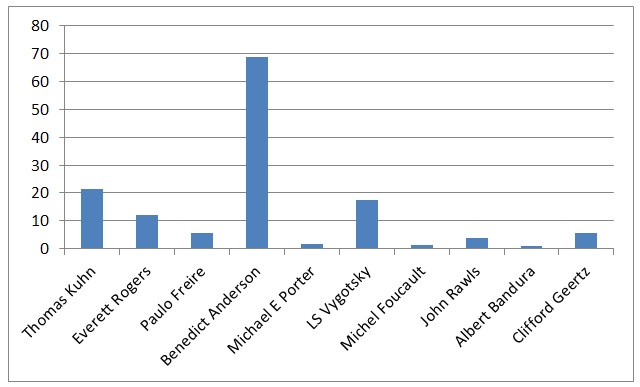
Ratio of most-cited publication to second-most-cited publication for authors among the top-10 most cited books in the social sciences:
New York City fact of the day
Nearly three-quarters of the existing square footage in Manhattan was built between the 1900s and 1930s, according to an analysis done by KPF, an architecture firm based in New York.
That is from the new Upshot piece “Forty Percent of the Buildings in Manhattan Could Not be Built Today.”
The Developmental Roots of Conformity Bias
Michael Tomasello reviews theories of learning–some suggest that liberalism may be unnatural:
…a consistent finding in comparative studies is that human children are much more concerned than are other great apes to copy the exact actions of others, including arbitrary gestures, conventions and rituals (Tennie et al. 2009). Indeed, this tendency is so strong…when children do not see a clear goal to an actor’s action, they imitate even more precisely than if they do see a goal…
Moreover, children quickly learn to enforce arbitrary conventions and rituals:
…young children are so concerned with conformity that they will even enforce it on others, even when they themselves are not affected and the action involved is merely an arbitrary convention. For example, if children learn that on this table we play the game this way and on that table we play it another way, if a puppet then plays the game the wrong way on the wrong table, they intervene and stop him (Rakoczy, Hamann, Warneken, & Tomasello, 2010; Rakoczy, Warneken, & Tomasello, 2008)….Interestingly, when actors violate conventional norms, 3-year-olds admonish them more often if they are in-group rather than out-group members, presumably because in-group members should know better and be more committed to how “we” do it (Schmidt, Rakoczy, & Tomasello, 2011).
The enforcement of conformity is so important for young children that 5-year-olds have more positive feelings toward a norm enforcer (even though he is acting aggressively) than they do toward someone who simply lets a norm violation go (even though he is behaving in a neutral manner; Vaish, Herrmann, Markmann, & Tomasello, 2016).
In the environment of evolutionary adaptedness (EEA) an individual could not survive outside the group of their birth and so conformity was a matter of life and death. Conform or be cast out. Conformity to arbitrary convention was not in fact arbitrary but signalled affiliation. Conformity banded groups together.
Today, however, conformity is often counter-productive. Trying to enforce the arbitrary conventions of one’s in-group impedes social cooperation on the scale that makes modernity possible. Conformity also slows the development of new ideas and new ways of doing things–the essence of growth and progress. Even though conformity is now counter-productive the desire to conform and to enforce conformity is buried deep–the atavism of social justice.
Individualism and liberalism are foundational ideas for modernity but these adult ideas battle the desire to conform in our childish hearts.
Hat tip: Rolf Degen on twitter.
A classical liberal case for the European Union
Dalibor Rohac had a new and important book just out — Towards an Imperfect Union: A Conservative Case for the European Union, obviously of great relevance to the Brexit debates. Here is the book’s home page, here is the publisher’s home page for the book.
My own view is this: if the United Kingdom could simply press a button and obtain the current status of Canada, via-a-vis the EU, probably they should do so. But they cannot, and in some issues, as with Catalonian independence, the path is everything. I’ve read through much of the Treasury report, and I believe it underestimates the economic cost of Brexit. Were Brexit to happen, probably the UK would see a major recession, and possibly a financial crisis, and there is even a chance significant parts of the EU could unravel in response. And for what gain? The country would not be able to boost living standards through EU immigration cuts. Building new trade agreements would take a long time and in few of the most important cases would the UK hold most of the bargaining power. Security issues probably would worsen.
Even if the Brexit vote fails, it remaining on the table as a live option, as would result from a close vote, would dampen investment in the UK. The best way forward is for the UK to swallow its pride and admit the whole referendum idea was a mistake by voting unanimously to stay. No one would take the unanimity vote as a sincere reflection of preference, but best not to know the true state of public opinion on this one!
I sometimes call Brexit “the Donald Trump of England” — don’t be fooled!