Category: History
Discussions about restaurants in the New York Times
The data start in 1880 and run through 2013. Based on my visual reading of the chart, discussion of Chinese restaurants appears to have peaked in the 1940s (!). German restaurants are the biggest loser over time, with plunges during each of the two World Wars; French falls more steadily. American and Japanese go up slowly but consistently. The big winner: Italian restaurants go up by far the most in discussions, starting in about 1940, and never stop rising.
The Los Angeles Times and Chicago Tribune show broadly similar patterns, though the absolute level of discussion for Mexican is much higher in Los Angeles. For the Western world at least, Italian cuisine is the major winner from globalization.
It is in the 1890s by the way that restaurants are discussed more often in The New York Tribune/Herald than are saloons.
That is all from Krishnendu Ray, The Ethnic Restaurateur, which is intermittently quite interesting. Here is the Google Books page.
The Soviet internet
There is a new and intriguing book out by Benjamin Peters called How Not to Network a Nation: The Uneasy History of the Soviet Internet, which outlines exactly what it claims to. Here is one introductory excerpt:
In late September 1970, a year after the ARPANET went online, the Soviet cyberneticist Viktor Glushkov boarded a train from Kiev to Moscow to attend what proved to be a fateful meeting for the future of what we might call the Soviet Internet. On the windy morning of October 1, 1970, he met with members of the Politburo, the governing body of the Soviet state, around the long rectangular table on a red carpet in Stalin’s former office in the Kremlin. The Politburo convened that day to hear Glushkov’s proposal and decide whether to build a massive nationwide computer network for citizen use — or what Glushkov called the All-State Automated System (OGAS, obshche-gosudarstvennyi avtomatizirovannaya system), the most ambitious computer network of its kind in the world at the time. OGAS was to connect tens of thousands of computer centers and to manage and optimize in real time the communications between hundreds of thousands of workers, factory managers, and regional and national administrators. The purpose of the OGAS Project was simple to state and grandiose to imagine: Glushkov sought to network and automatically manage the nation’s struggling command economy.
They failed! The author blames this not on backward technology, but rather “entrenched bureaucratic corruption and conflicts of interest at the heart of the system…”
Anyone interested in the history of the internet, comparative systems, or the history of the Soviet Union should read this book.
Soviet Union (China) fact of the day
In its first three decades, the Soviet Union urbanized at about the same rate as China since 1978.
That is from Arthur Kroeber, China’s Economy: What Everyone Needs to Know, a new and useful introductory guide to what the title suggests. This parallel of course is one reason why the early years of Soviet communism went as well economically as they did.
John Cochrane on the safe asset shortage
I gave some comments on “Global Imbalances and Currency Wars at the ZLB,” by Ricardo J. Caballero, Emmanuel Farhi, and Pierre-Olivier Gourinchas at the conference, “International Monetary Stability: Past, Present and Future”, Hoover Institution, May 5 2016. My comments are here, the paper is here
The paper is a very clever and detailed model of “Global Imbalances,” “Safe asset shortages” and the zero bound. A country’s inability to “produce safe assets” spills, at the zero bound, across to output fluctuations around the world. I disagree with just about everything, and outline an alternative world view.
A quick overview:
Why are interest rates so low? Pierre-Olivier & Co.: countries can’t “produce safe stores of value”
This is entirely a financial friction. Real investment opportunities are unchanged. Economies can’t “produce” enough pieces of paper. Me: Productivity is low, so marginal product of capital is low.Why is growth so low? Pierre-Olivier: The Zero Lower Bound is a “tipping point.” Above the ZLB, things are fine. Below ZLB, the extra saving from above drives output gaps. It’s all gaps, demand. Me: Productivity is low, interest rates are low, so output and output growth are low.
Data: I Don’t see a big change in dynamics at and before the ZLB. If anything, things are more stable now that central banks are stuck at zero. Too slow, but stable. Gaps and unemployment are down. It’s not “demand” anymore.
Exchange rates. Pierre-Olivier “indeterminacy when at the ZLB” induces extra volatility. Central banks can try to “coordinate expectations.” Me: FTPL gives determinacy, but volatility in exchange rates. There is no big difference at the ZLB.
Safe asset Shortages. Pierre-Olivier: driven by a large mass of infinitely risk averse agents. Risk premia are therefore just as high as in the crisis. Me: Risk premia seem low. And doesn’t everyone complain about “reach for yield” and low risk premia?
Observation. These ingredients are plausible about fall 2008. But that’s nearly 8 years ago! At some point we have to get past financial crisis theory to not-enough-growth theory.
I agree, here is the rest.
Growth of income and welfare in the U.S, 1979-2011
This new NBER paper by John Komlos is of real interest, and it documents the “average is over” idea of the dwindling of middle class fortunes:
We estimate growth rates of real incomes in the U.S. by quintiles using the Congressional Budget Office’s (CBO) post-tax, post-transfer data as basis for the period 1979-2011. We improve upon them by including only the present value of earnings that will accrue in retirement and excluding items included in the CBO income estimates such as “corporate taxes borne by labor” that do not increase either current purchasing power or utility. We estimate a high and a low growth rate using two price indexes, the CPI and the Personal Consumption Expenditure index. The major consistent findings include what in the colloquial is referred to as the “hollowing out” of the middle class. According to these estimates, the income of the middle class 2nd and 3rd quintiles increased at a rate of between 0.1% and 0.7% per annum, i.e., barely distinguishable from zero. Even that meager rate was achieved only through substantial transfer payments. In contrast, the income of the top 1% grew at an astronomical rate of between 3.4% and 3.9% per annum during the 32-year period, reaching an average annual value of $918,000, up from $281,000 in 1979 (in 2011 dollars). Hence, the post-tax, post-transfer income of the 1% relative to the 1st quintile increased from a factor of 21 in 1979 to a factor of 51 in 2011. However, income of no other group increased substantially relative to that of the lowest quintile. Oddly, the income of even those in the 96-99 percentiles increased only from a multiple of 8.1 to a multiple of 11.3. We next estimate growth in welfare assuming diminishing marginal utility of income. A logarithmic utility function yields a growth in welfare for the middle class of roughly 0.01% to 0.07% per annum, which is indistinguishable from zero. With interdependent utility functions only the welfare of the 5th quintile experienced meaningful growth while those of the first four quintiles tend to be either negligible or even negative.
Energy spending as a share of income
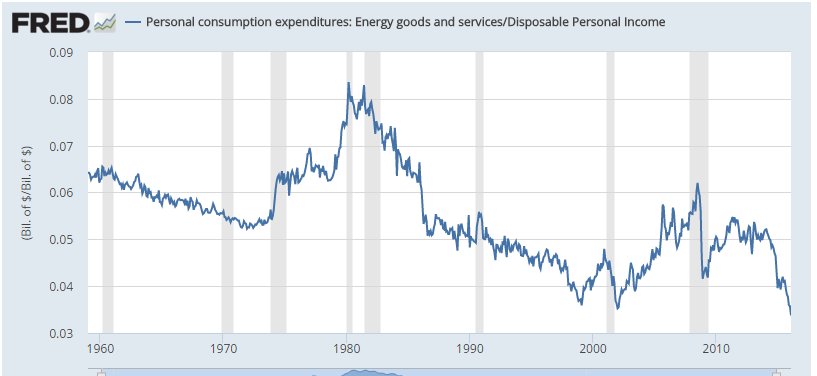
That is from TMFHousel, via @pmarca.
Russia facts of the day isn’t falling apart as much as you might think
This is often forgotten:
One traditional way of measuring nations’ power relative to each other is to compare their gross domestic product. By this measure, Russia gained economically on all of its competitors as well as on the world as a whole in 1999-2015.
And this:
The GINC measures national power as the geometric mean of the following ratios:
- TPR = total population of country ratio;
- UPR = urban population of country ratio;
- ISR = steel production of country ratio;
- ECR = primary energy consumption ratio;
- MER = military expenditure ratio;
- MPR = military personnel ratio.
The GINC shows Russia’s power rising by 6.53 per cent in 1999-2014, while the power of the US, UK, France, Germany and Italy declined 13.14 per cent, 24.42 per cent, 24.23 per cent, 29.92 per cent and 27.29 per cent respectively in 2014 compared with 1999.
The heroes of Jaron Lanier
There are many, but they include:
- J.M. Keynes, he was the first person to think about how to really manage an information system.
- E.M. Forster for The Machine Stops, written in 1907, which foresees our error with a very critical eye.
- Alan Turing, who stayed a kind person even as he was tortured to death.
- Mary Shelley who was a keen observer of people and how they can confuse themselves with technology.
And of course my friend Ted Nelson. He invented the digital media link and was perhaps the most formative figure in the development of online culture. He proposed that instead of copying digital media, we should keep one copy of each cultural expression on a digital network and pay the author of that expression an affordable amount whenever it is accessed. In this way, anyone could earn a living from their creative work.
Here is another interesting bit about the internet:
One thing that bugs me is the way context is lost. You start discovering new music or new culture in very particular ways. Algorithms become your guide. If an algorithm calculates that you may like a piece of music, it will recommend it to you. That makes the algorithm the master of context for humanity. It tends to remove culture from its context, and context is everything. The structure of the Net itself has become the context instead of real people or the real world. That’s a really big deal.
Here is the full piece, an interview with Catherine Jewell at WIPO, I would say that Lanier is or should be rising in relative status. For the pointer I thank Samir Varma.
The history of GPS
The United States Air Force never really wanted GPS. The 621B program, the precursor to GPS, was underfunded. After it evolved into the GPS program in the early 1970s, the Air Force largely neglected it, to the point of disowning it and defunding it. A few times, it tried to kill its own creation, and GPS was kept alive by the Pentagon’s largesse…
One reason the Air Force was slow to embrace GPS is the space-based projects were never seen as a priority. “The Air Force is not a big user of space,” says Scott Page..”The Air Force gets to build for space, but the Marine Corps, Army, and Navy are much more reliant on actual space services than the Air Force itself is. The budget for space is in the Air Force, but in terms of the number of customers and users, they’re all in the other services.
Another source said “…the Air Force is pilots who fly planes.”
That is from Greg Milner’s new and interesting book Pinpoint: How GPS is Changing Technology, Culture, and Our Minds.
Milner also relates how the park rangers in Death Valley National Park have the term “death by GPS.” It refers to park users who follow their GPS and then die:
It describes what happens when GPS fails you, not by being wrong, exactly, but often by being too right. It does such a good job of computing the most direct route from Point A to Point B that it takes you down roads which barely exist, or were used at one time and abandoned, or are not suitable for your car, or which require all kinds of local knowledge that would make you aware that making that turn is bad news.
Recommended.
Coyotes vs. dogs
The female coyote nurses the pups after they are born, yet they are hard to feed and the mother is not in ideal condition for hunting. She therefore regurgitates her food regularly for the pups, and furthermore the biological father brings food too. And yet:
Dogs have evolved a different parental strategy. Human waste tends to show up at the same place daily and so the dogs, as we have noted, have very low transportation and acquisition costs.
The pregnant female village dog can stay by her food source all through pregnancy and lactation. She can locate her den in the middle of the food source. frequently, she goes to some quiet place outside the village (but not too far outside). There are many quiet places in the Mexico City dump. All over the dump are fat nursing pups.
Regurgitation is occasional rather than regular, and the father is absent altogether. In evolutionary terms, it seems that is the result of cooperation with humans.
That is all from the new and excellent book What is a Dog?, by Raymond Coppinger and Lorna Coppinger. The best parts of this book draw inferences from what is observed in Mexican town dumps.
My conversation with Camille Paglia
Here is the transcript, the video, and the podcast. We covered a good deal of ground, here is one bit:
COWEN: You once wrote, I quote, “My substitute for LSD was Indian food,” and by that, you meant lamb vindaloo.
PAGLIA: Yes.
COWEN: You stand by this.
PAGLIA: Yes, I’ve been in a rut on lamb vindaloo.
COWEN: A rut, tell us.
PAGLIA: It’s a horrible rut.
COWEN: It’s not a horrible rut, it may be a rut.
PAGLIA: No, it’s a horrible rut. It’s a 40-year rut. Every time I go to an Indian restaurant, I say “Now, I’m going to try something new.” But, no, I must go back to the lamb vindaloo.
All I know is it’s like an ecstasy for me, the lamb vindaloo.
COWEN: Like De Quincey, tell us, what are the effects of lamb vindaloo?
PAGLIA: What can I say? I attain nirvana.
And this:
COWEN: This is Sexual Personae, your best known book, which I recommend to everyone, if you haven’t already read it.
PAGLIA: It took 20 years.
COWEN: Read all of it. My favorite chapter is the Edmund Spenser chapter, by the way.
PAGLIA: Really? Why? How strange.
COWEN: That brought Spenser to life for me.
PAGLIA: Oh, my goodness.
COWEN: I realized it was a wonderful book.
PAGLIA: Oh, my God.
COWEN: I had no idea. I thought of it as old and fusty and stuffy.
PAGLIA: Oh, yes.
COWEN: And 100 percent because of you.
PAGLIA: We should tell them that The Faerie Queene is quite forgotten now, but it had enormous impact, Spenser’s Faerie Queene, on Shakespeare, and on the Romantic poets, and so on, and so forth. The Faerie Queene had been taught in this very moralistic way. But in my chapter, I showed that it was entirely a work of pornography, equal to the Marquis de Sade.
COWEN: [laughs]
PAGLIA: How interesting that you would be drawn to that.
COWEN: Very interesting.

You also can read or hear Camille on Star Wars: The Force Awakens, the Byrds, Foucault, Suzanne Pleshette vs. Tippi Hendren, dating, Brazil, Silicon Valley, Harold Bloom, LSD, her teaching career, and much, much more.
Typically a Conversation with Tyler is about ten thousand words, this one is closer to fifteen thousand.
Interview with Axel Leijohufvud
Conducted by Arjun Jayadev and Josh Maso, here is one bit:
John Hicks was a stammerer, and so when you had an ordinary conversation with him, every utterance started with uh, uh, uh, uh, uh, uh, uh, uh, uh and sometimes was interminable. And then the answer would sort of burst forth rapid fire and then he would start all over again. But he was fond of poetry. When he was a student he had been the poetry editor for an Oxford student paper. He had memorized lots of poetry, including the whole fifth canto of the Divine Comedy in Italian. Now and then when you talked with him he would quote something, and that would flow perfect without stammering. Later on we were staying outside Sienna, and he would visit there regularly. At one point we were out with a bunch of students – it was the opportunity of their life
to sit and listen to Hicks. I brought up the poetry, and he explained it this way: He had trouble falling asleep. So the way he would get to sleep was he would set his mind to rehearsing or remembering one stanza of poetry for each century, starting in four or 500 B.C. And he gave some examples and then he said, but from the second to the ninth century there wasn’t much worth remembering.
And this:
I first met Hayek personally in Salzburg in 1975-1976. I met him several times after that at UCLA, Claremont, and Freiburg, and he was always gracious. He definitely was pleased by the
revival of interest in his work but, I believe, did not really want slavish followers. In particular, I remember a pamphlet he had written for Institute of Economic Affairs in London on a currency reform proposal and I raised a theoretical objection to his proposal. I remember walking with him to the UCLA Faculty Club for lunch and explaining what I thought was wrong. He got quite worried and said he wanted to think more about it. I do not think he found a satisfactory answer and, as far as I can recall, he stopped promoting the proposal.
Leijonhufvud these days is somewhat of a neglected figure, but the interview has numerous points of interest.
Another reason why Harriet Tubman is a good pick
It is also an example of great achievements in light of a disability:
As a teenager, following a severe head injury—the result of her efforts to protect another slave—Tubman developed a lifelong, chronic condition, with debilitating symptoms that have been described as being similar to those of narcolepsy and temporal lobe epilepsy.
Here is that source. Here are many other sources.
Now here’s the bad news: There is plenty in the media today about Tubman being female and black, but I haven’t seen a single story even mention this angle. Will anyone cover it? I hope so but I fear not.
Ruchir Sharma on Brazil
Today the average Brazilian income is about 16% of the U.S. average, with basically no gain for 100 years.
Even more striking, since the mid-1980s Brazil has seen its GDP growth rate track commodity prices more closely than any other nation in the world. Brazil’s fortunes are so closely tied to the global commodity cycle in part because so little works inside the country. The private economy does produce some internationally competitive companies in auto parts, aerospace and other industries, but they thrive by dodging a growing bureaucracy that smothers the rest.
Spending by local, regional and national governments amounts to 41% of Brazil’s GDP, the largest for any country in its middle-income class, and a scale close to those of much richer European welfare states such as Germany and Norway. Brazilians face the heaviest tax burden of any emerging country, with collections amounting to 35% of GDP. The widespread sense that they get a lousy return in public services is another reason for mass protests against Ms. Rousseff.
Here is the WSJ piece. Ruchir has a new book coming out on emerging economies, The Rise and Fall of Nations: Forces of Change in the Post-Crisis World. I have not yet read it, but it is surely of interest.
*Buddhisms: An Introduction*, or what do Buddhists argue about?
That is the new book by John S. Strong, which I recommend highly. It won’t charm you or interest you in the subject if you don’t already care, but the already-motivated can learn a great deal from it.
I find most books on Buddhism frustrating. One you know the basics, they just feed you the same blah blah blah, running your mind in empty circles. But perhaps Buddhism is like macroeconomics — you can’t understand it until you know what people argue about, and that is what John S. Strong clues us in on. Here is one typical summary passage:
We have, in this chapter, sought to explore various iterations of the Middle Way, a notion which the Buddha sets forth at the start of his First Sermon. In order to unravel the many implications of this principle and its applicability to other Buddhist doctrines (something the Buddha did not do in his sermon), I have presented several of its expressions and sought to set them within the context of various philosophical and religious movements that may have been around at the time of the Buddha. Thus, early Buddhists can be seen as finding their way between karma-deniers and karmic absolutists; and as combining views of saṃsāra both as a real material trap and as an illusory trap; and as shying away from the extremes of affirmation of an Absolute Self and denial of personal continuity. The Middle Way, however, is not the only thing set forth in the First Sermon as we have it, a text which is mostly devoted to the doctrine of the Four Truths, to which we shall now turn.
Another good way to read about Buddhism is to look at up through p.59 in Nicholas Ostler’s Passwords to Paradise: How Languages Have Re-Invented World Religions. It covers the differential historical spread of Buddhism through the languages of Pali, Gandhari, Sanskrit, and Chinese. Ostler himself claims to have a working knowledge of eighteen different languages.