Category: Medicine
The Birx Plan for Early Vaccination of the Nursing Homes
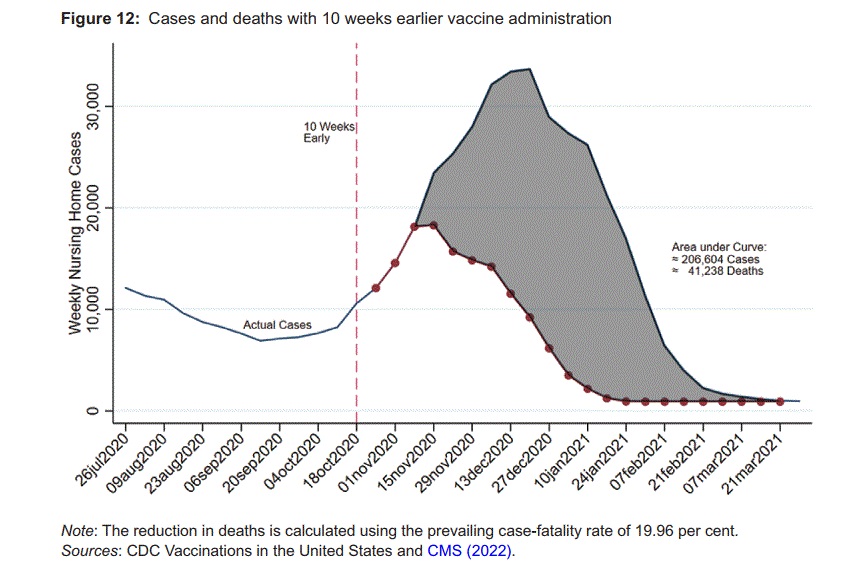
In Covid in the nursing homes: the US experience, Markus Bjoerkheim and I show that the Great Barrington “focused protection” plan was unlikely to have worked. I covered this last week. But there was one strategy which could have saved tens of thousands of lives–early vaccination. If the vaccine trials had been completed just 5 weeks earlier, for example, we could have saved 14 thousand lives in the nursing homes alone. But put aside the possibility of completing the trials earlier. There was another realistic possibility under our noses. We had could have offered nursing home residents the vaccine on a compassionate use basis, i.e. even before all the clinical trials were completed. An early vaccination option was neither unprecedented nor a question of 20-20 hindsight, early vaccination was discussed at the time:
Deborah Birx, the coordinator of the White House Coronavirus Task Force, forcefully advocated that nursing home residents should be given the option of being vaccinated earlier under a compassionate use authorization (Borrell, 2022). Many other treatments, such as convalescent plasma, were authorized under compassionate use procedures and there was more than enough vaccine available to vaccinate all nursing home residents. As a first approximation we find the Birx plan would have prevented in the order of 200,000 nursing home cases and 40,000 nursing home deaths. To put that in perspective, it amounts to reducing overall nursing home Covid deaths by over 26 per cent (using all CMS reported resident nursing home deaths as of 5 December 2021, and estimates of underreported deaths from Shen et al. (2021)).
The lesson is not primarily about the past. It’s about the central importance of vaccines in any plan to protect the vulnerable and about how we should be bolder and braver the next time.
Addendum: See also Tyler’s tremendous post (further below) on focused protection.
The Great Barrington Plan: Would Focused Protection Have Worked?
A key part of The Great Barrington Declaration was the idea of focused protection, “allow those who are at minimal risk of death to live their lives normally to build up immunity to the virus through natural infection, while better protecting those who are at highest risk.” This was a reasonable idea and consistent with past practices as recommended by epidemiologists. In a new paper, COVID in the Nursing Homes: The US Experience, my co-author Markus Bjoerkheim and I ask whether focused protection could have worked.
Nursing homes were the epicenter of the pandemic. Even though only about 1.3 million people live in nursing homes at a point in time, the death toll in nursing homes accounted for almost 30 per cent of total Covid-19 deaths in the US during 2020. Thus we asked whether focusing protection on the nursing homes was possible. One way of evaluating focused protection is to see whether any type of nursing homes were better than others. In other words, what can we learn from best practices?
The Centers for Medicaire and Medicaid Services (CMS) has a Five-Star Rating system for nursing homes. The rating system is based on comprehensive data from annual health inspections, staff payrolls, and clinical quality measures from quarterly Minimum Data Set assessments. The rating system has been validated against other measures of quality, such as mortality and hospital readmissions. The ratings are pre-pandemic ratings. Thus, the question to ask is whether higher-quality homes had better Covid-19 outcomes? The answer? No.
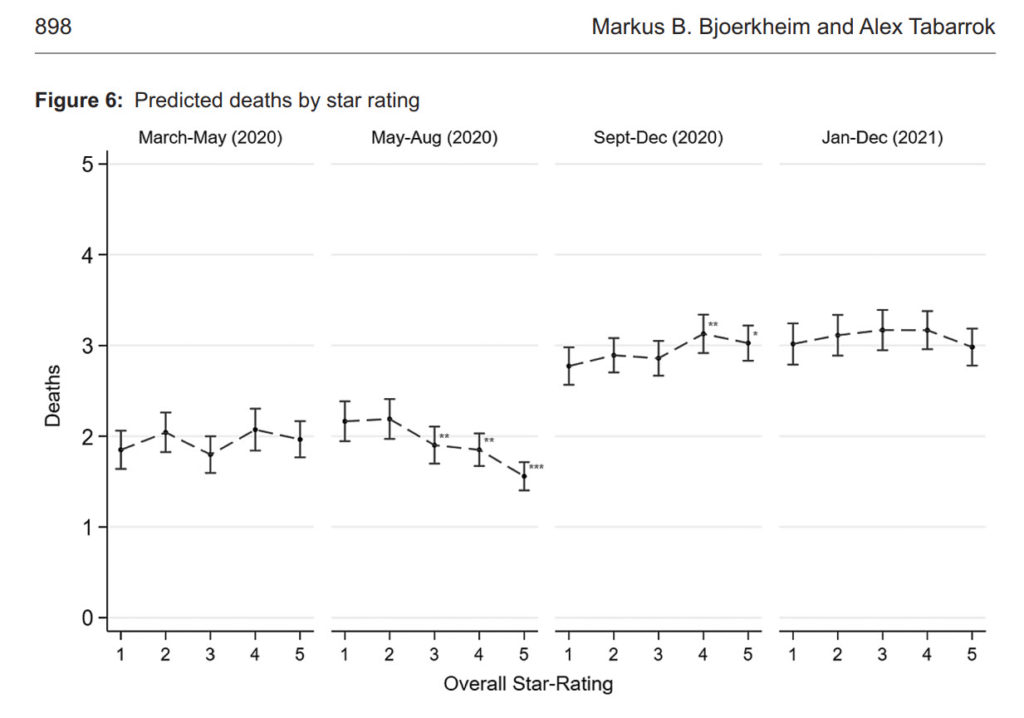
The following figure shows predicted deaths by 5-star rating. There is no systematic relationship between nursing homes rating and COVID deaths. (In the figure, we control for factors outside of a nursing homes control, such as case prevalence in the local community. But even if you don’t control for other factors there is little to no relationship. See the paper for more.) Case prevalence in the community not nursing home quality determined death rates.
More generally, we do some exploratory data analysis to see whether there were any “islands of protection” in the sea of COVID and the answer is basically no. Some facilities did more rapid tests and that was good but surprisingly (to us) the numbers of rapid tests needed to scale nationally and make a substantial difference in nursing home deaths was far out of sample and below realistic levels.
Finally, keep in mind that the United States did focused protection. Visits to nursing homes were stopped and residents and staff were tested to a high degree. What the US did was focused protection and lockdowns and masking and we still we had a tremendous death toll in the nursing homes. Focused protection without community controls would have led to more deaths, both in the nursing homes and in the larger community. Whether that would have been a reasonable tradeoff is another question but there is no evidence that we could have lifted community controls and also better protected the nursing homes. Indeed, as I pointed out at the time, lifting community controls would have made it much more difficult to protect the nursing homes.
Shruti on Effective Altruism, malaria, India, and air pollution
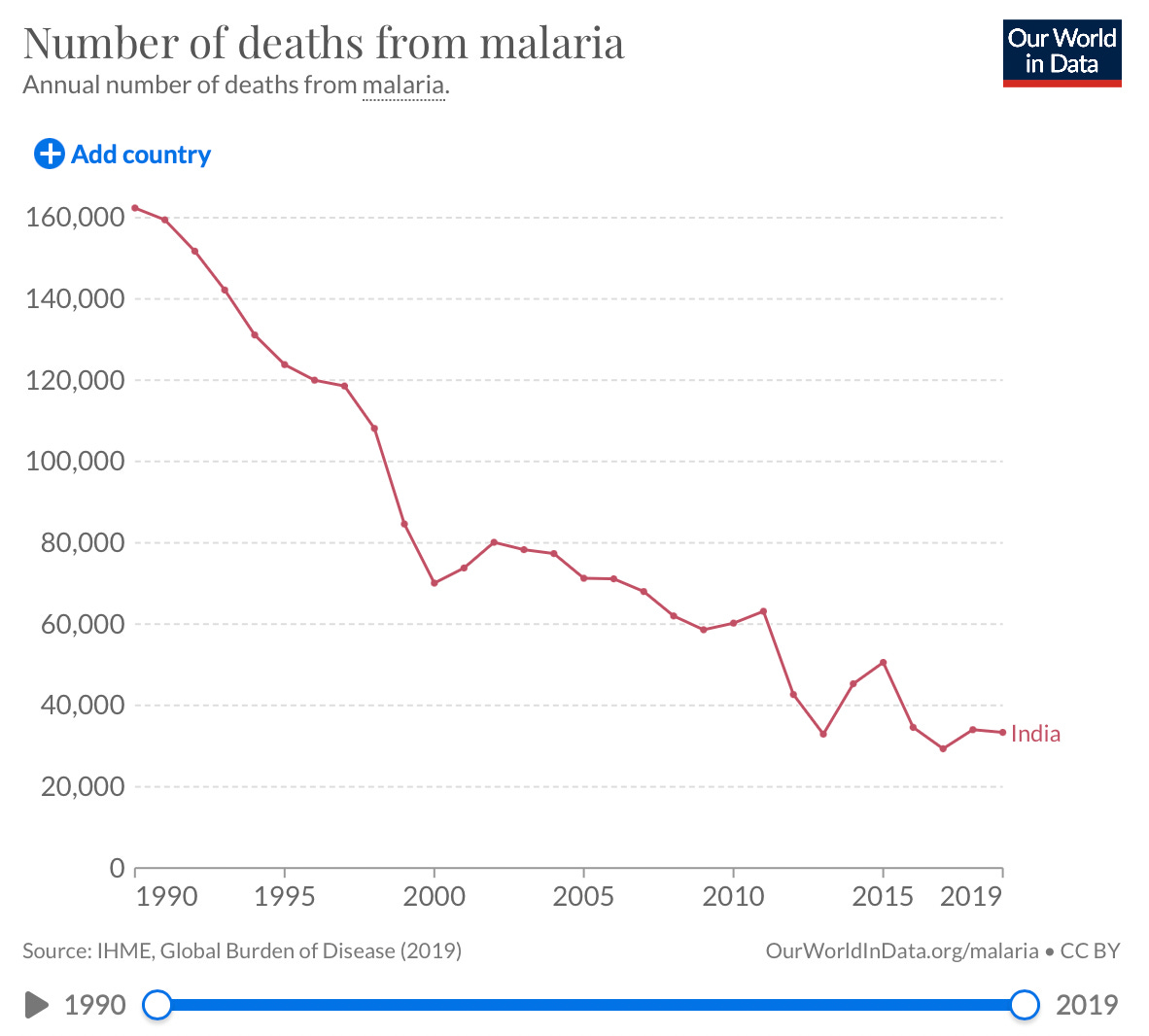
Look at the decline in malaria deaths in India since the big bang reforms in 1991, which placed India on a higher growth trajectory averaging about 6 percent annual growth for almost three decades. Malaria deaths declined because Indians could afford better sanitation preventing illness and greater access to healthcare in case they contracted malaria. India did not witness a sudden surge in producing, importing or distributing mosquito nets. I grew up in India, in an area that is even today hit by dengue during the monsoon, but I have never seen the shortage of mosquito nets driving the surge in dengue patients. On the contrary, a surge in cases is caused by the municipal government allowing water logging and not maintaining appropriate levels of public sanitation. Or because of overcrowded hospitals that cannot save the lives of dengue patients in time.
There is much more at the link, from Shruti’s new Substack.
The Story of VaccinateCA
The excellent Patrick McKenzie tells the story of VaccineCA, the ragtag group of volunteers that quickly became Google’s and then the US Government’s best source on where to find vaccines during the pandemic.
Wait. The US Government was giving out the vaccines. How could they not know where the vaccines were? It’s complicated. Operation Warp Speed delivered the vaccines to the pharmacy programs and to the states but after that they dissappeared into a morass of incompatible systems.
[L]et’s oversimplify: Vials were allocated by the federal government to states, which allocated them to counties, which allocated them to healthcare providers and community groups. The allocators of vials within each supply chain had sharply limited ability to see true systemic supply levels. The recipients of the vials in many cases had limited organizational ability to communicate to potential patients that they actually had them available.
Patients then asked the federal government, states, counties, healthcare providers and community groups, ‘Do you have the vaccine?’ And in most cases the only answer available to the person who picked up the phone was ‘I don’t have it. I don’t know if we have it. Plausibly someone has it. Maybe you should call someone else.’ Technologists will see the analogy to a distributed denial of service incident, and as if the overwhelming demand was not enough of a problem, the rerouting of calls between institutions amplified the burden on the healthcare system. Vaccine seekers were routinely making dozens of calls.
This caused a standing wave of inquiries to hit all levels of US healthcare infrastructure in the early months of the vaccination effort. Very few of those inquiries went well for any party. It is widely believed, and was widely believed at the time, that this was primarily because supply was lacking, but it was often the case that supply was frequently not being used as quickly as it was produced because demand could not find it.
It turned out that the best way to get visibility into this mess was not to trace the vaccines but to call the endpoints on the phone and then create a database that people could access which is what VaccinateCA did but in addition to finding the doses they had to deal with the issue of who was allowed access.
A key consideration for us, from the first day of the effort, was recording not just which pharmacist had vials but who they thought they could provide care to. This was dependent on prevailing regulations in their state and county, interpretations of those regulations by the pharmacy chain, and (frequently!) ad hoc decision-making by individual medical providers. Individual providers routinely made decisions that the relevant policy makers did not agree comported with their understanding of the rules.
VaccinateCA saw the policy sausage made in real time in California while keeping an eye on it nationwide. It continues to give me nightmares.
California, not to mince words, prioritized the appearance of equity over saving lives, over and over and over again, as part of an explicitly documented strategy, at all levels of the government. You can read the sanitized version of the rationale, by putative medical ethics experts, in numerous official documents. The less sanitized version came out frequently in meetings.
This was the official strategy.
The unofficial strategy, the result the system actually obtained, was that early access to the vaccine was preferentially awarded based on proximity to power and to the professional-managerial class.
… The essential workers list heavily informed the vaccination prioritization schedule. Lobbyists used it as procedural leverage to prioritize their clients for vaccines. The veterinary lobby was unusually candid, in writing, about how it achieved maximum priority (1A) for veterinarians due to them being ‘healthcare workers’.
Teachers’ unions worked tirelessly and landed teachers a 1B. They were ahead of 1C, which included (among others) non-elderly people for whom preexisting severe disability meant that ‘a covid-19 infection is likely to result in severe life-threatening illness or death’. The public rationale was that teachers were at elevated risk of exposure through their occupation. Schools were, of course, mostly closed at the time, and teachers were Zooming along with the rest of the professional-managerial class, but teachers’ unions have power and so 1B it was. Young, healthy teachers quarantining at home were offered the vaccine before people who doctors thought would probably die if they caught Covid.
Now repeat this exercise up and down the social structure and economy of the United States.
…Healthcare providers were fired for administering doses that were destined to expire uselessly. The public health sector devoted substantial attention to the problem of vaccinating too many people during a pandemic. Administration of the formal spoils system became farcically complicated and frequently outcompeted administration of the vaccine as a goal.
The process of registering for the vaccine inherited the complexity of the negotiation over the prioritization, and so vulnerable people were asked to parse rules that routinely befuddled healthy professional software engineers and healthcare administrators – the state of New York subjected senior citizens to a ‘51 step online questionnaire that include[d] uploading multiple attachments’!
That isn’t hyperbole! New York meant to do that! On purpose!
Lives were sacrificed by the thousands and tens of thousands for political reasons. Many more were lost because institutions failed to execute with the competence and vigor the United States is abundantly capable of.
…The State of California instituted a policy of redlining in the provision of medical care in a pandemic to thunderous applause from its activist class and medical ethics experts….Residency restrictions were pervasively enforced at the county level and frequently finer-grained than that. A pop-up clinic, for example, might have been restricted to residents of a single zip code or small group of zip codes.
All people are equal in the eyes of the law in California, but some people are . . . let’s politely say ‘administratively disfavored’.
The theory was, and you could write down this part of it, disfavored potential patients might use social advantages like better access to information and transportation to present themselves for treatment at locations that had doses allocated for favored potential patients. This part of the theory was extremely well-founded. Many people were willing to drive the length and breadth of California for their dose and did so.
What many wanted to do, and this is the part that they couldn’t write down, is deny healthcare to disfavored patients. Since healthcare providers are public accommodations in the state of California, they are legally forbidden from discriminating on the basis of characteristics that some people wanted to discriminate on. So that was laundered through residency restrictions.
Many more items of interest. I didn’t know this incredibly fact about the Biden adminsitratins Vaccines.gov for example:
Pharmacies through the FRPP had roughly half of the doses; states and counties had roughly the other half (sometimes administered at pharmacies, because clearly this isn’t complicated enough yet). You would hope that state and county doses were findable on Vaccines.gov. It was going to be the centerpiece of the Biden administration’s effort to fix the vaccine finding problem and take credit for doing so.
…Since the optics would be terrible if America appeared to serve some states much better than others on the official website that everyone would assume must show all the doses, no state doses, not even from states that would opt in, would be shown on it, at least not at the moment of maximum publicity. Got that?
A good point about America.
We also benefited from another major strength of America: You cannot get arrested, jailed, or shot for publishing true facts, even if those facts happen to embarrass people in positions of power. Many funders wanted us to expand the model to a particular nation. In early talks with contacts there in civil society, it was explained repeatedly and at length that a local team that embarrassed the government’s vaccination rollout would be arrested and beaten by people carrying guns. This made it ethically challenging to take charitable donations and try to recruit that team.
Many more points of interest about the process of running a medical startup during a pandemic. Read the whole thing.
Advancing antivenom
Venomous snakebites kill between 81,000 and 138,000 people each year, and leave another 400,000 with permanent disabilities. This ranks it among the deadliest of neglected tropical diseases, alongside better-known ailments such as typhus and cholera.
For many years, the number was believed to be much lower. The World Health Organization had previously estimated that only 50,000 died from snakebites each year, and the problem – known as envenoming – was prioritized accordingly. In 2014, an enormous study documenting one million deaths in India concluded with surprising results. They found that 46,000 people were dying yearly from snakebites in India alone, five times more than the WHO had anticipated. The WHO subsequently doubled their global estimate from around 50,000 to their new range of 81,000 to 138,000.
Despite playing host to the world’s most venomous snakes (including the inland taipan, the most venomous animal in the world), Australia averages only two deaths from snakebites each year…
An Australian is typically a short drive from a well-equipped hospital carrying antivenom in cold storage. Australian doctors and others in the West can use advanced diagnostic equipment to determine the species of snake the patient was bitten by and administer highly effective species-specific antivenom.
An Indian victim, on the other hand, would typically face a long journey to the nearest clinic. For over 34 percent of Indian snakebite victims, it takes more than six hours to receive treatment.
In other words, the problem is solvable. Here is more from Mathias Kirk Bonde at Works in Progress. Here is the new issue of Works in Progress. Small steps toward a much better world!
From the comments, on CDC reform
These are the word of commentator Sure:
Why the CDC is hard to fix
As of October, 10,020 of the CDC’s 12,892 full-time employees — 78% of the full-time workforce — were allowed to work remotely all or part of the time, according to data that KHN obtained via a Freedom of Information Act request.
Experts said the lack of face-to-face work will likely be a substantial obstacle to the top leadership’s effort to overhaul the agency after its failures during the pandemic — a botched testing rollout, confusing safety guidance, the slow release of scientific research, and a loss of public trust.
They also wondered whether Walensky, who frequently works remotely while traveling, can bring about that change from afar and whether a virtual workforce might experience more challenges battling infectious diseases than one working together in person.
“One of the things that a really strong new leader would do is they’d be visible, they’d be walking the halls, they’d have the open door,” said Pamela Hinds, a professor of management science and engineering at Stanford University. “That’s much harder to accomplish when nobody’s there.”
Here is the full story, via Rich Dewey.
Cognitive Behavioral Therapy among Ghana’s Rural Poor
We study the impact of group-based cognitive behavioral therapy (CBT) for individuals selected from the general population of poor households in rural Ghana (N = 7,227). Results from one to three months after the program show strong impacts on mental and perceived physical health, cognitive and socioemotional skills, and economic self-perceptions. These effects hold regardless of baseline mental distress. We argue that this is because CBT can improve well-being for a general population of poor individuals through two pathways: reducing vulnerability to deteriorating mental health and directly increasing cognitive capacity and socioemotional skills.
That is by Nathan Barker, Gharad Bryan, Dean Karlan, Angela Ofori-Atta and Christopher Udry, here is the AER Insights link. Here are other versions.
Bikers for Organ Donation
In this cross-sectional study of 10 798 organ donors and 35 329 recipients of these organs from a national transplant registry from 2005 to 2021, there were 21% more organ donors and 26% more transplant recipients per day during motorcycle rallies in regions near those rallies compared with the 4 weeks before and after the rallies.
Both donors and transplants increase around the time of major motorcycle rallies.

Paper here.
How good are on-line reviews for physicians?
We compare the online reviews of 221 “Questionable” Illinois and Indiana physicians with multiple paid medical malpractice claims and disciplinary sanctions with matched control physicians with clean records. Across five prominent online rating services, we find small, mostly insignificant differences in star ratings and written reviews for Questionable versus control physicians. Only one rating service (Healthgrades) reports on paid medical malpractice claims and disciplinary actions and it misses more than 90% of these actions. We also evaluate the online ratings of 171 Illinois hospitals and find that their ratings are largely uncorrelated with the share of hospital-affiliated physicians with paid medical malpractice claims and disciplinary sanctions. Online ratings have limited utility in helping patients avoid physicians with troubled medical malpractice and disciplinary records, and steering patients away from hospitals at which more physicians have paid medical malpractice claims and disciplinary sanctions.
That is from a new paper by David A. Hyman, Jing Liu, and Bernard S. Black. Via the excellent Kevin Lewis.
Speeding up Inhaled Vaccines
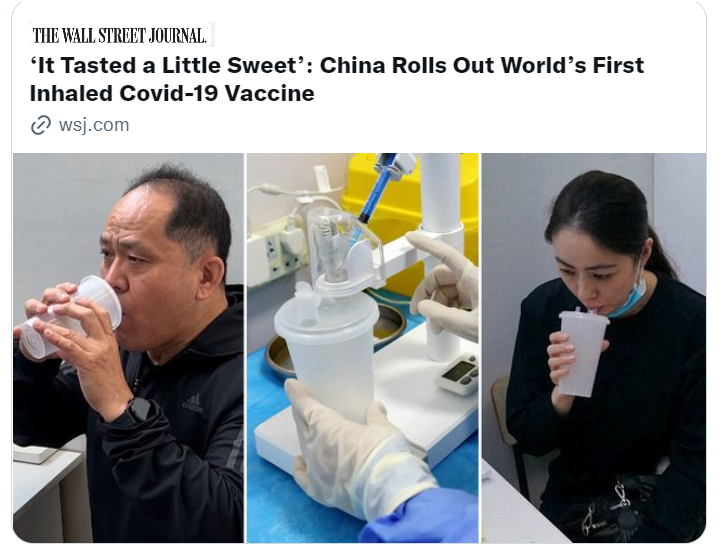
After Operation Warp Speed was disbanded by the Biden administration, vaccine development slowed from warp speed to impulse power. The rest of the world now has some innovative vaccines not yet available in the United States. China, for example, has an inhaled vaccine. We don’t yet know how good the vaccine is and China, of course, has its own problems. In my view, however, the Chinese vaccines have been incorrectly discounted, due in part to chauvinism and propaganda as well as the initial impression that mRNA vaccines had higher efficacy. That advantage, however, his diminished over time. There is something to be said for a tried and true inactivated vaccine that delivers the whole virus and not just the spike protein which is one reason I advocated in 2020 for including an inactivated vaccine in the Operation Warp Speed portfolio. It’s not just China either, as the NYTimes reports Russia, India and Iran all have a nasal vaccine. But in the United States it’s back to business as usual.
NYTimes: In the United States, nasal sprays have been held back by the same funding constraints and logistical hassles that, before the pandemic, often made developing vaccines a decade-long ordeal. The delay could not only weaken the country’s defenses against a more lethal coronavirus variant but also hurt preparations for a future pandemic, depriving the world of an oven-ready nasal vaccine platform that could be adapted to a new pathogen.
“It went back to the prepandemic speed of vaccine development,” said Florian Krammer, a virologist at the Icahn School of Medicine at Mount Sinai. His team’s nasal vaccine has undergone its most advanced testing in Mexico; collaborating with a pharmaceutical company there offered the fastest path to clinical trial funding. In the United States, he said, “The funding situation is pretty dire.”
See also my post on an Operation Warp Speed for Nasal Vaccines.
China fact of the day (with the usual grain of salt)
Nucleic Acid Testing 'Now Accounts for 1.3% of China’s GDP' https://t.co/sFw8zdNdk1
— That's Shanghai (@ThatsShanghai) November 7, 2022
FDA Deregulation Increases Safety and Innovation and Reduces Prices
In an important and impressive new paper, Parker Rogers looks at what happens when the FDA deregulates or “down-classifies” a medical device type from a more stringent to a less stringent category. He finds that deregulated device types show increases in entry, innovation, as measured by patents and patent quality, and decreases in prices. Safety is either negligibly affected or, in the case of products that come under potential litigation, increased.
After moving from Class III (high regulation) to II (moderate), device types exhibited a 200% increase in patenting and FDA submission rates relative to control groups. Patents filed after these events were also of significantly higher quality, as measured by a 200% increase in received citations and market valuations. These effects do not spill over into similar device types.1 For Class II to I deregulations, the rate of patent filings increased by 50%, though insignificantly, and the quality of patent filings exhibited a significant 10-fold improvement, suggesting that litigation better promotes innovation.
…Down-classification yields considerable benefits, as the proponents of deregulation would predict, but what of product safety? Perhaps counterintuitively, I find that deregulation can improve product safety by exposing firms to more litigation. Despite some adverse event rates increasing after Class III to II events (albeit insignificantly), Class II to I events are associated with significantly lower adverse event rates.3 My analysis of patent texts also reveals that inventors focus more on product safety after deregulation. These results suggest that litigation encourages product safety more than regulation…
Some background. Medical devices are regulated under three categories. New types of devices (new, not necessarily high risk) are highly regulated Class III devices which must go through a pre-market approval process to prove safety and efficacy (like new drugs). The pre-market approval process is time-consuming and expensive but it comes with one significant benefit, federal preemption of state tort action, i.e. these devices are shielded from product liability. Class II devices are devices that are judged to be substantially equivalent to an already approved device–proving equivalence also takes time and money but it’s less onerous than proving safety and efficacy de novo. Note that device manufacturers often make their devices less innovative so they can be approved as Class II devices rather than as Class III devices. Class II devices are mostly also protected against tort litigation. Class I devices are not FDA-approved and are subject to tort litigation.
As experience develops with new devices such that new devices turn out to be not especially risky, the FDA sometimes deregulates or down-classifies these devices from Class III to Class II or from Class II to Class I. Rogers studies these down-classifications by comparing what happens to the down-classified device category to a control group of similar devices that were not down-classified. The control group is critical and Rogers shows that his results are robust to defining the control group in a variety of plausible ways. Some of the key results are shown in the following figure:
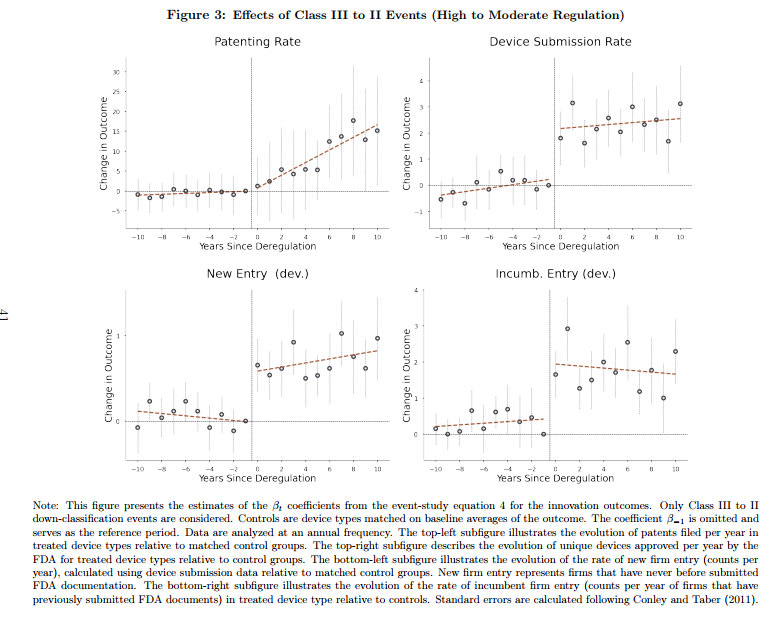 Nicely we see that device submissions and new entry occur very quickly once a device is down-regulated which indicates that firms have ideas and products on-the-shelf but they are dissuaded from entering the market by the onerous pre-market approval process. Most likely, these are products and firms which produce devices for the European market which tends to be less regulated and they enter the US market only when costs are reduced. Patenting also increases in the down-regulated device category and–exactly as one would expect–this takes more time.
Safety declines non-significantly if at all from Class III to Class II deregulations and increases for Class II to Class I deregulations. That makes the welfare comparisons easy because deregulation appears to be all benefit and no cost. Note, however, that I have always argued that drugs and devices are actually too safe–that, is we could save more lives on net by approving more drugs and devices even if safety went down. That’s a hard sell, however, but it’s clearly true that given the results here we should deregulate or down-classify many more products even if safety declined on the margin. Too much safety is risky. That’s also the upshot of my paper on off-label prescribing which shows that it’s often the FDA-unapproved off-label use which is the gold-standard treatment in fast moving fields of medicine.
Rogers argues that safety increases for Class II to Class I deregulations because liability is a stronger deterrent on the margin than regulation (and he provides some evidence for this view in that safety increases more among larger firms that are less judgment proof than small firms). Without denying that mechanism my view is that innovation itself increases safety. As I noted above, medical device manufactures often do not use the latest technology in their products because this would threaten the “substantial equivalence” test so you get devices that are actually less safe and also more costly to manufacture than necessary. In essence, substantial equivalence anchors new technologies to old technologies thus preventing movement, even movement towards safety and lower prices.
Rogers also has an excellent and unusual paper (with Jeffrey Clemens) on directed innovation in artificial limbs due to the civil war! That paper and this one show a real focus on digging deep into the data to unearth important and unusual sources of insight. N.B.! Parker Rogers is on the job market.
Addendum: See my many previous posts for more useful references on the FDA, especially Is the FDA Too Conservative or Too Aggressive.
*Risky Business*
The subtitle is Why Insurance Markets Fail and What To Do About It, and the authors are the highly regarded Liran Einav, Amy Finkelstein, Ray Fisman. The level is a bit above what could make this book a bestseller, but I consider that a good thing. The book in fact is a classic example of how to present economic research in readable, digestible form and should be regarded as such.
I do have a few qualms, but please note these are outweighed by the very high quality of the core material:
1. I think the authors underestimate how rapidly “Big Data” is shifting the information asymmetries away from consumers/policyholders. This is related to my recent remarks on AI.
1b. For reasons stemming from #1, insurance/surveillance/control, including from employers, will rise in importance as an issue, and soon. I don’t get a sense of that from reading this book. We might alleviate selection problems, while creating other difficulties including ethical dilemmas.
2. I would like to see more on moral hazard.
3. I also would want to see more — much more — on the public choice reasons why government insurance markets so often fail — the authors should consider their own title! Should the Florida government really be propping up insurance contracts and insurance markets to protect homeowners against climate change-related losses? No matter what your view, this kind of issue is under-discussed. How about the FDIC? Bailout-related moral hazard issues? Those are hardly “small potatoes.” I get that isn’t “the book they set out to write,” but still I worry that the final picture they present is misleading when it comes to market failure vs. government failure. Adverse selection is really just one part of insurance markets, but this book doesn’t teach you that.
3b. Isn’t excess liability through our court system another major reason why insurance markets fail? We needed a Price-Anderson Act, where government assumes a lot of the liability, to support our nuclear power sector, even though coal alternatives were riskier and more harmful, both short run and long run. In terms of actual importance, hasn’t this been a major, major factor?
3c. Are restrictions on “boil in oil” contracts (no matter what you think of them ethically) another factor in institutional failure here? Maybe that is one way of making America safe for bungee jumping. Or we can follow New Zealand, and limit liability here altogether. The interaction of insurance and liability law is a major issue, and we have not been getting it right.
4. The authors absolutely do consider “positive selection” (e.g., it is the responsible people who buy life insurance, thus leading to a favorable customer pool), but I would give it more emphasis. If you believe that income inequality, “deaths of despair,” and educational polarization are growing problems, this phenomenon likely is becoming more important.
4b. How about more concessions in the Obamacare analysis? For years I read that a weaker mandate would cause the system to collapse. Yet the Republicans significantly cut back on mandate enforcement and the system seems to be getting along OK, at least from that point of view. (In fact, politically speaking Trump arguably saved Obamacare.) What did everyone miss? Did they overrate adverse selection arguments and underrate positive selection? It seems that was a major failing of the economics profession, which if anything was more insistent on “the three legs of the stool” than policymakers were. The authors do cover this all at length, but they can’t bring themselves to note “we got down to 7-8 percent uninsured, the whole thing actually worked out OK, and the economists didn’t quite get it right.”
5. There are plenty of cases when expected “insurance” markets do not exist, and we cannot boil those down to adverse selection. Why don’t all those Bob Shiller proposals happen? (Is it really inside information about gdp? That seems doubtful.) Why aren’t there more prediction markets? Why have so many proposed futures contracts on exchanges failed? These all would seem to serve insurance-like purposes, among their other functions. Yet their supply seems skimpy, at least relative to an economist’s expectations. Why? Perhaps there is more to failed insurance markets than meets the eye.
I know authors can fit only so much into a book, but if I can fit this much into a blog post…I would like to see more! And I think that would result in a more realistic policy balance as well, and draw attention to major issues other than adverse selection.
A “Safety Emergency” Happened at the Wuhan Institute of Virology in November of 2019
Pro-Publica (with Vanity Fair) is putting their reputation on the line with a very damning report suggesting COVID emerged from a lab leak at the Wuhan Institute of Virology. The new information isn’t about the virus but about political reports that indicate that there was some kind of emergency at the lab in November of 2019, an emergency that was so serious Xi himself got involved.
… we sent key documents to experts on CCP communications. They told us that the WIV dispatches did indeed signal that the institute faced an acute safety emergency in November 2019; that officials at the highest levels of the Chinese government weighed in; and that urgent action was taken in an effort to address ongoing safety issues. The documents do not make clear who was responsible for the crisis, which laboratory it affected specifically or what the exact nature of the biosafety emergency was.
…[we] separately got three experts on CCP communications to review the WIV meeting summary. All agreed that it appeared to be urgent, nonroutine and related to some sort of biosafety emergency. Two also agreed that it appeared Xi himself had issued a pishi.
A former senior U.S. intelligence official said that, while the pishi [link, AT] in the dispatch is not necessarily a smoking gun, he reads it as saying that “there is some issue related to lab security, which doesn’t come up very often, that needed to be seen by Xi Jinping.” He added, “Something signed off on by the General Secretary (Xi) and Premier (Li) is high priority.”
there is also this, which I have long found surprising:
The interim report also raises questions about how quickly vaccines were developed in China by some teams, including one led by a military virologist named Zhou Yusen. The report called it “unusual” that two military COVID-19 vaccine development teams were able to reach early milestones even faster than the major drug companies who were part of the U.S. government’s Operation Warp Speed program.
Vanity Fair and ProPublica spoke to experts who said that the timeline of Zhou’s vaccine development seemed unrealistic, if not impossible. Two of the three experts said it strongly suggested that his team must have had access to the genomic sequence of the virus no later than in November 2019, weeks before China’s official recognition that the virus was circulating.
In other news, the authors of the wet-market “orgins” preprint that received a lot of positive mainstream press have substantially moderated their conclusions in the published (peer-reviewed) article which now only pinpoints the seafood market as an epicenter, which everyone already knew.
Here is the original post.