Category: Philosophy
Quotations from Paul Valery
“Two dangers constantly threaten the world: order and disorder.”
“Love is being stupid together.”
“Books have the same enemies as people: fire, humidity, animals, weather, and their own content.”
The link is here, and it has two more.
Libertarian vs. existentialist notions of freedom
Also known as Existential Star Wars. Pretty awesome, this is the funniest thing I’ve seen all year. For the pointer I thank Xavier, via Yana.
Bryan Caplan defends pacifism
In the real-world, however, pacifism is a sound guide to action.
And that includes an unwillingness to kill innocent civilians as collateral damage while acting in defense of one’s country. The original post is here, the defense against critics is here.
There is not enough consideration of specific times and place. Had England been pacifist in 1914, that might have yielded a better outcome. Had England been pacifist in 1939, likely not. Switzerland has done better for itself, and likely for the world, by being ready to fight back. Pacifism today could quite possibly doom Taiwan, Israel, large parts of India (from both Pakistan and internal dissent), any government threatened by civil war (who would end up ruling Saudi Arabia and how quickly?), and I predict we would see a larger-scale African tyrant arise, gobbling up non-resisting pacifist neighbors. Would China request the vassalage of any countries, besides Taiwan that is? Would Russia “request” Georgia and the Baltics? Would West Germany have survived?
And this is the best we can do? It’s much worse than the status quo, which is hardly delightful enlightenment. I don’t see these examples mentioned in Bryan’s post. There is also a Lucas critique issue of how the bad guys start behaving once they figure out that the good guys are pacifist, and I don’t see him discussing that either.
It would be a mistake to add up all the wars and say pacifism is still better overall, because we do not face an all-or-nothing choice. Many selective instances of non-pacifism are still a good idea, with benefits substantially in excess of their costs. Bryan, however, has to embrace pacifism, otherwise his moral theory becomes too tangled up in the empirics of the daily newspaper…
Which is exactly where I am urging him to go.
*How To Live*
The author is Sarah Bakewell and the subtitle is Or a Life of Montaigne in One Question and Twenty Attempts at an Answer. This book truly brings Montaigne to life — a task I would have thought impossible in a popular publication. I view Montaigne as one of the most important writers and thinkers and perhaps the single most important for anyone in the blogosphere. I had not known, by the way, that Montaigne was mayor of Bordeaux for four years.
Here is Tim Harford on why we are all too sure of ourselves.
For the pointer to the book I thank the excellent Christopher Weber, Citizen of the World.
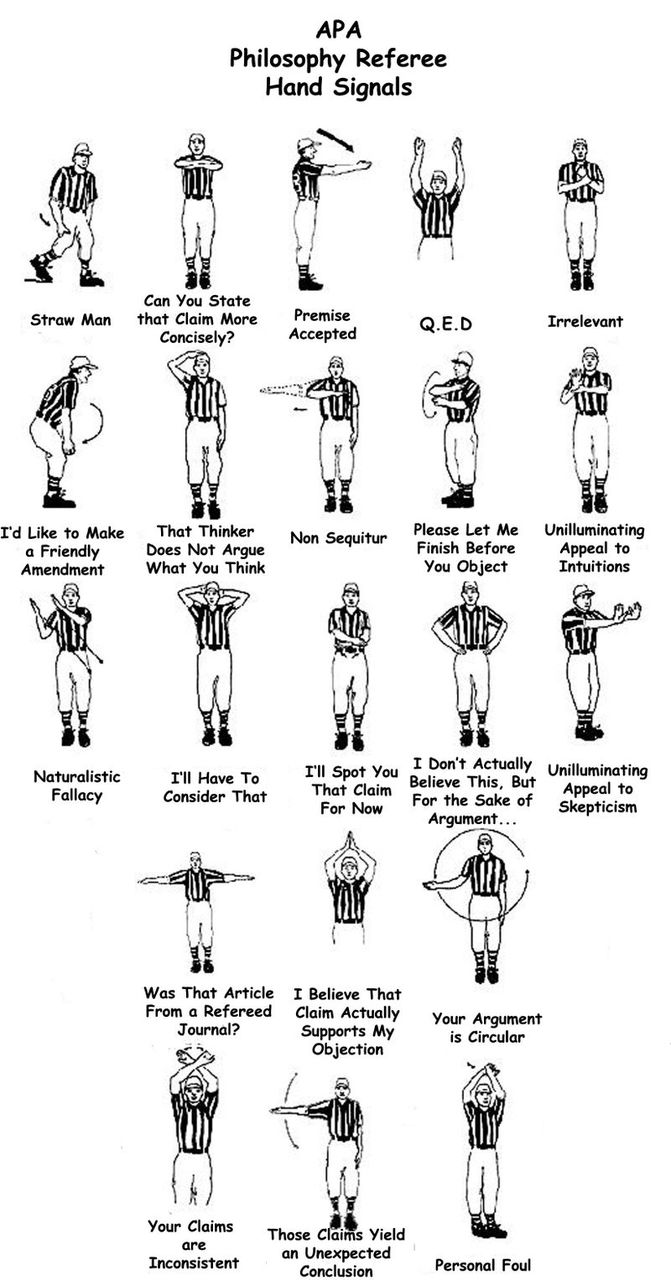
Philosophy Referee Signals


The fallacy of mood affiliation
Recently I wrote:
It seems to me that people are first choosing a mood or attitude, and then finding the disparate views which match to that mood and, to themselves, justifying those views by the mood. I call this the “fallacy of mood affiliation,” and it is one of the most underreported fallacies in human reasoning. (In the context of economic growth debates, the underlying mood is often “optimism” or “pessimism” per se and then a bunch of ought-to-be-independent views fall out from the chosen mood.)
Here are some further examples:
1. People who strongly desire to refute those who predicted the world would run out of innovations in 1899 and thus who associate proponents of a growth slowdown with that far more extreme view. There’s simply an urgent feeling that any “pessimistic” view needs to be countered.
2. People who see a lot of net environmental progress (air and water are cleaner, for instance) and thus dismiss or downgrade well-grounded accounts of particular environmental problems. There’s simply an urgent feeling that any “pessimistic” view needs to be countered.
3. People who see a political war against the interests of the poor and thus who are reluctant to present or digest analyses which blame some of the problems of the poor on…the poor themselves. (Try bringing up “predatory borrowing” in any discussion of “predatory lending” and see what happens.) There’s simply an urgent feeling that any negative or pessimistic or undeserving view of the poor needs to be countered.
4. People who see raising or lowering the relative status of Republicans (or some other group) as the main purpose of analysis, and thus who judge the dispassionate analysis of others, or for that matter the partisan analysis of others, by this standard. There’s simply an urgent feeling that any positive or optimistic or deserving view of the Republicans needs to be countered.
In the blogosphere, the fallacy of mood affiliation is common.
Meta-ethics, realism, and intuitionism
Dan S. asks:
What are your meta-ethical views? I’ve heard you mention the importance of subjective value as well as “virtue,” so I imagine you are inclined toward a more “morality is subjective” view. What is your opinion of Bryan Caplan’s moral realism and intuitionism? Do you think it faces insurmountable metaphysical obstacles?
I am a moral realist and intuitionist, as is Bryan, but my view on applications is very different.
On torturing babies, I a) think it is objectively wrong, but b) I don’t think that a philosophical unpacking of “wrong” here gets one very far. It’s wrong, and if you don’t understand why you won’t understand the philosophic explanation either. There is nothing in the philosophical explanation that is more evident than the initial wrongness. So far I’m on board with Caplan.
Yet I don’t wish to walk down this plank very far. Bryan wants to “coin” a large number of (non-trivial) moral truths this way, such as his claim that taxation is morally wrong for violating the precepts of common sense morality (“don’t take things from other people”). Last I looked, a lot of common sense people support taxation and the interpretation of common sense maxims depends very much on context. Reasoning by analogy is far, far weaker than Bryan wishes to believe.
I’m agnostic on a lot of ethical issues, but not a relativist or a subjectivist per se. I simply think that we don’t have very good facilities for detecting objective ethical truth, just as most of us are not very good at factoring large numbers in our heads. Indeed, ethical philosophy hasn’t made a lot of progress in the last two thousand years.
I find that my combination of views is fairly rare. People who believe that ethics is objective and intuitive are often quite keen to make a lot of detailed pronouncements about the content of those ethics. The agnostics tend to be relativists or subjectivists. It seems to me that people are first choosing a mood or attitude, and then finding the disparate views which match to that mood and, to themselves, justifying those views by the mood. I call this the “fallacy of mood affiliation,” and it is one of the most underreported fallacies in human reasoning. (In the context of economic growth debates, the underlying mood is often “optimism” or “pessimism” per se and then a bunch of ought-to-be-independent views fall out from the chosen mood.)
Here is an earlier post on ethical intuitionism. Here is my conclusion:
…ethical intuitionism settles many fewer issues than most of its proponents like to think. That said, there is often nowhere else to go. We somehow need to come to terms with two propositions at the same time:
1. We need to think more rather than less ethically.
2. The content of ethical philosophy tells us less, in reliable terms, than most people would like to believe.
Pre-order your Derek Parfit, *On What Matters*, volumes I and II
Bleeding heart libertarians
That is the name of a new and excellent blog. The writers include Andrew Jason Cohen, Daniel Shapiro, Jacob T. Levy, James Stacey Taylor, Jason Brennan, and Matt Zwolinski. They are all worth reading. Jason Brennan is perhaps not so well known in the blogosphere, but he is already one of the most important classical liberal thinkers in the world and you will be hearing more from him soon. Here is his post on neoclassical liberalism.
Globalization and the Expanding Moral Circle
In 1869 the Irish historian William Lecky (1838-1903) wrote that moral progress is about extending the moral circle.
At one time the benevolent affections embrace merely the family, soon the circle expanding includes first a class, then a nation, then a coalition of nations, then all humanity…
What is the effect of globalization on the moral circle? Does trade melt barriers and expand the moral circle or does globalization make "the other" a more salient division allowing politicians to demonize and control through xenophobia?
Two pieces of evidence, one anecdotal the other experimental, suggests that globalization expands the moral circle. The anecdotal evidence is the cover story of this month's Wired titled "1 Million Workers. 90 Million iPhones. 17 Suicides. This is where your gadgets come from? Should you care?"
Now from a rational point of view this is absurd. Put aside that the suicide rate is higher among American college students than Chinese workers at Foxconn, even odder is that the writer cares about 17 suicides but not say the million plus deaths in China due to lung disease. But no one said that the moral circle grows for rational reasons. In this case, the writer, Joel Johnson, found that the purchase of the cell phone extended his moral circle to workers who assembled the phone half a world away:
I was burdened by what felt like an outsize provision of guilt–an existential buyer’s remorse for civilization itself. I am here because I want to know: Did my iPhone kill 17 people?
What about the experimental evidence? In an excellent paper, Buchan et al. discuss results from a public good dilemma game that they ran on thousands of people in six countries around the world: Iran, South Africa, Argentina, Russia, Italy and the United States.
In each country the players could contribute to themselves, to a local group or to a world group. Local contributions were doubled and world contributions were tripled such that the world-group maximizing strategy would be for all contributions to go to the world account, the local-group maximizing strategy would be for all contributions to go to the local account and (as usual) the dominant strategy was to contribute to self only. (Local contributions also paid more to self than did contributions to the world account).
The authors find two strong effects. First, the rate of donation to the world account increased significantly with the extent of a country's globalization, as measured by a globalization index. Second, within countries the rate of donation to the world acount increased with an individual's globalization index (based on measures such as whether the individual worked for an international firm, watched foreign movies, called people abroad etc.) Thus, globalization increases the potential for global cooperation.
The authors conclude:
…not only is living in a more globalized country associated with more cooperation at the world level, but the same relationship holds as the degree of individual global connectedness increases as well. The cosmopolitan hypothesis receives clear support from our experiments.
… our findings suggest that humans' basic “tribal social instincts” may be highly malleable to the influence of the processes of connectedness embedded in globalization.
Western intellectuals and Gadhafi
Robert Putnam was once called to a meeting with Gadhafi. Here is an excerpt from his account:
Students of Western political philosophy would categorize Col. Gadhafi as a quintessential student of Jean-Jacques Rousseau: He made clear that he deeply distrusted any political group that might stand between individual citizens and the "General Will" as interpreted by the Legislator (i.e., Col. Gadhafi himself). When I argued that freedom of association could enhance democratic stability, he vehemently dismissed the idea. That might be so in the West, he insisted, but in Libya it would simply strengthen tribalism, and he would not stand for disunity.
Throughout, he styled our meeting as a conversation between two profound political thinkers, a trope that approached the absurd when he observed that there were international organizations for many professions nowadays, but none for philosopher-kings. "Why don't we make that happen?" he proposed with a straight face. I smiled, at a loss for words. Col. Gadhafi was a tyrant and a megalomaniac, not a philosopher-king, but our visit left me convinced that he was not a simple man.
Was this a serious conversation or an elaborate farce? Naturally, I came away thinking–hoping–that I had managed to sway Col. Gadhafi in some small way, but my wife was skeptical. Two months later I was invited back to a public roundtable in Libya, but by then I had concluded that the whole exercise was a public-relations stunt, and I declined.
Hat tip goes to Monkey Cage and ultimately, the fabled Daniel Lippman. But that's not all — Benjamin Barber also had some visits to meet with the Libyan leader, here is his account:
Written off not long ago as an implacable despot, Gaddafi is a complex and adaptive thinker as well as an efficient, if laid-back, autocrat. Unlike almost any other Arab ruler, he has exhibited an extraordinary capacity to rethink his country's role in a changed and changing world.
And:
Surprisingly flexible and pragmatic, Gaddafi was once an ardent socialist who now acknowledges private property and capital as sometimes appropriate elements in developing societies. Once an opponent of representative central government, he is wrestling with the need to delegate substantial authority to competent public officials if Libya is to join the global system. Once fearful of outside media, he has permitted satellite dishes throughout his country, and he himself surfs the Internet.
Libya under Gaddafi has embarked on a journey that could make it the first Arab state to transition peacefully and without overt Western intervention to a stable, non-autocratic government and, in time, to an indigenous mixed constitution favoring direct democracy locally and efficient government centrally.
Here is Barber's piece on Libya from 2011. It starts like this:
I offer my views about Libya here not just as a democratic theorist and HuffPost regular, but as a member of the International Board of the Gaddafi International Charity and Development Foundation until this morning, when I resigned.
Externalities across monozygotic twins
Suppose you have a right to genetic privacy. You might believe you do. Suppose you have an identical twin. Suppose the identical twin decides to publish his (or her) genetic sequence on the web. Do you have the right to stop this?
That is from Randall Parker. More generally, how much do identical twins impose Pareto-relevant externalities on each other?
One model is that each twin benefits the other by finding an appropriate niche and pursuing some degree of differentiation. In this view, too much "sameness" is bad for each twin. I believe that is the common intuition, and it suggests that twins will in effect pay each other to be more different. It also suggests that the resulting behavior of each twin is not quite at that twin's ideal point; if not for the deal each twin would prefer to be less different.
An alternative model is that a "doubled" person is more than twice as productive as a singleton. For instance, positive reputation earned by one twin rebounds to the benefit of the other. Just as companies and brands and families carry and spread reputations across collectives, so might signals of a common zygote. If twins can signal that they are quite similar, perhaps more overall trust (or mistrust?) will be produced. On these grounds, might twins implicitly subsidize each other's transportation into public spaces, to parties, and so on?
How much more easily can identical twins trade with each other?
Katja has a related post on women and swimsuits.
How to think about refugee policy
Dave Bieler, a loyal MR reader, asks:
I see that you've provided some commentary on Marginal Revolution about refugee situations, but I'm curious to know what you think about refugee policies – i.e. what is the role of government? What is the role of private insitutions? How can different types of institutions and organizations improve or make worse various situations? Do you have any thoughts or links to articles or books? I think it would make for an interesting blog post!
This question may be more relevant soon, although Muslim refugees from the Middle East do not have the best chances of getting into America. I have read that one small town in Sweden has taken in more Iraqi refugees than has the entire United States. Here is Wikipedia on refugees. I hold a few views:
1. Refugees are deserving of migration toleration when possible, but they are not more deserving than equally destitute non-refugees.
2. Refugees nonetheless capture the imagination of the public to some extent, albeit for a very limited period of time. Their beleaguered status provides a useful means of framing, to boost migration for humanitarian reasons. When it comes to private institutions, refugee issues may be a useful way of raising funds, again for humanitarian aid, although again refugees should not be privileged per se, relative to other needy victims.
3. Legal treatment of refugees is inevitably arbitrary and unfair. There is not and will not be a clear set of rational standards for who gets in and who doesn't. There are better and worse standards at the extreme points, but don't expect this to ever get rigorous, not even at the level of ideal theory.
4. There always exists some pool of refugees who will help the migration-accepting country, even if you do not believe that about all pools of refugees. Let's take in some Egyptian Copts, who possibly are in danger now. Some groups of African migrants have done quite well in the United States and we can take in more oppressed women from north Africa. In other words, "immigration skepticism" may redirect the direction of refugee acceptance, but it need not discriminate against the idea of taking in refugees.
5. Optimal refugee policy is most of all an exercise in public relations, as ruled by the idea of the optimal extraction of sympathy. Explicit sympathy from the public cannot be expected to last very long. In the best case scenario, sympathy for the refugees is replaced by fruitful indifference, so as to avoid "refugee fatigue."
See my earlier remarks on sovereignty. Here is an argument against admitting refugees; I don't agree with it.
The Pippi Longstocking essay and gay adoption in Sweden
Thanks to Jayme Lemke, it has fallen into my clutches; the previous summary reference was here. The essay by Henrik Berggren and Lars TrägÃ¥rdh, is interesting throughout. It has useful insights on Sweden, statism, how collectivism and individualism interact, what architecture reflects, and why many things are not always as they seem. Here is one good passage with a different slant than what I already covered:
While it is obviously true that gay marriage remains a highly controversial issue in the US, what is often over-looked is that adoption of children by gays is not prohibited but indeed rather common. In Sweden the opposite is true: gay marriage or partnership is today relatively uncontroversial (although an opposition of course exists there as well), where the adoption of children by single or couples gays remains a problematic issue.
One way of understanding this difference is to see that while in the US marriage is a highly public matter, and the family a sacred institution, children are by and large seen as a kind of private property, or something to which every adult individual has a right. In Sweden, on the other hand, the family is a private matter, while it is the child who is the public matter.
Can Swede readers attest to this? This short BBC bit seems to confirm. Gay adoption was legalized in Sweden in 2002, but in 2000 16 children were put up for adoption in Sweden. As in the Netherlands, it seems that Swedish gays are not always encouraged to adopt abroad, given that the source countries often object. There is now a Swedish film comedy about gay adoption.
You can find the essay in this unorthodox and stimulating book.