Category: Political Science
“Republicans start more firms than Democrats.”
Republicans start more firms than Democrats. In a sample of 40 million party-identified Americans between 2005 and 2017, we find that 6% of Republicans and 4% of Democrats become entrepreneurs. This partisan entrepreneurship gap is time-varying: Republicans increase their relative entrepreneurship during Republican administrations and decrease it during Democratic administrations, amounting to a partisan reallocation of 170,000 new firms over our 13-year sample. We find sharp changes in partisan entrepreneurship around the elections of President Obama and President Trump, and the strongest effects among the most politically active partisans: those that donate and vote.
Here is the full NBER paper by Joseph Engelberg, Jorge Guzman, Runjing Lu, and William Mullins.
Adam Smith and Colombia
I gave a keynote address in Bogotá to the International Adam Smith Society, here is my talk. Why is Adam Smith still relevant to Colombia of all places? It’s not just the market economics, rather my remarks focused on Book V (the best and most interesting part of WoN!) and Smith’s take on standing armies and why they are conducive to liberty.
Quantitative Political Science Research is Greatly Underpowered
We analyze the statistical power of political science research by collating over 16,000 hypothesis tests from about 2,000 articles. Even with generous assumptions, the median analysis has about 10% power, and only about 1 in 10 tests have at least 80% power to detect the consensus effects reported in the literature. There is also substantial heterogeneity in tests across research areas, with some being characterized by high-power but most having very low power. To contextualize our findings, we survey political methodologists to assess their expectations about power levels. Most methodologists greatly overestimate the statistical power of political science research.
*Adventure Capitalism*
The author is Raymond B. Craib and the subtitle is A History of Libertarian Exit, from the Era of Decolonization to the Digital Age. This is really two books in one. The first is a quite useful and well-researched history of various libertarian attempts to ease the costs of political exit, or sometimes to obtain exit altogether. He is well-informed about the 1972 Michael Oliver attempt to set up the libertarian “Isle of Minerva,” nearby to Tonga. The King of Tonga nixed it, but even Rothbard and Tuccille mocked it. And remember Jimmy Stevens and the Phoenix Foundation and their plans near New Caledonia? This stuff was never the libertarian mainstream, or close to it, but it dominates this book (that said it is a fascinating story and well-researched).
Nonetheless these odd goings-on are treated as “the history of libertarian exit” when in fact plenty of other plans were afoot, how about say free movement within the European Union? The dismantling of capital controls? Fighting to have the Berlin Wall come down?
The narrative then continues through seasteading, charter cities, Balaji, and so on.
The second book contained herein is simply a use of smear terms and sneering, Nancy MacLean style, to indicate that these various ventures are bad, playthings of the evil wealthy, anti-democratic, even loose affiliates of these ventures were bad people, and so on. Usually there is not even an argument, rather it is assumed that somehow the reader is on board with an anti-exit perspective. In this regard the author is simply a defective thinker.
I’ll leave the final evaluation up to you.
What exactly is the problem these days?
In my latest Bloomberg column I tried to express the “model” in as few dimensions as possible. Here is an excerpt:
I am increasingly worried that human success and failure are ruled by taste — the demand side, in economic terms. If there are fewer beautiful and charming residential post-World War II neighborhoods, it is because most people do not want to live in them. If there are fewer movies today with the dramatic impact and compositional rigor of “Citizen Kane,” it is because people do not very much want to see them. It is not that it is too difficult or expensive to make another “Citizen Kane.”
Again, this is not an argument for pessimism. Hollywood movies may be worse, but television programs are much better. Neighborhoods may look less interesting, but the insides of homes are more comfortable. For every potential lost Baroque concerto, there are gains in other areas of life.
Still, it is striking how much the quality of taste can decline — and stay there for long periods.
Social contagion plays a significant role in this process. That is, when some people become interested in a particular genre, many others may follow: Think of the rise of Beatlemania. The process also works the other way: Think of the decline of disco.
The question is why some particular tastes decline, and others rise. There are probably deep structural explanations, but for the most part those reasons are not transparent to our understanding. For all practical purposes, many shifts in cultural tastes are random.
It’s also important to realize that a lot of politics is about aesthetic tastes for a particular set of values, a particular set of people, a particular set of processes and outcomes. There was a series of democratic revolutions starting in the late 18th century, just as there were numerous fascist revolutions starting in the early 20th century and neoliberal revolutions in the 1990s. Social contagion can help explain those as well.
My fear, quite simply, is that we have entered an age in which the popular taste for good political outcomes, and fair political processes, is much weaker than it used to be. You might think that people would always want at least decent political outcomes, but that hypothesis has gotten increasingly hard to defend in the last 10 years, both in the US and globally. Attachment to democracy, for instance, seems significantly weaker, as does love for capitalism. People’s tastes are being pulled in different directions, whether it be the Proud Boys or the extremely woke.
All of which is to say, a rather simple and unglorified possibility is becoming more likely: People have stopped wanting good things to happen.
I realize this explanation is banal and does not hold much emotional appeal. Many people prefer conspiracy theories, or tightly structured theoretical hypotheses, or to pin the blame on some particular political faction, usually one they oppose. Or they focus on some very specific issue, such as climate change.
I view all of those problems, real though they may be, as downstream from the more fundamental issue: Why haven’t our systems of government responded better to whatever particular dilemmas concern us most?
Happy 4th!
Scottish Enlightenment vs. Irish Enlightenment
The Scottish Enlightenment seems like a real enlightenment to most observers, the 18th century Irish Enlightenment (Swift, Berkeley, Burke, toss in James Barry too) does not. In my admittedly unorthodox view, I think the Irish Enlightenment simply had different concerns but was no less of an enlightenment. Much of the Scottish Enlightenment was concerned with the following:
1. Increasing market size and division of labor
2. Martial virtue and security against foreign enemies
3. Sympathy
That all makes broad sense when you realize that Britain was indeed building the world’s largest economic market, and furthermore had to worry about its enemies on the Continent. Regular social interactions were becoming normal enough that one could ask basic questions about sympathy, and assume that some degree of sympathy was present.
None of those conditions held true for Ireland. Market size was small, and external market relations typically were controlled by the British. As for military issues, Britain could dominate you in any case, so martial virtue was of secondary import, at least until later civil wars. And sympathy was not to be assumed at all, for reasons of religious, political, and class prejudice.
My “standing on one foot” version of the Irish Enlightenment would be a concern with:
1. Is toleration at all possible? Toleration needed before sympathy!
2. Can we expect there to be progress at all? James Barry argues for the universality of progress, but Swift doubts whether moral progress is likely. Burke wishes to take progress in baby steps. Berkeley is skeptical altogether. If you are ruled by the Brits, the richest society to date, but they are still bastards to you, maybe you will be more skeptical about moral progress.
3. A sense of terror from difference, as mirrored both in Burke’s aesthetics of the sublime and the voyages in Swift’s Gulliver’s Travels. Everyone is running around deeply afraid of “the other,” and this concern surfaces also in Burke’s fears for the French aristocrats. The enthusiasms of the French revolutionaries reminded Burke all too much of the earlier Irish civil wars and rebellions and massacres, even though in both cases he knew the privileges of the nobles were not deserved. Swift is consistently asking whether one culture can understand the other at all.
I view the two Enlightenments as embodying different kinds of skepticism. The Scots, such as Hume and Smith, hold a deep epistemic skepticism, which led them to recipes for decentralization and mechanism design. The Irish had a more practical skepticism, doubting whether moral progress in human beings was all that likely.
The Irish and Scottish Enlightenments perhaps clashed most directly when Burke took issue with David Hume’s accounts of the Catholic 1641 “massacres” in Ireland, arguing that a more nuanced understanding of Irish history was needed. Burke considered writing his own history of Ireland.
Burke, like Swift, understood the point of view of “the settled” fairly well, arguably better than the Scots did:
Beyond Irish affairs, Burke also began the impeachment of Warren Hastings over his actions as governor-general of India. The fourteen-year impeachment clearly displayed his obsessive nature, but it also finds him arguing against the imposition of British laws and manners on India. Instead, he defends the native civilisations, their institutions and religious beliefs.
Bishop Berkeley is a more complicated fit in this story, and might require a blog post of his own. But think of him as telling everyone that everything they think they know is wrong, and they actually exist in a simulation in the mind of God. A prospect to strike terror into the hearts of many! Even the supposed truths of mathematics and the calculus melt away on close examination. As for politics, Berkeley worried a great deal about corruption and factions, and he favored extensive government interventions, both social and economic, to make life stable again and human beings virtuous. He feared that perhaps progress was not possible, as growing wealth would lead to luxurious and corrupted tastes.
Overall, the Irish Enlightenment wasn’t nearly as optimistic as its Scottish counterpart. But it was far more mindful of the perspective of the victim, presaging more modern developments. And later in the 19th century, the Irish Enlightenment turned its attention to themes of depopulation and excessively high land rents, both extremely relevant to current times as well…
The Irish Enlightenment is, dare I say, underrated?
My Conversation with Barkha Dutt
Here is the link, and here is part of the CWT summary:
Barkha joined Tyler to discuss how Westerners can gain a more complete picture of India, the misogyny still embedded in Indian society, why family law should be agnostic of religious belief, the causes of declining fertility in India, why relations between Hindus and Muslims seem to be worsening, how caste has persisted so strongly in India, the success of India’s subsidized institutes of higher education, the best city for Indian food, the power of Amar Chitra Katha’s comics, the influence of her English liberal arts education, the future of Anglo-American liberalism in India, the best ways to use Twitter, and more.
And from the conversation:
COWEN: Many outsiders have the impression that relations between Hindus and Muslims and the aggregate in India have become worse over the last 10 to 15 years. If you put aside particular actions of particular political personalities, and you try to think of a structural reason why that might be true — because normally the intuition is, people grow richer, they’re more tolerant, there’s more commercial interaction, there’s more intermingling — what would be your structural account of why, in some ways, that problem has become worse?
DUTT: You just spoke of intermingling, Tyler. I think that one of the biggest reasons for the worsening relations, or the othering, as it were, of communities that are not your own is the ghettoization of how people live. For example, if there were neighborhoods where people live cheek by jowl — that still happens, of course, in many cities, but it also happens less than it used to, and that is true. We are seeing a Muslim quarter, to give an example, or a Christian quarter in a way that we wouldn’t have before our cities were so ghettoized.
I think that kind of intermingling, of living in the same housing societies or neighborhoods, participating in each other’s festivals as opposed to just tolerating them — those are the structural changes or shifts that we are witnessing. It’s also true that it is tougher for a person from a religious minority — in particular, an Indian Muslim — to get a house as easily as a non-Muslim. I think I would be lying if I did not acknowledge that. Also, the last point is interfaith marriages or interfaith love. This is a deeply politicized issue as well.
While I’m talking to you, in the last 24 hours in the Southern city of Hyderabad, one of our big technology hubs, we’ve had reports of a Muslim family that attacked a Hindu man for marrying a Muslim woman. In reverse, we see Muslim women also targeted all the time if they choose to marry Hindus. This is not helped by the fact that you’ve had several states now talking about what they call love jihad. That’s the phrase they use for marriages that are across religious communities, in particular between Hindus and Muslims.
The percentage of Indians marrying not just outside their religion but also outside their caste — which in Hinduism is a hierarchical system of traditional occupation that you’re born into — is woefully low. I don’t know if I remember my data correctly, but I think less than 5 percent of Indians actually marry outside of their own communities. I would need to go back to that number and check it, but that’s what I remember off the top of my head.
Those are the structural reasons: the fact that people don’t love or have relationships outside of their community, don’t live enough with people of diverse faiths, and don’t participate in each other’s lives.
We used to have this politically correct phrase called tolerance, which I actually just hate, and I keep nudging people towards the Indian military. The Indian military actually has a system of the commanding officer taking on the faith of his troops during religious prayers. The military has multireligious places of worship. It even has something called an MMG, which is not just a medium machine gun but a Mandir Masjid Gurdwara, which is all the different faiths praying together at the same place. We don’t see a lot of that kind of thing happening outside of the military.
Another survey done by Pew reinforced this when it spoke of Indians today being more like a thali than khichri. Let me just explain that. A thali is a silver tray where you get little balls of different food items. Pew found that Hindus and Muslims — when surveyed, both spoke of the need for religious diversity as being a cornerstone of India. They like the idea of India as a thali, where there were different little food items, but separate food items. The khichri is rice and lentils all mixed up and eaten with pickle. The khichri is that intermingling, the untidy overlapping.
We are just seeing less and less of that overlapping. In my opinion, that is tragic. Where there is social interdependence, where there is economic interdependence, where there is personal interdependence is when relationships thrive and flourish and get better. But when they remain ghettos, separations just tolerating each other — that, I think, remains in the realm of othering.
Recommended, interesting throughout.
Democracy for our Mars colony?
That is the topic of my latest Bloomberg column, here is one excerpt:
The Yale proposal is about how to make a Mars settlement democratic, as is an earlier proposal published in Space Legal Issues. But I fear a harsher question needs to be addressed first: Should a Mars settlement allow for contractual servitude?
When the New World was settled, it was common practice for workers to sign multiyear contracts, receiving passage across the ocean but giving up a share of their earnings and some of their freedom.
Contractual servitude is distinct from slavery in the sense that it is chosen voluntarily. But once the contract is signed, the worker is in an uncomfortable position, in both an economic and democratic sense. And once these individuals land in the New World — or, as the case may be, on Mars — their protection by mainstream legal institutions cannot be assumed.
It is easy to inveigh against contractual servitude, but it has one valuable function: It creates incentives for someone to finance the voyage in the first place. If I had to finance my own passage to Mars, and then sustain myself when I got there, and pay off the travel costs, I would never go. But if a company can send a few thousand people, keep half the profits, and remain in charge, the voyage might stand a chance, at least decades from now when the technology is further along…
The tension is that most people have well-developed moralities for wealthy, democratic societies in which most citizens can earn their keep or be provided for by a well-funded social welfare state. Neither of those assumptions holds for Mars, which at least at the beginning will be a kind of pre-subsistence economy.
The upshot is that feasible Mars constitutions will probably offend the educated classes dearly.
Recommended.
Blockchains: A Promise Enforcement Engine
Anthony Lee Zhang on blockchains
How do blockchains change the state of things? Blockchains are an alternative system for promise enforcement, fundamentally different from any system human history has seen before. Promises in blockchain systems are enforced by miners, who — in reasonably competitive mining markets — have limited ability, and weak incentives, to do anything other than execute others’ promises roughly according to the gas fees they pay. In other words, the blockchain can be thought of as a universal, extremely low-discretion promise enforcement engine.
Consider, for example, automated market maker (AMM) protocols, such as Uniswap. An automated market maker allows anyone to become a liquidity provider, that is, to contribute capital, to make markets in a pair of tokens. Fees are collected from anyone trading with the market maker, and can be programmatically redistributed to liquidity providers. These “terms” are promises in the same way classic financial contracts are — but, rather than promises stated in English enforced in courts of law, they are written in Solidity and “enforced” by Ethereum miners.
Lending protocols, such as Aave, allow agents to borrow if they pledge their risky assets to the system as collateral. Aave values the collateral automatically using price oracles, and automatically seizes and liquidates collateral when the amount borrowed is worth too much compared to the collateral staked. MakerDAO similarly functions like a virtual “pawn shop”, taking risky assets and printing tokens whose value derives from the fact that they are overcollateralized by risky collateral, automatically valued using collateral price feeds. Aave and Maker function similarly to margin lending systems in traditional finance, except that the lenders are bots instead of banks. A nontrivially large fraction of the useful promises that are traded in financial systems, it seems, can be approximately as easily expressed in Solidity as they can in English, and thus can be enforced by miners rather than by courts.
The consequences of the existence of blockchains are thus that, for the first time in human history, we have a real alternative to governments and legal systems for the enforcement of promises. What are the effects this will have on the world?
Governments in developed economies are imperfect but they are adequate promise enforcers and they have reasons to suppress their competitor, blockchains. Hence Zhang argues:
…The future of finance will not be built on Wall Street, by a handful of privileged graduates from a handful of top colleges in a handful of high-income countries. The future of finance will be built on blockchains, in Africa, South America, Southeast Asia, through the combined efforts of many billions of people, who for the first time in human history will be able to participate on an equal footing in the market for promises.
This is similar to what Tyler and I write in cryptoeconomics:
Traditional finance relies on legal documents like contracts, titles, and personal identification and thus it ultimately relies on a legal system that can enforce those contracts quickly, reliably, and at low cost. Relatively few countries in the world have all the required abilities, which is why traditional finance clusters in a handful of places like New York, London, Singapore, and Zurich.
Decentralized finance, in contrast, relies on smart contracts and cryptographic identification that work exactly the same way everywhere. Decentralized finance, therefore, could be broader based and more open than traditional finance. Indeed, decentralized finance could prosper in precisely those regions of the world that do not have reliable legal systems or governments with the power to regulate heavily.
Regulatory quality is declining
One example of such evidence-free regulation in recent years comes from the Department of Health and Human Services (HHS). In 2021, HHS repealed a rule enacted by the Trump administration that would have required the agency to periodically review its regulations for their impact on small businesses. The measure was known as the SUNSET rule because it would attach sunset provisions, or expiration dates, to department rules. If the agency failed to conduct a review, the regulation expired.
Ironically, in proposing to rescind the SUNSET rule, HHS argued that it would be too time consuming and burdensome for the agency to review all of its regulations. Citing almost no academic work in support of its proposed repeal — a reflection of the anti-consequentialism that animates so much contemporary regulatory policy — the agency effectively asserted that assessing the real-world consequences of its existing rules was far less pressing an issue than addressing the perceived problems of the day (by, of course, issuing more regulations).
Through its actions, HHS has rejected the very notion of having to review its own rules and assess whether they work. In fact, the suggestion that agencies review their regulations is an almost inexplicably divisive issue in Washington today. “Retrospective review” has become a dirty term, while cost-benefit analysis has morphed into a tool to judge intentions rather than predict real-world consequences. The shift highlights how far the modern administrative state has drifted from the rational, evidence-based system envisioned by the law-and-economics movement just a few decades ago.
Here is more from James Broughel at Mercatus.
How unhappy should we be about the current economy?
I consider that question in my latest Bloomberg column:
When it comes to the economy, Republicans tend to focus on the negative and Democrats on the positive. If the parties were intellectually consistent, it would be the opposite.
Think back to the presidency of George W. Bush. Republicans offered a consistent (albeit debatable) vision of economic success: an “ownership society” where net worth was relatively high, savings were high, and people relied on their own resources to deal with the vicissitudes of the marketplace. With secure property rights and high savings, momentary disturbances could be offset by individual economization. People could manage temporarily higher prices by consuming less or by seeking appropriate substitutes. The initial problem, to the extent there was one, was that not enough households had enough ownership and material resources.
The Bush administration never succeeded into turning the ownership society vision into reality. But fast forward to the present: Quite unintentionally, the pandemic has brought about the ownership society — a distorted and somewhat dystopian version. Household balance sheets have been remarkably strong and liquidity is high, in part because the pandemic reduced spending and in part because of the federal government’s fiscal policy response.
And from the other side:
At the risk of oversimplification, it can be said that the Democratic [economic policy] ideal is one of low prices, with government helping to block or blunt large price increases for household products. Under this ideal, robust household balance sheets are not a priority, as many of the preferred policies would lower savings rates.
You might then think that Democrats would view the current mix of high savings with high and volatile prices as pretty disastrous. Yet the apologists for the current economic situation are more frequently Democrats. Paul Krugman, for instance, has argued repeatedly that there is a huge disconnect between how people portray the economy and how they actually are doing. In essence, he thinks there is too much complaining.
As usual, consistency is hard to come by…
List of American membership associations with at least 1% of American adults enrolled as members, 1733-2004
https://twitter.com/Scholars_Stage/status/1536424749299032064
The book of the year?
Yale University Press is republishing Mancur Olson’s The Rise and Decline of Nations: Economic Growth, Stagflation, and Social Rigidities, with a new introduction by Ed Glaeser.
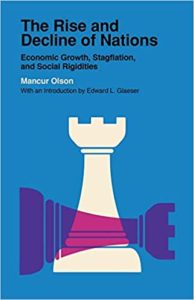
Here is an earlier Alex post on the book.
Should the U.S. have a monarchy?
That is the topic of my latest Bloomberg column, riffing on Curtis Yarvin and others. Here is one bit:
The engineer and entrepreneur Curtis Yarvin, who also has written under the pseudonym Mencius Moldbug, has called for a new American monarchy, more like Elizabeth I than Elizabeth II. The usual instant American reaction, of course, is to dismiss absolute monarchy as unjust, old-fashioned and unworkable. And in fact that remains the correct reaction — yet it’s worth thinking through what the desire for monarchy says about the current state of America’s intellectual right.
And in response:
Many monarchist critics focus on the anti-democratic nature of the proposal. They may not realize how much parts of the New Right see the status quo as promoting a stifling conformity in academia, the media and corporate America (Yarvin’s “Cathedral”), rather than a truly pluralistic discourse.
I see far more intellectual diversity in today’s America than Yarvin does. Still, I wish that the “Cathedral” (am I allowed to call it that too?) would be a little more self-aware of its own limitations rather than just shouting down the anti-democratic thinkers as fascists. It’s also possible to think of absolute monarchy as a desperate way to restore diversity of thought, by creating a post whose holder is not accountable to the Cathedral.
The most telling criticism of absolute monarchy is a historical one. In the UK above all, the so-called “absolute” monarchs faced severe fiscal demands, which they met only by granting increasing powers to Parliament or the local nobles. And that was the case when government was a very small percentage of GDP. How would things work today? Would a king have as much power as, say, Tim Cook does? If the executive branch and legislature were to renegotiate old bargains today, the results might be so messy that each would end up with less power and coherence than what Yarvin sees now.
There are other interesting points at the link.
When should rhetoric be racially salient?
Utilizing a correlational design (N = 498), we found that those who perceived COVID-19 racial disparities to be greater reported reduced fear of COVID-19, which predicted reduced support for COVID-19 safety precautions. In Study 2, we manipulated exposure to information about COVID-19 racial disparities (N = 1,505). Reading about the persistent inequalities that produced COVID-19 racial disparities reduced fear of COVID-19, empathy for those vulnerable to COVID-19, and support for safety precautions. These findings suggest that publicizing racial health disparities has the potential to create a vicious cycle wherein raising awareness reduces support for the very policies that could protect public health and reduce disparities.
Here is more from Skinner-Dorkenoo et.al. Via D. There may be broader lessons as well.