Category: Science
There is no great stagnation (remote-controlled cockroach edition)
Built-in power supply? Check. Ability to survive anything? Check. Easy to control? Okay, anyone who’s had a cockroach as an uninvited houseguest knows that’s not the case. So, rather than re-inventing the biological wheel with a robotic version, North Carolina State university researchers have figured out a way to remotely control a real Madagascar hissing cockroach. They used an off-the-shelf microcontroller to tap in to the roach’s antennae and abdomen, then sent commands that fooled the insect into thinking danger was near, or that an object was blocking it. That let the scientists wirelessly prod the insect into action, then guide it precisely along a curved path, as shown in the video below the break. The addition of a sensor could allow the insects to one day perform tasks, liking searching for trapped disaster victims — something to think about the next time you put a shoe to one.
What’s it like trying to climb the IQ gradient with this device? There are videos at the link, and for the pointer I thank magilson.
The Distribution of Summer Temperatures,1950-2011
Here is an animation from NASA showing the distribution of summer temperatures in the Northern Hemisphere. The initial smooth distribution is based on data from 1950-1980. The video advances in yearly increments showing data for 10 year periods from 1950-1960 through to 2001-2011. As the data advances one can see a pronounced shift in the curve to the right and also, a little less clearly, the curve gets shorter and fatter. Thus, not only are we seeing an increase in the mean temperature but also a greater possibility for extremes in temperature around the increased mean.
The visualization is an extension of ideas from a paper by Hansen et al. which includes additional, global data.
Addendum: Here are graphs using 1930-1980 as the baseline.

The next transformational technology?
Noah Smith writes:
Addendum: I seem to be the only person talking about Desire Modification as a transformational technology. Greg Egan and Vernor Vinge have written books in which this technology plays a central role. In my “spare time” I’m writing a couple of sci-fi short stories based on the idea. It’s a really big deal, and I’ll write a post about it soon.
The path dependence of astronaut walks
…there was a fierce behind-the-scenes battle between them to be first to set foot on the Moon. Early plans were for Aldrin, as module pilot, to step out first, but one version reported by Smith has it that Armstrong, as mission commander, lobbied more vigorously than Aldrin, and Nasa backed him up because he would be ‘better equipped to handle the clamour when he got back’ and, more mundanely, because his seat in the lunar module was closer to the door. Aldrin paid Armstrong back by taking no photographs of him on the Moon: the only manually taken lunar image of the First Man on the Moon is in one of many pictures Armstrong snapped of Aldrin, showing himself reflected in the visor of Aldrin’s spacesuit.
That is from this excellent Steve Shapin article, hat tip goes to @MauraCunningham. I liked this part:
…they were on the same basic pay rates as other US military officers: most were captains, making about $17,000 a year. (On their missions to the Moon, they were entitled only to the standard $8 per diem for being away from base, with deductions for ‘accommodation’ provided in the spaceship.)
The Twelve
Neil Armstrong, first moon walker, died yesterday.
In total, there have been twelve. Armstrong who was first, Peter Conrad who was 3rd, Alan Shepard who was 5th and James Irwin who was 8th, are gone, leaving just eight. Just eight of 7 billion. Alan Shepard was the oldest, he was born in 1923, the others were all born in the 1930s at a time when Orville Wright still lived. The youngest, Charles Duke, will be 77 this year.
Could we soon have an age where all the moon walkers are gone? Will children then wonder whether it happened at all?

From Neil Armstrong
I fully expected that, by the end of the century, we would have achieved substantially more than we actually did.
And this:
I guess we all like to be recognized not for one piece of fireworks, but for the ledger of our daily work.
And finally:
I was elated, ecstatic and extremely surprised that we were successful.
There are more Armstrong quotations here.
The new Thomas Nagel book
The title is *Mind and Cosmos: Why the Materialist Neo-Darwinian Conception of Nature Is Almost Certainly False*. Here is a brief summary of his “teleological” argument. My bottom lines on it:
1. He is good on attacking the hidden hypocrisies of many reductionists, secularists, and those who wish to have it both ways on religious modes of thinking.
2. He fully recognizes the absurdities (my word, not his) of dualism, and thinks them through carefully and honestly. Bryan Caplan should beware.
3. The most typical sentence I found in the book was: “We can continue to hope for a transcendent self-understanding that is neither theistic nor reductionist.”
4. He doesn’t take seriously enough the view: “The Nagel theory of mind is simply wrong.”
5. People will dismiss his arguments to remain in their comfort zone, while temporarily forgetting he is smarter than they are and furthermore that many of their views do not make sense or cohere internally.
6. It is ultimately a book about how Christian many of us still are, and how closely the egocentric illusion is connected to a broadly religious worldview. I don’t think he would see it that way.
For the pointer to the book — now out early on Kindle — I thank David Gordon.
*Science Left Behind*
The authors are Alex Berezow and Hank Campbell, and the subtitle is Feel-Good Fallacies and the Rise of the Anti-Scientific Left. I agree with many of the particular claims in this book, and also I find those undervalued in broader intellectual discourse. Nonetheless I am struck by a mismatch between the book’s message and some of its tone, as well as the sense that one side should be singled out for condemnation (the same point can be made about left-wing books on related topics).
This excerpt made me giggle:
…despite what some progressives will contend, the purpose of this book is not to demonize all progressives. We just want to demonize the loony ones.
Monkeys reject unequal pay
Greg Mankiw points us to this revealing video from Frans de Waal. This is an excerpt from a longer TED video, also excellent.
http://youtu.be/g8mynrRd7Ak?t=30s
Too Central to Fail
A lot of attention has been put on “too big to fail,” the idea that big is risky. What really matters in a complex network system, however, is not bigness per se but connection centrality. In a network the liabilities of institution A become the assets of institution B whose own liabilities become the assets of institution C. An institution with high connection centrality can spread distress throughout a large portion of the network.
Inspired by Google’s PageRank, the authors of a new paper create DebtRank, a measure of connection centrality. The vertical axis in the following diagram shows DebtRank (centrality) the horizontal axis asset shows size relative to the total network and the color indicates fragility/leverage. Institutions such as Wachovia, RBS and Barclays were relatively small but because of their centrality and fragility they imposed big risks on the system.
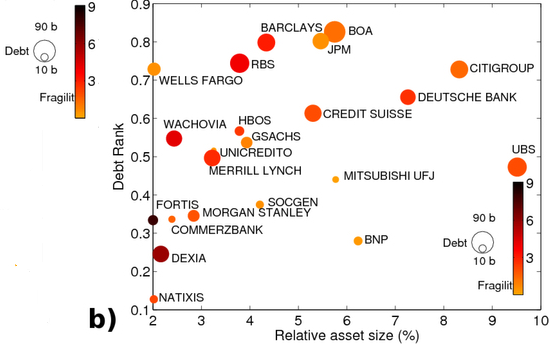
You can find the paper here but do check out the web page of the author group which includes much more material including these animations. Mark Buchanan over at Bloomberg also offers useful comment.
One point to note is that the authors calculated centrality using ex-post data from the Fed. Using this measure, DebtRank clearly signaled danger prior to the crisis and did so earlier than other metrics. In order to do this in real time, however, much more transparent and timely data would be necessary. The fact that centrality doesn’t correlate all that well with bigness, however, indicates that without this data the problem of monitoring risk is even more difficult than it appears.
Increased aggression during human group contests when competitive ability is more similar
From Stulp G, Kordsmeyer T, Buunk AP, Verhulst S.:
Theoretical analyses and empirical studies have revealed that conflict escalation is more likely when individuals are more similar in resource-holding potential (RHP). Conflicts can also occur between groups, but it is unknown whether conflicts also escalate more when groups are more similar in RHP. We tested this hypothesis in humans, using data from two professional sports competitions: football (the Bundesliga, the German first division of football) and basketball (the NBA, the North American National Basketball Association). We defined RHP based on the league ranks of the teams involved in the competition (i.e. their competitive ability) and measured conflict escalation by the number of fouls committed. We found that in both sports the number of fouls committed increased when the difference in RHP was smaller. Thus, we provide what is to our best knowledge the first evidence that, as in conflicts between individuals, conflicts escalate more when groups are more similar in RHP.
The paper is here, hat tip goes to Neuroskeptic. One hypothesis is behavioral. The other hypothesis is more directly microeconomic. Perhaps fouling has positive expected returns within the context of the game, but costs a player long-term reputation, risks long-term retaliation, and so on, and thus the aggression is deployed more in the really important situations.
From the comments
From Tom, a good pick and a good point:
Prolly you’ve all seen it … the most underrated invention — The Pallet. More underrated even than the shipping container, but just about as needed. http://www.slate.com/articles/business/transport/2012/08/pallets_the_single_most_important_object_in_the_global_economy_.html
Old Lady Opposition to Driverless Cars
I think driverless cars will change the design of cities, revolutionize retailing, and greatly change our driving culture, soon for example you will need a license to drive…well, you know what I mean. The scale effects on this technology are tremendous, once it works for one car it works for all. The technology won’t be expensive and it will get better every year. The technology will also get better the more driverless cars their are. Once these cars become common, for example, I expect speed limits for driverless vehicles to be substantially increased.
I do worry about lawsuits in the early years. I am not worried, however, about the following attack on driverless cars which appears to be real although it seems like something from the Onion:
One of the reasons I don’t think this will work is that the technology will be offered first as an option, like cruise control, which will appeal most to the safety conscious. The elderly in danger of losing their license, for example, may appreciate a driverless car. Personally, I would like the driverless option for night driving and I would be much happier lending my teenager the car if I could say “but only if you use the Google option!” At first when there is an accident people will ask, “did he have the driverless option on?” But soon they will start to say “if only he had the driverless option on.”
I do think, however, that technologists should change the name to the electronically chauffeured vehicle. Electronically chauffeured vehicles will appeal to the affluent, the influential and the productive.
The ubiquitous Daniel Lippman gets the hat tip.
What is the most underrated innovation of the last one hundred years?
That was another question I was asked.
I find it difficult to compare the “ratings” of early 20th century innovations to the ratings of innovations today, since it is often different audiences doing the admiring, or lack thereof.
For the most underrated innovations of the last one hundred years I might pick the insights of Alan Turing, various developments in electrical engineering including better transformers, or the nitrogen-fertilizer connection, noting that in some quarters there is already plenty of recognition for each of these, Turing in particular. But still not enough!
As for contemporary innovations, I see an underrated one as Amazon’s warehousing and shipping practices. It will mean the death of much of retail and transform our suburban physical spaces into something quite…????. Into something, in any case. I am a social networking optimist, and think it has largely beneficial effects on social mores, but I also see it as having peaked at a near-saturation point.