Category: Television
What is emblematic of the 21st century?
A recent reader request was:
What things that are around today are most distinctively 21st century? What will be the answer to this question in 10 years?
Here is what comes to mind and I think most of it will remain emblematic for some time:
Technology: iPhone, Wii, iPad, Kindle. These are no-brainers and I do think it will go down in American history as "iPhone," not "iPhone and other smart phones." Sorry people.
To read: blogs and Freakonomics, this is the age of non-fiction. I don't think we have an emblematic and culturally central novel for the last ten years. The Twilight series is a possible pick but I don't think they will last in our collective memory. Harry Potter (the series started 1997) seems to belong too much to the 1990s.
Films: Avatar, Inception (for appropriately negative reviews of the latter, see here, here, and here). Both will look and feel "of this time." Overall there have been too many "spin-off" movies. Keep in mind this question is not about "what is best."
Music: It's been a slow period, but I'll pick Lady Gaga, most of all for reflecting the YouTube era rather than for her music per se. I don't think many musical performers from the last ten years will become canonical, even though the number of "good songs" is quite high. Career lifecycles seem to be getting shorter, for one thing.
Television: The Sopranos starts in 1999, so it comes closer to counting than Harry Potter does. It reflects "the HBO era." Lost was a major network show and at the very least people will laugh at it, maybe admire it too. Battlestar Galactica. Reality TV.

What am I missing? What does this all add up to? Pretty strange, no?
p.s. Need to add Facebook and Google somewhere!
Why do we like adventure stories with guides?
Robin Hanson asks:
I’ve been sick, so watched tv more than usual. Watching Journey to the Center of the Earth, I noticed yet again how folks seem to like adventure stories and games to come with guides. People prefer main characters to follow a trail of clues via a map or book written by someone who has passed before, or at least to follow the advice of a wise old person.
Dante of course provides another example, as does Sibyl and Aeneas. And Robin's conclusion?:
This has a big lesson for those who like to think of their real life as a grand adventure: relative to fiction, real grand adventures tend to have fewer guides, and more randomness in success. Real adventurers must accept huge throws of the dice; even if you do most everything right, most likely some other lucky punk will get most of the praise.
If you want life paths that quickly and reliably reveal your skills, like leveling up in video games, you want artificial worlds like schools, sporting leagues, and corporate fast tracks. You might call such lives adventures, but really they pretty much the opposite. If you insist instead on adventuring for real, achieving things of real and large consequence against great real obstacles, well then learn to see the glorious nobility of those who try well yet fail.
An Option Value Problem from *Seinfeld*
The author is Avinash Dixit, who in this paper addresses the problem of the "spongeworthy," as it was once explained by Elaine. The abstract of the paper reads:
This is a paper about nothing.
For the pointer I thank Brandon Robison.
Where should LeBron James go?
According to what moral theory?
Still, to me the answer is obvious, though no one seems to even discuss my idea. He should go to the Los Angeles Lakers. For a one-year contract, zero pay, if he can't convince the Lakers to pay the luxury tax. Better yet, make zero pay part of the PR in an age where viewers are sick of huge corporate bonuses for non-winning CEOs. This way he would learn the ways of a winning organization, which he needs to do, and very likely win a title immediately. He would convince Phil Jackson to return for another year. Most of his income comes from endorsements anyway, so he doesn't need the salary, plus the title and Los Angeles exposure would make his name more valuable. He would get "credit" for the title (does anyone these days complain that Magic Johnson never won a title without Kareem Abdul-Jabbar? No.) He could play fewer minutes and extend his career and keep his stamina intact for the playoffs. The next year he could move on or he might even decide to stay, pairing with Gasol and Bynum for years, while Kobe slides into a sixth man role. Since he has had good health, he could buy an insurance policy to protect against career-ending injury.
The idea of pairing James with Wade and Bosh seems to me extremely misguided: LeBron, please read Ludwig Lachmann's Capital and its Structure!
Capitalism: Hollywood’s Miscast Villain
In the WSJ online I cover Hollywood and capitalism including Star Wars, Star Trek, Avatar, The Wire and much else. Here are two bits:
Although Hollywood does sometimes produce leftist films like "Reds," it has no deep love for socialism…
But Hollywood does share Marx's concept of alienation, the idea that under capitalism workers are separated from the product of their work and made to feel like cogs in a machine rather than independent creators. The lowly screenwriter is a perfect illustration of what Marx had in mind–a screenwriter can pour heart and soul into a screenplay only to see it rewritten, optioned, revised, reworked, rewritten again and hacked, hacked and hacked by a succession of directors, producers and, worst of all, studio executives. A screenwriter can have a nominally successfully career in Hollywood without ever seeing one of his works brought to the screen. Thus, the antipathy of filmmakers to capitalism is less ideological than it is experiential. Screenwriters and directors find themselves in a daily battle between art and commerce, and they come to see their battle against "the suits" as emblematic of a larger war between creative labor and capital.
On The Wire:
…although it uses character, "The Wire" is ultimately about how character is dominated by larger economic forces: drug dealers come and go, but the drug market is forever. "Capitalism is the ultimate god in The Wire. Capitalism is Zeus," says David Simon, the show's creator.
Over its five seasons, "The Wire" shows how money and markets connect and intertwine white and black, rich and poor, criminal and police in a grand web that none of them truly comprehends–a product of human action but not of human design. It's the invisible hand that's calling the shots, as Mr. Simon subtly reminds us in the conclusion to the third season, when Detective McNulty wondrously pulls a book from the shelf of murdered drug dealer Stringer Bell, and the camera focuses in on the title: "The Wealth of Nations" by Adam Smith.
Smith's metaphor of the invisible hand, like Mr. Simon's invocation of Zeus, tells us that to understand the world we need to look beyond the actions of individuals to see the larger forces at work. But Zeus is an arbitrary and capricious god whose lightning bolts fall out of the sky without reason or direction. Smith's "invisible hand," however, is that of a kinder god, a god that cares not one whit for individuals but nevertheless guides self-interest toward the social good, progress, and economic growth. So Mr. Simon understands that the Baltimore dockworkers lost their jobs because of the relentless change that capitalism brings and not through any fault of their own. But Adam Smith sees what Mr. Simon does not, namely that it was capitalism that brought the Baltimore stevedores their high wages in the first place and it is the relentless change of capitalism that slowly raises wages throughout the world.
More here.
*Lost*: commentary on the final episode
Most of all, it reminded me of Jacob's Ladder and especially Michael Powell's Stairway to Heaven (A Matter of Life and Death), two movies worth rewatching in any case. The final scene, while the credits roll, is simply that of a plane crash with no survivors. I view the show's cosmology as reflecting the existence of all possible universes and we get to see, and live with, a few of them. That includes the universe where they all die in the initial crash, the universe where they all die in the hydrogen bomb explosion, the universe where the hydrogen bomb creates an alternative reality, the universe where there really is a miraculously surviving "Oceanic Six," the universe where the main island narrative happens, the universe where it is all a dream of Jack's, and bits of others as well. This Leibnizian move "explains" the show's numerous unanswered questions, such as those about the lottery numbers and many more. It was possible, so it happened, toss in the anthropic principles as well.
The most striking moment of the final episode was when Locke tells Jack, quite sincerely, that he does not in fact have a son. The question remains how the different universes fit together or interact and in some manner it seems they do. The final episode is extremely effective in bringing out the dreamy and speculative tones of many of the previous episodes.
Most of all I viewed the ending as tragic. It was not mainly about any particular account of the metaphysics of the island. It was about how few couples had the chance to actually live together, love together, and stay together. The perfect reunions of the couples in the "we're all dead" scenario only drove this point home. I found this contrast moving.
At the end, the door is left open for Jack (the body of Jack?) to become the next smoke monster on the island and you can spot some clues to this effect, such as Jack's body being strewn on the stones in the same manner as it was for The Man in Black.
I saw two major weaknesses in the denouement. First, Widmore is dispatched too summarily in the penultimate episode. That thread of the story is not so much hanging (which would have been OK), but rendered irrelevant. Years of dramatic gravitas were swept away in a single, hastily executed murder scene. Second, Ben is a weak and poorly defined character in the final episode and runs around like a puppy dog, with no clear moral stance. Since he usually dominates any scene he is in, this is strikingly incongruous.
Overall I thought it was the best final episode of a series I have seen, with close competition from The Sopranos.
Not From The Onion: PA Big Brother
I thought this was a joke but apparently it's real.
Wham-O
I like this clip from the Daily Show on insourcing- amusing but with some real insights on the (changing) economics of international trade.
| The Daily Show With Jon Stewart | Mon – Thurs 11p / 10c | |||
| Wham-O Moves to America | ||||
|
||||
Extreme Foreclosure
The house at 10512 Baldy Mountain Rd. in Sandpoint, Idaho, looks like just another vacant foreclosed home. Some appliances, a bathroom mirror and even the hot tub are missing. The dining room of the three-bedroom house has water damage.
But this isn't your run-of-the-mill problem house. Call it an Extreme Foreclosure. The 3,678-square-foot McMansion is a product of the popular "Extreme Makeover: Home Edition" reality television show. It isn't the only "Extreme" home to fall on hard times.
From the WSJ.
The iPad
Could this be the medium through which the fabled convergence finally occurs?
Most of all, think of it as a substitute for your TV.
It has the all-important quality of allowing you to bend your head and body as you wish (more or less), as you use it. By bringing it closer or further, you control the "real size" of the iPad, so don't fixate on whether it appears "too big" or "too small."
The pages turn faster than those of Kindle. The other functions are also extremely quick and the battery feels eternal.
So far my main complaint is how it uses "auto-correct" to turn "gmu" into "gum."
While I will bring it on some trips, most of all it feels too valuable to take very far from the house.
On YouTube I watched Chet Atkins, Sonny Rollins, and Angela Hewitt.
Note all the categories on this short post!
Questions that are rarely asked: why so many retired cops?
JIm Crozier, a loyal MR reader, asks:
Why do cop movies and TV shows so often begin with an older (and often jaded) officer that is just about to retire? It is quite astounding how often this unrealistic plot trick is employed, and the psychological grounding seems weak at best.
I don't have the viewing experience to give you an evidence-based response. I would think the answer might lie in marginal utility theory plus behavioral economics. Perhaps all his life that officer has failed to achieve some desired end, such as catching a criminal, bringing an evil politician to justice, reforming the corrupt police force, or whatever. If the officer is near retirement, we know we are watching a very dramatic story which will define the life and career of that officer for ever and ever. It is harder for the viewer to have the same feeling if the officer has four years, three months remaining on the force. Failure would not mean final failure.
On the behavioral front, our impressions of experiences, and the memories we form, very often depend on what comes last. Judges are more impressed by the group which sings last in the Eurovision contest, even though it is randomized. The viewer thus implicitly knows that the cop really cares about the final segment of his or her career, reinforcing the point about decisiveness and marginal utility.
Viewers, can you do better?
The High Cost of Free TV
Despite the fact that 91 percent of American households get their television via cable or satellite huge chunks of radio-spectrum are locked up in the dead technology of over-the-air television. In his Economic View column today Richard Thaler features the work of our GMU colleague Tom Hazlett who argues that auctioning off the spectrum to the high value users would generate at least $100 billion for the government and generate a trillion dollars of value to consumers. Thaler writes:
I KNOW that this proposal sounds too good to be true, but I think the opportunity is real. And unlike some gimmicks from state and local governments, like selling off proceeds from the state lottery to a private company, this doesn’t solve current problems simply by borrowing from future generations. Instead, by allowing scarce resources to be devoted to more productive uses, we can create real value for the economy.
Temple Grandin’s theories on autism
As you probably know, the Temple Grandin biopic, starring Claire Danes, is showing this Saturday evening. Here is Temple on the movie. Grandin has done a great deal to benefit animals, by designing more humane slaughterhouses, stockyards, and encouraging other innovations. She also has promoted the idea of talented autistics and helped raise that notion to a very high profile. I have enormous respect for what she has done and I would gladly see her win a Nobel Prize if the appropriate category for such a prize existed.
That said, researchers disagree with Grandin's theories on autism in a number of ways and my own reading leads me to side with the researchers on some issues. Many non-autistics defer to Grandin on autism because of her life story, her remarkable achievements, and yes because of her autism. I thought it would be useful to offer a more skeptical view of a few of her claims:
1. Autistic individuals do not in general "think in pictures," though some autistics offer this self-description. Grandin repeatedly refers to herself in this context. I don't read her as claiming this tendency is universal or even the general rule, but the disclaimers aren't as evident as I would like them to be.
2. There is little evidence to support her view that autistics "think like animals." Here is one published critique of her theory: "We argue that the extraordinary cognitive feats shown by some animal species can be better understood as adaptive specialisations that bear little, if any, relationship to the unusual skills shown by savants." You'll find a response by Grandin at that same link. I'm not totally on board with the critique either (how well do we understand savants anyway?), but at the very least Grandin's claim is an unsupported hypothesis.
3. Grandin tends to brusquely classify autistic children into different groups. She will speak of "the nerds who will do just fine" (see the eBook linked to below) as opposed to the "severely autistic," who require that someone take control of their lives and pound a bit of the autism out of them. There's a great deal of diversity among autistics, and autistic outcomes, but I don't see that as the most useful way of expressing those differences. Autism diagnoses are often unstable at young ages, there is not any useful or commonly accepted measure of "autistic severity," her description perpetuates stereotypes, and Grandin herself as a child would have met criteria for "severely autistic" and yet she did fine through parental love and attention, which helped her realize rather than overturn her basic nature. That's not even a complete list of my worries on this point; for more see my Create Your Own Economy.
4. Grandin supports some varieties of intensive behavioral therapy for autistics. Many research papers support those same therapies but those papers do not generally conduct an RCT and furthermore many of the said researchers have a commercial stake in what they are studying and promoting. In my view we don't know "what works" but my (non-RCT-tested) opinion is that giving autistic children a lot of fun things to do — fun by their standards — and a lot of information to study and manipulate, gives the best chance of good outcomes. (In any case "spontaneous improvement" is considerable, so anecdotally many therapies will appear to work when they do not; nor is there a common control for placebos.) Many of the behavioral therapies seem quite oppressive to me and if we don't know they work I am worried that they are being overpromoted. Grandin has in some ways the intellectual temperament of an engineer and I am worried that she has not absorbed the lessons of Hayek's The Counterrevolution of Science.
5. Grandin refers to herself as more interested in tangible results and less interested in emotions. She is entitled to that self-description, but it is worth noting that most individuals in the "autism community" would not consider this a good presentation of their attitude toward emotions.
There is a recent eBook (selling for only $4.00), consisting of a dialogue between myself and Grandin, mostly on autism and talented autistics but not just. For instance we also talk about our favorite TV shows, including a discussion of Lost, and there is a segment on science fiction and the future of humanity. I try to draw her out on autism, cognitive anthromorphizing, and attitudes toward religion, but she is reluctant to offer her opinions on that important topic. I would describe the eBook as a good introduction to her thought on autism and society, while also giving an idea of how someone else (me) might differ from some of her basic attitudes.
Time Travel with Doctor Who
When I was a young boy of ten or eleven I lived in a small town in England. I remember eating the black berries on the country lane on my way home from school and I remember my father and I watching Doctor Who. Each week the Doctor would venture into mystery and danger and as the tension rose I would boil with greater and greater excitement until suddenly the Doctor would confront the Cybermen or even worse the Daleks! Just then, of course, the episode would end. Total agony! I could not wait for the week to pass and I was a devil to tuck into bed those nights as I trembled with speculation and trepidation about whether the Doctor would survive.
“My Doctor,” was primarily the fourth, played by Tom Baker. His unique signature was a very long scarf–so enthralled was I that I asked my grandmother to knit me a similar scarf which I then wore everywhere I went… even when I returned to Canada and nobody understood the reference.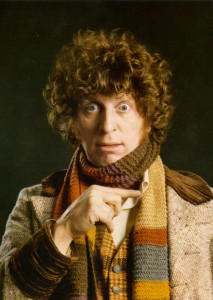
Recently I have been watching Doctor Who again, now with David Tennant playing the tenth doctor–the best since Baker in my view.
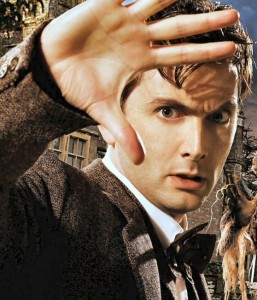 Only now, more than a quarter century past my childhood, I have been watching Doctor Who with my son. My eldest is a young boy of ten or eleven and he boils with greater and greater excitement as the Doctor ventures deeper into mystery and danger. He too jumps out of his chair in total agony when an episode ends with a cliffhanger and calming him after such an episode isn’t easy!
In the last episodes of the latest season the Doctor teams up with his old companion, Sarah Jane. The very same Sarah Jane played by the very same actress as accompanied “my Doctor” some thirty years ago–now aged and older just like me. As I watch Doctor Who with my son, just as I watched with my father, I reflect on time and age and how a dream of my childhood has been fulfilled–my living room darkened and flickering with light has transformed and become my own TARDIS…my own time machine.
Root for the home team
Controlling for location and time fixed effects, weather factors, the pre-game point spread, and the size of the local viewing audience, we find that upset losses by the home team (losses in games that the home team was predicted to win by more than 3 points) lead to an 8 percent increase in police reports of at-home male-on-female intimate partner violence.
Here is the source paper and that is from David Card and Gordon Dahl. In contrast, if you go see a violent movie, for that same length of time you are sequestered and thus less likely to be a danger to others.