Category: The Arts
What should I ask Ada Palmer?
I will be doing a Conversation with her. She is a unique thinker and presence, and thus hard to describe. Here is a brief excerpt from her home page:
I am an historian, an author of science fiction and fantasy, and a composer. I teach in the History Department at the University of Chicago.
Yes, she has tenure. Her four-volume Terra Ignota series is a landmark of science fiction, and she also has a deep knowledge of the Renaissance, Francis Bacon, and the French Enlightenment. She has been an advocate of free speech. Here is her “could be better” Wikipedia page. The imaginary world of her novels is peaceful, prosperous, obsessed with the Enlightenment (centuries from now), suppresses both free speech and gender designations, and perhaps headed for warfare once again?
Here is her excellent blog, which among other things considers issues of historical progress, and also her problems with chronic pain management and disability.
So what should I ask her?
My excellent Conversation with Seth Godin
Here is the audio, video, and transcript from a very good session. Here is part of the episode summary:
Seth joined Tyler to discuss why direct marketing works at all, the marketing success of Trader Joe’s vs Whole Foods, why you can’t reverse engineer Taylor Swift’s success, how Seth would fix baseball, the brilliant marketing in ChatGPT’s design, the most underrated American visual artist, the problem with online education, approaching public talks as a team process, what makes him a good cook, his updated advice for aspiring young authors, how growing up in Buffalo shaped him, what he’ll work on next, and more.
Here is one excerpt:
COWEN: If you were called in as a consultant to professional baseball, what would you tell them to do to keep the game alive?
GODIN: [laughs] I am so glad I never was a consultant.
What is baseball? In most of the world, no one wants to watch one minute of baseball. Why do we want to watch baseball? Why do the songs and the Cracker Jack and the sounds matter to some people and not to others? The answer is that professional sports in any country that are beloved, are beloved because they remind us of our parents. They remind us of a different time in our lives. They are comfortable but also challenging. They let us exchange status roles in a safe way without extraordinary division.
Baseball was that for a very long time, but then things changed. One of the things that changed is that football was built for television and baseball is not. By leaning into television, which completely terraformed American society for 40 years, football advanced in a lot of ways.
Baseball is in a jam because, on one hand, like Coke and New Coke, you need to remind people of the old days. On the other hand, people have too many choices now.
And another:
COWEN: What is the detail you have become most increasingly pessimistic about?
GODIN: I think that our ability to rationalize our lazy, convenient, selfish, immoral, bad behavior is unbounded, and people will find a reason to justify the thing that they used to do because that’s how we evolved. One would hope that in the face of a real challenge or actual useful data, people would say, “Oh, I was wrong. I just changed my mind.” It’s really hard to do that.
There was a piece in The Times just the other day about the bibs that long-distance runners wear at races. There is no reason left for them to wear bibs. It’s not a big issue. Everyone should say, “Oh, yeah, great, done.” But the bib defenders coming out of the woodwork, explaining, each in their own way, why we need bibs for people who are running in races — that’s just a microcosm of the human problem, which is, culture sticks around because it’s good at sticking around. But sometimes we need to change the culture, and we should wake up and say, “This is a good day to change the culture.”
COWEN: So, we’re all bib defenders in our own special ways.
GODIN: Correct! Well said. Bib Defenders. That’s the name of the next book. Love that.
COWEN: What is, for you, the bib?
GODIN: I think that I have probably held onto this 62-year-old’s perception of content and books and thoughtful output longer than the culture wants to embrace, the same way lots of artists have held onto the album as opposed to the single. But my goal isn’t to be more popular, and so I’m really comfortable with the repercussions of what I’ve held onto.
Recommended, interesting throughout. And here is Seth’s new book The Song of Significance: A New Manifesto for Teams.
My Conversation with Anna Keay
A very good episode, here is the audio, video, and transcript. Here is part of the episode summary:
Tyler sat down with Anna to discuss the most plausible scenario where England could’ve remained a republic in the 17th century, what Robert Boyle learned from Sir William Petty, why some monarchs build palaces and other don’t, how renting from the Landmark Trust compares to Airbnb, how her job changes her views on wealth taxes, why neighborhood architecture has declined, how she’d handle the UK’s housing shortage, why giving back the Koh-i-Noor would cause more problems than it solves, why British houses have so little storage, the hardest part about living in an 800-year-old house, her favorite John Fowles book, why we should do more to preserve the Scottish Enlightenment, and more.
And here is one excerpt:
COWEN: Which are the old buildings that we have too many of in Britain? There’s a lot of Christopher Wren churches. I think there’s over 20.
KEAY: Too many?
COWEN: What if they were 15? They’re not all fantastic.
KEAY: They’re not all fantastic? Tell me one that isn’t fantastic.
COWEN: The Victorians knocked down St. Mildred. I’ve seen pictures of it. I don’t miss it.
KEAY: Well, you don’t miss something that’s not there. I think it’d be pretty hard to convince me that any Christopher Wren church wasn’t worth hanging on to. But your point is right, which is to say that not everything that was ever built is worth retaining. There are things which are clearly of much less interest or were poorly built, which are not serving a purpose anymore in a way that they need to. To me, it’s all about assessing what matters, what we care about.
It’s incredibly important to remember how you have to try and take the long view because if you let things go, you cannot later retrieve them. We look at the decisions that were made in the past about things that we really care about that were demolished — wonderful country houses, we’ve mentioned. It’s fantastic, for example, Euston Station, one of the great stations of the world, built in the middle of the 19th century, demolished in the ’60s, regretted forever since.
So, one of the things you have to be really careful about is to make a distinction between the fashion of the moment and things which we are going to regret, or our children or our grandchildren are going to curse us for having not valued or not thought about, not considered.
Which is why, in this country, we have this thing called the listing system, where there’s a process of identifying buildings which are important, and what’s called listing them — putting them on a list — which means that if you own them, you can’t change them without getting permission, which is a way of ensuring that things which you as an owner or I as an owner might not treat with scorn, that the interest of generations to come are represented in that.
COWEN: Why were so many big mistakes made in the middle part of the 20th century? St. Pancras almost was knocked down, as I’m sure you know. That would have been a huge blunder. There was something about that time that people seem to have become more interested in ugliness. Or what’s your theory? How do you explain the insanity that took all of Britain for, what, 30 years?
KEAY: Well, I think this is such a good question because this is, to me, what the study of history is all about, which is, you have to think about what it was like for that generation. You have to think of what it was like for people in the 1950s and ’60s, who had experienced, either firsthand or very close at hand, not just one but two catastrophic world wars in which numbers had been killed, places had been destroyed. The whole human cost of that time was so colossal, and the idea for that generation that something really fundamental had to change if we were going to be a society that wasn’t going to be killing one another at all time.
This has a real sort of mirror in the 17th century, during the Civil War in the 17th century. There’s a real feeling that something had to be done. Otherwise, God was going to strike down this nation, this errant nation. I think for that generation in the ’50s and ’60s, the sense that we simply have to do things differently because this pattern of life, this pattern of existence, this way we’ve operated as a society has been so destructive.
Although lots of things were done — when it comes to urban planning and so on — that we really regret now, I think you have to be really careful not to diminish the seriousness of intent of those people who were trying to conceive of what that world might be — more egalitarian, more democratic, involving more space, more air, more light, healthier — all these kinds of things.
Definitely recommended, with numerous interesting parts. And I am very happy to recommend Anna’s latest book The Restless Republic: Britain Without a Crown.
My excellent Conversation with Jessica Wade
Here is the audio, video, and transcript. Here is part of the summary:
She joined Tyler to discuss if there are any useful gender stereotypes in science, distinguishing between productive and unproductive ways to encourage women in science, whether science Twitter is biased toward men, how AI will affect gender participation gaps, how Wikipedia should be improved, how she judges the effectiveness of her Wikipedia articles, how she’d improve science funding, her work on chiral materials and its near-term applications, whether writing a kid’s science book should be rewarded in academia, what she learned spending a year studying art in Florence, what she’ll do next, and more.
Here is the opening bit:
COWEN: Let’s start with women in science. We will get to your research, but your writings — why is it that women in history were so successful in astronomy so early on, compared to other fields?
WADE: Oh, that’s such a hard question [laughs] and a fascinating one. When you look back at who was allowed to be a scientist in the past, at which type of woman was allowed to be a scientist, you were probably quite wealthy, and you either had a husband who was a scientist or a father who was a scientist. And you were probably allowed to interact with science at home, potentially in things like polishing the lenses that you might use on a telescope, or something like that.
Caroline Herschel was quite big on polishing the lenses that Herschel used to go out and look at and identify comets, and was so successful in identifying these comets that she wanted to publish herself and really struggled, as a woman, to be allowed to do that at the end of the 1800s, beginning of the 1900s. I think, actually, it was just that possibility to be able to access and do that science from home, to be able to set up in your beautiful dark-sky environment without the bright lights of a city and do it alongside your quite successful husband or father.
After astronomy, women got quite big in crystallography. There were a few absolutely incredible women crystallographers throughout the 1900s. Dorothy Hodgkin, Kathleen Lonsdale, Rosalind Franklin — people who really made that science possible. That was because they were provided entry into that, and the way that they were taught at school facilitated doing that kind of research. I find it fascinating they were allowed, but if only we’d had more, you could imagine what could have happened.
COWEN: So, household production you think is the key variable, plus the ability to be helped or trained by a father or husband?
The discussion of chirality and her science work is very interesting, though hard to summarize. I very much like this part, when I asked her about her most successful unusual work habit:
But just writing the [Wikipedia] biography of the person I was going to work with meant that I was really prepped for going. And if I’m about to see someone speak, writing their biography before means I get this. That’s definitely my best work habit — write the Wikipedia page of what it is that you are working on.
I don’t agree with her on the environment/genes issue, but overall a very good CWT, with multiple distinct parts.
How to visit Italy
Ajit requests such a post, and I note that plenty of people have plenty of experience with this topic. So I’ll offer a few observations at the margin:
1. Venice, Florence, and Rome have, on average, the worst food in Italy. They have some wonderful places, but possibly hard to get into, requiring advance planning, and often expensive. For random meals, those cities are not impressive, noting that Rome, due to its size, is much better than Venice or Florence.
2. My favorite “single sights” in Italy, moving beyond the core sights of Rome, Venice and Florence, are the Giotto chapel in Padua, the Basilica in Ravenna, and the Cathedral in Monreale in Sicily (near Palermo). To this day, they remain underrated sights. As for the major cities, both Genoa and Torino are underrated.
3. My favorite food in Italy would be in Sicily, Naples, and the lower-tier towns of the North, such as Bologna and Parma. The area near Torino/Piedmont would be another contender. I have heard Veneto is wonderful for food, though have only had a single meal there, which was indeed outstanding. In Sicily, don’t order the usual Italian dishes (which are available and excellent), rather look for regional offerings which reflect the area’s Arabic heritage. Orange slice and mint — bring it on!
4. Usually there is little gain from pursuing Michelin-starred restaurants in Italy. You want the “two-forker” places with outstanding regional cuisine. Originality, which is rewarded by the Michelin system, too often is a negative in Italian food.
5. Italy has a large number of third-tier towns which are wonderful for walking through. But you don’t need to overnight in them, so there is much to be said for randomly driving around Italy, but avoiding the larger cities. Stop, walk for a few hours, take a meal, and then move on.
6. There is a great deal of available trip prep material for Italy in the form of movies, fiction, and history. Most of all, however, you should focus on using picture books to have an advance sense of the art and architecture. The classic book on Italy, Luigi Barzini’s The Italians, is still worth reading. And often the postwar fiction, or even Manzoni, are better trip prep than the very famous classics such as Dante and Petrarch (though you should read them anyway, but for other reasons).
What else?
Alex Murrell, The Age of Average
One of the best essays of this year, though I think the author considerably underrates how much heterogeneity we are building on the internet, globally, and also through GPT models. Nonetheless an excellent read with some hard-hitting points and good photos to illustrate. Here is one excerpt:
This article argues that from film to fashion and architecture to advertising, creative fields have become dominated and defined by convention and cliché. Distinctiveness has died. In every field we look at, we find that everything looks the same.
Welcome to the age of average.
Here is a photo of some (supposedly different) current cars:

You can read the whole thing here. Note that in my model, the homogenizations we do observe spring precisely from the greater diversity on the fringes of the distribution. People at the edges can get exactly what they want, so the fight over the mainstream middle becomes all the more mainstream, as it is targeting the true conformists in that particular area.
New Emergent Ventures winners, 25th cohort
Duncan McClements, 17, incoming at King’s College Cambridge, economics, general career and research support.
Jasmine Wang and team (Jasmine is a repeat winner), Trellis, AI and the book.
Sophia Brown, Berlin/Brooklyn, to study the State Department,and general career development.
Robert Tolan, western Ireland, farmer and math Olympiad winner, YIMBY by street for Ireland.
Conor Durkin, Chicago, to write a Chicago city Substack.
Guido Putignano, Milan/Zurich, to do a summer internship in computation bio for cell therapies, at Harvard/MIT.
Michelle K. Huang, to revitalize Japanese real estate and to enable a creative community in Japan, near Kyoto.
Rasheed Griffith, repeat winner, to found a Caribbean think tank.
The Fitzwilliam, a periodical of ideas, Ireland. To expand and built it out, Fergus McCullough and Sam Enright, both repeat winners.
Lyn Stoler, Los Angeles, general career development and to develop material for a new pro-growth, pro-green agenda for states and localities.
Gwen Lester, Chicago, to develop a center for abused, battered, and sexually abused women, namely GLC Empowerment Center, also known as Nana’s House.
Sabrina Singh, Ontario, pre-college, to help her study of neurotechnology.
And Emergent Ventures Ukraine:
Isa Hasenko, eastern Ukraine, medical care for eastern Ukraine, performed by a system of digital information, using a real-time tracking system, to trace every allocation. He works with Fintable.io and MissionKharkiv.com.
Stephan Hosedlo, Lviv, to expand his company selling farm products and herbal products, and to buy a tractor.
Olesya Drashkaba, Kyiv, Sunseed Art, a company to market Ukrainian art posters around the world.
Peter Chernyshov, Edinburgh, mathematician, to run math education project — Kontora Pi — to teach advanced math for talented kids and school teachers in Ukraine. To produce more math videos and to recruit more teachers around Ukraine.
Andrew Solovei, western Ukraine, to build out a network to compensate small scale Ukrainian volunteers in a scalable and verifiable manner.
Olena Skyrta, Kyiv, to start a for-profit that will tie new scientific innovations to Ukrainian and other businesses.
Yevheniia Vidishcheva, Kyiv, theatrical project to travel around Ukraine.
Alina Beskrovna, Mariupol and Harvard Kennedy School, general career support and to work on the economic reconstruction of Ukraine.
One path for science fiction submissions? (from my email)
Thought you mind find this interesting:http://neil-clarke.com/a-concerning-trend/
The online sci-fi magazine Clarkesworld has seen a steep increase in submissions, driven by stories created using ChatGPT and similar systems. I didn’t see precise numbers in the post but they have a graph that makes it look like fewer than 20 submissions per month for every month October 2022 and prior and then:December: 50
January: ~115
February so far: nearly 350
That is from Kevin Postlewaite. I suspect that fashion magazines do not (yet?) have this problem to the same degree.
My excellent Conversation with Katherine Rundell
One of my favorite CWTs, here is the audio, video, and transcript. Here is part of the summary:
She joined Tyler to discuss how she became obsessed with John Donne, the power of memorizing poetry, the political implications of suicide in the 17th century, the new evidence of Donne’s faith, the contagious intensity of thought in 17th century British life, the effect of the plague on national consciousness, the brutality of boys’ schooling, the thrills and dangers of rooftop walking, why children should be more mischievous, why she’d like to lower the voting age to 16, her favorite UK bookshop, the wonderful weirdness of Diana Wynne Jones, why she has at least one joke about Belgium in every book, what T.S. Eliot missed about John Donne, what it’s like to eat tarantula, the Kafka book she gives to toddlers, why The Book of Common Prayer is underrated, and more.
Here is one excerpt:
COWEN: Now, you have two books, Rooftoppers and Skysteppers, about rooftop walking. Some might call them children’s books. I’m not sure that’s exactly the right description, but what is the greatest danger with rooftop walking?
RUNDELL: Oh, it’s falling off.
COWEN: What leads you to fall off? If you’re rooftop walking, if you were to fall off, what would be the proximate cause of that event?
RUNDELL: Philippe Petit, who is, of course, one of the great roof walkers of the world and the man who strung the wire between the Twin Towers in 1977, talks about vertigo as a beast that has to be tamed piece by piece, that can never be overcome all at once.
Vertigo, he says, is not the fear that you will fall. It is the fear that you will jump. That, of course, is the thing that, when you are roof walking, you are taming. You are trying to unmoor your sense of danger and of not being able to trust yourself not to jump from your sense of beauty and the vision of a city that you get up high.
I roof-walk for very practical reasons: to see views that would otherwise be not really available to me in an increasingly privatized City of London.
And:
COWEN: For you, what is most interesting in Donne’s sermons?
RUNDELL: The thing I find most interesting would be the radical honesty that he has — that you will find in so few other sermons of the time — about the difficulty of finding God. He is a man who writes often with certainty about the idea of reaching the infinite, the divine. But he also writes this famous passage where he says, “I summon God and my angels, and when God and the angels are there, I neglect them for . . .” I forget what it is. “The sound of a carriage, a straw under my knee, a thought, a chimera, and nothing and everything.”
That sense that, even though he had a brain that could control incredibly rigorous poetry, he did not have a brain that would control itself in prayer. He offered that to his congregation as a vulnerability and a piece of honesty that so few sermoners of the time — who thought of themselves more as a regulatory ideal that should never admit vulnerability — would offer.
Definitely recommended. And Katherine’s recent book Super-Infinite: The Transformations of John Donne was perhaps my favorite book of last year.
What is an optimum degree of LLM hallucination?
Ideally you could adjust a dial and and set the degree of hallucination in advance. For fact-checking you would choose zero hallucination, for poetry composition, life advice, and inspiration you might want more hallucination, to varying degrees of course. After all, you don’t choose friends with zero hallucination, do you? And you do read fiction, don’t you?
(Do note that you can ask the current version for references and follow-up — GPT is hardly as epistemically crippled as some people allege.)
In the meantime, I do not want an LLM with less hallucination. The hallucinations are part of what I learn from. I learn what the world would look like, if it were most in tune with the statistical model provided by text. That to me is intrinsically interesting. Does the matrix algebra version of the world not interest you as well?
The hallucinations also give me ideas and show me alternative pathways. “What if…?” They are a form of creativity. Many of these hallucinations are simple factual errors, but many others have embedded in them alternative models of the world. Interesting models of the world. Ideas and inspirations. I feel I know what question to ask or which task to initiate.
Oddly enough, for many queries what ChatGPT most resembles is…don’t laugh — blog comments. Every time I pose a query it is like putting a blog post out there, or a bleg, and getting a splat of responses right away, and without having to clog up MR with all of my dozens of wonderings every day. Many of those blog comment responses are hallucinations. But I learn from the responses collectively, and furthermore some of them are very good and also very accurate. I follow up on them on my own, as it should be.
LLMs are like giving everyone their own comments-open blog, with hallucinating super-infovores as the readers and immediate response and follow-up when desired. Obviously, the people with some background in that sector, if I may put it that way, will be better at using ChatGPT than others.
(Not everyone is good at riding a horse either.)
Playing around with GPT has in fact caused me to upgrade significantly my opinion of MR blog comments — construed collectively — relative to other forms of writing.
Please do keep in mind my very special position. The above may not apply to you. I have an RA to fact-check my books, and this process is excellent and scrupulous. Varied and very smart eyes look over my Bloomberg submissions. MR readers themselves fact-check my MR posts, and so on. Having blogged for more than twenty years, I am good at using Google and other methods of investigating reality. At the margin, pre-LLM, I already was awash in fact-checking. If GPT doesn’t provide me with that, I can cope.
And I don’t take psychedelics. R-squared is never equal to one anyway, not in the actual world. And yet models are useful. Models too are hallucinations.
So if GPT is doing some hallucinating while at work, I say bring it on.
What to Watch: Holiday Edition 2022
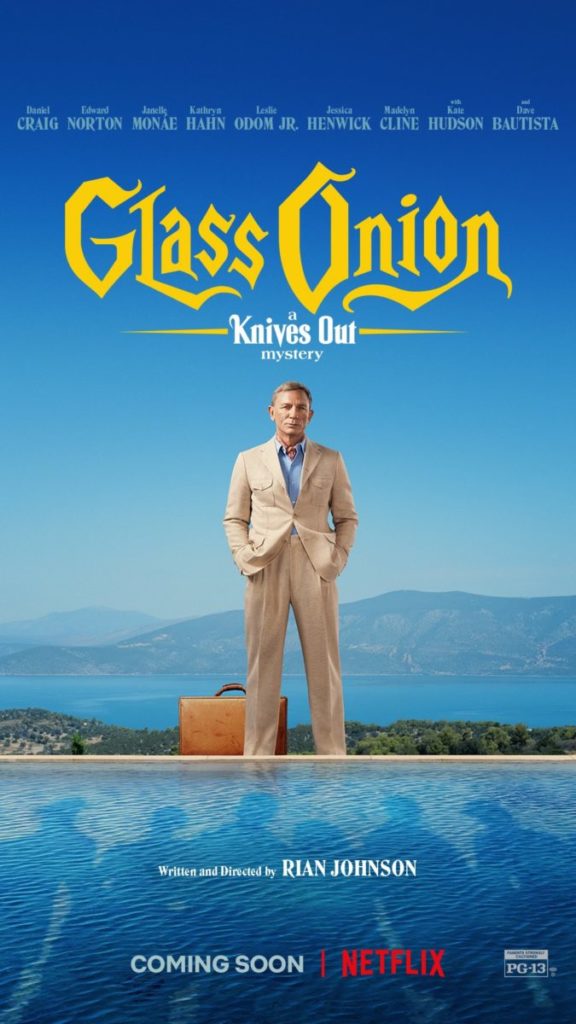 Glass Onion is a con job. It temporarily fools the viewer into thinking it original and clever and yet it is actually derivative and dumb. The ending left me bitter. It should be noted, however, that it is artfully constructed and the authors knew what they were doing. Benoit Blanc, the detective, stands in for the audience and comes to the same conclusion, “it’s all so obvious and also so stupid.” The name also gives a clue—it appears to be multi-layered but it’s glass so you can just look and see what is going on.
The Fabelmans—a paean to movie making and a close biography of Spielberg. He waited till his parents had died to make this movie. Yes, his mother actually brought home a monkey as a pet. The parents, the arty, flighty wife and the analytical, scientific husband couldn’t make it together but produced Spielberg who can and does—the opening scene with Spielberg watching his first movie between his parents says it all.
Avatar 2 I saw it in IMAX 3D. As spectacle it was great, especially the quieter water scenes. As movie it was good but broke no new ground. Indeed, Avatar 2 was exactly the same as Avatar only with more water. If you can’t see it in 3D or at least on a giant screen don’t bother.
The Recruit (Netflix): A fun CIA series which is ridiculous but rises a bit above the genre with some insight into the functions of a bureaucracy which kills people but attempts to do so legally.
 Acapulco (Apple TV). On the surface it’s a situation comedy about Maximo, a young Mexican man who sees opportunity in Los Colinas, the local resort run by a coterie of oddball characters, including the aging ex-starlet owner, Diane, who is fast approaching Norma Desmond territory. The situation is narrated by an older Maximo who has become rich and fabulously successful. At first the narration seems to be a mere device, but, over time, we begin to see that the writers are aiming at something bigger. How did Maximo become so rich? What lessons about life and business did he learn at Las Colinas? The second, hidden story line gives deeper meaning to the events of the first. Season one of Acapulco is almost entirely about Las Colinas. Only in season two do the two stories begin to converge. Can the writers pull off a denouement that brings everything together? I don’t know but the purposeful pacing and the fact that the writers aren’t showing all their cards makes me think we are seeing more than we first imagine. The opposite of Glass Onion in many ways.
*The Harvest Moon*
My Conversation with Ken Burns
Here is the transcript, audio, and video. Here is part of the episode summary:
Ken joined Tyler to discuss how facial expressions in photos have changed over time, where in the American past he’d like to visit most, the courage of staying in place, how he feels about intellectual property law, the ethical considerations of displaying violent imagery, why women were so prominent in the early history of American photography, the mysteries in his quilt collection, the most underrated American painter, why crossword puzzles are akin to a cup of coffee, why baseball won’t die out, the future of documentary-making, and more.
And an excerpt:
COWEN: Why are women so prominent in the early history of American photography — compared, say, to painting or sculpture?
BURNS: It’s interesting, I think, because at the beginning we’re recording ourselves, our families. The first one is a self-portrait. (Of course, being an American it would be a self-portrait.) But families are involved.
There’s so many ways in which we transcend — the Declaration of Independence did not apply to any women. It’s 144 years after the Declaration that women get the right to vote: basic thing. When the Declaration and the Constitution were there, they had no rights. But they were part of the landscape.
They are a majority of the population, and have been. What you have is the beginning of photographs being a much more democratic and accessible medium, that is going to be populated by the people who actually exist. I think it’s that that’s helpful to break down.
As you see in this book, there are lots of images of women from the earliest time involved in things like abolition, involved in things like slavery unions, involved in things like women’s suffrage, involved in just playing, having a good time on the beach in Massachusetts in your bloomer swimming suits dancing, or three gals stealing a cigarette in the early part of the 19th century.
This film is about darkness and light, about black and white — both in the photographic process but in the American dynamic: there are many Native Americans, there’s lots of landscapes of the beauty of the country. There’s lots of horrible signs of discrimination and war and death and suffering and grief.
And that’s us. That’s the story of us. I’ve been trying to tell that complicated history with my films, and this was an opportunity to stop and allow the viewer this time to be the director. That is to say, in most performance art, as film is, I set the time that you get to look at that photograph and you see what you’re able to see in that. If you want to spend an hour with one photograph in this book, you’re welcome to.
If you want to go through this over-amount of time, these photographs, and then hold your thumb in the back matter and go back and forth between the full page of the photograph, that might say “Gettysburg, 1863,” and then the description of people reading the list of the dead outside a newspaper in New York City just after the Battle of Gettysburg in July of ’63 — you can learn a lot more about the photograph, but in a different way. I first wanted the photographs to speak for themselves, un- . . . diminished — I guess, is the word — by words.
There is much more at the link. And I liked Ken’s new book Our America: A Photographic History.
My excellent Conversation with Mary Gaitskill
Here is the audio and transcript. She is one of my favorite contemporary American writers, most notably in The Mare, Veronica, and Lost Cat. Here is part of the episode summary:
She joined Tyler to discuss the reasons some people seem to choose to be unhappy, why she writes about oddballs, the fragility of personality, how she’s developed her natural knack for describing the physical world, why we’re better off just accepting that people are horrible, her advice for troubled teenagers, why she wouldn’t clone a lost cat, the benefits and drawbacks of writing online, what she’s learned from writing a Substack, what gets lost in Kubrick’s adaptation of Lolita, the not-so-subtle eroticism of Victorian novels, the ground rules for writing about other people, how creative writing programs are harming (some) writers, what she learned about men when working as a stripper, how her views of sexual permissiveness have changed since the ’90s, how college students have changed over time, what she learned working at The Strand bookstore, and more.
It is perhaps a difficult conversation to excerpt from but here is one bit:
COWEN: You once quoted your therapist as saying, and I’m quoting him here, “People are just horrible, and the sooner you realize that, the happier you’re going to be.” What’s your view?
GAITSKILL: [laughs] I thought that was a wonderful remark. It’s important to note the tone of voice that he used. He was a Southern queer gentleman with a very lilting, soft voice. I was complaining about something or other, and he goes, “People are horrible. They’re stupid, and they’re crazy, and they’re mean, and the sooner you realize that, the better off you’ll be, the more you’re going to start enjoying life.”
I just laughed, because partly it was obvious he was being funny, and it was a very gentle way of allowing my ranting and raving and acknowledging the truth of it. Gee, I don’t know how anybody could deny that. Look at human history and some of the things that people do. It was being very spacious about it and just saying, “Look, you have to accept reality. You can’t expect people to be perfect or to be your idea of good or moral all the time. You’re probably not either. This is what it is.”
I thought that was really wisdom, actually.
I am very pleased to have had the chance to chat with her.
Rubell Museum, Washington, D.C., review
I give it an A+/A. DC now has a new museum, taken from one family collection, namely the Rubells, who already opened a large and excellent private museum in Miami. If you know that place, this one will not surprise you.
The DC branch is in Southwest, in a former junior high school with a nice brick look (supposedly Marvin Gaye’s junior high), and it has 25 or so galleries. All but one or two of those work extremely well. More than half of the art on current exhibit is American “black art,” typically of recent vintage and on average with a representational and sometimes expressionistic bent. Some of it might count as “Woke,” but it is all there because of its quality, not its politics.
Kara Walker, Glenn Ligon, Cecily Brown, Carrie Mae Weems, Purvis Young, and Keith Haring would be some of the better-known artists represented in the current display. But the Rubells own thousands of works, so change is to be expected.

Some of the smaller rooms come across as cramped, but overall the curatorial impulse is nearly perfect. The right paintings are hung next to the right paintings, and each room has its own identity. Most of all, this is an excellent museum for appreciating the consistency of their taste and the consistency of their eye. The entire time you are aware that you are observing a collection.
SW will never be the same again, and it is not so far from The Wharf and Gordon Ramsey Fish n’ Chips. Admission is free for DC residents, $15 for others.
Addendum: Here is decent NYT coverage, with some photos, so far there are oddly few substantive reviews. However Garett Jones in his wisdom likes it too, don’t forget he has a new book coming out in two weeks.