Category: Travel
Pristina, Kosovo bleg
Violence permitting, I will be there soon. So what should I see and what should I do? I thank you all in advance for your wise counsel.
Sri Lanka information bleg
I am well aware of the power blackouts and food problems of recent times. But how is it being in the country right now? How inconvenient is it to be there? What are the biggest practical problems for a tourist on a daily basis? I thank you all for the information.
My Conversation with the excellent Kevin Kelly
Here is the audio, video, and transcript. Here is part of the summary:
…Kevin and Tyler start this conversation on advice: what kinds of advice Kevin was afraid to give, his worst advice, how to get better at following advice, and whether people who ask for advice really want it in the first place. Then they move on to the best places to see traditional cultures in Asia, the one thing in Kevin’s travel kit he can’t be without, his favorite part of India, why he’s so excited about brain-computer interfaces, how AI will change religion, what the Amish can teach us about tech adoption, the most underrated documentary, his initial entry point into tech, why he’s impressed by the way Jeff Bezos handles power, the last thing he’s changed his mind about, how growing up in Westfield, New Jersey affected him, his next project called the Hundred Year Desirable Future, and more.
Here is one excerpt:
COWEN: Do you ever feel that if you don’t photograph a place, you haven’t really been there? Does it hold a different status? Like you haven’t organized the information; it’s just out on Pluto somewhere?
KELLY: Yes, I did. When I was younger, I had a religious conversion and I decided to ride my bicycle across the US. And part of that problem — part of the thing was that I was on my way to die, and I decided to leave my camera behind for this magnificent journey of a bicycle crossing the US. It was the most difficult thing I ever did, because I was just imagining all the magnificent pictures that I could take, that I wasn’t going to take. I took a sketchbook instead, and that appeased some of my desire to capture things visually.
But you’re absolutely right. It was a little bit of an addiction, where the framing of a photograph was how I saw the world. Still images: I was basically, in my head, clicking — I was clicking the shutter at the right moments when something would happen. That, I think, was not necessarily healthy — to be so dependent on that framing to enjoy the world.
I’ve learned to wean myself off from that necessity. Now I can travel with just a phone for the selfies that you might want to take.
COWEN: Maybe the earlier habit was better.
Recommended. And here is Kevin’s new book Excellent Advice: Wisdom I Wish I’d Known Earlier.
“Almost space” markets in everything
The space race just got a new entrant. France’s Zephalto is offering passengers the chance to travel to the stratosphere in a balloon, starting at €120,000 ($132,000) per person in 2025.
“I partnered with the French space agency, and we worked on the concept of the balloon together,” says Zephalto founder and aerospace engineer Vincent Farret d’Astiès.
He tells Bloomberg that he’s planning on 60 flights a year, with just six passengers on board each flight. The company aims to provide an experience that brings the best bits of French hospitality—fine food, wine and design—to the edges of space for those who can afford the six-figure ticket.
Balloons filled with helium or hydrogen will depart from France with two pilots on board and rise 25 kilometers (15.5 miles) into the stratosphere for 1 1/2 hours. Once at peak altitude, which is about three times higher than for a commercial airliner, the balloon will stay for three hours, giving guests a chance to take in views previously seen only by astronauts. The descent will take a further hour and a half, for a six-hour round trip.
Here is more from Sarah Rappaport at Bloomberg. Via Daniel Lippman.
Seattle bleg
Your thoughts and suggestions are most welcome, thank you!
How to visit Italy
Ajit requests such a post, and I note that plenty of people have plenty of experience with this topic. So I’ll offer a few observations at the margin:
1. Venice, Florence, and Rome have, on average, the worst food in Italy. They have some wonderful places, but possibly hard to get into, requiring advance planning, and often expensive. For random meals, those cities are not impressive, noting that Rome, due to its size, is much better than Venice or Florence.
2. My favorite “single sights” in Italy, moving beyond the core sights of Rome, Venice and Florence, are the Giotto chapel in Padua, the Basilica in Ravenna, and the Cathedral in Monreale in Sicily (near Palermo). To this day, they remain underrated sights. As for the major cities, both Genoa and Torino are underrated.
3. My favorite food in Italy would be in Sicily, Naples, and the lower-tier towns of the North, such as Bologna and Parma. The area near Torino/Piedmont would be another contender. I have heard Veneto is wonderful for food, though have only had a single meal there, which was indeed outstanding. In Sicily, don’t order the usual Italian dishes (which are available and excellent), rather look for regional offerings which reflect the area’s Arabic heritage. Orange slice and mint — bring it on!
4. Usually there is little gain from pursuing Michelin-starred restaurants in Italy. You want the “two-forker” places with outstanding regional cuisine. Originality, which is rewarded by the Michelin system, too often is a negative in Italian food.
5. Italy has a large number of third-tier towns which are wonderful for walking through. But you don’t need to overnight in them, so there is much to be said for randomly driving around Italy, but avoiding the larger cities. Stop, walk for a few hours, take a meal, and then move on.
6. There is a great deal of available trip prep material for Italy in the form of movies, fiction, and history. Most of all, however, you should focus on using picture books to have an advance sense of the art and architecture. The classic book on Italy, Luigi Barzini’s The Italians, is still worth reading. And often the postwar fiction, or even Manzoni, are better trip prep than the very famous classics such as Dante and Petrarch (though you should read them anyway, but for other reasons).
What else?
What should I ask Kevin Kelly?
From Wikipedia:
Kevin Kelly (born 1952) is the founding executive editor of Wired magazine, and a former editor/publisher of the Whole Earth Review. He has also been a writer, photographer, conservationist, and student of Asian and digital culture…
Among Kelly’s personal involvements is a campaign to make a full inventory of all living species on earth, an effort also known as the Linnaean enterprise. He is also sequencing his genome and co-organizes the Bay Area Quantified Self Meetup Group.
His Out of Control is a wonderful Hayekian book. His three-volume Vanishing Asia is one of the greatest picture books of all time. His new book (I haven’t read it yet) is Excellent Advice for Living: Wisdom I Wish I’d Known Earlier. Here is Kevin on Twitter, here is his home page.
I will be doing a Conversation with him, so what should I ask?
Travel philosophies for the well-traveled
How should you choose your next trip? I can see a few general philosophies on the table:
1. Prioritize those countries and regions you haven’t visited yet. For me that might mean Montenegro, Lithuania, Bangladesh, and Saudi Arabia. But the downside is waking up one morning and saying “Hey, what the hell am I doing in Sardinia!?”
2. Get to know some of your favorite places truly in depth, most of all major cities that are easy to reach and often are connected to free or paid invitations. For me that would imply more trips to London, Paris, Tokyo, Berlin — you get the picture. Under this view, the returns to variety are diminishing. And have I ever regretted stopping in on those places?
3. Try to visit “events,” especially temporary events. Right after the Berlin Wall came down, I did a big car trip around Eastern Europe. Loved it. Perhaps these days I should be stopping in at Neom, flying to Lviv, and so on. Those historical moments will never be recaptured. And usually such trips are memorable.
4. Do more trips with the friends you value most, and go wherever will maximize their interest and participation. You already know the world, people are what make life special, and now it is time to “give back” your expertise.
How to decide!? WWGPTS?
There is also the approach I discussed with Nabeel:
5. Figure out, within the bounds of safety and reasonable expense, where you really don’t want to go. Then go there! Expectations and surprise are everything, right? And how else are you to develop a truly diversified portfolio? Won’t you this way learn the most?
I am indebted to Ben Casnocha for a relevant conversation here, though without holding him liable for any of these views.
Addendum: GPT-4 opts for #3:
As an experienced traveler, if I were to pick only one of the philosophies, I would choose to visit events and historical moments (Philosophy 3). The reason for this choice is that it allows for unique, once-in-a-lifetime experiences that capture the essence of a particular time and place. Such trips often become memorable stories that you’ll cherish for a lifetime.
By prioritizing events and historical moments, you immerse yourself in situations that reveal the true character of a destination and its people, as well as provide valuable insights into the forces that shape societies and cultures. Additionally, this approach can lead to a greater appreciation for the world’s interconnectedness, as you witness firsthand the impact of global events on different regions.
While this philosophy might not cover all aspects of a well-rounded travel experience, it offers a powerful way to engage with the world and create lasting memories that will enrich your life beyond the confines of a single trip.
In Praise of the Danish Mortgage System
When interest rates go up, the price of bonds goes down. As Tyler and I discuss in Modern Principles, the inverse relationship between interest rates and prices holds for any asset that pays out over time. In particular, as Patrick McKenzie points out, when interest rates go up, the value of a loan goes down. McKenzie suggests that you can use this fact to buy back your mortgage from a bank when interest rates rise.
For example, suppose you get a 500k 30-year fixed rate mortgage when interest rates are 3%–that loan obligates you to pay $2108 per month for 30 years. Now suppose that interest rates go to 6%, now that same stream of payments is only worth, in present value, about $358k. Thus, the bank should be willing to let you buy your mortgage for $358k–that is, after all, what the market would pay for such a stream of payments if your mortgage was securitized.
I am skeptical that I could find the right person at the right bank to actually authorize a deal like this but it turns out that the Danish mortgage system is built to allow this relatively easily. The Danish mortgage system is built on the match principle:
JYSKE Bank: The match-funding principle entails that for every loan made by the mortgage bank, a new bond is issued with matching cash-flow properties. This eliminates mismatches in cash-flows and refinancing risk for the mortgage bank, which also secures payments for the bondholder. In the Danish mortgage system the mortgage bank functions as an intermediary between the investor and borrower. Mortgage banks fund loans on a current basis, meaning that the bond must be sold before the loan can be given. This also entails that the market price of the bond determines the loan rate. The loan is therefore equal to the investment, which passes through the mortgage bank.
In essence, in the Danish system, mortgage banks are more like a futures clearinghouse or a platform (ala Airbnb) than a lender–they take on some credit risk but not interest rate risk.
Thus, if a Danish borrower takes out a 500k mortgage at 3% interest and then rates rise to 6%, the value of that mortgage falls to $358k and the borrower could go to the market, buy their own mortgage, deliver it to the bank, and, in this way, extinguish the loan. Since the value of homes also falls as interest rates rise this is also a neat bit of insurance. Remarkable!
The Danish mortgage market appears to be very successful and so may be a model for American reform:
JYSKE Bank: The Danish Mortgage Bond Market is one of the oldest and most stable in the world, tracing its roots all the way back to 1797 with no records of defaults since inception. Furthermore, the market value of the Danish Mortgage Bond Market is approx. EUR 402bn, making it the largest mortgage bond market in Europe.
Indonesia observations (from my email)
These are from Khalil Manaf Hagerty:
I’m half Indonesian by ethnicity (one-quarter Bugis, one-quarter Minangkabau, half bule, what we refer to as ‘blasteran’ or mixed race) and have worked on and off there for the past 15 years. Here are some observations:
The internal market is enormous. Unlike many SE Asian countries Indonesia really isn’t dependent upon exports. Domestic demand is massive and the middle class is growing. Combined with a cultural life social structure that allows for upward mobility (more than, say, India), many Indonesians have seen and experienced significant improvements in the quality of life over the past 25 years, post-Suharto. They have a lot of democracy and increasing wealth.
So, adding to this: There are 17,000 islands and if someone wants to ‘make it’, they can quite easily go to Jakarta, a city of around 15 million people, depending on whose estimate you are using. Even within the less urbanised islands, there have still been significant rural agricultural opportunities for smallholder farmers operating on 10ha or so to meet domestic demand for food. So these are big improvements for many people and the success or changes in wealth are all relative.
Think of the narrative of President Jokowi: born and raised in a slum, now President.
On emigration: I’m sorry, but the West still tends to treat Indonesians as though they are Muslim terrorists. The immigration and visa requirements for Indonesians entering Australia for example are (informally) tougher than those entering from Malaysia, the Philippines, Thailand and Singapore (obviously), e.g. there is no easy-to-obtain 30-day holiday visa for Indonesians.
With foreign education, Indonesians are likely to go to Australia for higher ed, it’s cheaper and closer, and the objective is generally an English-language education. There’s a small number of wealthy folks that can afford the US system. There’s a generation of folks who were educated in the US system under the Colombo Plan and its successors, but that has thinned out. You will occasionally meet a guy who went to Purdue for this Masters.
Following on from this, why do Indonesians go home after their degree? Most folks will have very, very strong ties to their community in Jakarta, rural Indonesia or both. This often expresses itself in Islam but is present in Javanese/Sumatran/Malay culture more broadly.
On the entrepreneurial spirit, it very much exists in the country, but as noted above the growth is higher and the cultural barriers to entry are lower domestically. The Chinese community is arguably the best at this, but they see bigger or as many opportunities across the region — particularly through informal Chinese diaspora networks across Asia. Ethnic Chinese are much less persecuted now across the region than they were 25 years ago.
Finally, Indonesia is a big country and the sense of national identity is getting bigger. The US-China thing is a good example; Indonesians believe they can carve their own path without having to choose between the West (and there is still a great deal of resentment towards Europe after 1945-1949) and China. The country’s population is expected to overtake the US within a couple of decades.
If I was to summarise: opportunities at home are big, real and probably easier.
Here was my initial query.
Okie-dokie
BREAKING: Pentagon says they don’t know how the shot down "objects" stayed afloat, says they don’t have reason to believe they’re from China.
What is your theory?
— Collin Rugg (@CollinRugg) February 13, 2023
Russia fact of the day
Turkish Airlines plans to run daily flights from Istanbul to Buenos Aires from September, up from four times a week in 2022. Weekly flights to São Paulo will increase from seven to 11 times this year, the company said. While the airline explained that demand for these routes was “quite balanced” between the countries, travel agencies in Argentina indicated that it was primarily due to flights from Turkey.
Turkey is less hospitable to Russian migrants than before, and thus it comes to this:
So many Russian babies are being born in the Brazilian city of Florianópolis that parents are banding together to hire an Orthodox priest to baptise the newest members of their families.
Here is the full FT story by Lucinda Elliott. I also would point your attention to this excellent FT long read on the decline of Barcelona. Remember the Catalonian independent movement? Well, here is what that actually brought about — a shrinking of maintenance and investment.
Fewer Visitors to the US
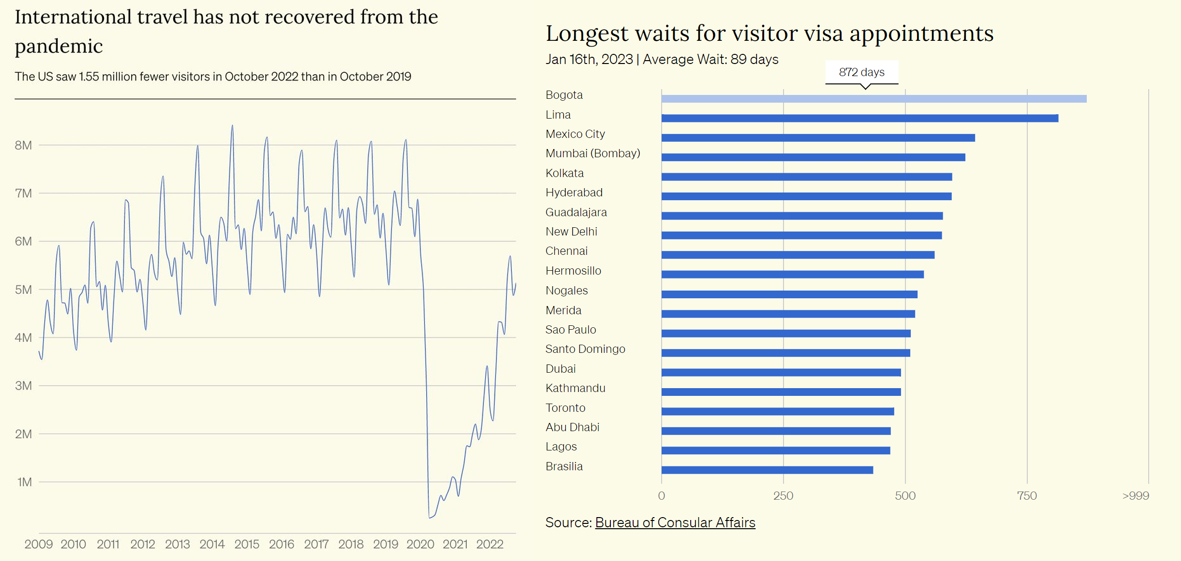 International travel to the United States is well below pre-pandemic levels, hurting our tourism industries, and embarrassingly long times to get a visitor visa are probably part of the problem.
Hat tip: Alec Stapp.
Erika Fatland’s *High*
The subtitle is A Journey Across the Himalaya Through Pakistan, India, Bhutan, Nepal, and China. This is the first great book of 2023, at least that I have seen. Bravo! Travel books are hard to summarize, but I will note that most of them are bad or at best mediocre. They assume you care about the author’s adjectives, or that the interesting nature of experienced events will translate automatically to the page. This work, in contrast, is a wonderful blend of fact, history, political observation, and narrative. I read every page, and it would likely make my list of my favorite thirty travel books of all time. Here is the author’s home page, she is by background a Norwegian anthropologist who speaks eight languages.
My excellent Conversation with Paul Salopek
Here is the transcript and audio, here is the summary:
Paul Salopek is a Pulitzer Prize-winning journalist and National Geographic fellow who, at the age of 50, set out on foot to retrace the steps of the first human migrations out of Africa. The project, dubbed the “Out of Eden Walk,” began in Ethiopia in 2012 and will eventually take him to Tierra Del Fuego, a distance of some 24,000 miles.
Calling in just as he was about to arrive in Xi’an, he and Tyler discussed his very localized supply chain, why women make for better walking partners, the key to crossing deserts, the most difficult terrain to traverse, what he does for exercise, his information prep for each new region, how he’s kept the project funded, why India is such a good for walkers, which cuisines he’s found most and least palatable, what he learned working the crime beat in Roswell, New Mexico, how this project challenges conventional journalism, his thoughts on the changing understanding of early human migration, and more.
Here is one excerpt:
COWEN: What’s true is true. How is it that you crossed the desert? You’ve been through some of the Gulf States, I think.
SALOPEK: Yes, I’ve been through several deserts. The first was the Afar Desert in north Ethiopia, one of the hottest deserts in the world, and then the Hejaz in western Saudi Arabia, and then some big deserts in Central Asia, the Kyzyl Kum in Uzbekistan.
You cross deserts with a great attentiveness. You seem to want to speed up to get through them as quickly as possible, but often, they require slowing down, and that seems counterintuitive. You have to walk when the temperatures are congenial to your survival. Sometimes that means walking at night as opposed to the day. It means maybe not covering the distances that you would in more moderate climates.
Deserts are like a prickly friend. You approach them with care, but if you invest the time, they’re pretty inspiring and remarkable. There are reasons why old hermits go out into the deserts to seek visions. I was born in a desert. I was born in the Mojave Desert of Southern California, so I’m partial to them, maybe even by birth.
COWEN: Do you find deserts to be the most difficult terrain to cross?
SALOPEK: No, I find alpine mountains to be far trickier. Deserts can be fickle. Deserts can kill you if you’re not careful. Of course, water is the most limiting factor for survival.
But alpine mountain weather is so unpredictable, and a very sunny afternoon can turn into a very stormy late afternoon in a very quick time period. Threats like rock falls, like avalanches, blizzards — those, for me, are far more difficult to navigate than deserts. Also, I guess having been born in the subtropics, I don’t weather the cold as well, so there’s that bias thrown in.
COWEN: What do you do for exercise?
Recommended, interesting throughout.