Category: Uncategorized
Charter city finally in Honduras?
Próspera is the first project to gain approval from Honduras to start a privately governed charter city, under a national program started in 2013. It has its own constitution of sorts and a 3,500-page legal code with frameworks for political representation and the resolution of legal disputes, as well as minimum wage (higher than Honduras’s) and income taxes (lower in most cases). After nearly half a decade of development, the settlement will announce next week that it will begin considering applications from potential residents this summer.
The first colonists will be e-residents. Próspera doesn’t yet have housing ready to be occupied. But even after the site is built out, most constituents will never set foot on local soil, says Erick Brimen, its main proprietor. Instead, Brimen expects about two-thirds of Prósperans to sign up for residency in order to incorporate businesses there or take jobs with local employers while living elsewhere…
After years of debate, Próspera will be the first real-world test of a divisive libertarian idea, says Beth Geglia, an anthropologist who studies charter cities. “There was a noticeable lull in the startup city movement in general until the Próspera Zede project got off the ground,” she says. “It’s ground zero.”
There is considerably more at the link, if this continues on track I will gladly visit and report back.
Saturday assorted links
1. The breakthrough in computational biology (good long NYT feature).
2. On the early history of Elon Musk. And Twitch stream of a stop sign.
3. Female tennis players are more Covid-averse.
4. Rich Lowry on Trump’s border policy.
5. Do Republicans look more alike? And is it voter-driven?
6. “Your pet’s details have not been lost. We just need to clean up some of your data first.”
7. BitClout — is there a token representing you? And here is a critical perspective on the venture.
Flood the Zone
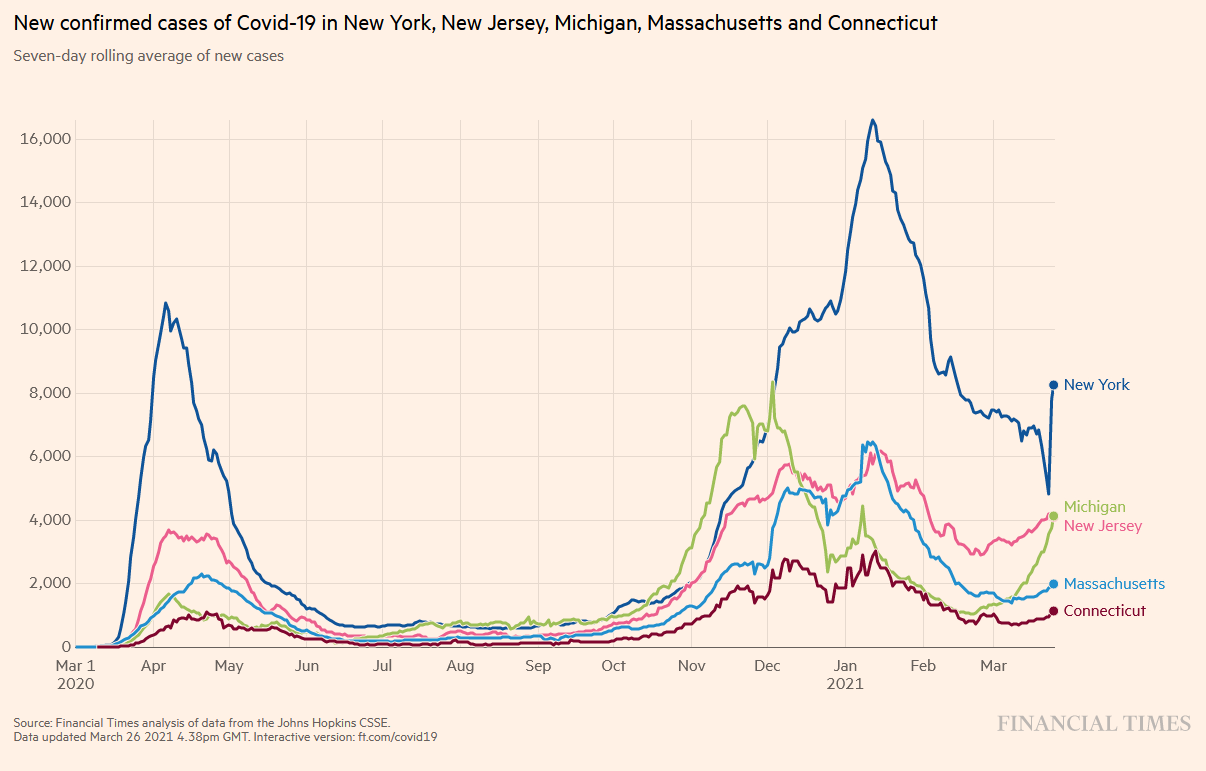
COVID cases are rising in New York, Michigan and New Jersey with most cases coming from the British and New York variants (B.1.1.7, B.1.526). It would be a good idea to flood these zones with vaccines. J&J production should hit 11 million doses this week. Send the J&J vaccine to pharmacies and clinics in these states that are capable of putting a lot of shots in arms quickly.
Friday assorted links
1. The UK’s new £50 note celebrates Alan Turing with lots of geeky Easter eggs.
3. The latest from China concerning cotton.
4. Rutgers will require students to get the vaccine.
5. A response from the temperature-gdp authors.
6. Coverage of the left-wing economics revolution at Berkeley.
7. The rate of sexual victimization is higher than most people think.
Socioeconomic roots of academic faculty
Using a survey of 7218 professors in PhD-granting departments in the United States across eight disciplines in STEM, social sciences, and the humanities, we find that the estimated median childhood household income among faculty is 23.7% higher than the general public, and faculty are 25 times more likely to have a parent with a PhD. Moreover, the proportion of faculty with PhD parents nearly doubles at more prestigious universities and is stable across the past 50 years.
Here is the full paper, via all over Twitter.
Thursday assorted links
1. If he had titled this “We have come to bury Ayn Rand,” he might have had a point.
3. “Alabama school district, once home to infamous Tuskegee study, nears full COVID vaccination level.”
4. UK competition authority concerned about “supply of GIFs.” (You can’t make this stuff up, and yes Ayn Rand remains relevant.)
5. New Zealand nonetheless is facing a hospital crisis (see parenthetical remark on #4).
6. Response to Newell, Prest, and Sexton on the temperature-gdp paper. I think the critique scores some good points against the authors, but it does not dissuade me from their fundamental conclusion that the current literature does not have a coherent answer to the key question about costs.
7. Forthcoming Congressional approaches to the next pandemic.
Cereal brand to reimburse consumers who paid inflated prices during COVID shortage
For those with pandemic pangs for the sweet crunch of Grape Nuts, take heart. The Great Grape-Nuts Shortage of 2021 is officially over.
After months of being out of stock, the cereal is shipping at full capacity to stores nationwide, parent company Post Consumer Brands told USA TODAY exclusively.
And if you paid wildly inflated prices on the black market to get your hands on a box, you may be eligible for reimbursement.
“It became abundantly clear during the shortage that Grape-Nuts fans are ‘Nuts for Grape-Nuts,’” Kristin DeRock, Grape-Nuts brand manager at Post Consumer Brands, said in a statement. “So much so that some of our loyal super fans were willing to pay extreme prices just to ensure they wouldn’t be without their favorite crunchy cereal.”
Here is the full story, via John B. Chilton. One way to read this is Grape Nuts subsidizing habit formation. Alternatively, you might read it as Grape Nuts subsidizing very loyal customers, and hoping to get publicity in the process. Or is Grape Nuts subsidizing future middlemen in any future black market transactions by assuring them of ongoing demand? How are you supposed to prove you bought a black market box? And was it illegal to resell and buy Grape Nuts in the first place? I don’t entirely understand all of the microeconomic mechanisms at work here.
Wednesday assorted links
1. Thomas Meaney on Singapore. Good, interesting long read from LRB.
2. What is the ideological news slant of your Twitter account? (mine was 57% left-wing, 34% right-wing, not too many centrists, at least by their measures, maybe I prefer “the kooks”). I don’t wish to embarrass anyone in particular, but some of the ideological bubbles you can find with this are…just remarkable.
3. Why it is important to translocate rhinos upside down.
4. Ten economists address overheating, my view is closest to that of Jason Furman (NYT).
5. Are the economics of tennis broken? (Bloomberg)
My Conversation with Sarah Parcak, space archaeologist and Egypt lover
Here is the audio, video, and transcript. Here is part of the summary:
She joined Tyler to discuss what caused the Bronze Age Collapse, how well we understand the level of ancient technologies, what archaeologists may learn from the discovery of more than a hundred coffins at the site of Saqqara, how far the Vikings really traveled, why conservation should be as much of a priority as excavation, the economics of looting networks, the inherently political nature of archaeology, Indiana Jones versus The Dig, her favorite contemporary bluegrass artists, the best archeological sites to visit around the world, the merits of tools like Google Earth and Lidar, the long list of skills needed to be a modern archeologist, which countries produce the best amateur space archeologists, and more.
Lots of talk about data issues and rights as well. Here is one excerpt:
COWEN: Here’s something that struck me studying your work. Give me your reaction. It seems to me your job is almost becoming impossible. You have to know stats. You have to know trigonometry. You have to know geometry. In your case, you need to know Egyptian Arabic, possibly some dialect, possibly some classical Arabic, maybe some other languages.
You have to know archaeology, right? You have to know history. You must have to know all kinds of physical techniques for unearthing materials without damaging them too much. You need to know about data storage, and I could go on, and on, and on.
Hasn’t your job evolved to the point where you’re almost . . . You need to know about technologies, right? For finding data from space — we talked about this before. That’s also not easy. Isn’t your job evolving to the point where, literally, no human can do it, and you’re the last in the line?
PARCAK: I am, I guess, jack of all trades, master of a few. But that’s not true either because I have to know the remote sensing programs. I have to know geographic information systems. I have to be up to date on international cultural heritage laws.
I think I’m not special by a long shot. Every archaeologist is a specialist. This archaeologist is a specialist in the pottery of this period of time, or does DNA, or excavates human remains — they’re bioarchaeologists — or they do computation. We all are specialists in a particular thing, but that’s really broad. My unsexy, more academic term is landscape archaeologist, so I’m interested in ancient human-environment interaction, which encompasses a lot of different fields and subfields. I’ve taken many courses in geology.
All of us who study Egyptology — we do a lot of training in art history because, of course, the iconography and the art and the objects that we’re finding. It takes a lot, but I would say most of the knowledge I’ve gotten is experiential. It’s from being in the field, I’ve visited hundreds of museums. I’ve spent countless hours in museum collections learning, touching objects.
Yeah, it’s a lot, but it’s also the field of archaeology. That’s why so many people really love it — because you get to touch on so many different areas. I would never, for example, consider myself a specialist in bioarchaeology. I know a tibia. When I find pitting on a skull, I know what that could potentially mean.
But also, I’m in a position now where I’m a dig director, so that means I’m in charge of a large group of humans, most of whom are far smarter, more capable than I am in whatever they’re doing. They’re specialists in pottery and bone, in rocks — project geologist — and conservation in art. We have project artists. We have specialists in excavation, and of course, there’s my very talented Egyptian team. They’re excavating. I’m probably a lot more of a manager now than I ever expected to be —
COWEN: And fundraiser perhaps, right?
One of my favorite CWTs in some time. And here is Sarah’s book Archaeology from Space: How the Future Shapes Our Past.
Noah Smith on the new macro wars
The most interesting thing about the new Macro Wars is that academic research is almost a total non-factor. In 2011 we were arguing about the Zero Lower Bound, DSGE models versus reduced-form models, etc. Now, though academics are involved in the debates, you rarely see an actual paper invoked. And when it is, it’s nearly always an empirical paper rather than a theory paper.
Why? If academics themselves weren’t involved in the debates, you could say that OK, maybe these people are just ignorant of the literature. But academics are involved, and they do know the literature; they’re just not invoking it much. Also, it’s not that Twitter econ debates are lightweight or short on references — the minimum wage debate, for example, cites papers constantly.
You can come up with various hypotheses for this, but it seems fairly clear to me that the reason is that everyone quietly stopped believing in the usefulness of academic macro theory. Macro profs are still out there doing their jobs, writing theory papers, and getting paid handsomely for it — in fact, I’d argue that with folks like Emi Nakamura, Jon Steinsson, Yuriy Gorodnichenko, and Ivan Werning on the job, the field of macro theory is chock full of top talent. And those are good people who take their jobs seriously and aren’t out to push political narratives.
But the problem is that macro theory is just really, really hard.
His whole Substack post is very good, though I give the entire matter a different interpretation. I do not view contemporary macroeconomics as wonderfully predictive, but it does put constraints on what you can advocate or for that matter on what you can predict. I saw the Republicans go down this path some time ago, and now the Democrats are following them — it ain’t pretty. I think what we are seeing now is that (some, not all) Democratic economists want Democrats to be popular, and to win, and so they will rearrange macroeconomic thinking accordingly. David Henderson, in a recent post, put the point well:
Notice what even Krugman admits. First, that the aid to state and local governments is too much, even by his standards. Second, the checks to people who hadn’t suffered much, which are a huge part of the package, are the “least-justifiable piece in terms of standard economics.” And what’s Krugman’s justification for those payments? That they are “by far the most popular” and, for that reason, we can’t “entirely disregard that.”
On the actual analytics of this debate, Summers has been a clear winner, and that simply hasn’t mattered much at all. See also this excellent comment by Karl Smith:
Bidenism is hitting at exactly the right time politically. It’s not pushing the American people but meeting them where they are. It is quite frankly the coherent manifestation of MAGAism in the same way that Reaganism was a coherent manifestation of Carter-era deregulation
Ongoing…
Assorted links
1. First NFT digital house sells for over 500k.
2. Vitamin D not effective for whites, some Covid effectiveness for blacks with low vitamin D levels.
4. Are the Japanese more risk-averse in their baseball decisions?
5. I am giving a Fairfax County Library Zoom talk tomorrow night at seven p.m. — I benefit so much from them!
When Did Growth Begin?
The subtitle of the paper is “New Estimates of Productivity Growth in England from 1250 to 1870” and it is by Paul Bouscasse, Emi Nakamura, and Jon Steinsson:
We provide new estimates of the evolution of productivity in England from 1250 to 1870. Real wages over this period were heavily influenced by plague-induced swings in the population. We develop and implement a new methodology for estimating productivity that accounts for these Malthusian dynamics. In the early part of our sample, we find that productivity growth was zero. Productivity growth began in 1600—almost a century before the Glorious Revolution. Post-1600 productivity growth had two phases: an initial phase of modest growth of 4% per decade between 1600 and 1810, followed by a rapid acceleration at the time of the Industrial Revolution to 18% per decade. Our evidence helps distinguish between theories of why growth began. In particular, our findings support the idea that broad-based economic change preceded the bourgeois institutional reforms of 17th century England and may have contributed to causing them. We also estimate the strength of Malthusian population forces on real wages. We find that these forces were sufficiently weak to be easily overwhelmed by post-1800 productivity growth.
Via Anton Howes. Here is a related tweet storm from Steinsson.
Google Trends as a measure of economic influence
That is a new research paper by Tom Coupé, here is one excerpt:
I find that search intensity rankings based on Google Trends data are only modestly correlated with more traditional measures of scholarly impact…
The definition of who counts as an economist is somewhat loose, so:
Plato, Aristotle and Karl Marx constitute the top three. They are followed by B. R. Ambedkar, John Locke and Thomas Aquinas, with Adam Smith taking the seventh place. Smith is followed by Max Weber, John Maynard Keynes and the top-ranking Nobel Prize winner, John Forbes Nash Jr.
…John Forbes Nash Jr., Arthur Lewis, Milton Friedman, Paul Krugman and Friedrich Hayek are the most searched for Nobel Prize winners for economics, while Tjalling Koopmans, Reinhard Selten, Lawrence Klein, James Meade and Dale T. Mortensen have the lowest search intensity.
Here are the Nobelist rankings. Here are the complete rankings, if you are wondering I come in at #104, just ahead of William Stanley Jevons, one of the other Marginal Revolution guys, and considerably ahead of Walras and Menger, early co-bloggers (now retired) on this site. Gary Becker is what…#172? Ken Arrow is #184. The internet is a funny place.
I guess I found this on Twitter, but I have forgotten whom to thank – sorry!
Twitter macro and Twitter economics
I’ll compare Twitter macro to blog macro throughout, and here is how I see the strengths and weaknesses of Twitter macro:
1. Super-fast speed of response, and less repetitive than the old blog world. It is easy to comment right away on the most current happening. Unlike with (some) blogs, no wind-ups are required. On Twitter both good and bad ideas go viral far more rapidly.
2. It is more fun than blog macro, and attracts fewer hobby horse drones.
3. It is too easy to tell people that they “completely misunderstand” something, because links, while they exist on Twitter, are not the prime currency. This leads to many bad tweets, typically tweets that…completely misunderstand something or someone, yet with less verification possible.
4. It attracts a younger set of writers than blog macro did. That makes it both more left-wing and also less informed about economic history, recent decades in particular. Very recent evidence and experience is considerably overstressed in its relevance, and this is reinforced by the fad-like nature of Twitter opinion.
5. Twitter macro is poor at spelling out the entirety of an empirical literature on an empirical question. I am not sure whether this is intrinsic to the medium, but I observe this regularly. Blogs in contrast are/were most likely to take a more exhaustive approach to literature survey, sometimes too exhaustive rather than focusing on the single best argument.
6. Twitter macro is poor for spelling out mechanisms. Most coherent macro mechanisms do in fact take more than 280 characters to spell out. Tweet storms are useful, but more for a series of sequential observations on some new data, rather than for mechanisms per se. Overall Twitter is poor for “grasping the whole elephant” approaches to economics, and for that matter to other topics as well.
7. It is easier to learn from other people on econ Twitter, due to the “rapid scan” and retweet and “comment on tweet” properties of the system. At the same time, econ Twitter is more prone to fads and bubbles of opinion, for broadly the same reasons.
8. Econ Twitter involves more “don’t really know anything at all” kinds of people, and sarcastic people, in the discussions. Overall this has a negative external impact on the tone and thoughtfulness of those who do know something. In the blog world, we all made each other a bit more “cross-checking, linking, and drone-like.”
9. I genuinely do not understand why more tweeters do not set up free blog or Substack accounts, and, if only five times or so a year, write a longer post or column explaining and defending their views and tying them into the broader literatures. This seems to me to betray a certain kind of intellectual laziness, which the Twitter medium itself encourages and amplifies.
10. Entry barriers are lower with Twitter, so there is a much broader diversity of opinion. This can be very good, but see #8.
11. It is easier to express meaningful agnosticism in a successful blog post than in a successful tweet. This is one of the biggest problems with Twitter macro, and indeed with Twitter more broadly. It is also hard to express trade-offs in a successful tweet, another major problem. “We must do this” kinds of thinking are instead encouraged.
12. Both blog posts and tweets very often mix in normative judgments with the positive analysis. But it is much harder to be sophisticated on the normative side on Twitter. The morality is often third-rate or worse.
13. The one-sentence (supposed) refutation is very much overrated on Twitter, even serious Twitter. Such dismissals are usually wrong, or at least seriously incomplete, and their possibility and popularity discourage people from developing deeper understandings.
14. Is Twitter so great for methodological self-awareness? Yes, you could do a tweet storm but this kind of analysis, as embodied in this post itself, seems harder to do on Twitter, and harder to receive non-sarastic feedback on.
Monday assorted links
1. “Our estimation shows that wildfire damages in 2018 totalled $148.5 (126.1–192.9) billion (roughly 1.5% of California’s annual gross domestic product), with $27.7 billion (19%) in capital losses, $32.2 billion (22%) in health costs and $88.6 billion (59%) in indirect losses (all values in US$).” Link here.
2. More on the who is Satoshi debate.
3. “… the presence of immigrant students has a positive effect on the academic achievement of US-born students, especially for students from disadvantaged backgrounds. Moreover, the presence of immigrants does not affect negatively the performance of affluent US-born students, who typically show a higher academic achievement compared to immigrant students.” Link here.
4. “We find that elderly suicide rate decreases by 8.7% during the Chinese Lunar New Year.”
5. Hitler’s parents.