What I’ve been reading
1. Philip Norman, Paul McCartney: The Life. From this book one learns that young Beatle Paul had more sex with more women than most people had thought, his daily pot habit started earlier than most people had thought (it inspired “Got to Get You Into My Life”), and Paul not John was the musical innovator (duh). I enjoyed this book (duh) and it had a reasonable amount of detail about his last twenty years. Good for fans, at the very least, but it will not convert the uninitiated.
2. Joseph E. Stiglitz, The Euro: How a Common Currency Threatens the Future of Europe. Recall that while Krugman is much more influential in America, Stiglitz is more influential in Europe and in most of the developing world, thus the topic of this book makes sense. I agree with most of the arguments, though not the view that trade surpluses are essential for understanding the problem. This book is good for fans, at the very least, but it will not convert the uninitiated.
3.George J. Borjas, We Wanted Workers: Unraveling the Immigration Narrative. My favorite two-sentence sequence in this book is: “It is worth emphasizing that the distributional pain is the flip side of the economic gain. And ironically, the greater the distributional pain, the greater the economic gain.” Good for fans, etc.
Thursday assorted links
The Absurdity of Mandatory Voting
NBER: We study a unique quasi-experiment in Austria, where compulsory voting laws are changed across Austria’s nine states at different times. Analyzing state and national elections from 1949-2010, we show that compulsory voting laws with weakly enforced fines increase turnout by roughly 10 percentage points. However, we find no evidence that this change in turnout affected government spending patterns (in levels or composition) or electoral outcomes. Individual-level data on turnout and political preferences suggest these results occur because individuals swayed to vote due to compulsory voting are more likely to be non-partisan, have low interest in politics, and be uninformed.
In other words, all mandatory voting did was add noise to the system and as such probably made everyone worse off including the new voters.
The Soviet internet
There is a new and intriguing book out by Benjamin Peters called How Not to Network a Nation: The Uneasy History of the Soviet Internet, which outlines exactly what it claims to. Here is one introductory excerpt:
In late September 1970, a year after the ARPANET went online, the Soviet cyberneticist Viktor Glushkov boarded a train from Kiev to Moscow to attend what proved to be a fateful meeting for the future of what we might call the Soviet Internet. On the windy morning of October 1, 1970, he met with members of the Politburo, the governing body of the Soviet state, around the long rectangular table on a red carpet in Stalin’s former office in the Kremlin. The Politburo convened that day to hear Glushkov’s proposal and decide whether to build a massive nationwide computer network for citizen use — or what Glushkov called the All-State Automated System (OGAS, obshche-gosudarstvennyi avtomatizirovannaya system), the most ambitious computer network of its kind in the world at the time. OGAS was to connect tens of thousands of computer centers and to manage and optimize in real time the communications between hundreds of thousands of workers, factory managers, and regional and national administrators. The purpose of the OGAS Project was simple to state and grandiose to imagine: Glushkov sought to network and automatically manage the nation’s struggling command economy.
They failed! The author blames this not on backward technology, but rather “entrenched bureaucratic corruption and conflicts of interest at the heart of the system…”
Anyone interested in the history of the internet, comparative systems, or the history of the Soviet Union should read this book.
Add them all up to get the truth

The middle class is shrinking almost everywhere
The decline of the American middle class is “a pervasive local phenomenon,” according to Pew, which analyzed census and American Community Survey data in 229 metros across the country, encompassing about three-quarters of the U.S. population. In 203 of those metros, the share of adults in middle-income households fell from 2000 to 2014.
On the average is over front, there is also this:
In total, 172 of these 229 metros saw a growing share of households in the upper-income tier. About as many — 160 — saw a growing share at the bottom. And 108 experienced both: The middle class shrank as the ranks of both the poor and the rich grew.
Here is more from Wonkblog on the new Pew study. The decline in the middle class is typically strongest in areas where manufacturing used to be strong.
This used to be a debate, but the funny thing is the nomination of Trump has sealed it for the more pessimistic side. That is unfair, actually, though I think the pessimistic side is correct nonetheless.
Jan Morris’s *Conundrum*
This 174-page book, from 1974, is probably the best I have read this year so far. The main tale is the author’s pioneering transgender experiences, but it’s far broader than that, also being an excellent travel book, romance, family story, and tale of ineradicable obsession. Everything is pitch perfect, and you can finish it in a sitting, these are the kinds of books I wish people recommended to me. Here is the end of the story, quite romantic. Here is an interview with Morris.
Wednesday assorted links
1. Will dueling robots be the next major sport?
2. North American political refugee dating markets in everything.
3. New data on the gender wage gap in STEM fields.
4. David Beckworth podcast with Miles Kimball.
5. Do vegans have better personalities than do vegetarians?
The Solow Model and Ideas
The fifth video in the Solow series from our Principles of Macroeconomics course is really the capstone. It explains how ideas drive growth on the cutting edge. A key insight of the model, however–one which many people still don’t really get–is that ideas increase output and by doing so they also drive capital accumulation so both forces are always at play.
*The Nordic Gender Equality Paradox*
That is the new and quite interesting book by Nima Sanandaji. The main point is that there are plenty of Nordic women in politics, or on company boards, but few CEOs or senior managers. In fact the OECD country with the highest share of women as senior managers is the United States, coming in at 43 percent compared to 31 percent in the Nordics. More generally, countries with more equal gender norms do not have a higher share of women in senior management positions. Within Europe, Bulgaria does best and other than Cyprus, Denmark and Sweden do the worst in this regard.
One reason for the poor Nordic performance at higher corporate levels is high taxes, which limits the amount of household services supplied through markets. If it is harder to hire someone to do the chores, that makes it harder for women to invest the time to climb the career ladder. Generous maternity leave policies may encourage women to take off “too much” time, or at least this is suggested by the author. A history of communism is also strongly correlated with women rising to the top in business and management; this may stem from a mix of relatively egalitarian customs and a more general mixing up of status relations in recent times and a turnover of elites.
I don’t find this book to be the final word, and I would have liked a more formal econometric treatment. It is nonetheless a consistently interesting take which revises a lot of the stereotypes many people have about the Nordic countries as being so absolutely wonderful for gender egalitarianism in every regard.
Here is the book’s website, from Timbro (a very good group), I don’t yet see it on Amazon.
What I’ve been reading
1. Jason Brennan, Against Democracy. He is a epistocrat. P.S. voters are ignorant and irrational. Furthermore “Politics is not a Poem.” I agree with most of the debunking arguments in this book, but I am not convinced epistocracy ends up being better; Brennan’s examples of epistocracy include restricted franchise, plural voting, voting by lottery, epistocratic veto (the Senate, but more so), and weighted voting. I see big advantages to a strict normative ideal of legal egalitarianism of civic rights, and I suspect that ends up meaning some form of democracy, albeit constrained by the overlay of a constitutional republic.
2. Ji Xianlin, The Cowshed: Memoirs of the Chinese Cultural Revolution. The classic account of its kind, in this edition brilliantly translated and presented.
And I am happy to praise Frank Dikötter’s The Cultural Revolution: A People’s History 1962-1976, but I did not find it as revelatory as his earlier books on China. Here is a Judith Shapiro NYT review.
3. Aileen M. Kelly, The Discovery of Chance: The Life and Thought of Alexander Herzen. Beautifully written, and full of interesting history, but it never quite convinces the reader that Herzen is an interesting and worthwhile intellect for 2016. Maybe he isn’t — does that make this book better or worse?
David L. Ulin’s Sidewalking: Coming to Terms with Los Angeles is a meditation on to what extent Los Angeles succeeds as a walkable city, or someday might get there.
There is Don Watkins and Yaron Brook, Equal is Unfair: America’s Misguided Fight Against Income Inequality, by no means do I go all the way with them, but still this a useful corrective to some current obsessions.
Don and Alex Tapscott, Blockchain Revolution: How the Technology Behind Bitcoin is Changing Money, Business, and the World lists more possible uses for blockchains than you would have thought possible.
James T. Bennett, Subsidizing Culture: Taxpayer Enrichment of the Creative Class, the subtitle says it all.
VPN in China
What is the deal these days? How well are VPNs working, and which do you recommend? Can Apple iPhones and iPads still access the “real web” directly through 4G, as was the case as recently as last year? I thank you in advance for your assistance, it is much appreciated.
Tuesday assorted links
1. Maybe America isn’t an oligarchy after all. A very good post on this topic.
2. School districts, test scores, and socioeconomic status. Ditto.
3. Do the Chinese welcome Trump? And Peter Thiel is likely to be a delegate for Donald Trump.
4. “We find that the effect of GED certification on either employment or earnings is not statistically significant.” (pdf, I believe a version of this is forthcoming in the JPE).
I, medical device robotic pancreas
Third-grader Andrew Calabrese carries his backpack everywhere he goes at his San Diego-area school. His backpack isn’t just filled with books, it is carrying his robotic pancreas.
The device, long considered the Holy Grail of Type 1 diabetes technology, wasn’t constructed by a medical-device company. It hasn’t been approved by regulators.
It was put together by his father.
Jason Calabrese, a software engineer, followed instructions that had been shared online to hack an old insulin pump so it could automatically dose the hormone in response to his son’s blood-sugar levels. Mr. Calabrese got the approval of Andrew’s doctor for his son to take the home-built device to school.
The Calabreses aren’t alone. More than 50 people have soldered, tinkered and written software to make such devices for themselves or their children. The systems—known in the industry as artificial pancreases or closed loop systems—have been studied for decades, but improvements to sensor technology for real-time glucose monitoring have made them possible.
The Food and Drug Administration has made approving such devices a priority and several companies are working on them. But the yearslong process of commercial development and regulatory approval is longer than many patients want, and some are technologically savvy enough to do it on their own.
Here is the Kate Linebaugh story, interesting throughout, via Adam Thierer and Eli Dourado.
Life Expectancy is Increasing and Health Inequality is Down
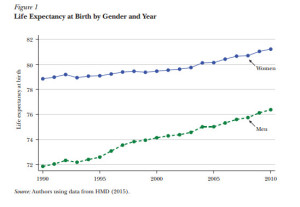
We have heard a great deal about increases in mortality among white, non-hispanic, middle-aged Americans (especially women) but to state the case is also to note that this is one group among many. In an excellent new paper, Currie and Schwandt discuss the good news overall–life expectancy is up and health inequality is down, in some cases dramatically. Here, for example, is life expectancy at birth by gender and year.
 Even more impressive is that life expectancy has increased significantly across all poverty groups (as measured by county poverty levels). In the graph below, for example, the blue triangles indicate life expectancy in 1990 (men on the left, women on the right). Note that as the poverty level of the county increases along the horizontal axis life expectancy falls. The green dots are life expectancy in 2010. Once again, as poverty increases, life expectancy falls. What’s remarkable, however, is how much life expectancy increased between 1990 and 2010 in counties of all poverty levels.
The news is good and may get better. Between 1990 and 2010 mortality rates for children ages 0-4 fell especially dramatically and especially so in poor counties. Moreover, since mortality at older ages is often baked in 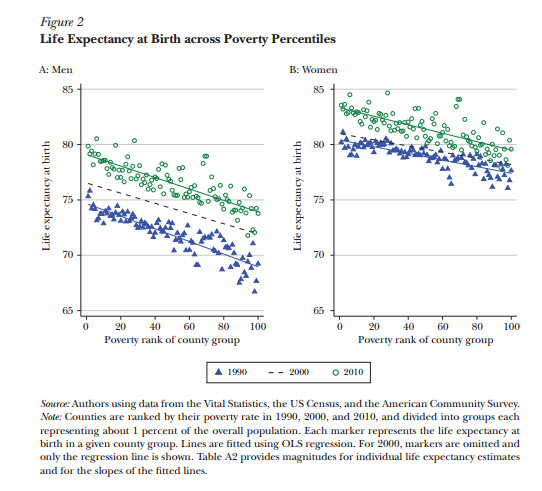 by poor health at younger ages there is significant opportunity for these gains to persist over time.
The New York Times also reported yesterday on inequality in life expectancy across race. It’s down.
Infant mortality is down by more than a fifth among blacks since the late 1990s, double the decline for whites. Births to teenage mothers, which tend to have higher infant mortality rates, have dropped by 64 percent among blacks since 1995, faster than for whites.
Blacks are still at a major health disadvantage compared with whites. But evidence of black gains has been building and has helped push up the ultimate measure — life expectancy. The gap between blacks and whites was seven years in 1990. By 2014, the most recent year on record, it had shrunk to 3.4 years, the smallest in history, with life expectancy at 75.6 years for blacks and 79 years for whites.
Part of the reason has been bad news for whites, namely the opioid crisis. The crisis, which has dominated headlines — some say unfairly, given racial disparities — has hit harder in white communities, bringing down white life expectancy and narrowing the gap.
But there also has been real progress for blacks. The rate of deaths by homicide for blacks decreased by 40 percent from 1995 to 2013, according to Andrew Fenelon, a researcher with the National Center for Health Statistics, compared with a 28 percent drop for whites. The death rate from cancer fell by 29 percent for blacks over that period, compared with 20 percent for whites.
The Currie and Schwandt paper is also very good on describing how these estimates are produced and some of the data issues with making these estimates. It’s a must read for those interested in these issues.