Medical Tourism
We have all heard about medical tourism to India, Singapore or Thailand, places where patients can enjoy high quality and low prices. But do you know about medical tourism to the United States? By some estimates, around 400,000 people travel to the United States for medical treatment every year and the big surprise is that for tourists U.S. health care prices can be very low! Canadians coming to the United States can get a knee replacement for less than half of what Americans pay and at a price not much more than they would pay in India. I learned this from John Goodman’s very interesting new book, Priceless: Curing the Healthcare Crisis (this is an Independent Institute book where I am director of research).
Nor is that the end of the story. Here is Goodman on an even more surprising twist:
Moreover, you do not have to be a foreigner to benefit from domestic medical tourism.
Colorado-based BridgeHealth International offers US employer plans a specialty network
with flat fees for surgeries paid in advance that are 15 percent to 50 percent less than a
typical network. North American Surgery, Inc., has negotiated deep discounts with 22
surgery centers, hospitals and clinics across the United States as an alternative to foreign
travel for low-cost surgeries. As noted, the “cash” price for a hip replacement in the
network is $16,000 to $19,000, making it competitive with facilities in India and
Singapore.One reason why so little is known about the domestic medical tourism market is that
hospitals prefer that most of their patients not know about it. The reason: they are often
offering the traveling patient package prices not available to local patients. That occurs
because the hospital is only competing on price for the patients who travel.
To be sure, the prices paid in the “travel” market are probably closer to marginal prices than average prices. Nevertheless, I think Goodman is absolutely right to focus in on the sectors of the health care economy which are competitive, it is in these sectors that we see listed prices, falling costs and increasing quality. Priceless is about how we can expand the competitive sectors. More on the book here.
What kind of mandate should “the right” have supported?
The conservatives and libertarians who earlier supported a mandate, ideally, should have been looking for the following qualities in a health care policy:
1. A very small number (one?) of categories for health care coverage and also reimbursement rates. Mandates for everyone, in other words. No Medicare, no Medicaid, no separate set of people in an employer-based, tax-subsidized health insurance sector, rather a unified system. Switzerland comes relatively close to this, and of course some commentators hope ACA will evolve into this (“means-tested vouchers”), though I suspect the scope of the mandate and the cost of the subsidies will prevent this.
2. A rejection of health care egalitarianism, namely a recognition that the wealthy will purchase more and better health care than the poor. Trying to equalize health care consumption hurts the poor, since most feasible policies to do this take away cash from the poor, either directly or through the operation of tax incidence. We need to accept the principle that sometimes poor people will die just because they are poor. Some of you don’t like the sound of that, but we already let the wealthy enjoy all sorts of other goods — most importantly status — which lengthen their lives and which the poor enjoy to a much lesser degree. We shouldn’t screw up our health care institutions by being determined to fight inegalitarian principles for one very select set of factors which determine health care outcomes.
3. A modest bundle of guaranteed coverage and services. I am very influenced by David Braybrooke’s book on meeting basic needs. Yet for me basic needs truly are basic and do not involve cable TV or small probability chances of delaying death from prostate cancer.
4. Price transparency (mandated if need be) and real competition in the health care sector, including freer immigration for doctors, nurses, and other caregivers, and relaxation of medical licensing and encouragement of retail medical clinics, a’la WalMart style. This helps keep the cost of the mandate to reasonable levels. Most cost-saving innovation should come through markets. The man strapped to a gurney, bleeding, while negotiating a price with his doctor is the exception in this sector, not the rule. In any case the insurance companies can prearrange the price for that one.
5. If you wish to move away from the strictly conservative direction, you could consider price controls on some areas of medicine. Singapore does them.
6. Always convert dollars of benefits, usually a private good, into dollars of support for medical research and development, a public good. You will never end up at a margin where this is a bad trade.
7. Society should firmly believe that it is the duty of the government, first and foremost, to protect us against foreign enemies, environmental catastrophes, pandemics, and other existential threats. History shows that such existential threats are real. Alleviating individual sufferings through governmental charity can be a useful source of mutual advantage but it should be subordinate to these broader goals. Furthermore we should be determined to resist the creation of a large class of perpetual beneficiaries who will strangle the government fiscally and pull it away from these more basic duties.
I would think that such a mandate would be a serious policy option, though maybe not a first best choice. (There are also mixes of single payer backstops and HSAs, as in Singapore, and a variety of provincial systems.) Yet that is far from the ACA. We should not “blame” Obama for that difference (it’s not clear what his more utopian preferences might be, though it is clear he could not have passed them), but still it seems to me that observers can support some version of an individual mandate and oppose ACA.
I agree, by the way, with Ezra Klein’s analysis of the “motivated reasoning” of many particular individuals when confronted with ACA a few years ago. You can think of this post as an “ideal type” analysis which may or may not apply to many actual people.
What I’ve been reading
1. Charles Rosen, Freedom and the Arts: Essays on Music and Literature. Rosen has mastered pianism, writing, and learning. The best parts, such as on Chopin or Schumann, are stunningly good.
2. Karl E. Meyer and Shareen Blair Brysac, Pax Ethnica: Where and How Diversity Succeeds. Some parts of the world make cross-ethnic collaboration work. I would prefer more comparative analysis with the regions where diversity does not work so well, but this is an interesting book with historical substance.
3. Navi Radjou, Jaideep Prabhu, and Simone Ahuja, Jugaad Innovation: Think Frugal, Be Flexible, Generate Breakthrough Growth. Full of cliches, but thoey do not totally drown out the substance. I have been wanting a book on this topic, namely why the poor are (sometimes) more innovative, illustrated through India.
4. Alonso Cueto, The Blue Hour. Just translated from Spanish, this book made a big splash in Peru. It turns on a family story, the history of the Shining Path, and a man’s obsession with a woman. I have yet to see major reviews (here is one summary), but for my taste it is one of the best novels of the year. The UK has paper copies, right now US has only Kindle, possibly a paper edition in July.
*The Twilight of the Elites: America After Meritocracy*
That is the new book by Christopher Hayes, here is one marvelously good review. I was myself very impressed by the level of execution in this book.
In terms of pushback, I would offer two points.
1. The best critiques of meritocracy usually come from those with extreme merit.
2. I wish the book had been more Hegelian. One could well have written a book called *The Twilight of the Non-Elites*, for instance:
“Can’t you’all have some better schools? It’s not mainly about money, rather a school is a collection of parents and children.”
“Get married. And stay married.”
“You didn’t have to falsify your income on that mortgage application; isn’t that a felony?”
“It’s your fault you ended up in jail, don’t blame the elites.”
And so on. What’s interesting about today’s scene is that both “Twilights” seem correct.
Assorted links
1. Slides on decoupling, and the paper is here.
3. How the American grocery bill has changed.
4. What is up with the Australian yield curve?
5. Is plastination near?, and I am happy to make the FP Twitter Top 100.
Cyprus sentences to ponder
Now many on this tiny island nation, whose banks and government are facing economic insolvency, are hoping for financial salvation from Russia rather than Germany and the European Union.
“I would much rather be saved by Moscow,” said Elena Tsolia, 30, an attendant at the department store Debenhams, where Russian shoppers snap up bottles of Dior and Chanel perfume. “We are a small island and we don’t want to be owned by Germany.”
Here is more.
Drug Shortages Caused by the FDA
 Shortages of drugs, especially generic injectables, continue to cause significant harm to patients. A new Congressional report offers the best account to date of the shortages and provides details confirming my earlier post. The story in essence is this:
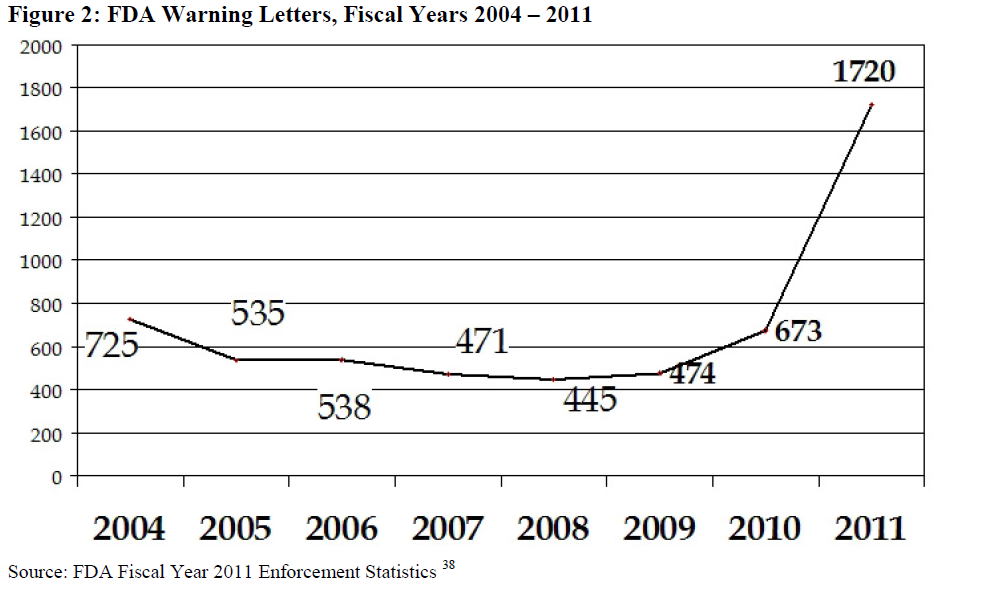 The FDA began to ramp up GMP rules and regulations under the new commissioner in 2010 and 2011 (see figure at left (N.B. this includes all warning letters not just GMP so it is just illustrative, AT added). In fact, the report indicates that FDA threats shut down some 30% of the manufacturing capacity at the big producers of generic injectables. The safety of these lines was not a large problem and could have been handled with a targeted approach but instead the FDA launched a sweep against all the major manufacturers at the same time. These problem have been exacerbated by a change in Medicare reimbursement rules and by the rise of GPOs (buying groups) which reduced the prices of generics. Thus, in response to the cut in capacity, firms have shifted production from less profitable generics to more profitable branded drugs, so we get shortages of generics rather than of branded drugs.
Add to these major factors a few unique events such as the FDA now requiring pre-1938 and pre-62 drugs to go through expensive clinical trials, the slowdown of ANDAs and crazy stuff such as DEA control over pharmaceutical manufacturing and you get very extensive shortages.
Is lack of trust a fundamental macro problem?
Ezra responds to my column of Sunday with this post. Excerpt:
…Tyler Cowen attributes the decline in public-sector employment to “a collapse of trust in politics.” In fact, he says, “the reason that we aren’t getting more expansionary macro policy is fundamental: a lack of trust.”
I don’t buy it. I think the reason we aren’t getting more expansionary macro policy is a polarized political system oriented toward gridlock.
If there’s been a decline in trust toward state and local governments, it’s hard to find it in the polling. State and local governments rank as highly trusted. In a March 2011 poll — so, the period when state and local cutbacks were at their worst — Gallup found that most Americans thought state and local governments had “about the right” amount of power. Only 34 percent wanted state governments to have less power, and only 22 percent wanted local governments to have less power. They outpolled banks, corporations, the federal government and the courts. Local government outpolled churches.
I view political polarization as another manifestation of lack of trust. For instance the core voters behind the two major parties do not trust each other in power. In addition Republicans, many independents, and also many Democrats do not trust that tax hikes or rising deficits actually will be used to provide useful public services. (Ezra himself has stressed in the past how far to the right the Democrats have moved on taxes.) They still like their local school teachers, but they also do not trust “Federal-state/local coordinated fiscal stimulus.” Obama stopped boasting about the first round of stimulus some time ago, correctly or not.
I would add that gridlock is endogenous; for instance the Democrats, when they possibly had a chance, did not make hard moves to try to abolish the filibuster and these days they are not keen to present and vote on federal budgets. Politicians do not have enough trust that voters will reward them for being courageous, if that is the right word, and voters do not have enough trust that the political act is in fact one of courage. Yet I doubt if we’ll see gridlock on the Medicare doc fix or the AMT patch, as most people still trust direct cash or in kind benefits to themselves.
On another of Ezra’s points, I don’t think trust has fallen because voters are not getting what they want, but rather because the economy has turned down and they feel less wealthy and face higher risk. (Not getting what you want is more likely to explain trust levels rather than changes.) Here is plenty of evidence that trust in institutions falls cyclically. Although the study does not measure trust in local government, the effect appears to be fairly general.
It’s also not electoral gridlock which stops the Fed from doing more. One major obstacle is simply that voters and many interest groups, rightly or wrongly, view additional inflation as a major vehicle for wealth redistribution and they do not trust that they “will get their money back” through other means.
Addendum: Catherine Rampell adds comment.
When are ‘secure’ property rights bad for growth?
Greg Clark has argued that private property was secure in medieval England on the basis that
‘Medieval farmland was an asset with little price risk. This implies few periods of disruption and uncertainty within the economy, for such disruption typically leaves its mark on the prices of such assets as land and housing’ (p 158).
And on the basis of low taxes in medieval England, he goes on to claim that:
‘if we were to score medieval England using the criteria typically applied by the International Monetary Fund and the World Bank to evaluate the strength of economic incentives, it would rank much higher than all modern high-income economies—including modern England’ (p 147) . . . If incentives are the key to growth, then some preindustrial societies like England had better incentives than modern high-income economies. And incentives may be much less important to explaining the level of output in economies than the Smithian vision assumes’ (p 151).

Even if most would not go so far as Clark, many economic historians now argue that property rights were secure in late medieval and early modern England, and that some property rights actually became less secure after the Glorious Revolution. Drawing on the work of Jean-Laurent Rosenthal, Dan Bogart, and Gary Richardson, Bob Allen summarizes these findings as follows:
‘Growth was also promoted by Parliament’s power to take people’s property against their wishes. This was not possible in France. Indeed, one could argue that France suffered because property was too secure: profitable irrigation projects were not undertaken in Provence because France had no counterpart to the private acts of Parliament that overrode property owners opposed to the enclosure of their land or the construction of canals or turnpikes across it’
See here, here and here for links to the academic work that underpins these claims. For the sake of argument let us agree that they are correct. What does this finding mean?
It does not mean that insecure property rights are good for growth.
It does mean that feudalism was bad for growth.
The property rights that Clark and others describe as being secure in medieval Europe were feudal property rights. Feudalism structured ownership rights in such a way as to channel rents to the king and the military elite. Feudal property rights were designed to maintain concentrated holdings of land, large enough to support feudal armies. Feudal laws limited land sales that would break-up large estates and bundled together rights over land with rights over individuals.
In a market economy, where rights are clearly defined, assets will be allocated to their highest-value user so long as transaction costs are not too high. In this type of environment protecting asset holders from expropriation provides the best incentives for investment and growth. But this was not true of the medieval world.
What Bogart and Richardson establish is that these feudal rights impeded efficient land use in England and made it difficult to organize the provision of public goods. They show how Parliament in the 18th century was able to rewrite and override existing property rights. Their work suggests that given the initial allocation of rights and the extremely high transactions costs associated with feudal land law, a reconfiguration of property rights was necessary for economic growth to begin.
*The Locavore’s Dilemma*
The authors are Pierre Desrochers and Hiroko Shimizu, and the subtitle is In Praise of the 10,000 Mile Diet:
The publisher’s page summarizes it thus:
Today’s food activists think that “sustainable farming” and “eating local” are the way to solve a host of perceived problems with our modern food supply system. But after a thorough review of the evidence, Pierre Desrochers and Hiroko Shimizu have concluded that these claims are mistaken.
In The Locavore’s Dilemma they explain the history, science, and economics of food supply to reveal what locavores miss or misunderstand: the real environmental impacts of agricultural production; the drudgery of subsistence farming; and the essential role large-scale, industrial producers play in making food more available, varied, affordable, and nutritionally rich than ever before in history.
They show how eliminating agriculture subsidies and opening up international trade, not reducing food miles, is the real route to sustainability; and why eating globally, not only locally, is the way to save the planet.
I very much enjoyed reading the book, you can order a copy here. For the pointer I thank Daniel Klein.
Assorted links
2. Euro 2012 markets in everything.
3. Scott Sumner’s favorite things Icelandic.
4. Robin Hanson: writing a book, and turning his blog into a group blog.
5. Did the robot pass or the humans fail this “composing Turing test”?
Assorted Links
1. Valve, the game company, hires Yanis Varoufakis, expert on the European situation, to help deal with balance of payment and currency issues between different worlds.
2. The great Deirdre McCloskey lets loose on the high liberals of political philosophy. Read the whole thing, it builds to gale force.
3. Aussie retailers charging more if you use an “old” browser.
4. The U.N. Internet Power Grab revealed by WCITLeaks a project of GMU economists Eli Dourado and Jerry Brito.
Institutions and Islamic Law
Adeel Malik has a very interesting essay responding to Timur Kuran’s excellent book The Long Divergence. There are many previous MR posts on Kuran’s thesis that Islamic law impeded the transition to impersonal exchange in the Middle East (see here and here).
I think The Long Divergence is one of the most important recent contributions to New Institutional Economics (incidentally I reviewed it for Public Choice). Malik takes on board Kuran’s main argument but then argues that it is not institutional enough because it does not tackle the argument that Islamic law was endogenous to the politics of the region.
‘Islamic law can be described, at best, as a proximate rather than a deep determinant of development, and that there is limited evidence to establish it as a causal claim. Finally, I propose that, rather than exclusively concentrating on legal impediments to development, a more promising avenue for research is to focus on the co-evolution of economic and political exchange, and to probe why the relationship between rulers and merchants differed so markedly between the Ottoman Empire and Europe.’
Lack of trust is one reason why macro policy is underperforming
From my latest NYT column, here is one excerpt:
During the financial crisis, the prices of stocks, homes and other assets all fell, leaving the American public feeling less wealthy. In fact, the Federal Reserve reported last week that the crisis had erased almost two decades of accumulated prosperity for a typical family. The American economy and its financial system failed a giant stress test, at least when compared with previous expectations. Feeding the fears today are the crisis in the euro zone, the slowdown in China and political polarization at home.
In short, there is a prevailing sense that we are simply not as safe, financially speaking, as we used to be. The productive capacity of the economy may appear largely intact, but the perceived risk is significantly higher.
Think of hiring as a business investment, and that investment often requires:
1. A not too high risk premium
2. Consensus within organizations, and thus trust within organizations
3. Commitments from banks that they will provide liquidity when needed and not flinch in light of pressures to cut their balance sheets
4. Ability to afford concomitant capital costs
5. Ability to scale up rapidly if the new projects “hit paydirt”
6. Consumers perceive they have enough wealth to (potentially) become captive customers of a new and successful product
7. Affordable real wages
Inflating away the real wage helps with #7 — and that can be a big help indeed — but it is far from the entire picture. When trust is low, both monetary and fiscal policy will underperform, relative to textbook predictions.
Here is another bit:
In response, some people have moralized about this shift — sometimes by telling voters they’re stupid to let government shrink. But that kind of talk can lower public trust even further.
If your blogging or writing doesn’t increase the degree of trust among people who do not agree with each other, probably you are lowering the chance for better policy, not increasing it, no matter what you perceive yourself as saying. I also wrote:
Although Sweden and Switzerland have had effective monetary policies recently, both of those countries have especially high rates of trust in government.
And high trust in each other. I could have added Iceland to that list.
Taxes and the Onset of Economic Growth
In a recent book Besley and Persson 2011 argue that fiscal capacity is strongly correlated with economic performance across countries (see also here and here). They cite important historical work by Mark Dincecco who has shown that across Europe, between 1650 and 1900, higher taxes were associated with both limited government and economic growth (see here). The following graph is from Dincecco (2011) which contains similar figures for other European countries.

This finding can be interpreted in many ways. The state capacity literature emphasizes the idea that governments need an adequate tax system in order to provide the institutional preconditions necessary for economic growth.
Perhaps there is an alternative explanation for the historical correlation between higher taxes and economic growth. This has to do with selection bias in historical data sets. Modern states did not emerge out of nowhere. They replaced pre-existing local systems of taxation, patronage, and rent seeking. We have a relatively large amount of information about what strong, central, governments were doing and what taxes they were collecting. However, we do not have much information about local regulations or tax systems that existed before the rise of modern states because these local institutions were subsumed or destroyed by the state-building process. There is plenty of evidence that these local systems imposed large deadweight losses, although it is difficult to put together a database measuring how large these distortions were (see this paper by Raphael Frank, Noel Johnson, and John Nye or just read about the Gabelle; also see Nye (1997) for this point).
The implication of this argument is that an increase in the measured size of central government need not have been associated with an increase in the total burden of government. Rather the total deadweight loss of all regulations and taxes could have gone down in the 18th and 19th centuries, even as the tax rates imposed by the central state went up.
(Note: the increase in per capita revenues in England depicted in the figure is largely driven by higher rates of taxation (notably the excise) and more effective tax collection and not by Laffer curve effects (although the growth of a market economy during the 18th century did make it easier for the state to collect taxes).