But does he care about on-time performance?
While the 17-year-old does indeed live on trains, he does so entirely legally. And with a surprising amount of comfort.
Lasse travels 600 miles a day throughout Germany aboard Deutsche Bahn trains. He travels first class, sleeps on night trains, has breakfast in DB lounges and takes showers in public swimming pools and leisure centres, all using his unlimited annual railcard.
The self-employed coder technically has no fixed abode and appears to really enjoy his unusual way of life, something which he chronicles regularly on his blog, Life on the Train.
Here is the full story, via John McLennan. It costs him about ten thousand euros a year. And he reports:
‘My favourite route leads through the Middle Rhine Valley between Mainz and Bonn. Here the trains always travel very slowly along the river. It’s a beautifully picturesque route that stretches at the foot of the vineyards. The view outside is wonderful.’
I can second that judgment.
Is Bidenomics working?
It is too soon to say, as I express in my 2x the usual length Bloomberg column. It is amazing how many people are swallowing this one whole. Here is the simplest point:
The biggest problem is that it’s not yet clear these investments are going to pay off. They are being paid for with borrowed money, not higher taxes or lower spending elsewhere. It is always possible to boost wages and employment in the short run by funding new investments with borrowed money. The critical question is whether those investments will succeed in the long run.
And:
If they do not, today’s boom will eventually turn into a bust. Sooner or later, the federal government will have to pay for all this borrowing and spending, and that will mean some mix of (additional) tax hikes and spending cuts. That contractionary fiscal policy will hurt the economy, giving back some or all of the gains it is reaping today. The net effect of this reversal of fiscal policy could even be negative.
And is it working?
One defense of the limited global scope of Bidenomics is that the most the US can hope to do is to “take care of our own.” That may be true, but it does not alter the underlying reality. If the new investments do not bring about a significantly greener world, they will have failed. In a matter this serious, it really is about results.
Another possible outcome is more optimistic: Namely, the rest of the world will move to cheap green energy without needing support from Bidenomics. If that’s the case, however, then Bidenomics’ green-energy investments are still hard to justify. Why couldn’t the US simply borrow cheaper technologies from the rest of the world?
The most favorable scenario for Bidenomics is that US investments lead, through faster innovation and shallower learning curves, to cheaper green energy sources that otherwise would not have come about. Again, that is certainly possible. And again, it is hardly obvious that it is the most likely outcome.
We shall see. The “everything-bagel” gets discussed as well.
Claude 3 Opus as economic analyst
Via Francis Santora, Hudson County, NJ.
Swedish economists seem to be doing OK
419 Swedish economists were asked which economics concepts are most important to understand and manage economics "for an individual" and "for a citizen", respectively.
Opportunity cost was the most popular answer to both questions.https://t.co/wGQNdmzyrI pic.twitter.com/OoPK2xEMrX
— Stefan Schubert (@StefanFSchubert) March 4, 2024
Monday assorted links
1. Houston (Siena) fact of the day.
2. Royals receiving payment from land.
3. Katherine Boyle on the hard realignment.
4. Most common domesticated animal, by county, counting humans (and pheasants!).
5. “Lebron was created by the OLS gods.”
6. Claude 3 from Anthropic. Exciting times.
U.S.A. yikes fact of the day
Between January 2016 and December 2022, the monthly antidepressant dispensing rate increased 66.3%, from 2575.9 to 4284.8. Before March 2020, this rate increased by 17.0 per month (95% confidence interval: 15.2 to 18.8). The COVID-19 outbreak was not associated with a level change but was associated with a slope increase of 10.8 per month (95% confidence interval: 4.9 to 16.7). The monthly antidepressant dispensing rate increased 63.5% faster from March 2020 onwards compared with beforehand. In subgroup analyses, this rate increased 129.6% and 56.5% faster from March 2020 onwards compared with beforehand among females aged 12 to 17 years and 18 to 25 years, respectively. In contrast, the outbreak was associated with a level decrease among males aged 12 to 17 years and was not associated with a level or slope change among males aged 18 to 25 years.
That is by Kao-Ping Chua, et.al., from the high-quality journal Pediatrics. So that is how we respond to crises? By doping up the young women? Yikes!
Via the excellent Kevin Lewis.
Further data on alcohol use amongst American youth
This paper provides the first long-run assessment of adolescent alcohol control policies on later-life health and labor market outcomes. Our analysis exploits cross-state variation in the rollout of “Zero Tolerance” (ZT) Laws, which set strict alcohol limits for drivers under age 21 and led to sharp reductions in youth binge drinking. We adopt a difference-in-differences approach that combines information on state and year of birth to identify individuals exposed to the laws during adolescence and tracks the evolving impacts into middle age. We find that ZT Laws led to significant improvements in later-life health. Individuals exposed to the laws during adolescence were substantially less likely to suffer from cognitive and physical limitations in their 40s. The health effects are mirrored by improved labor market outcomes. These patterns cannot be attributed to changes in educational attainment or marriage. Instead, we find that affected cohorts were significantly less likely to drink heavily by middle age, suggesting an important role for adolescent initiation and habit-formation in affecting long-term substance use.
Here is the article by Tatiana Abboud, Andriana Bellou, and Joshua Lewis, via tekl once again. People, you can make things easier for the political philosophers — why should they have to weigh liberty against utility? Just give up drinking voluntarily.
Kind of like the NBA All-Star game
BREAKING: Queen Camilla is taking a break from public duties for some "downtime", which means that NONE of the four most senior royals – King Charles, Queen Camilla, Prince William and Kate Middleton – are working right now.
All is not well with the Royal Family. 💁♂️ pic.twitter.com/2sgSrM0Otz
— Cillian (@CilComLFC) March 2, 2024
In the NBA All-Star game, no one is playing defense any more, and so the score was a ridiculous 211-186, something which would never happen in a regular season game. (Note that some of the league’s finer defenders were on the floor, though Joel Embiid, the reigning MVP and an intimidating defender, was sidelined due to injury.) Some part of the ethic of (defensive) service has disappeared, though the players are still happy to shoot and score. And they certainly will play defense hard when the playoffs roll around.
I’ve never seen papers on the labor supply of royal families (Cowen’s Second Law?), but I do wonder what it varies with. It is hard to use one’s royal position to influence politics, at least in the UK. And certainly you are not paid more if you work harder. The King or Queen nominally owns a lot of land and art, but in practice one cannot pull income streams from those assets. You can have a Michelangelo drawing hung in your bedroom, but that if anything is a reason not to go out in public.
You can use a royal family position to meet with lots of important people, but toward what end? Raising money for your next start-up? Alternatively, you can work harder to raise your stature and influence with the other royal family members (now we’re getting somewhere). But what if that equilibrium falls apart, if only because of one or two initial defections, or in the case of the King an illness? What external force would keep the whole struggle for royal family influence going? Is this a case of multiple competitive equilibria, and now we (they?) are stuck in the low effort corner? Can Lina Khan work on this?
What if they are all just pissed off with the lot of us? In that case, what is our next move in this von Stackelberg game? Should America reapply to the Empire with some trembling hand probability? Would it suffice to give them Newfoundland back? Take Northern Ireland off their hands? Do they want us to send more or fewer tourists to London? Should one of them marry Taylor Swift, or at least date her, to remain in the public eye?
If the NBA All-Star game is to improve, perhaps viewer censure (or mockery) for the non-cooperators is the primary way forward?
Sunday assorted links
1. Do philosophers overrate philosphy?
2. Northern Minnesota helium discovery!
4. Belmopan, Belize (NYT, it is brutalist too).
Which nations have cultural inferiority complexes?
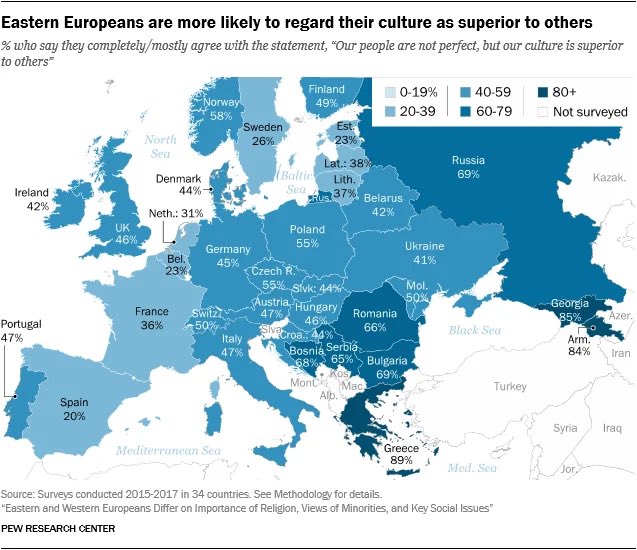
Here is the link, via the wisdom of Garett Jones. And OK, which nations have the cultural inferiority complexes? The ones that rate themselves highly, or the converse?
What I’ve been reading
1. Abigail Shrier, Bad Therapy: Why the Kids Aren’t Growing Up. I agree with many of the anti-therapy arguments in this book, but still I feel that “bad therapy” is a second-order phenomenon, not the initial cause of the growing mental health problems of America’s young people. Furthermore, the analysis (much like Jon Haidt’s recent work) should be more tightly framed in the context of the “most interventions really don’t matter that much” results in social science at the very general level.
2. Adam Shatz, The Rebel’s Clinic: The Revolutionary Life of Frantz Fanon. Well-written and well-organized, this checks all the boxes for what I would want from a Fanon biography. Here is an Adam Shatz NYT Op-Ed on Fanon.
3. Nabila Ramdani, Fixing France: How to Repair a Broken Republic. What is wrong with France, from a French-Algerian point of view. The book is full of substance, and there aren’t enough “stand alone books on countries,” so this is a good one whether or not you agree with all of the observations.
4. Michael Bliss, The Discovery of Insulin. “Tassting the urine was the doctors’ original test for diabetes.” An excellent biomedical history, noting that the key breakthrough came in Toronto in the 1920s.
And the AEI Press has reprinted the 1951 Edward Banfield classic Government Project.
Rainer Zitelmann has a new book out How Nations Escape Poverty: Vietnam, Poland, and the Origins of Prosperity.
Lewis E. Lehrman has published his autobiography The Sum of It All. He was one of the important figures behind the Reagan Revolution, in addition to his longstanding presence amongst New York elites.
What Ireland and Scotland are doing to their housing markets
From Kieran Lucid and Polysee:
Saturday assorted links
1. Is Somalia running on electronic money?
2. Lookism and blond privilege?
3. What do states do with fiscal windfalls?
4. Jane Austen fans oppose Jane Austen statue on the grounds that people might visit it.
5. A user has created a very useful guide to Marginal Revolution University videos.
7. Nvidia is now worth more than Saudi Aramco.
8. The Elon vs. OpenAI legal case. Worth a read.
The Continuing Influence of Fast Grants
Fast Grants, the rapid COVID funding mechanism created by Tyler, Patrick Collison and Patrick Hsu continues to inspire change around the world. Jano Costard, the Head of Challenges at SPRIND, the German Federal Agency for Disruptive Innovation writes:
Lots to learn from Fast Grants! Can we implement it in a public institutions that face a different set of rules (and legacy)? We tried with the Challenge program at the German Federal Agency for Disruptive Innovation, SPRIND, and succeeded, mostly.
While Fast Grants gave out grants in the first round in 48h, we haven’t been that speedy. Our last Challenge had 2 weeks and 2 days from deadline until final decision in a two stage evaluation procedure. Those last two days were spent doing pitches and the teams were informed of the decision the following night. So, it rather compares to the 2 weeks decision time Fast Grants has for later rounds.
During Covid, speed was of the utmost importance. But speed remains crucial now. Teams we fund have applications with other public funders undecided after more than 2 years. These delays accumulate and matter even for pressing but slowly advancing threats like climate change. No cleantech solution that is still in the lab today will have a meaningful impact on achieving our climate goals for 2030! It’s not only the R&D that takes time, getting to meaningful scale quickly will be much harder. That’s why there is no time to waste at the start of the process.
Fast grants has two important advantages when it comes to implementation: private funds and limited legacy. Public institutions often face additional rules and procedures that slow down processes. But this is not inevitable.
For SPRIND Challenges, we implemented a funding mechanism that left room for unbureaucratic processes and provided solutions for challenges that public funders or procurers typically face. This mechanism, called pre-commercial procurement, has been established by the European Commission in 2007 but was used in Germany only 1 time until we started to use it in 2021. This is also due to legacy in processes. Institutions execute their work in part based on an implicit understanding of how things need to be, about what is allowed and what is not. This might lead them to ignore new and beneficial instruments just because “this can’t be true”. Even worse, if new mechanisms are adopted by an institution with strong inherent understand of what can and cannot work, they run the risk of overburdening new and beneficial mechanisms with previous processes and requirements. In the end, a funding mechanism is just a tool. It needs to be used right.
SPRIND had the benefit of being a newly established public institution with important liberties in doing things differently and it’s lead by a Director @rafbuff who, at the time, had no experience in the public sector. So, did we find the ultimate way to research and innovation funding with SPRIND Challenges? Certainly not! Improvements are necessary but sometimes hard to achieve (looking at you, state-aid-law!).
Impressive! And check out SPRIND, they are funding have some interesting projects!
Canada fact of the day
*NEW* Canada's GDP grew by 1.1% between the 4th quarter of 2022 and 2023, while its population grew by 3.2%. That means GDP per capita is now falling at 2% annually (roughly the difference). Zero economic growth in more than 6 years. pic.twitter.com/SrGGKPZjNx
— Mikal Skuterud (@mikalskuterud) February 29, 2024