Marriage sentences to ponder
Increased exposure to opposite-sex members of other class groups generates a substantial increase in interclass marriage, but increased exposure to other race groups has no detectable effect on interracial marriage.
That is from the job market paper of Benjamin Goldman, a job market candidate from Harvard University.
My excellent Conversation with Stephen Jennings
Recorded in Tatu City, Kenya, not far from Nairobi, Tatu City is a budding Special Enterprise Zone. Here is the transcript, audio, and video. Here is the episode overview:
Stephen and Tyler first met over thirty years ago while working on economic reforms in New Zealand. With a distinguished career that transitioned from the New Zealand Treasury to significant ventures in emerging economies, Stephen now focuses on developing new urban landscapes across Africa as the founder and CEO of Rendeavour.
Tyler sat down with Stephen in Tatu City, one of his multi-use developments just north of Nairobi, where they discussed why he’s optimistic about Kenya in particular, why so many African cities appear to have low agglomeration externalities, how Tatu City regulates cars and designs for transportation, how his experience as reformer and privatizer informed the way utilities are provided, what will set the city apart aesthetically, why talent is the biggest constraint he faces, how Nairobi should fix its traffic problems, what variable best tracks Kenyan unity, what the country should do to boost agricultural productivity, the economic prospects for New Zealand, how playing rugby influenced his approach to the world, how living in Kenya has changed him, what he will learn next, and more.
Here is one excerpt:
COWEN: Just give us some basic facts. Where is Tatu City right now, and where will it be headed when it’s more or less finished?
JENNINGS: Tatu City is the only operational special economic zone [SEZ] in the country. It is 5,000 hectares of fully planned urban development. It is at quite an advanced stage. We have 70 large-scale industrial companies with us, including major multinationals and many of the regional leaders. We have 3,000 students come on site every day to our four new schools. We’re advanced in building the first phase of the first new CBD for the region. We have tens of thousands of core center jobs moving into that area, together with other modern office amenities. All of the elements — we have many residential modules, thousands of new residential units at a wide range of price points — all of the elements of a new city are in place.
COWEN: How many people will end up living here?
JENNINGS: Around 250,000.
COWEN: And how many businesses?
JENNINGS: There’ll be thousands of businesses.
And delving more deeply into matters:
COWEN: What do you think is the book [on economic development] that has influenced you most?
JENNINGS: It’s a very good question. I think I’ve read just about everything in development. There’s nothing I really like very much. Development is a black box. I don’t think there’s anything that has much predictive power. There’s a lot of ex post explanations, whether they be policy settings, location, culture. I think 90% of them are ex post; very few of them are predictive. Some of them are just tautologies. I really like factualization.
It’s descriptive more than analytical, but it just makes it clear that most of the world has been on a very similar development trajectory. It’s just not sequenced. Sweden started early; Ethiopia started late. But the nature of the transition and the inevitability of that transition, other than very extreme circumstances, is kind of the same.
COWEN: What do you think economists get wrong?
JENNINGS: I don’t think we really understand development at all, because if we could, we could predict it. We can predict virtually nothing. It’s just too complicated. It’s too connected with politics. I think there’s a lot of feedback loops and elements of development that we don’t understand properly. We certainly can’t quantify them because the development’s happening in such a wide range of settings, from communism dictatorships through to very liberal systems and with all different kinds of industrial — on every dimension, there’s a huge range of variables.
Excellent and interesting throughout.
Wednesday assorted links
1. Jake Seliger on the clinical trial system, from the point of view of a patient. And from his wife Bess Stillman.
2. The war in Sudan, and its economics.
3. Progress on the dengue front (link corrected).
4. Joy Buchanan review of GOAT.
5. Zvi’s review of the AI Executive Order, recommended if you care.
Why aren’t the American hostages receiving more attention?
Yesterday Senator Marsha Blackburn tweeted: “The White House admitted Hamas is holding nearly 500 Americans hostage in Gaza.” To be clear, those are Americans not allowed to leave Gaza (NYT), they are not being held in a compound. As for hostages in the narrower sense of that term, there seem to be about ten. Neither are instances of liberty, nor are they safe positions to be in. Personally, I would consider both groups to be hostages.
No matter which definition of hostage you prefer, I don’t see so many major MSM articles about these hostages. I remember the much earlier Iranian hostage crisis, when many Americans even knew the identities and life stories of individual hostages. It was a front page item almost every day. As I am composing this post (the day before), I don’t see it on the NYT front page at all. Same with WaPo, though they do have “Biden hosts Trick or Treaters at the White House.” If you consider this New Yorker story, well yes it covers the American hostages somewhat, but it is nothing close to what I might have expected. They are not even the article lead. So why so little coverage? I have a few candidate hypotheses, which may or may not be true:
1. The MSM wants Biden’s reelection, and they don’t want him ending up painted as “another Jimmy Carter” who cannot rescue the hostages.
2. The young Woke staffers at MSM don’t want to make Hamas look too bad, or to make the Israeli retaliation look too good.
3. These hostages are themselves not “The Current Thing,” even though the war itself seems to be The Current Thing. Has “The Current Thing” become so narrowly circumscribed?
4. For some national security reasons, MSM has been told by our government that too much hostage coverage would endanger their possible release or rescue.
5. The Biden administration is pressuring MSM not to cover the hostages too much, out of fear that the domestic pressures for America to intervene will become too strong.
6. It simply hasn’t happened yet, due to noise in the system.
What else? I am not saying any of those are true, and some of them are more conspiratorial than the kinds of explanation I usually find persuasive. So why don’t the American hostages receive more attention?
The Burial
I loved The Burial on Amazon Prime. Not because it’s a great movie but because it serves as a cinematic representation of my academic paper with Eric Helland, Race, Poverty, and American Tort Awards. Be warned—this isn’t a spoiler-free discussion, but the plot points are largely predictable.
 The Burial is a legal drama based on real events starring Jamie Foxx as Willie Gary, a flashy personal injury lawyer who takes the case of Jeremiah O’Keefe, a staid funeral home operator played by Tommy Lee Jones. O’Keefe is suing a Canadian conglomerate over a contract dispute and he hires Gary because he’s suing in a majority black district where Gary has been extremely successful at bringing cases (always black clients against big corporations).
As a drama, I’d rate the film a B-. The major failing is the implausible friendship between the young, black, flamboyant Willie Gary and the older, white subdued Jeremiah O’Keefe. Frankly, the pair lack chemistry and the viewer is left puzzled about the foundation of their friendship. The standout performance belongs to Jurnee Smollett, who excels as the whip-smart opposing counsel.
What makes The Burial interesting, however, is that it tells two stories about Willie Gary and the lawsuits. The veneer is that Gary is a crusading lawyer who uncovers abuse to bring justice. Most reviews review the veneer. Hence we are told this is a David versus Goliath story, a Rousing True Story and a story about the “dogged pursuit of justice.” The veneer is there to appease the simple minded, an interpretation solidified by The Telegraph which writes, without hint of irony:
The audience at the showing was basically adult and they applauded at the end which you often see in children’s movies but rarely in adult films.
The real story is that Gary is a huckster who wins cases in poor, black districts using a combination of racial resentment and homespun black-church preaching to persuade juries to redistribute the wealth from out-of-state big corporations to local knuckleheads. I use the latter term without approbation. Indeed, Gary says as much in his opening trial where he persuades the jury to give his “drunk”, “tanked” “wasted”, “no-good”, “depressed,” “suicidal” client, $75 million dollars for being hit by a truck! Why award damages against the corporation? Because, “they got the bank.” (He adds that his client had a green light–this is obviously a lie. Use your common sense.)
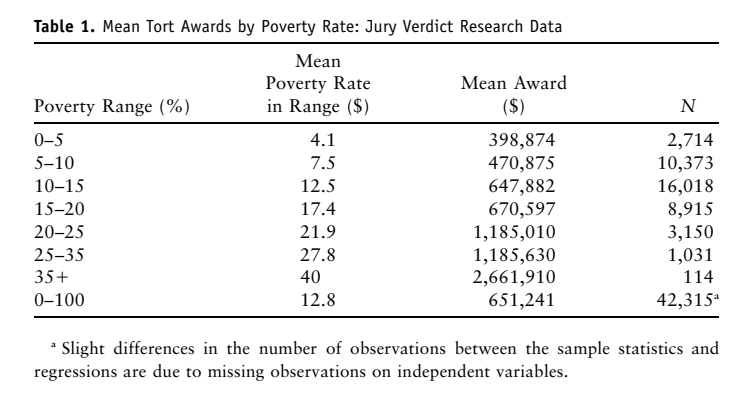 My paper with Helland, Race, Poverty, and American Tort Awards, finds that tort awards during this period were indeed much higher in counties with lots of poverty, especially black poverty. We find, for example, that the average tort award in a county with 0-5% poverty was $398 thousand but rose to a whopping $2.6 million in counties with poverty rates of 35% or greater! The Burial is very open about all of this. The movie goes out of its way to explain, for example, that 2/3rds of the population of Hinds county, the county in which the trial will take place, is black and that is why Willie Gary is hired.
The case on which the movie turns is as absurd as the opening teaser about the drunk, suicidal no-good who collects $75 million. Indeed, the two trials parallel one another. The funeral home conglomerate, the Loewen group, offered to buy three of O’Keefe’s funeral homes but after shaking on a deal they didn’t sign the contract. That’s it. That’s the dispute. The whole premise is bizarre as Loewen could have walked away at any time. Moreover, O’Keefe claims huge damages–$100 million!–when it’s obvious that O’Keefe’s entire failing business isn’t worth anywhere near as much. So why the large claim of damages? Have you not being paying attention? Because the Loewen group, “they got the bank.”
Furthermore, and in parallel with the earlier case, it’s O’Keefe who is the no-gooder. O’Keefe’s business is failing because he has taken money from burial insurance premiums–money that didn’t belong to him and that should have been invested conservatively to pay out awards–and lost it all in a high-risk venture run by a scam artist. Negligence at best and potential fraud at worst. Moreover, in a strange scene motivated by what actually happened, O’Keefe agrees to sell to Loewen only if he gets to keep a monopoly on the burial insurance market. Thus, it’s O’Keefe who is the one scheming to maintain high prices.
Indeed, the whole point of both of Gary’s cases is that he is such a great lawyer that he can win huge awards even for no-good clients. As if this wasn’t obvious enough, there is an extended discussion of Willie Gary’s hero….the great Johnnie Cochran, most famous for getting a murderer set free.
Loewen should have won the case easily on summary judgment but, of course, [spoiler alert!] the charismatic Gary wows the judge and the jury with entirely irrelevant tales of racial resentment and envy. The jury eats it up and reward O’Keefe with $100 million in compensatory damages and $400 million in punitive damages! The awards are entirely without reason or merit. The awards drive the noble Canadians of the Loewen group out of business.
The Burial is a courtroom drama surfaced with only the thinnest of veneers to let the credulous walk away feeling that justice was done. But for anyone with willing eyes, the interplay of racism, poverty, and resentment is truthfully presented and the resulting miscarriage of justice is plain to see. I enjoyed it.
Addendum: My legal commentary pertains only to the case as presented in the movie although in that respect the movie hews reasonably close to the facts.
Argentina fact of the day
Argentina just released birth statistics for 2022, and the TFR just keeps on dropping. Last year it reached a new record low of 1.36 children per woman. Some provinces have already reched the ultra low levels common in Spain. https://t.co/ZWI4qzkIco
— Birth Gauge (@BirthGauge) October 31, 2023
Denmark takes forceful measures to integrate immigrants
After they fled Iran decades ago, Nasrin Bahrampour and her husband settled in a bright public housing apartment overlooking the university city of Aarhus, Denmark. They filled it with potted plants, family photographs and Persian carpets, and raised two children there.
Now they are being forced to leave their home under a government program that effectively mandates integration in certain low-income neighborhoods where many “non-Western” immigrants live.
In practice, that means thousands of apartments will be demolished, sold to private investors or replaced with new housing catering to wealthier (and often nonimmigrant) residents, to increase the social mix.
The Danish news media has called the program “the biggest social experiment of this century.” Critics say it is “social policy with a bulldozer.”
The government says the plan is meant to dismantle “parallel societies” — which officials describe as segregated enclaves where immigrants do not participate in the wider society or learn Danish, even as they benefit from the country’s generous welfare system.
Here is more from the NYT, and do note that Singapore has its own version of this policy. I would make a few observations:
1. Putting aside the normative, analyzing the effects of such policies will be increasingly important. Economists are not especially well-suited to do this, nor is anyone else. I am well aware of the Chetty “Moving to Opportunity” results. That is good work, but a) it probably doesn’t apply to coercive Danish resettlements, and b) cultural context is likely important for the results. At least for the countries that migrants wish to move to, most will have their own versions of this dilemma.
2. “Open Borders” as a sustainable political equilibrium is looking much weaker than it did a month ago. The key question in immigration policy is not “how many migrants should we take in?” (a lot, I would say), but rather “how can we make continuing immigration a politically sustainable proposition?” Many immigration advocates are in a fog about their inability to offer better answers to that question.
3. Will this Danish action, once the entire political economy is worked through, increase or decrease the allowed number of migrants to the country? Looking at the demand side to migrate, will this policy end up attracting a higher or lower quality of migrants to Denmark? Is Denmark even attractive enough as a destination to get away with this? Or will it send a better signal to would-be migrants and thus raise quality?
I would not be too confident about my answers to those questions, nor should you be so confident.
Agustin Lebron on the new AI Executive Order (from my email)
Even though it’s not a compute cap (just a requirement to register, for now), surely this emboldens competitors to OpenAI/etc? If I think I can build a system up to the cap, then my playing field just got more level.
This will also spur lots of research into sample efficiency again, which IMO is a very good thing. It’s been a research area that has languished for years under the “just throw more flops at it” regime.
Finally, I think the order perversely legitimizes capabilities research by showing the world “Well, the US gov’t thinks capabilities are SO important they’re making orders about it”. More attention, more dollars, more progress.
Overall this is accelerative for AI/AGI IMO.
Tuesday assorted links
1. Some comments on the AI Executive Order. And on the role of HHS. And Adam Thierer. And yet another negative take. I agree with the general perspective of the more negative takes, but perhaps they are overrating the legality/enforcement of the actual Order?
2. Acapulco report.
4. New paper on the economic recovery of Hiroshima (Princeton job market paper also).
5. Shocker: university faculty are very slow to adopt generative AI, students are way ahead of them.
Narrative Bending Chart of the Day
From an excellent piece by John Burn-Murdoch in the FT on education and wages in England.

Are dementia rates falling?
A study published in 2020, which drew together multiple pieces of research to track the health of almost 50,000 over-65s, showed the incidence rate of new cases of dementia in Europe and North America had dropped 13 per cent per decade over the past 25 years — a decline that was consistent across all the studies.
For Albert Hofman, who chairs the department of epidemiology at the Harvard TH Chan School of Public Health, the research points to one conclusion: “The absolute risk [of developing dementia] is lower now” than it was 30 years ago. Now, there are early signs that the same phenomenon may be emerging in Japan, a striking development in one of the world’s most aged populations, suggesting that the downward trend is becoming more widespread…
While emphasising that the reasons for the reduction in incidence are not yet fully understood, Hofman believes better cardiovascular health is likely to be a significant factor given the proven links between the two.
Here is more from Sarah Neville at the FT. Maybe that is where the Flynn effect has been hiding!
What predicts anti-Semitism?
Two cross-sectional studies were carried out in order to identify predictors of antisemitism, measured using the Generalised Antisemitism or GeAs scale. In the first, which used a self-selecting sample of UK-resident adults (n = 809), age, gender, ethnicity, and educational level as well as a wide range of ideological predictors were analysed as bivariate predictors of antisemitism. In the second, which used a representative sample of UK-resident adults (n = 1853), the same demographic predictors plus the non-demographic predictors found to have the strongest bivariate relationships with Generalised Antisemitism in the previous study were used to construct a linear model with multiple predictors. Ethnicity, support for totalitarian government, belief in malevolent global conspiracies, and anti-hierarchical aggression were identified as the strongest predictors of Generalised Antisemitism. However, support for totalitarian government was only found to predict ‘old’ antisemitic attitudes (measured using the Judeophobic Antisemitism or JpAs subscale) and not ‘new’ antisemitic attitudes (measured using the Antizionist Antisemitism or AzAs subscale), whereas ethnicity, anti-hierarchical aggression, and belief in malevolent global conspiracies were found to predict both ‘old’ and ‘new’ antisemitic attitudes. This finding adds nuance to ongoing debates about whether antisemitism is more prevalent on the political right or left, by suggesting that (at least in the UK) it is instead associated with a conspiracist view of the world, a desire to overturn the social order, and a preference for authoritarian forms of government—all of which may exist on the right, the left, and elsewhere.
That is from a recent paper by Daniel Allington, David Hirsh, and Louise Katz. Via Jay Van Bavel.
Monday assorted links
1. That was then, this is now, railway compartment edition.
2. Harriet Taylor is underrated.
3. “My data show that nearly half of my study participants report meaningful and regular interactions with deceased relatives and friends who were important in their lives.” — solve for the AI equilibrium.
4. Yet another paper showing that the evidence for YouTube radicalization is weak.
5. Russ Roberts Substack on current life in Israel.
6. Patrick O’Shaughnessy interview John and Patrick Collison.
Covid vaccines and mortality
The global COVID-19 vaccination campaign is the largest public health campaign in history, with over 2 billion people fully vaccinated within the first 8 months. Nevertheless, the impact of this campaign on all-cause mortality is not well understood. Leveraging the staggered rollout of vaccines, we find that the vaccination campaign across 141 countries averted 2.4 million excess deaths, valued at $6.5 trillion. We also find that an equitable counterfactual distribution of vaccines, with vaccination in each country proportional to its population, would have saved roughly 670,000 more lives. However, this distribution approach would have reduced the total value of averted deaths by $1.8 trillion due to redistribution of vaccines from high-income to low-income countries.
That is from a new NBER working paper by Virat Agrawal, Neeraj Sood, and Christopher M. Whaley.
The SEC Burned LBRY to the Ground
LBRY was YouTube on the blockchain, a public good protocol for delivering video content. Unfortunately, after years of protracted and extremely expensive legal wrangling with the SEC, LBRY has been driven into bankruptcy and forced to shut down as an organization (although the code lives on). I was a long-time LBRY advisor.
It makes me angry that with all the scams in the crypto world, the SEC chose to go after a working product with real customers and users. No one, not the customers, the content creators or the investors has benefitted or been protected by the SEC. But you don’t have to take my word for it. Here is SEC commissioner Hester Peirce’s compelling Statement of Dissent:
The Commission has brought many troubling crypto enforcement actions, but the LBRY, Inc. (“LBRY”) case has especially unsettled me. A statement on the case is overdue. I did not support bringing the case, but have been unable to speak publicly about my concerns while the case has been in litigation. Last week, after losing in federal district court on the question of whether the sale of LBRY tokens was an unregistered securities offering, LBRY announced that it will not move forward with an appeal of the decision.[1] Instead, the company will shut down and its assets will be placed in receivership and used to satisfy its debts, including the civil money penalty owed to the Commission.[2] Are investors and the market really better off now after the Commission’s litigation contributed to the demise of a company that had built a functioning blockchain with a real-world application running on top of it? This case illustrates the arbitrariness and real-life consequences of the Commission’s misguided enforcement-driven approach to crypto.
One does not have to dig deep to find fraudulent crypto projects that sold tokens with promises that they did nothing to fulfill. This sad reality makes the Commission’s decision to bring a case against LBRY especially puzzling. LBRY’s approach was more conservative than the approach many other projects took.[3]Here, the blockchain was up and running at the time most tokens were sold, and the Commission’s complaint did not allege, and the court did not find, evidence of fraud. LBRY built a blockchain to facilitate data sharing, afford greater control to content creators, and make censorship more difficult. LBRY created a popular platform on the blockchain for sharing videos and other media.[4] The open-source LBRY blockchain was available for anyone else to use.[5] Why go after a company that sold a token for a functioning blockchain with an established use when we could have pursued plenty of other projects that were outright frauds and did not attempt to comply with the securities laws? To make matters worse, the Commission took an extremely hardline approach in this case. For example, after winning on summary judgment, the Commission sought monetary remedies of $44 million and asserted that LBRY’s offer to burn all tokens in its possession was not sufficient assurance that LBRY would not violate the registration provisions in the future.[6] The Commission’s requested remedies were entirely out of proportion to any harm. Indeed, the court stated during the remedies hearing that “the absence of fraud allegations, [and] the fact that there was some measure of uncertainty” regarding the application of the securities laws when LBRY commenced its offering were facts that “should be taken into account when considering a penalty.”[7] After the remedies hearing, the Commission pared its penalty request back to a significantly lower $111,614, which the court approved.[8]
The application of the securities laws to token projects is not clear, despite the Commission’s continuous protestations to the contrary. There is no path for a company like LBRY to come in and register its functional token offering.[9] Even if a company did manage to register its token offering, it would not be a particularly useful effort. Compliance with the securities laws is important because we want to ensure that people buying securities receive accurate and reliable information so they can assess the risks and rewards of an investment. Here, LBRY made significant disclosures outside of the registration process—disclosures that the Commission did not allege were fraudulent or misleading—and there is little to indicate that LBRY’s disclosures did not provide token purchasers with information adequate to assess whether the tokens were a good fit for them.[10] The time and resources we expended on this case could have been devoted to building a workable regulatory framework that companies like LBRY could have followed. Then the market could have decided LBRY’s fate.
Even if, as the judge ruled here, the offering of tokens should have been registered, our scorched earth approach in remedying the violation was completely out of proportion to any investor harm. How does the result in this case protect LBRY investors, who likely would have preferred that the company continue to exist to support the blockchain, which is still in its infancy? The judge did not rule on whether the token itself was a security or on the status of secondary sales of LBRY tokens,[11] which means that the LBRY blockchain may live on, but its path forward is difficult. The Commission’s action forced a group of entrepreneurs to abandon what they built. Our disproportionate reaction in this case will dissuade people from experimenting with blockchain technology, which LBRY aptly describes as “technology that enables dissent.”[12] A government of a free people should welcome dissent and the technologies that enable it.
Earlier this year, LBRY tweeted: “It’s the year 2028, hundreds of thousands of Americans have been jailed for using illegally cryptocurrency instead of CBDCs, and Hester Pierce [sic] is still just writing dissenting memos.”[13] Although I will be tending bees, not writing dissents, in 2028, I think often about the crux of that criticism and ask myself: “What could I do to help prevent another group of people with a big idea for changing the world from going through what LBRY has over the past several years?” I have not come up with an answer to that question; however, I urge people who have suggestions about how the Commission can right its course on crypto and innovation more broadly, to send them my way.[14]