Might the status of India and Pakistan fundamentally change?
That is the topic of my latest Bloomberg column, here is the LiveMint version, here is one excerpt:
The status quo between India and Pakistan is temporary. The world should start thinking about a future in which the two nations have a fundamentally different relationship.
Full reunification, of course, is difficult to imagine. But there are many possible options that fall short of that: a loose confederation, a NAFTA-like trade structure, a military alliance, even a broader regional reconfiguration under which each nation loses some territory but the remaining parts move closer together.
And:
What about arguments on the other side? They are mostly longer-term.
First, it’s worth noting that major changes in borders — whether through conquest, secession or unification — are the historical norm. In this respect, the post-colonial era is an anomaly. One view is that this era of relative stability will continue. Another is that it will prove temporary, and frequent border changes will become common once again — just as the border between Russia and Ukraine is being contested again.
If this second view is correct, India and Pakistan are hardly such longstanding, well-defined nations that they are natural candidates to stay exactly as they are. Both their borders and their political arrangements can quickly change.
Just think how unlikely today’s configuration in the Middle East might have seem fifty years ago. We now have Iran as the enemy of Israel and America, a democratic Iraq, a devastated Syria, a wealthy UAE friendly with Israel, a rather passive Egypt at peace with Israel, and Lebanon no longer the jewel of the region, among other major surprises. Get over your recency bias!
I suspect Ethiopians and Eritreans will have a relatively easy time digesting this argument.
Time for Direct Instruction!
Time magazine has a good piece on the massive efforts to return to phonics based reading instruction. The Open Court program mentioned below is a variant of Direct Instruction (DI) which I have written about before (most recently here). As usual, DI works but the teachers don’t like it.
As a teacher in Oakland, Calif., Kareem Weaver helped struggling fourth- and fifth-grade kids learn to read by using a very structured, phonics-based reading curriculum called Open Court. It worked for the students, but not so much for the teachers. “For seven years in a row, Oakland was the fastest-gaining urban district in California for reading,” recalls Weaver. “And we hated it.”
The teachers felt like curriculum robots—and pushed back. “This seems dehumanizing, this is colonizing, this is the man telling us what to do,” says Weaver, describing their response to the approach. “So we fought tooth and nail as a teacher group to throw that out.” It was replaced in 2015 by a curriculum that emphasized rich literary experiences. “Those who wanted to fight for social justice, they figured that this new progressive way of teaching reading was the way,” he says.
A short memoir of Christine M. Korsgaard
Here is her take on what is wrong with philosophy today:
Young people are expected to produce an absurdly large number of papers, preferably published in refereed journals, in order to get tenure, or even in order to get jobs. Some people even try to publish papers in order to get into graduate school. The papers are supposed to be blind reviewed, and these days many referees for journals require that papers should respond to the extant literature on the topic, whether responding to the extant literature enhances the author’s argument in some way or not. Because the sheer mass of the literature is growing exponentially, people draw the boundaries of their specializations more and more narrowly, both in terms of subject matter and in terms of time. The extant literature necessarily becomes the recent literature, which is a philosophically arbitrary category. Big, systematic philosophy of the sort we find in Kant and Aristotle, philosophy that is responsible to the ways in which one’s views in one area fit in with one’s views about everything else, has become nearly impossible, because someone trying to do that kind of work would supposedly have to know the literature in too many different areas
Most of the piece covers her earlier career and other issues, interesting throughout. This part I found excellent:
I first began to think about this when I began to go around giving colloquium talks in other departments. Often I would meet philosophers whom I had only known in print before. And I was constantly surprised to find that in their questions to me, many of these philosophers seemed more imaginative, more speculative, more playful in their thinking, than they appeared to be in print. Was this just because they were more willing to go out on a limb when they were talking about someone else’s ideas? Or does the very act of committing your ideas to paper somehow clip your wings? I believe that much of the trouble with philosophical writing springs from the author’s failure to strike up the right kind of relationship with his reader, his audience. Above all, much philosophical writing is defensive.
For the pointer I thank Siddharth Muthukrishnan.
Gender Differences in Persistence and Publishing in Economics
We design an experiment to study gender differences in reactions to editorial decisions on submissions to top economics journals. Respondents read a hypothetical editor’s letter where the decision (e.g., revise and resubmit) is randomized across participants. Relative to an R&R, female assistant professors who receive a rejection perceive a significantly lower likelihood of subsequently publishing the paper in any leading journal than comparable male assistant professors. We do not find this gender difference among tenured professors. We consider several mechanisms, pointing to gender differences in attribution of negative feedback to ability and confidence under time constraints as likely explanations.
Here is the full paper by Gauri Kartini Shastry and Olga Shurchkov. Via the excellent Kevin Lewis.
Sunday assorted links
3. Russ Roberts critique of utilitarianism, that is part I, finishes up with part IV.
5. Ross Douthat on the CDC and its continuing failures (NYT).
Why Matt Yglesias should be a conservative
“Conservative” isn’t exactly the word I would use, but he chose it, so for now let’s just run with that. Here is an excerpt from Matt’s Substack (do subscribe!):
In terms of Tyler’s take, while I accept the logic of the view that it’s better to tax consumption than to tax investment, I just don’t buy into the idea that taxing investment is really bad. If I did, I would be a conservative like he is. But I don’t. I also think that, frankly, he always holds Democratic bills to a super-high standard of technocratic rigor while setting a much lower bar for Republican ones — to be generous, he maybe does that to counteract what he sees as a prevailing left bias of econ Twitter.
But to me, taxing investment with one hand while subsidizing investment with another is pretty good, especially paired with deficit reduction and permitting reforms.
Whether taxing investment at high rates is “bad,” or “really bad,” I am not sure. But it is at least one of those. Let me lay out a core, simple case for relatively low rates of taxation on capital income. One can slug it out with the models, but much of the case comes down to two core intuitions:
1. A lot of people are myopic. That encourages too much consumption relative to investment. Matt himself frequently cites examples of myopia, in this Substack post it is Doritos chips and also Instagram.
2. A lot of institutions, including corporations, are too risk-averse relative to social returns. This is the old Arrow-Lind argument. They won’t take enough chances, and that too stifles some investment. After all, consumption usually is safer than investment, at least if you know where to take your dinners. Furthermore, the bureaucratization of society, including much of the private sector, is proceeding apace, so the thrust of the Arrow argument is stronger than it used to be, even though it may be relying increasingly on non-Arrovian mechanisms.
If you favored Operation Warp Speed, chances are you buy into this argument for at least some kinds of investment.
We simply don’t want the tax system to make these biases worse. And those biases are pretty strong, close to ever present, and fairly universal.
You might add a third argument from time inconsistency:
3. Governments are often not credible, and short-sighted, so they have an excess tendency to tax or confiscate fixed capital investments, even when this is bad in the longer run.
To refer back to Matt’s post, I am not so keen on the general concept “raise the taxes on capital and make the subsidies for investment even bigger” as an approach If you wish to subsidize some kinds of investment, do so at the lowest (optimal) rate possible.- It is simpler, cheaper, involves less deadweight loss, and places less burden on the government to find and implement all of the right tax and subsidy offsets.
I used to favor a zero tax rate of capital, but I no longer hold that view. There are too many options for reclassifying labor income into capital income and thwarting the purposes of the tax system altogether. Nonetheless, subject to this constraint, I think taxes on capital should be as low as possible.
John Stuart Mill was considered a “socialist” in his time, but even he thought the tax rate on capital should be zero and governments should tax land and consumption, still a good formula.
I would make a few additional points:
a. You can favor a low rate of capital taxation without thinking the elasticity of savings is very high. If you tax Amazon less, they will have more money to invest, no matter how savings respond. Furthermore, capital can flow in from abroad, all the more as the world becomes wealthier (and less politically safe?).
b. Capital investment boosts wages, and the quantity/quality of capital invested per worker is a major long-run determinant of wages.
c. Capital investments produce goods and services, which create consumer surplus for everyone. If you are tempted to use the words “trickle down” in this discussion, you are not understanding #b or #c. You really do want to live in the economies with more capital investment per worker.
d. Plenty of Western European governments have relatively favorable taxation for capital income, and still achieve relatively egalitarian outcomes. I don’t myself put much stock in this point, but if it matters to you fine by me. A low tax rate on capital income is hardly “giving away the store.”
So Matt should be a conservative. It is fine if he in turn thinks the alternate views are “bad,” rather than “really bad.”
Saturday assorted links
Amritsar is underrated
The Sikh Golden Temple is for me India’s best sight, far more appealing than the Taj Mahal. Would you rather see a mausoleum or a living, breathing site full of human joy? The buildings are remarkably well done and most beautiful at dusk. The site is clean and largely maintained by volunteers, a triumph of Sikh civil society. More people should come here!
The surrounding shops in the pedestrian zone are appealing, and the primary touristy element is directed at Sikh and Hindu pilgrims, not to Westerners.

The food is first-rate, even by Indian standards. Lentils, spinach, mustard leaves, and kulcha soaked with ghee are some of the local specialties. You can eat butter chicken as it was intended, or fish fry. The lassis and raitas are almost as good as those in neighboring Pakistan. Kesar da Dhaba would be my top pick for a restaurant.

And you can stay in a five-star hotel for about $100 a night, excellent swimming pool and restaurant to boot.
From the comments, on corporate tax
Rankings where Canada comes in last
Rankings in which Canada is now last among advanced economies:
-Most unaffordable housing
-Highest cellphone bills
-Most COVID debt as % of GDP (public & private)
-Most-delayed airport (Pearson)
-3rd most inefficient port (Vancouver)
via @nationalposthttps://t.co/SMCTXwB7ez— Jon Hartley (@Jon_Hartley_) August 12, 2022
Friday assorted links
1. Eastward travel benefits NBA teams.
2. How does copyright for AI-created art work?
3. Why aren’t smart people happier?
5. “Fund managers who run marathons deliver higher risk-adjusted returns.” (speculative)
6. What would Cole Porter say? “My Favorite Things,” or rather yours?
Gender Differences in Peer Recognition by Economists
Card et al. study the selection of fellows to the prestigious Econometrics Society showing essentially that prior to about 1980 there was modest discrimination against women. Between 1980 and 2005 about equal access but since 2005 a large bias towards women. Not surprising but citation metrics give us a way of comparing selection with achievement.
The key result can be seen in the raw data–compare the green line of at least 3 top-5s with the red line of selection as an ES fellow.
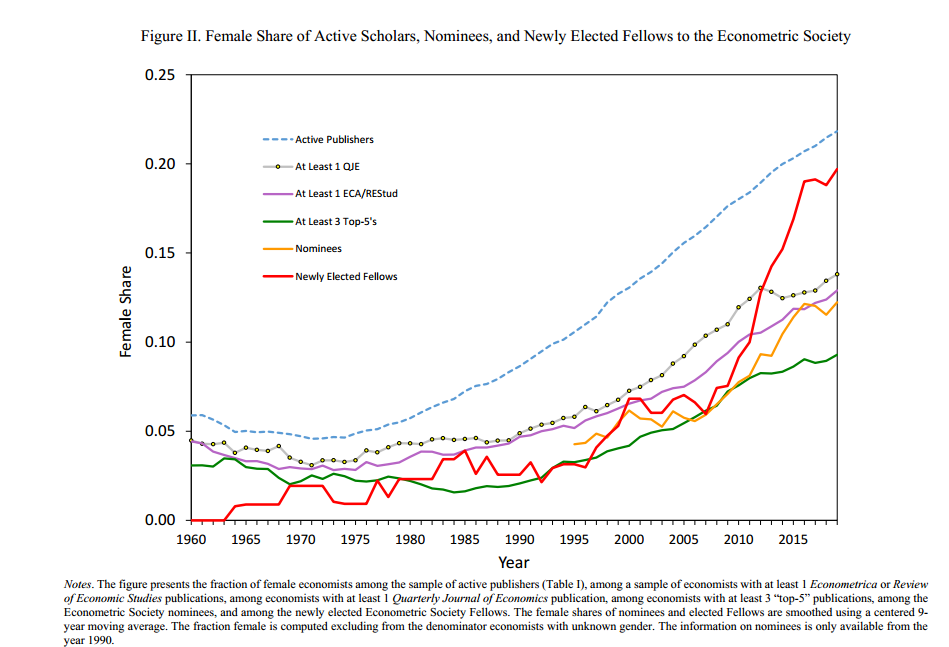
Here is the abstract to the paper with more details.
We study the selection of Fellows of the Econometric Society, using a new data set of publications and citations for over 40,000 actively publishing economists since the early 1900s. Conditional on achievement, we document a large negative gap in the probability that women were selected as Fellows in the 1933-1979 period. This gap became positive (though not statistically significant) from 1980 to 2010, and in the past decade has become large and highly significant, with over a 100% increase in the probability of selection for female authors relative to males with similar publications and citations. The positive boost affects highly qualified female candidates (in the top 10% of authors) with no effect for the bottom 90%. Using nomination data for the past 30 years, we find a key proximate role for the Society’s Nominating Committee in this shift. Since 2012 the Committee has had an explicit mandate to nominate highly qualified women, and its nominees enjoy above-average election success (controlling for achievement). Looking beyond gender, we document similar shifts in the premium for geographic diversity: in the mid-2000s, both the Fellows and the Nominating Committee became significantly more likely to nominate and elect candidates from outside the US. Finally, we examine gender gaps in several other major awards for US economists. We show that the gaps in the probability of selection of new fellows of the American Academy of Arts and Sciences and the National Academy of Sciences closely parallel those of the Econometric Society, with historically negative penalties for women turning to positive premiums in recent years.
From my email, on the new health care provisions
I saw your post on the new bill, and I actually think the healthcare components of it might be worse than the rest of it.The bill has a provision that allows the government to “negotiate” prices for drugs that are among the top 10-20 by spend in Medicare Part B (physician administered, usually IV infusions) and Part D. Since drugs that are selected in one year are not eligible for inclusion in subsequent years, this will capture more and more drugs over time. The negotiation of course happens with a gun to the head—the bill sets statutory minimum discounts of anywhere between 25-60%, depending how long the drug in question has been on market.The biggest issue with the bill is that it makes small molecule drugs eligible 9 years after approval, while biologic drugs are eligible after 13 years. This is based on some silly misconception that small molecule drugs are quicker and cheaper to develop and therefore have shorter payback periods. That may have been true when we were tackling relatively low-hanging fruit like high cholesterol, but small molecule drugs that tackle unmet needs today are nothing less than miracles. An oral pill that treats cystic fibrosis, like Vertex’s Trikafta, or sickle-cell disease, like Global Blood Therapeutics’ Oxbryta, is incredibly challenging to develop.This is going to hurt returns for small molecule drugs and skew R&D efforts away from them to biologics. Biologics like monoclonal antibodies are great, but many of them carry substantial administration costs or suffer from worse compliance/adherence because they are IV infusions that require patients to go into a care setting periodically to receive their next dose. But the real issue is they do not go generic the way small-molecule drugs do. Generics for small-molecule drugs are relatively cheap to develop, benefit from a streamlined approval process, and can be substituted for the branded drug at the pharmacy counter even if the doctor prescribes the brand, and as a result, drive 90% discounts to the brand price. Biologics, as the name suggests, are derived from living cells and thus cannot be easily proven to be equivalent to the brand—clinical trials are required and the overall expense of developing a biosimilar is 10x that of a small-molecule generic ($20M vs $200M). Between the higher development cost, lack of automatic substitution, and doctor and patient reluctance to believe these biosimilars are identical to the brand, biosimilars discount the brand price less and take a smaller share of the market, resulting in smaller savings to the system.It gets worse—many drugs these days are a “pipeline in a product,” targeting a biological mechanism that is implicated in many diseases. The most famous example might be Humira, which began as a rheumatoid arthritis drug and added psoriasis, psoriatic arthritis, ulcerative colitis, Crohn’s disease, ankylosing spondylitis, and hidradenitis suppurative over time, running trials to prove efficacy in each. Humira is a complex example—patent evergreening extended its lifetime and justified the investment in expanding its approved indications, and on a societal basis, it’s hard to know whether that’s good or bad, but hopefully we can agree that the solution to an IP issue is not to create an artificial time of expiry that discourages investment in science.The bill also includes an exemption through 2028 for orphan drugs that are approved in only one indication—these are drugs that target very rare diseases and generally charge extremely high prices to be financially viable. Some of these drugs are eventually tested in and expand to other smaller indications—but this exemption would discourage that and create an incentive to only try the drug in the largest indication and not expand the label to maintain the exemption and maximize its lifespan.Moreover, small companies that derive at least 80% of their revenue from one drug get a partial exemption from this, rendering them unacquirable by a larger drug company, since the drug is worth more as a standalone asset. This is again a failure of incentive design—it forces replication of corporate and commercial infrastructure that would otherwise have been a source of cost synergies for an acquirer.An example of the orphan disease issue is a drug called mavacamten, that Bristol-Myers acquired for $13.1B (it was the main asset of a company called Myokardia). The development plan was to first test the drug in an orphan indication, obstructive hypertrophic cardiomyopathy (oHCM), then expand to non-obstructive HCM, and eventually to a broader non-orphan heart failure market. This is a small-molecule drug, so negotiation eligibility is 9 years after launch in oHCM, or 2031–this would leave only 5-6 years for commercial launch in the heart failure market. While it probably makes sense for BMS to go ahead and test this molecule in heart failure at this point, the NPV of the molecule would be materially lower assuming a 25% discount to Medicare prices at year 9. The investment bank Jefferies estimates it at a 19% haircut—$10.6B from $13.1B. If the discount is deeper and/or spills over to commercial reimbursement, the haircut gets steeper and steeper—this overhang will reduce the number of drugs developed and/or force ever-higher launch prices since more of the value of the molecule has to be generated from the first indication.Lastly, this encourages even more gaming of the system. In theory, authorizing a generic competitor at a small discount at 9 or 13 years would protect the branded drug, as drugs with generic/biosimilar competition are exempt from negotiation. Handing the rights to produce a 10% cheaper version of your drug to Teva or Sandoz could therefore be less costly than the government’s proposed price cuts.This is sadly the story of our entire HC system—poor incentive structures layered on top of each other in an increasingly wobbly manner rendering the whole system unfit for purpose and on the verge of collapse. I should note here that this also targets one of the few industries where the US is still the undisputed global leader—can we really afford to do that? Especially when pharmaceuticals are less than a fifth of US HC spend, and the real drivers of out-of-control healthcare spending are guilds like the AMA and local monopolies (hospital systems that have consolidated heavily and are the largest employers in many congressional districts and even states, giving them both outsize negotiating power against insurers and lobbying clout in Congress).
That is from Anonymous!
Who is for freedom anyway?
For much of the midterm campaign, Democrats have grappled with how to define their message, weighing slogans like “Democrats deliver” and “Build back better,” and issuing warnings against “ultra-MAGA” Republicans.
Now, a coalition of progressive organizations has settled on what its leaders hope will be a unified pitch from the left. This November, they plan to argue, Americans must vote to protect the fundamental freedoms that “Trump Republicans” are trying to take away.
That pitch is the product of a monthslong midterms messaging project called the “Protect Our Freedoms” initiative, fueled by polling and ad testing.
The move is the latest evidence that Democrats at every level of the party and of varying ideological stripes — including President Biden, abortion rights activists in Kansas and, now, a constellation of left-leaning groups — are increasingly seeking to reclaim language about freedom and personal liberty from Republicans. It is a dynamic that grew out of the overturning of Roe v. Wade in June, and one that is intensifying as more states navigate abortion bans while Republicans nominate election deniers for high office.
Here is more from The New York Times.
Thursday assorted links
1. A new anti-schizophrenia drug of real potential.
2. Is the productivity slowdown due to the implementation/idea processing side?
3. How much will the climate bill lower global temperatures?
4. Place-based policies in the CHIPS and Science Act (don’t they usually fail? Why are investing so much in them?).
5. Markers of Long Covid? And an explainer.
That is all from Vivian Darkbloom.