Friday assorted links
1. ““[The plan] asks faculty members, some of whom have lived their entire adult lives working and teaching at Yale, to make a sudden life-changing decision in a matter of months in return for a cash payment,” the draft report reads.” And they are outraged by that fact, link here. Just imagine what getting fired must be like.
2. Toward a public choice theory of the Clintons.
3. “Beavers have built a dam on Exmoor for the first time in more than 400 years.”
4. New Proust stories appearing in English for the first time order them here.
5. Gaming vaccine distribution? And how epidemiologists have changed/will change their behavior (NYT).
6. Financial predictors of Alzheimer’s and dementia.
7. The Lancet published this b.s.?
9. The snapback on this M2 growth is going to be a doozy.
10. Talking about Trees (New Yorker link), a very good Sudanese movie, also a lesson in development economics.
The Distribution of One Million Z-Values
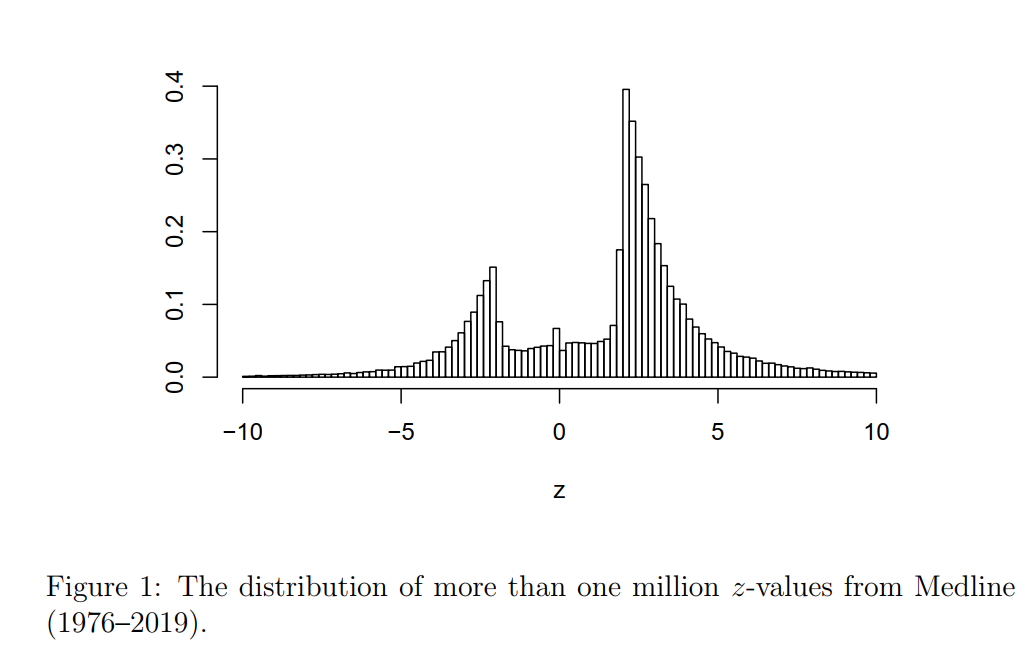
What could possibly explain the dearth of z-values between about -2 and 2???
Hat tip: A tweet from Inquisitive Bird. Paper here.
Covid-19 as a Ramsey tax problem
So many commentators cite lives, hospitalizations, and so on, as measuring the costs of the pandemic, and I understand that those are the rules of engagement, and furthermore I know that welfare economics is not the only relevant normative approach.
Nonetheless let us try to apply welfare economics for just a moment. In that framework what counts as a cost is deadweight loss (no sick pun intended, nor recursively).
Look at it as a public finance problem. The total deadweight loss stems from the size of the “pandemic taxes” or “risk mark-ups” being applied to various human activities, then magnified by elasticities of adjustment, and quite possibly further social externalities from the collapse of critical scale (e.g., it is not just that movie-going might be dangerous, you can no longer enjoy the movie with large crowds of people).
Many of the biggest “risk pandemic taxes” have been put on in-door socializing, many church activities, offices, elevators, live NBA games, etc. You know the story.
If you say that people are overreacting to Covid, in essence you are admitting that those elasticities are high, and probably you think the resulting social externalities are high too. And thus you are saying and indeed emphasizing that the costs of the pandemic are high.
There is a positive statement — “those elasticities are high!” — bundled with a normative statement — “I don’t think those elasticities should be so high!” Being a human, your attention may be drawn to the normative statement. But what welfare economics hears is the positive statement about high elasticities and thus high deadweight loss.
Now you might believe that “talking people down out of their high elasticities” is a good strategy. Maybe. Still I ask you to consider whether this is generally how you approach economic problems. How about?: “Don’t leave NYC just because the taxes are going up! It will wreck the city.” Would your focus be on talking people out of leaving, or rather on keeping taxes down or raising residence benefits correspondingly?
The “overreaction” advocates try to signal “the costs of Covid aren’t that high,” but translated into econspeak it is actually “the costs of Covid are really high.”
Unless they believe a great, great deal in the efficacy and corrective power of moral education. (Does Bryan?)
On top of that, keep in mind that the better informed and better educated people tend to be playing it safer, so the moral education you would have to deploy here would be very strange indeed — “don’t listen to what the other educated sources are telling you, listen to me! You are overreacting!”
That is not where I wish to put my money or my time.
As a side point, note that in the 1968/1957 pandemics elasticities of adjustment were way lower, because you couldn’t switch things to Zoom, Amazon, and so on. So those pandemics were closer to being a “lump sum tax” on human life and thus they were cheaper, and had lower deadweight loss, probably in per capita terms as well. From the framework on welfare economics, that is. The value of human lives was lower then too.
We all know that welfare economics is an inadequate “all things considered” moral framework. But still it brings us insights every now and then.
China fact of the day
Following an FBI investigation this summer, more than 1,000 researchers who had hidden their affiliation with the Chinese military fled the United States, the Justice Department said Wednesday.
Here is the full story.
Thursday assorted links
1. The immediate immigration policy dilemmas faced by Biden. And humans in Mexico 30,000 years ago?
2. Kerfluffle surrounding Philip Lane, chief ECB economist, about making calls privately to banks.
3. Good Dube thread on new wage stickiness paper.
4. Don Boudreaux on Walter Williams (WSJ). And Jayme Lemke. And David Henderson. And Thomas Sowell.
5. The culture that is San Francisco what is up with you people?
6. US vs. UK vaccine review procedures.
7. Delta: “Our partners at Mayo Clinic
8. Some new corporate and banking stuff (WSJ).
“What will they do on Thursday?”
So wondered Eli Dourado. Well, from the front page of Nature:
Sight restored by turning back the epigenetic clock [in mice, to be clear]
Neurons progressively deteriorate with age and lose resilience to injury. It emerges that treatment with three transcription factors can re-endow neurons in the mature eye with youthful characteristics and the capacity to regenerate.
OK people, are you ready for Friday? C’mon, Eli, give ’em another dare!
Via Tom Jens.
The Great Walter Williams, Radical Troublemaker
Our colleague, the great Walter Williams, died on Tuesday shortly after teaching his last class–which is exactly how he would have wanted to go. He was 84 and had been teaching at George Mason since 1980. As Don Boudreaux writes in the WSJ:
For 40 years Walter was the heart and soul of George Mason’s unique Department of Economics. Our department unapologetically resists the trend of teaching economics as if it’s a guide for social engineers. This resistance reflects Walter’s commitment to liberal individualism and his belief that ordinary men and women deserve, as his friend Thomas Sowell puts it, “elbow room for themselves and a refuge from the rampaging presumptions of their ‘betters.’ ”
Walter taught UCLA-Chicago price theory to multiple generations of George Mason students. His students loved him. He secured funding for me when I was a student, for which I have always been grateful. You can find many of his graduate exam questions here. They are tough!
Walter led a remarkable life recounted in his autobiography, Up From the Projects. He was arrested for disorderly conduct several times and drafted into the army. He was later court-martialed but, acting as his own attorney, he wins his case. He’s sent to Korea and when asked to fill in a form stating his race he writes Caucasian because the Negros got all the worst jobs. He tells his commanding officer that he has pledged to defend the constitution against all enemies foreign and domestic and that he, the commanding officer, is a domestic enemy of the constitution. He writes to complain to President John F. Kennedy. The army gives him an honorable discharge. His wife, Connie, helps him to become more mannerly. It was only when he discovered economics, however, that he learned to combine trouble-making with discipline. He was interviewed a few years ago on these themes by Jason Riley for the WSJ:
“I was more than anything a radical,” says Mr. Williams. “I was more sympathetic to Malcolm X than Martin Luther King because Malcolm X was more of a radical who was willing to confront discrimination in ways that I thought it should be confronted, including perhaps the use of violence.
“But I really just wanted to be left alone. I thought some laws, like minimum-wage laws, helped poor people and poor black people and protected workers from exploitation. I thought they were a good thing until I was pressed by professors to look at the evidence.”
During his junior year at California State College in Los Angeles, Mr. Williams switched his major from sociology to economics after reading W.E.B. Du Bois’s “Black Reconstruction in America,” a Marxist take on the South’s transformation after the Civil War that will never be confused with “The Wealth of Nations.” Even so, the book taught him that “black people cannot make great progress until they understand the economic system, until they know something about economics.”
He earned his doctorate in 1972 from UCLA, which had one of the top economics departments in the country, and he says he “probably became a libertarian through exposure to tough-mined professors” — James Buchanan, Armen Alchian, Milton Friedman — “who encouraged me to think with my brain instead of my heart. I learned that you have to evaluate the effects of public policy as opposed to intentions.”
Walter was never politically correct. He once demanded that our Dean do something about the lack of representation of Asian-Americans on the GMU basketball team. He enjoyed his iconoclasm but his provocations were designed to get people to stop and think not to offend. It’s not clear that this is possible anymore.
Walter was a brilliant communicator. GMU Econ Chair Daniel Houser noted:
That Walter is so beloved by legions of non-economists speaks not to his dumbing down of economics in order to attain popularity. Instead, it speaks to his unusual mastery of economics to make it accessible and relevant to ordinary men and women.”
Walter was always his own person, perhaps best reflected in this interview with Nick Gillespie.
Gillespie: Let’s talk a little bit about the broad-based libertarian movement. Do you feel that you are part of a libertarian movement?
Williams: No, I don’t.
Gillespie: So, what are you then?
Williams: I am not a part of a movement. I have never been part of a movement, I just do my own thing.
I miss him already. There is no replacement. Here is Suffer No Fools, an excellent video-biography of the great Walter Williams.
Canada gamble of the day
Canada’s deficit is growing at the fastest rate among developed nations as it seeks to prop up its economy during the Covid-19 pandemic.
Canadian officials are betting the aggressive approach will pay off, pointing to the number of jobs already recovered, and argue that the country can afford to pour money into the economy while borrowing costs are historically low. But some economists warn the heavy spending could lead to a fiscal crisis, and one major ratings firm has already stripped the country of its triple-A rating…
Canada’s virus-related spending, the bulk of which originates with the federal government, has totaled about 382 billion Canadian dollars, the equivalent of $294 billion, and accounts for roughly 19% of Canada’s total economic output.
Yet data from the IMF indicate Canada’s fiscal position during the pandemic—incorporating all levels of government—has deteriorated at the fastest pace among the major economies in the Group of 20 industrialized countries as it seeks to keep the economy pumping.
…So far, Canada has recovered about 80% of the jobs lost in March and April because of the virus, whereas the U.S. has regained just over half of employees shed. Canada’s economy grew by a record 40.5% annual rate in the third quarter, Statistics Canada said Tuesday. However, growth is expected to grind to a halt in the final three months of 2020 as restrictions re-emerged to deal with a rise in Covid-19 infections.
The federal government’s debt is also set to surpass C$1 trillion for the first time this year, or 50% of GDP, and debt from all levels of Canadian government will surge to roughly 115% of GDP this year from 89% in 2019, the IMF said.
Here is the WSJ article, do stay tuned…
I would like to complain about complaining
That is in my latest Bloomberg column, here is part of the argument:
…complaining at a hotel…very often yields a relatively high return, whether your complaint is justified or not. If you tell the front desk that your room was not cleaned promptly and properly, or contact the hotel chain with a similar message, there is a good you will get an upgrade or extra points on your account. Most hotels have empty rooms most of the time, so they are not forgoing very much revenue by granting such favors. They might even be turning you into a more loyal customer.
The injustice you cite doesn’t have to be that serious — what matters is that you brought it to their attention. That means you are looking for a benefit, perhaps with an exploitative motive, but still hotel management may respond. If you are a complainer by nature, you might also be especially likely to post on travel websites, and hotels want to prevent that.
The basic service and pricing model of hotels was never egalitarian to begin with, and that too makes it easier for them to give you a break. They usually charge different prices depending on the time and manner of booking — so if they cut you a special favor, no one looks askance.
The basic “economics of complaining” are becoming clear: Complain when the marginal cost of extra service is low. Complain when the reputation of the seller is evaluated online in a meaningful way. Complain when the service norms are something other than equal treatment.
…Complaining to the airlines is a tricky one. They often have free inventory to give away or offer at a discount, but unlike hotels, almost all their customers have something to complain about! (The same is often true of social media services.) Unless your case is strong and well-documented, airlines also tend to be pretty stingy about complaints.
As progress proceeds, and more services become automated and homogenized and well-functioning, businesses will resemble hotels more than airlines — at least from a complaining point of view. There will be fewer reasons for complaints, but the complaints that surface will be treated very well. Return on a complaint will be quite high, and if you (like me) do not love most complainers, you may find this slightly upsetting.
…What about complaining about the economics of complaining? The sad reality is this: Complaining is most lucrative precisely when and where it’s needed least.
If you have any complaints, you may leave them in the comments section. And I thank an emailing “Peter” for drawing my attention to this question and suggesting some possible answers.
Ho hum now I am definitely up to five percent
Here is the article. And more here.
Wednesday assorted links
1. Gross contracts written under coercion. But contracts nonetheless, and informed by agency theory.
3. Google discovers a new problem with machine learning? (Is it new?) Source paper here.
5. Family portrait (photo).
6. 52 things Tom Whitwell learned this year. Some are disputable, but always a good series.
7. My colleague Walter E. Williams has passed away.
8. Should South Korea allow its K-pop royalty to postpone conscription duties until age 30? (NYT)
My excellent Conversation with Zach Carter
Zach is author of the recent book The Price of Peace: Money, Democracy, and the Life of John Maynard Keynes, which has been on many year-end “best of” lists. Here is the audio, transcript, and video. Here is part of the CWT summary:
Zach joined Tyler to discuss what Keynes got right — and wrong — about the Treaty of Versailles, how working in the India Office influenced his economic thinking, the seemingly strange paradox of his “liberal imperialism,” the elusive central message of The General Theory, the true extent of Keynes’ interest in eugenics, why he had a conservative streak, why Zach loves Samuel Delaney’s novel Nova, whether Bretton Woods was doomed to fail, the Enlightenment intuitions behind early defenses of the gold standard, what’s changed since Zach became a father, his next project, and more.
Here is one excerpt:
COWEN: [Keynes is] sympathetic to his own ideas and wants to promote them. But to me, there’s a discord. Milton Friedman spends, what, 45 minutes talking to Pinochet, has a very long record of insisting economic and political freedom come together — maybe even too simplistically — writes against the system of apartheid in South Africa and Rhodesia, calls for free markets there. And people give Friedman hell over that.
Keynes writes the preface for the Nazis and favors eugenics his whole life, and that’s hardly ever mentioned.
CARTER: I don’t know that the way that Keynes talks about eugenics is as salient as you suggest. The best article that I came across on Keynes and eugenics is by this guy — I think David Singerman. It’s in the Journal of British Studies. It’s a pretty in-depth look at the way Keynes came to eugenics and what he did and did not support. It’s very clear that Keynes didn’t support eugenics in the way that Americans sterilizing poor Black workers in the South were interested in eugenics.
Keynes was broadly interested in it from the perspective of birth control. This is a time when eugenics and genetics are not as clearly defined as they are today, so he’s thinking about heritability of eye colors — how he gets involved in this stuff. He never really supports anything other than birth control.
When he actually has power as a policymaker, he just doesn’t do any of this stuff. He is working on the Beveridge plan. He is working on financial stuff that is much more egalitarian than what we think of him when we think about eugenics.
COWEN: But he is chair of the British Eugenics Society for eight years late in his career.
CARTER: He doesn’t do much there. There are big debates that are happening within that society, and he’s mostly sitting them out. Singerman goes into this in much more detail. It’s been a while since I read the article, but Singerman seems to think that this is a useful way of understanding Keynes’s worldview, but not that Keynes is some guy who’s going around wanting to sterilize people and do the things that we think of with the eugenics movement in the United States.
COWEN: I don’t think he wants to sterilize people, but he has those essays on population, which are not put into the collected works. They’re not mentioned by Roy Harrod. He is greatly worried that the people from some countries — I think including India — will outbreed the people from Britain, and this will wreak havoc on prices and wages, and it’s a big crisis. He even says, “We need to worry not only about the quantity of people, but the quality of people in the world.”
A very good episode, definitely recommended. And here is Zach on Twitter.
The UK Approves the Pfizer Vaccine
Your daily reminder that 14,696 people have died from COVID in the United States since Pfizer applied for an EUA from the FDA.
This has been quite a week for science
Vaccine approval in the UK, protein folding advances, isn’t there a SpaceX launch today?, and now this:
Cultured meat, produced in bioreactors without the slaughter of an animal, has been approved for sale by a regulatory authority for the first time. The development has been hailed as a landmark moment across the meat industry.
The “chicken bites”, produced by the US company Eat Just, have passed a safety review by the Singapore Food Agency and the approval could open the door to a future when all meat is produced without the killing of livestock, the company said.
…The product would be significantly more expensive than conventional chicken until production was scaled up, but Eat Just said it would ultimately be cheaper.
…The growth medium for the Singapore production line includes foetal bovine serum, which is extracted from foetal blood, but this is largely removed before consumption. A plant-based serum would be used in the next production line, the company said, but was not available when the Singapore approval process began two years ago.
As Eli said on Twitter, what are they planning for Thursday? Here is the full story, via Michelle Dawson. Just yesterday I was rereading my CWT with her, it is very good.
Wage stickiness for incumbents vs. new workers
Masao Fukui, job market candidate from MIT, has made some significant progress on this problem, paper here. You should cringe if you just hear ‘wage stickiness” — for the incumbents, maybe, due to morale effects, because a grumpy worker who just took a pay cut might wreck things. But why is there wage stickiness for the new, not yet hired workers? Isn’t the new wage bargain what they need to negotiate in the first place? Other than postulating stubborn unemployed workers who overestimate their worth, how might we generate microfoundations for wage stickiness for the not yet hired, also known as “the unemployed”? Here is Fukui’s abstract:
I develop a new theory of wage rigidity and unemployment fluctuations. The starting point of my analysis is a generalized version of Burdett and Mortensen’s (1998) job ladder model featuring risk-neutral firms, risk-averse workers, and aggregate risk. Because of on-the-job search, my model generates wage rigidity both for incumbent workers, through standard insurance motives, and for new hires, through novel strategic complementarities in wage setting between firms. In contrast to the conventional wisdom in the macro literature, the introduction of on-the-job search implies that: (i) the wage rigidity of incumbent workers, rather than new hires, is the critical determinant of unemployment fluctuations; (ii) fairness considerations in wage setting dampen, rather than amplify, unemployment fluctuations; and (iii) new hire wages are too flexible, rather than too rigid, in the decentralized equilibrium. Quantitatively, the wage rigidity of incumbent workers caused by the insurance motive alone accounts for about one fifth of the unemployment fluctuations observed in the data.
As for wage stickiness for the not yet hired workers, here is I think the key point:
I show using simple phase diagrams that new hire wages must always feature rigidity at the top of the job ladder. This comes from the fact that at the very top of the job ladder, potential new employers have no incentive to increase wages above what the incumbent firms offer because there would be no additional workers to poach. This extremely strong strategic complementarity spills over toward lower job ladder rungs, and the wages are asymptotically rigid regardless of functional forms or parameter values. This result provides an explanation for the recent evidence on new hire wage rigidity.
The paper has many other interesting features. For instance, once wage rigidity for incumbent workers is a larger cause of unemployment, as opposed to just wage rigidity for new hires, the Shimer empirical critiques of labor market matching models dissipate. So matching models are strengthened, as are models of real rather than nominal rigidity of wages.
I am not yet sure if Fukui is right, but in any case this paper is a major contribution to the theory of wage-setting and it seems he is getting closer to the truth than anyone else has.
Tricky stuff! Via Ivan Werning.