South Korea facts of the day
When I was young, the South Korean model was generally lumped in with places like Taiwan, Singapore and Hong Kong as a case of “export-led growth”. Even in the early 1970s, South Korea was still poorer than the North. There was no consensus that East Asia would do better than Latin America (or indeed that America would do better than the Soviet Union.)
I hate the term “export-led growth”, as on its face it would seem to imply that South Korea got rich by running trade surpluses. But exactly the opposite is true. During the three and a half decades of near double-digit growth (roughly 1963-97), Korea ran almost nonstop trade deficits, apart from a few years in the 1980s. This graph is from an excellent Doug Irwin paper that discusses the Korean reforms of 1964-65…
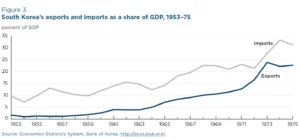
Here is more from Scott Sumner.
Revealing Life Preferences Through LLMs
Here is some Weberian verstehen (or is it?), but from unexpected quarters:
Large Language Models (LLMs) are trained on a prodigious corpus of human writing and may reveal human preferences over characteristics of life courses, such as income, longevity, and working conditions. We present OpenAI’s GPT-5.4 and a broadly representative sample of Americans with pairs of life stories and ask them to choose the life they would prefer for themselves. A person’s choice is better predicted by the LLM’s choice than by another person’s choice over the same stories, and LLM valuations of several life attributes are similar to those derived from human responses. Our results suggest that LLM responses offer a scalable and cost-effective complement to existing methods for studying human preferences.
That is from a new NBER working paper by
Saturday assorted links
Ned Phelps, RIP
Here is a brief appreciation from Olivier Blanchard, link now corrected.
Hayek in Jacobin
Here’s something I never expected to write: Jacobin, the magazine of the DSA-aligned left, has a good article on central planning. In an interview, Vivek Chibber lays out essentially the Mises–Hayek–Kornai critique of central planning. Information problems, incentive problems and the consequent failures are laid bare. Moreover, Chibber refuses to lay the blame at the feet of Stalin, poverty, or the Russians. Nor does he wave hopefully at supercomputers and AI, as is fashionable today on the planning-curious left:
The dilemma is this. There is a problem of information. Supercomputers will in fact help process information better. But if the information coming in is junk, and if that junk is built into the system because of the incentives that operators have in workplaces to lie, you will not have a planning system that can be put on its feet through the advent of computers or artificial intelligence or anything like that. I don’t see any reason to think that that strategic misalignment of incentives is simply there because of Russian backwardness or poverty.
Even the pedestrian is shocking coming from Jacobin:
Normally in capitalism, what do managers do? They want to make profits. The way to make a profit is by trying to sell, at the lowest price possible, the best-quality good that you can.
A vivid conclusion:
Melissa Naschek: What do you think leftists should learn from the failure of fully planned economies?
Vivek Chibber: What they should learn is that the burden of proof is on us, on the Left, if we want to continue with this slogan of replacing the market with the plan. The burden of proof is on us to show that it can work. You might say that along with this ought to come a kind of humility about facts and about the world.…it would be criminally negligent to ignore the experience of decades upon decades of planning and say to yourself, “Well, that wasn’t what my vision of socialism is, so I’m going to ignore it.” Because if you do that, I can guarantee 100 percent you will end up repeating many of the mistakes and falling into the same dilemmas that the planners did.
I could offer critiques. Stalin was not an impediment to central planning but a consequence of it. And to warn that ignoring the experience of central planning risks repeating “the same dilemmas that the planners did” is a bloodless way to describe dictatorship, famine, and mass murder. But that would be churlish. Let me end instead by saying that I agree with this:
If we’re actually serious about changing the world, people on the Left … should be the most remorseless and the most merciless when it comes to facts.
Replace “people on the Left” with “we” and the line is exactly right.
Detroit notes
It remains one of America’s most interesting cities, and now it is seeing a continuing comeback. Downtown remains mostly empty of foot traffic, but I was stunned to see new office buildings and signs of budding prosperity. It did not feel abandoned or hopeless.
Detroit Institute of Art is one of America’s best art museums, showing impeccable taste, though it is notable how much the picture donations simply disappear after some point in time. This is a temple for those are skeptical about modern art, as you will not find it reprensented much here. The American art, the Rembrandt Visitation, the Poussin Holy Family, the Breughel, and the huge Diego Rivera murals are all to die for. The average quality of painting is high as well.
Baobab Fare, not too far from the museum, is a good Burundian (!) restaurant in town.
I was lucky enough to visit the General Motors research and development complex in Cranbrook, mostly designed by Eero Saarinen, due to the ingenuity of Dan Wang (it is mostly not open to the public). Around 20,000 people work there, and it remains a temple of modernist architecture, perhaps anachronistic in effect but beautiful nonetheless. I had not realized how strong the colors were, as that does not come through in the photos.
The Saarinen (papa Saarinen!) house in the Cranbrook Art Museum is perhaps the best Art Deco design I have seen. The museum itself has excellent architecture, sculptures, and gardens, rather than being much of an art museum proper.
Here are good NYT photos of that part of the joy ride.
Overall a trip to the Detroit area is one of the very best American visits you can do, highly recommended, automobile required of course that is why they call it the Motor City.
Weapons, Wealth, and the Fates of Societies
Why do weapons sustain durable peace in some societies but provoke perpetual violence in others? We develop a theory in which the value of human life and the frequency of violence are jointly determined by weapons technology and economic conditions. Lethal weapons deter conflict but raise mortality, taxing the future returns to investing in one’s livelihood. When those returns are high, deterrence dominates and peace and investment reinforce each other. When those returns are low, the mortality tax dominates, agents divest from the future, the value of life falls, and violence deepens, a trap that deadlier weapons worsen. Whether weapons pacify or destabilize depends on the interaction between their offensive characteristics and the baseline prosperity of the society they enter. The theory illuminates four historical episodes: how Medieval Iceland (930–1262) sustained stateless order without a sovereign; why Tokugawa Japan (1603–1868) contained firearms within an institutional order that sustained two centuries of peace and growth; why firearms traded into West Africa and among Native American nations (17th–18th century) produced escalating violence and persistent underdevelopment rather than deterrence; and why the Comanche of the southern plains (c.~1750–1850) rose to regional dominance on horse and gun complementarities and then collapsed as sustained raiding into northern Mexico hollowed out the prosperity base on which their own order depended. The model also refines the logic of nuclear deterrence and generates testable predictions about urban gun violence in high-poverty neighborhoods.
That is from a new paper by Samuel Lee, Ilari Passivirta, and Alexander Zentefis, via the excellent Kevin Lewis.
What I’ve been reading
1. Mikhail Fishman, The Successor: Boris Nemtsov, Vladimir Putin, and the Decline of Modern Russia. One of the best books to read on how Russia moved from “had some democratic elements in place” to autocracy, on a step-by-step basis. The story is told using the career of Boris Nemtsov, who was assassinated in 2014, as a lens. The author has biases of his own, but they do not detract from what is valuable here.
2. Siri Hustvedt. Ghost Stories: A Memoir. About her history with her now-deceased husband Paul Auster, and how she dealt with his death. Moving and insightful, recommended.
3. Thomas Mann, Doctor Faustus, a new translation by Ritchie Robertson. An imperfect, problematic work, too caught up with its own Germanness, and lacking dramatic tension. Still, an important work and this new translation is much better than the old one.
Elsewhere, here is Beeple on AI and Monet, for the terminally online only.
Friday assorted links
1. Chinese modular innovation.
2. “Are you an emerging scholar passionate about scientific discovery and innovation, and interested in joining a community of classical liberal scholars for a year? We’d love to hear from you. Apply below…” New Mercatus program.
3. State media control influences large language models.
4. The best intellectual biographies of the last twenty-five years. An excellent thread, though it will induce you to spend some money.
5. An undervalued Jack Butler Yeats. Up for auction, I have seen many worse paintings priced in seven figures. Elsewhere, here are some major works up for auction.
Philosophical Ideas Behind Their Time
Justin Weinberg at Daily Nous riffs off my post, Ideas Behind Their Time, to ask for philosophical examples. He nominates Gettier problems–i.e. counterexamples to the idea that knowledge is simply “justified true belief” as a possibility. The classic Gettier paper is from 1963. Wikipedia notes that the Indian philosopher Dharmottara has some clear examples c770 AD but as an element within the Western tradition the idea does seem behind its time.
I would nominate the following as philosophical ideas behind their time:
- Hume’s is/ought distinction: the idea that you cannot derive a normative conclusion from factual premises.
- Hume’s problem of induction: past regularities do not rationally guarantee future regularities.
- Rawls’s Veil of Ignorance: the principles of justice should be derived without knowing one’s own particularities of class, race, gender and so forth. Seems obvious as an idea.
- The Trolley Problem: similar ideas can be found earlier but the clean distinction between killing and let die or more generally omission and commission could have come much earlier. One might also think of the Prisoner’s Dilemma in this category of ideas or constructs that cleanly isolate an otherwise present but opaque idea.
- The analytic/synthetic truths distinction: some things are true by definition, others are empirical. Obvious and it can be found before say Kant, yet a clear earlier statement would have resolved many issues and seems well within say Aristotle’s capability.
- Aumann’s Agreement Theorem, technically, this requires Bayesian machinery and is difficult to formulate with precision, so I would not say the actual theorem was behind its time. But the underlying idea—that disagreement itself, not merely the arguments offered, should cause one to question and refine one’s own beliefs—could have been developed in Athens.
- I’d also nominate a package of ideas like abolitionism, equal rights for women, and religious toleration–each of these is tendentious as examples yet the basic package seems fairly obvious as a category and yet late. (Perhaps if the veil of ignorance had been thought of earlier so would these ideas!) Note, that I am not arguing that abolitionism or equal rights for women could have happened much earlier only that these ideas were behind their time–the ideas were morally obvious even if not institutionally feasible.
Note also that I am not arguing that these ideas are all correct, only that they were philosophical ideas behind their time. More examples?
Christopher Nolan, Straussian?
When asked what secondary literature Nolan consulted in working on his epic magnum opus masterpiece, he said none. None save Benardete’s The Bow and the Lyre. “It was my muse” —Christopher Nolan,
, April 2026.
Here is the link.
One way to benefit adolescents
Have school start later:
We examine the impact of California’s Senate Bill 328 (SB 328), the first statewide mandate requiring later school start times for middle and high schools, on adolescent sleep, mental health, and academic outcomes. Using difference-in-differences and eventstudy designs across five data sources, we find that SB 328 increased the share of students sleeping at least 8 hours per night by 13%, meeting the CDC-recommended minimum for this age group. Average mental health effects are imprecisely estimated, but boys show significant reductions in sadness, hopelessness, and suicidal ideation, and Hispanic students, who experienced the largest sleep-timing shifts, show parallel reductions in difficulty concentrating; together these patterns are consistent with a dose-response relationship between sleep improvement and mental well-being. Math and English scores in grade 8 improved by approximately 0.08–0.10 standard deviations, with the largest gains among Hispanic and economically disadvantaged students. A within-state analysis using teachers’ commute arrival times as a proxy for pre-policy school start times corroborates these findings, and shows academic gains accumulating over 2023–2025 alongside a suggestive decline in high school dropout rates. The absence of effects on chronic absenteeism rules out an attendance-driven mechanism, pointing instead to the direct cognitive benefits of aligning school schedules with adolescents’ biological rhythms.
That is from a new NBER working paper by
Meta-papers in science (from my email)
From Brennan Plaetzer:
Hi Tyler,
Your post yesterday argued AI will replace papers with meta-papers that synthesize, re-run, and extend prior work. I built one in oncology last month, before reading your post.
I ran my friend Omar Abdel-Wahab’s (MSK) last ten papers through an AI synthesis layer. This came out on top: an integrated, falsifiable hypothesis bridging two of his 2025 papers, one in Cancer Cell on a refractory MEK1 mutation, one in Cell on splicing-derived neoantigens. It comes with seven testable experiments his lab can run today. The move generalizes to any field: surface the questions hidden in plain view, the ones the source papers could answer with their own data but never asked.
https://page56capital.com/writings/cross-paper-synthesis
The “box” you described already exists in biology. It just doesn’t have a name there yet.
Brennan
Note that if you, in the future, do not do this kind of thing yourself, someone else, or their AI agent, will do it for you. Solve for the equilibrium!
MIT fact of the day
Outside of Sloan and the EECS MEng program, still in the midst of admissions, compared with 2024, our departments’ new enrollments for next year are down close to 20%.
That means that, in total, outside of Sloan, we could have about 500 fewer graduate students. Which means we’ll have many fewer students advancing the work of MIT, and undergraduates will have fewer grad students as mentors in their research.
That is from the president of MIT in a recent speech. It is time to put aside denial about the tsunami coming for higher education.