Monday assorted links
1. WSJ covers the Sahm rule and Claudia Sahm.
2. Was the Industrial Revolution caused by a combinatorial explosion? One author of that piece is Abigail Devereaux, now on the job market, and here is the full list of GMU job market candidates.
The Prescription Escalator
Ask anyone and they will tell you that their prescription costs are rising. But generic drug prices are falling (also here) and generics are 80-90 percent of all prescriptions. Moreover, although branded drugs are expensive total out-of-pocket costs for the population as a whole are flat or even decreasing as Michael Mandel points out:
[A] May 2019 research report from the Agency for Healthcare Research and Quality reported that average out-of-pocket spending for prescribed medications, among persons who obtained at least one prescribed medication, declined from $327 in 2009 to $238 by 2016, a decrease of 27 percent. Data from the Bureau of Labor Statistics Consumer Expenditure Survey shows that average household spending on prescription drugs fell by 11% between 2013 and 2018.
Moreover, OECD data shows that average out- of-pocket spending on prescribed medicines in the United States ($143 per capita in 2017) is actually lower than countries such as Canada ($144), Korea ($156), Norway ($178), and Switzerland ($215).
So are people simply mistaken about what they are experiencing? Not quite. Mandel uses the metaphor of the prescription escalator to explain the apparent paradox:
It turns out that an escalator is the appropriate model for prescription drug costs for individuals. As people get older, they unwillingly ride the prescription escalator, with their average spending on prescription drugs rising by about 5-6% per year. This figure assumes no change in the underlying price of drugs. Rather, people fill more prescriptions as they age.
In other words, every individual experiences an increase in prescription costs as they age even though for the population as a whole prescription prices are flat or falling–a form of Simpson’s paradox. The driver of higher costs is usage not price. People aged 65-74 have on average 25 (!) prescriptions to fill, more than two and half times as many as people aged 25-34 (about 9 per year).
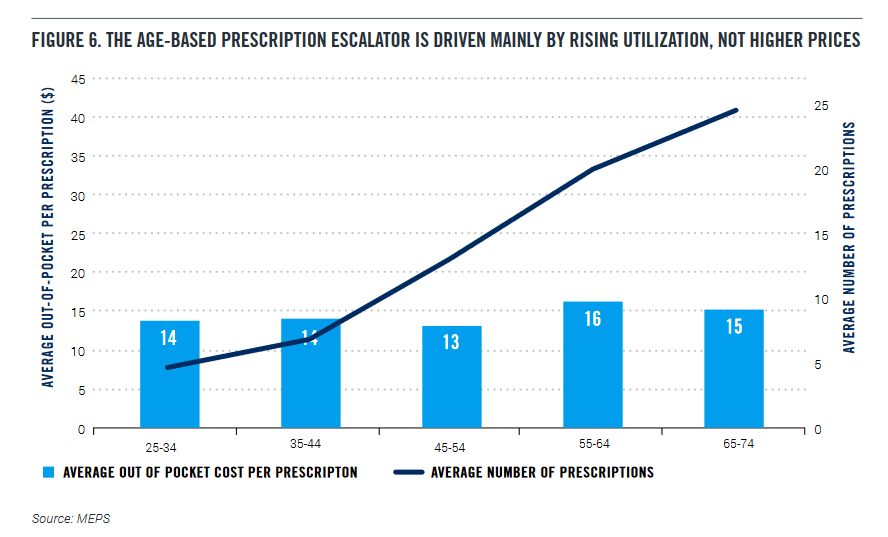
Understanding the prescription escalator is important because regulating drug prices–aside from being a bad idea–won’t solve the perceived problem.
…even if drug reform efforts were successful and there were no more increases in drug costs, every individual would still face a 5.6% increase each year in drug spending as they got older. That would total 30% after five years, and 70% after ten years, across the board.These are enormous increases.
Indeed, the prescription escalator is a sign of success. If drugs weren’t successful we wouldn’t buy more of them when we were older and sicker and costs wouldn’t rise.
Opioids and labor market participation
The onset of the opioid crisis coincided with the beginning of nearly 15 years of declining labor force participation in the US. Furthermore, the areas most affected by the crisis have generally experienced the worst deteriorations in labor market conditions. Despite these time series and cross-sectional correlations, there is little agreement on the causal effect of opioids on labor market outcomes. I provide new evidence on this question by leveraging a natural experiment which sharply decreased the supply of hydrocodone, one of the most commonly prescribed opioids in the US. I identify the causal impact of this decrease by exploiting pre-existing variation in the extent to which different types of opioids were prescribed across geographies to compare areas more and less exposed to the treatment over time. I find that areas with larger reductions in opioid prescribing experienced relative improvements in employment-to-population ratios, driven primarily by an increase in labor force participation. The regression estimates indicate that a 10 percent decrease in hydrocodone prescriptions increased the employment-to-population ratio by about 0.7 percent. These findings suggest that policies which reduce opioid misuse may also have positive spillovers on the labor market.
That is from a job market paper by David Beheshti at the University of Texas at Austin.
What I’ve been reading
C. Bradley Thompson’s America’s Revolutionary Mind: A Moral History of the American Revolution and the Declaration That Defined It, is a beautifully written history of exactly what the title and subtitle claim.
Also noteworthy is Richard Brookhiser, Give Me Liberty: A History of America’s Exceptional Essays, a kind of companion volume. Can you beat the title, especially given world trends today?
Eric Schwitzgebel, A Theory of Jerks and Other Philosophical Misadventures. Collected essays, interesting throughout, and among other points Schwitzgebel shows that ethicists do not in fact behave better than other human beings, higher rates of vegetarianism aside.
I do not have time to read David Abulafia’s The Boundless Sea: A Human History of the Oceans, but based on a browse it is 918 pp. of substance on everything from the Polynesians to the monsoon to sailing across the Atlantic, and then some.
I am a big fan of Yuval Levin, and now he has a new forthcoming book A Time to Build: From Family and Community to Congress and the Campus, How Recommitting to Our Institutions Can Revive the American Dream.
Sunday assorted links
*Terminator: Dark Fate*
Much of the movie is set in Mexico, to excellent effect, and arguably the main lines of the plot mirror some themes from Nahua culture and history:
“…the Aztec saw themselves as “the People of the Sun,” whose divine duty was to wage cosmic war in order to provide the sun with his tlaxcaltiliztli (“nourishment”). Without it, the sun would disappear from the heavens.” Link here.
Quetzalcoatl descending into the land of the dead, and the breaking of the bones.
“…a sibling rivalry grew between Quetzalcoatl and his brother the mighty sun, who Quetzalcoatl knocked from the sky with a stone club.”
“…When the Aztecs sacrificed people to Huitzilopochtli (the god with warlike aspects) the victim would be placed on a sacrificial stone. The priest would then cut through the abdomen with an obsidian or flint blade.” Link here.
Overall the movie reminded me of Rogue One. Rogue One did not have the freshness or originality of the core Star Wars movies, but it was a member of the actual franchise in a way that some of the later sequels were not, and thus a refreshing reminder of what the whole thing was all about in the first place.
The Causal Effect of Cannabis on Cognition
Does smoking lots of pot make you dumb or do dumb people smoke lots of pot? Mostly, the latter. Ross et al. (2019) write:
Although many researchers have concluded that cannabis causes impairment in cognition, there are alternative explanations. First, poor cognitive functioning is a risk factor for substance use. Specifically, EF measured in childhood predicts later substance use and substance use disorders (SUDs; Ridenour et al., 2009). Thus, studies need to control for prior cognitive functioning (Meier et al., 2012). Second, poor cognitive functioning and cannabis use may also be related, not because one causes the other, but because they share common risk factors, like lower SES (Rogeberg, 2013). Lynskey and Hall (2000) proposed that early use is likely to occur in a social context characterized by affiliations with substance using peers, poor school attendance, and precocious adoption of adult roles including dropping out of school; such an effect on educational participation may also influence later cognitive functioning.
Indeed–twin studies which control for genetics and family environment–do not find that cannabis reduces cognition:
Lyons et al. (2004) examined MZ twins discordant for use 20 years after regular use, and found a significant difference between twins on only one of 50+ measures of cognition. Second, Jackson et al. (2014) found no evidence for a dose-dependent relationship or significant differences in cognition among MZ twins discordant for cannabis use. Similarly, Meier et al. (2017) found no evidence for differences in cognition among a combined sample of MZ and DZ twins discordant for cannabis dependence or use frequency. Thus, quasi-experimental, co-twin control designs have yielded little evidence that cannabis causes poorer cognition.
Ross et al. run a similar study but testing also for executive function skills–the ability to plan, focus, control impulses and so forth which are skills related to IQ but distinct–and they conclude:
Families with greater cannabis use showed poorer general cognitive ability. Yet within families, twins with higher use rarely had lower cognitive scores. Overall, there was little evidence for causal effect of cannabis on cognition.
Hat tip: The excellent Kevin Lewis.
Learning is Caring: An Agrarian Origin of American Individualism
I am looking forward to reading this one, from Itzchak Tzachi Raz, who is on the job market from Harvard this year:
This study examines the historical origins of American individualism. I test the hypothesis that local heterogeneity of the physical environment limited the ability of farmers on the American frontier to learn from their successful neighbors, turning them into self-reliant and individualistic people. Consistent with this hypothesis, I find that current residents of counties with higher agrarian heterogeneity are more culturally individualistic, less religious, and have weaker family ties. They are also more likely to support economically progressive policies, to have positive attitudes toward immigrants, and to identify with the Democratic Party. Similarly, counties with higher environmental heterogeneity had higher taxes and a higher provision of public institutions during the 19th century. This pattern is consistent with the substitutability of formal and informal institutions as means to solve collective action problems, and with the association between “communal” values and conservative policies. These findings also suggest that, while understudied, social learning is an important determinant of individualism.
Here is the home page, the paper is not yet available. Here is his actual job market paper, on adverse possession. I do hope the author lets me know once this paper is ready, I am very much looking forward to reading it.
Saturday assorted links
What should I ask Esther Duflo?
I will be doing a Conversation with her, no associated public event, so what should I ask?
I thank you all in advance for your sage wisdom and counsel.
Public employee pension and municipal insolvency
This paper studies how governments manage public employee pensions and how this affects insolvency risk. I propose a quantitative model of governments that choose their savings and risk exposure by borrowing/saving in defaultable bonds, borrowing in non-defaultable pension benefits, and saving in a pension fund that earns a risk premium. In insolvency, the government can receive transfers from households who may differ from the government in their preferences for public services and private consumption. I match the model to a panel of CA cities and a hand-collected record of fiscal emergencies. The model predicts that governments are highly vulnerable to another stock market bust. A hypothetical shock to pension funds in 2015 produces twice as many fiscal emergencies as the original 2008-10 shock. In the quantified model, the government undersaves and take excess risk relative to what households would choose. Savings requirements that limit spending to essential services plus 0.3% of cash-on-hand produce large welfare gains for households. Requiring the pension fund to invest more in safe assets decreases household welfare because the lower average return discourages the government from saving.
That is from the job market paper by Sean Myers of Stanford University.
Economists and non-economists on elasticity
From a recent paper by Joanna Venator and Jason Fletcher:
In this paper, we estimate the impacts of abortion clinic closures on access to clinics in terms of distance and congestion, abortion rates, and birth rates. Legislation regulating abortion providers enacted in Wisconsin in 2011-2013 ultimately led to the closure of two of five abortion clinics in Wisconsin, increasing the average distance to the nearest clinic to 55 miles and distance to some counties to over 100 miles. We use a difference-in-differences design to estimate the effect of change in distance to the nearest clinic on birth and abortion rates, using within-county variation across time in distance to identify the effect. We find that a hundred-mile increase in distance to the nearest clinic is associated with 25 percent fewer abortions and 4 percent more births. We see no significant effect of increased congestion at remaining clinics on abortion rates. We find significant racial disparities in who is most affected by abortion clinic closures, with increases in distance increasing birth rates significantly more for Black, Asian, and Hispanic women. Our results suggest that even small numbers of clinic closures can result in significant restrictions to abortion access of similar magnitude to those seen in Texas when a greater number of clinics closed their doors.
There are (at least) two possible responses to such results, and that is without even getting into one’s underlying view of the ethics of abortion. One is to say that a great deprivation has occurred because many fewer women end up having abortions. Another response is to infer that the marginal value of the abortions could not have been so high to begin with, if the number drops off so readily.
The same issue comes up with Obamacare. If the price of health insurance goes up, quite a large number of people decide to go without coverage. Is the size of that number a measure of the human tragedy resulting from the price increase? Or is it a measure of how little those people actually value health insurance? Or somehow both?
I have yet to meet a person who can think through these issues rationally and absorb what is interesting and valid in each of those two perspectives.
Are queens more warlike than kings?
Yes, in a nutshell, as Gordon Tullock used to claim:
Are states led by women less prone to conflict than states led by men? We answer this question by examining the effect of female rule on war among European polities over the 15th-20th centuries. We utilize gender of the first born and presence of a female sibling among previous monarchs as instruments for queenly rule. We find that polities led by queens were more likely to engage in war than polities led by kings. Moreover, the tendency of queens to engage as aggressors varied by marital status. Among unmarried monarchs, queens were more likely to be attacked than kings. Among married monarchs, queens were more likely to participate as attackers than kings, and, more likely to fight alongside allies. These results are consistent with an account in which marriages strengthened queenly reigns because married queens were more likely to secure alliances and enlist their spouses to help them rule. Married kings, in contrast, were less inclined to utilize a similar division of labor. These asymmetries, which reflected prevailing gender norms, ultimately enabled queens to pursue more aggressive war policies.
That is by Oeindrila Dube and S.P. Harish, here is the working paper version, here is the forthcoming in the JPE version.
Friday assorted links
Release Bad News on a Friday
Politicians have long known to release bad news on a Friday and it appears that pharmaceutical firms may do likewise.
Safety alerts are announcements made by health regulators warning patients and doctors about new drug-related side effects. However, not all safety alerts are equally effective. We provide evidence that the day of the week on which the safety alerts are announced explains differences in safety alert impact. Specifically, we show that safety alerts announced on Fridays are less broadly diffused: they are shared 34% less on social media, mentioned in 23% to 66% fewer news articles, and are 12% to 51% less likely to receive any news coverage at all. As a consequence of this, we propose Friday alerts are less effective in reducing drug-related side effects. We find that moving a Friday alert to any other weekday would reduce all drug-related side effects by 9% to 12%, serious drug-related complications by 6% to 15%, and drug-related deaths by 22% to 36%. This problem is particularly important because Friday was the most frequent weekday for safety alert announcements from 1999 to 2016. We show that this greater prevalence of Friday alerts might not be random: firms that lobbied the U.S. Food and Drug Administration in the past are 49% to 56% more likely to have safety alerts announced on Fridays.
From The Friday Effect in Management Science by Diestre, Barber and Santalo.
Hat tip: Kevin Lewis.