The rise of the non-religious in the Middle East and nearby
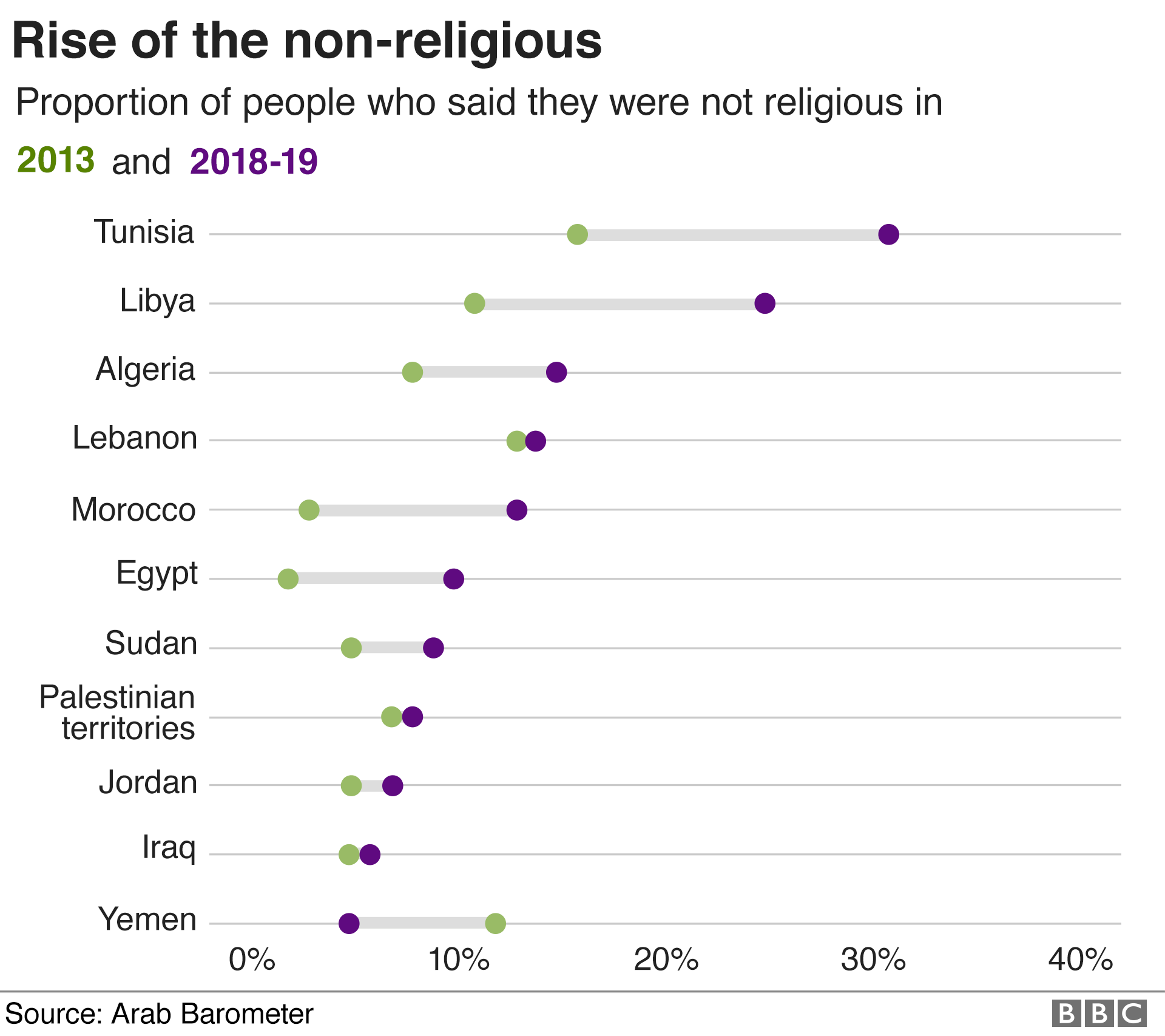 Here is the BBC source, which has several other interesting pieces of information, for instance in the polled countries Erdogan is more popular than Putin who in turn is more popular than Trump: 51-28-12% on the approval ratings.
Those new (?) service sector jobs
Teen mail boat jumpers: “Rain or shine won’t keep these mail jumpers from their appointed rounds. Each year a bunch of high school seniors try out as mail jumpers on Wisconsin’s Lake Geneva and it may be the best summer job ever. The challenge is to dash to the mailbox and race back to the boat before it pulls away. The boat slows down but never stops so you have to…”
Via Jamie Jenkins.
Monday assorted links
1. The commercialization of cornhole.
2. Argentina interview (in Spanish).
3. China and North Korea (NYT).
4. Robert Kaplan on China and other stuff.
5. “This study uses an experimental design to explore how people react to criminal stigma in the context of online dating…White females disclosing parole matched at a higher rate than White females not disclosing parole.” Link here.
6. Is Amazon getting worse at bookselling? (NYT)
The Economist covers Why Are the Prices So D*mn High?
The Economist does a very nice job covering Why Are the Prices So D*mn High.
Baumol’s earliest work on the subject, written with William Bowen, was published in 1965. Analyses like that of Messrs Helland and Tabarrok nonetheless feel novel, because the implications of cost disease remain so underappreciated in policy circles. For instance, the steadily rising expense of education and health care is almost universally deplored as an economic scourge, despite being caused by something indubitably good: rapid, if unevenly spread, productivity growth. Higher prices, if driven by cost disease, need not mean reduced affordability, since they reflect greater productive capacity elsewhere in the economy. The authors use an analogy: as a person’s salary increases, the cost of doing things other than work—like gardening, for example—rises, since each hour off the job means more forgone income. But that does not mean that time spent gardening has become less affordable.
It’s an implication of the Baumol effect that everyone ends up working in a low productivity industry!
The only true solution to cost disease is an economy-wide productivity slowdown—and one may be in the offing. Technological progress pushes employment into the sectors most resistant to productivity growth. Eventually, nearly everyone may have jobs that are valued for their inefficiency: as concert musicians, or artisanal cheesemakers, or members of the household staff of the very rich. If there is no high-productivity sector to lure such workers away, then the problem does not arise.
Misunderstanding the Baumol effect can lead to a cure worse than the “disease”:
These possibilities reveal the real threat from Baumol’s disease: not that work will flow toward less-productive industries, which is inevitable, but that gains from rising productivity are unevenly shared. When firms in highly productive industries crave highly credentialed workers, it is the pay of similar workers elsewhere in the economy—of doctors, say—that rises in response. That worsens inequality, as low-income workers must still pay higher prices for essential services like health care. Even so, the productivity growth that drives cost disease could make everyone better off. But governments often do too little to tax the winners and compensate the losers. And politicians who do not understand the Baumol effect sometimes cap spending on education and health. Unsurprisingly, since they misunderstand the diagnosis, the treatment they prescribe makes the ailment worse.
My only complaint is that the excellent reviewer has not followed our lead and called it the Baumol effect–cost disease is a misleading name!
Addendum: Other posts in this series.
We place too much weight on redundant information
The present work identifies a so-far overlooked bias in sequential impression formation. When the latent qualities of competitors are inferred from a cumulative sequence of observations (e.g., the sum of points collected by sports teams), impressions should be based solely on the most recent observation because all previous observations are redundant. Based on the well-documented human inability to adequately discount redundant information, we predicted the existence of a cumulative redundancy bias. Accordingly, perceivers’ impressions are systematically biased by the unfolding of a performance sequence when observations are cumulative. This bias favors leading competitors and persists even when the end result of the performance sequence is known. We demonstrated this cumulative redundancy bias in 8 experiments in which participants had to sequentially form impressions about the qualities of two competitors from different performance domains (i.e., computer algorithms, stocks, and soccer teams). We consistently found that perceivers’ impressions were biased by cumulative redundancy. Specifically, impressions about the winner and the loser of a sequence were more divergent when the winner took an early lead compared with a late lead. When the sequence ended in a draw, participants formed more favorable impressions about the competitor who was ahead during most observations. We tested and ruled out several alternative explanations related to primacy effects, counterfactual thinking, and heuristic beliefs. We discuss the wide-ranging implications of our findings for impression formation and performance evaluation.
That is from a new paper by Hans Alves and André Mata, via the excellent Kevin Lewis.
Is the generalist returning?
It would be supremely ironic if the advance of the knowledge economy had the effect of devaluing knowledge. But that’s what I heard, recurrently, while reporting this story…If that’s the case, I asked John Sullivan, a prominent Silicon Valley talent adviser, why should anyone take the time to master anything at all? ‘You shouldn’t!’ he replied.
That is from a new Atlantic piece by Jerry Useem. In essence, the division of labor may be running in reverse in some endeavors. In Adam Smith’s argument, division of labor and specialization increase with the size of the market. But say a mix of Moore’s Law and globalization means that software (output and operations) expands rapidly, yet companies seek to shed labor costs due to competition. At the margin the new demand might be for generalists, who can step in whenever unforeseen problems arise which need fixing. Or in other words, you may not wish to specialize with your truly scarce factor, namely labor. In contrast, in Smith’s time, demographics were favorable and labor was pouring into cities from the countryside.
As for the Navy:
The LCS was the first class of Navy ship that, because of technological change and the high cost of personnel, turned away from specialists in favor of “hybrid sailors” who have the ability to acquire skills rapidly. It was designed to operate with a mere 40 souls on board—one-fifth the number aboard comparably sized “legacy” ships and a far cry from the 350 aboard a World War II destroyer. The small size of the crew means that each sailor must be like the ship itself: a jack of many trades and not, as 240 years of tradition have prescribed, a master of just one.
And:
Minimal manning—and with it, the replacement of specialized workers with problem-solving generalists—isn’t a particularly nautical concept. Indeed, it will sound familiar to anyone in an organization who’s been asked to “do more with less”—which, these days, seems to be just about everyone. Ten years from now, the Deloitte consultant Erica Volini projects, 70 to 90 percent of workers will be in so-called hybrid jobs or superjobs—that is, positions combining tasks once performed by people in two or more traditional roles.
Why aren’t remote interviews as useful as face-to-face interactions?
Skype and Zoom aren’t quite as good as meeting in the physical world. But why? Pioneer and Emergent Ventures are looking to fund research on exactly how and why video conferencing interactions are different. Apply at https://pioneer.app and mention this tweet…Given the rise of remote work, the economic impact of this research could be Nobel-worthy.
That is from Daniel Gross, and here you can apply for Emergent Ventures.
Sunday assorted links
Flying and academic quality
Using the University of British Columbia as a case study, we investigated whether the faculty at our institution who flew the most were also the most successful. We found that beyond a small threshold there was no relationship between scholarly output and how much an individual academic flies…
We certainly did find evidence that researchers fly more than is likely necessary. In the portion of our sample composed of only fulltime faculty, we categorized 10% of trips as “easily avoidable”. These were trips like going to your destination and flying back in the same day or flying a short distance trip that could have been replaced by ground travel. Interestingly, green academics (those studying subjects like climate change or sustainability) not only had the same level of emissions from air travel as their peers, but they were indistinguishable in the category of “easily avoidable” trips as well.
But success isn’t just measured by scholarly output, and so we also checked for relationships between how much academics flew and their annual salaries (which are publicly available). We did find a significant relationship: people who fly more, get paid more. Causation though, could lie in the other direction. Prestigious scholars with more grant money may have extra funds with which to book air travel, for instance.
Here is the full post by Seth Wynes, via Anecdotal.
*Talking to Strangers*, the new Malcolm Gladwell book
Definitely recommended, talking to strangers is one of the most important things you do and it can even save your life. This book is the very best entry point for thinking about this topic. Here is a summary excerpt:
We have strategies for dealing with strangers that are deeply flawed, but they are also socially necessary. We need the criminal justice system and the hiring process and the selection of babysitters to be human. But the requirement of humanity means that we have to tolerate an enormous amount of error. That is the paradox of talking to strangers. We need to talk to them. But we’re terrible at it — and, as we’ll see in the next two chapters, we’re not always honest with each other about just how terrible at it we are.
One recurring theme is just how bad we are at spotting liars. On another note, I found this interesting:
…the heavy drinkers of today drink far more than the heavy drinkers of 50 years ago. “When you talk to students [today] about four drinks or five drinks, they just sort of go, “Pft, that’s just getting started,'” the alcohol researcher Kim Fromme says. She says that the heavy binge drinking category now routinely includes people who have had twenty drinks in a sitting. Blackouts, once rare, have become common. Aaron White recently surveyed more than 700 students at Duke University. Of the drinkers in the group, over half had suffered a blackout at some point in their lives, 40 percent had had a blackout in the previous year, and almost one in ten had had a blackout in the previous two weeks.
And:
Poets die young. That is not just a cliche. The life expectancy of poets, as a group, trails playwrights, novelists, and non-fiction writers by a considerable margin. They have higher rates of “emotional disorders” than actors, musicians, composers, and novelists. And of every occupational category, they have far and away the highest suicide rates — as much as five times higher than the general population.
It also turns out that the immediate availability of particular methods of suicide significantly raises the suicide rate; it is not the case that an individual is committed to suicide regardless of the means available at hand.
Returning to the theme of talking with strangers, one approach I recommend is to apply a much higher degree of arbitrary specificity, when relating facts and details, than you would with someone you know.
In any case, self-recommending, this book shows that Malcolm Gladwell remains on an upward trajectory. You can pre-order it here.
China Bible fact of the day
The parent company of the two largest Bible publishers in the United States has warned the Trump administration that proposed tariffs on China would amount to a “Bible tax.”
Trump’s proposed tariffs on $300 billion in Chinese-made products would affect books and other printed materials, according to Bloomberg. That includes Bibles, which are overwhelmingly printed in China because of the specialized technology and skills they require to produce…
More than half of the 100 million Bibles printed every year have been printed in China since the 1980s, he said. Of those, 20 million are sold or given away in the United States.
That’s because of the specialized printing requirements for a complex book such as the Bible, which requires thin paper that cannot be fed into standard printing equipment, leather covers, stitched binding, color pages and special inserts such as maps.
Here is the full Washington Post story.
Saturday assorted links
The legal culture that is America
The battle for supremacy in the world of hand hygiene is a dirty one, and nothing demonstrates this better than the depressing sight of a paper towel dispenser with a EULA.
That’s right: even dumb plastic boxes whose only use in this world is to hold paper towels apparently need an end-user license agreement now. In this case, the EULA — spotted by Harvard Library curator and Twitter user John Overholt at a recent conference — forbids the people who have to refill this Tork dispenser from using rival, non-Tork products.
Here is the full story, via the excellent Samir Varma.
Civic honesty around the globe
I am a bit late to this party, having been traveling, but I will serve this one up anyway:
Civic honesty is essential to social capital and economic development, but is often in conflict with material self-interest. We examine the trade-off between honesty and self-interest using field experiments in 355 cities spanning 40 countries around the globe. We turned in over 17,000 lost wallets with varying amounts of money at public and private institutions, and measured whether recipients contacted the owner to return the wallets. In virtually all countries citizens were more likely to return wallets that contained more money. Both non-experts and professional economists were unable to predict this result. Additional data suggest our main findings can be explained by a combination of altruistic concerns and an aversion to viewing oneself as a thief, which increase with the material benefits of dishonesty.
That is the abstract of a new paper by Alain Cohn, Michel André Maréchal, David Tannenbaum, and Christian Lukas Zünd. It is easy to say this ex post, but I find this intuitive. Here is the famed country-by-country picture which is circulating:

Here is a picture of the actual vs. the predicted reporting rate. Experts predicted more overall cooperation than turned out to be the case, most of all for the wallets with no money in them, but basically got it right for wallets with lots of money. Non-experts got it backwards altogether.
For the pointer to this one I thank many different MR readers.
Friday assorted links
1. Country Time paying kids’ fines, lobbying for legalizing lemonade stands (link has video chatter on it).
2. 100 best drummers of all time? Listed at #98 is Karen Carpenter.
3. Let’s ask the astrologers about Libra!
4. David Henderson reviews *Big Business: A Love Letter to an American Anti-Hero*, you need to scroll down a wee bit.
5. The Brown Shoe case ugh, antitrust that makes no sense (NYT).