What should I ask Eric Schmidt?
I will be doing a Conversation with Eric, in San Francisco, September 19. It is not an open event, but you can apply to attend. It is sponsored by Village Global, which is connected with Ben Casnocha and Erik Torenberg.
In case you have been living under a rock, here is the opening bit of Wikipedia on Eric:
Eric Emerson Schmidt (born April 27, 1955) is an American businessman and software engineer. He is known for being the Executive Chairman of Google from 2001 to 2015[ and Alphabet Inc. from 2015 to 2017.
Not everyone knows that Eric is the son of Wilson Schmidt, a well-known economist at Virginia Tech and Johns Hopkins, who wrote on currency matters and also worked with Jim Buchanan.
So what should I ask Eric?
Would a multi-planet humanity be freer?
Kevin P. emails me:
Suppose humanity becomes a multi-planet species. Does the percentage of people living in autocratic societies decrease or increase relative to what we see on our planet today? How do the time and resources required to travel between inhabited planets affect this?
Do some people on “free” planets work to help the non-free? More or less than such countries today? Is there some scale that is reached so a free Federation comes to guaranty freedom everywhere? Or maybe a tyrant or tyrants, once they have a couple wealthy planets under their belt are unstoppable because of cooperation difficulties of the individual free planets?
When I think of settling other planets, my base case is one of extreme scarcity and fragility, at least at first and possibly for a long time. Those are not the conditions that breed liberty, whether it is “the private sector” or “the public sector” in charge.
Maybe corporations will settle space for some economic reason. Then you might expect space living to have the liberties of an oil platform in the sea, or perhaps a cruise ship. Except there would be more of a “we are in this all together” attitude, which I think would favor a kind of corporate autocracy.
Another scenario involves a military settling space, possibly for military reasons, and that too is not much of a liberal or democratic scenario.
You might also have religiously-motivated settlements, which presumably would be governed by the laws and principles of the religion. Over time, however, this scenario might give the greatest chance for subsequent liberalization.
America developed to be as free as it did (at least for some people) mostly there was so much free land. Living standards were relatively high, and moving further westward was always an option. It is hard for me to think of an interplanetary version of the same condition. Easy exit and free resources don’t seem to go well together with the concept of space settlement.
Space stations and settlement will give the power to those who control the infrastructure, a bit like Wittvogel’s Oriental Despotism hypothesis, except with both air and water being scarce.
I thus expect that interplanetary settlements, whatever their other virtues, will not do much for liberalism or liberty. Here is my earlier post on The Moon is a Harsh Mistress.
Thursday assorted links
1. As I like to say, social conservatism is underrated.
2. Taiwan crowdsources some of its laws.
3. Martin Shubik has passed away.
4. Ghosts of black holes from earlier universes?
5. Hybrid humans (NYT).
6. 2600 graphs from the AER (video), and text version: “…of the more than 2,600 graphs in total, more than 80% are line charts.”
What should I ask Michele Gelfand?
I am doing a Conversations with Tyler with her, here is her home page. She is a Professor of Psychology at the University of Maryland and has a new book coming out: Rule Makers, Rule Breakers: How Tight and Loose Cultures Wire Out World. Here is part of the Amazon summary:
Why are clocks in Germany so accurate while those in Brazil are frequently wrong? Why do New Zealand’s women have the highest number of sexual partners? Why are “Red” and “Blue” States really so divided? Why was the Daimler-Chrysler merger ill-fated from the start? Why is the driver of a Jaguar more likely to run a red light than the driver of a plumber’s van? Why does one spouse prize running a “tight ship” while the other refuses to “sweat the small stuff?”
In search of a common answer, Gelfand has spent two decades conducting research in more than fifty countries. Across all age groups, family variations, social classes, businesses, states and nationalities, she’s identified a primal pattern that can trigger cooperation or conflict. Her fascinating conclusion: behavior is highly influenced by the perception of threat.
She also is well-known for her analyses of how negotiations vary across organizations and cultures. Here is Gelfand on scholar.google.com. Here is her Wikipedia page.
So what should I ask?
Airbnb Has Implemented Smart Property
In one of Nick Szabo’s classic papers on smart contracts he gives an example of smart property:
Smart property might be created by embedding smart contracts in physical objects. These embedded protocols would automatically give control of the keys for operating the property to the party who rightfully owns that property, based on the terms of the contract. For example, a car might be rendered inoperable unless the proper challenge-response protocol is completed with its rightful owner, preventing theft.
Airbnb is close to achieving smart property. On a recent trip, for example, I booked online. Shortly before I was to take control of the residence I received a code which opened an on-site lockbox with a key. I left the key in the lockbox when I left–never having met the owner or any employee. At a hotel that I stayed in on the same trip, I still had to wait in line to check-in. The Airbnb process is more convenient and cheaper because there is no need to have staff to man a front desk.
The Airbnb process typically uses physical keys but I have also stayed at places that use electronic keys and digital door locks. An electronic key is more secure since it can be a one-time use that opens the door only during the rental period.
All of this may seem somewhat ordinary but that is the point. Smart property is becoming ordinary.
Addendum: The more automated the process becomes the more a decentralized protocol or platform becomes a competitive option. Smart property that can reach out to say a matching protocol and an identity protocol could rent itself.
Airbnb is a very good company that provides valuable services at reasonable prices so a decentralized platform may not have significant advantages but as more base protocols are laid down and stabilized (“primitives”) it will become easier and more natural to create these kinds of decentralized services. See my post Blockchains and the Opportunity of the Commons.
What went wrong in the West and with liberalism?
That is the topic of my latest Bloomberg column, and the core of my answer is that liberalism and cooperativeness declined in the West, as WWI and the Cold War receded into historical distance (I am indebted to a much earlier conversation with Daniel Klein on these matters). But I wish to excerpt from another point of the piece:
There is another explanation for the rise in anti-liberal sentiment: immigration. Through a series of historical accidents, it was kept off the table as a major issue for many decades. The U.S. had choked off immigration in 1920, and at first the liberalization of the 1960s did not have much of a visible impact on the American population. In those early decades after the Immigration and Naturalization Act of 1965, many poor nations were so poor and unfree that it wasn’t easy to leave them.
As for Europe, in-migration was too small to make much of a political impact. For a while in the 1960s and 1970s, the bigger story was emigration, due to high taxes, from countries such as the U.K. and Sweden. The presence of the Iron Curtain also blocked some of the routes and sources that enable some migration to Western Europe today.
In a democratic society where there simply isn’t much immigration, it is much harder for nationalists and populists to use it as an issue. But today much of the West has seen high immigration for 20 years or more, giving nationalist and populist forces a major talking point. Even if most of the population is broadly pro-immigration, perhaps a core of 15 to 20 percent will not be. With that base, a movement of counterreaction can have real political impact.
Do read the whole thing.
Is Facebook causing anti-refugee attacks in Germany?
Here is the key result, as summarized by the NYT:
Wherever per-person Facebook use rose to one standard deviation above the national average, attacks on refugees increased by about 50 percent.
Here is the underlying Müller and Schwarz paper. They consider 3,335 attacks over a two-year period in Germany. But I say no, their conclusion has not been demonstrated. Where to start?
Here is one picture showing a key correlation:
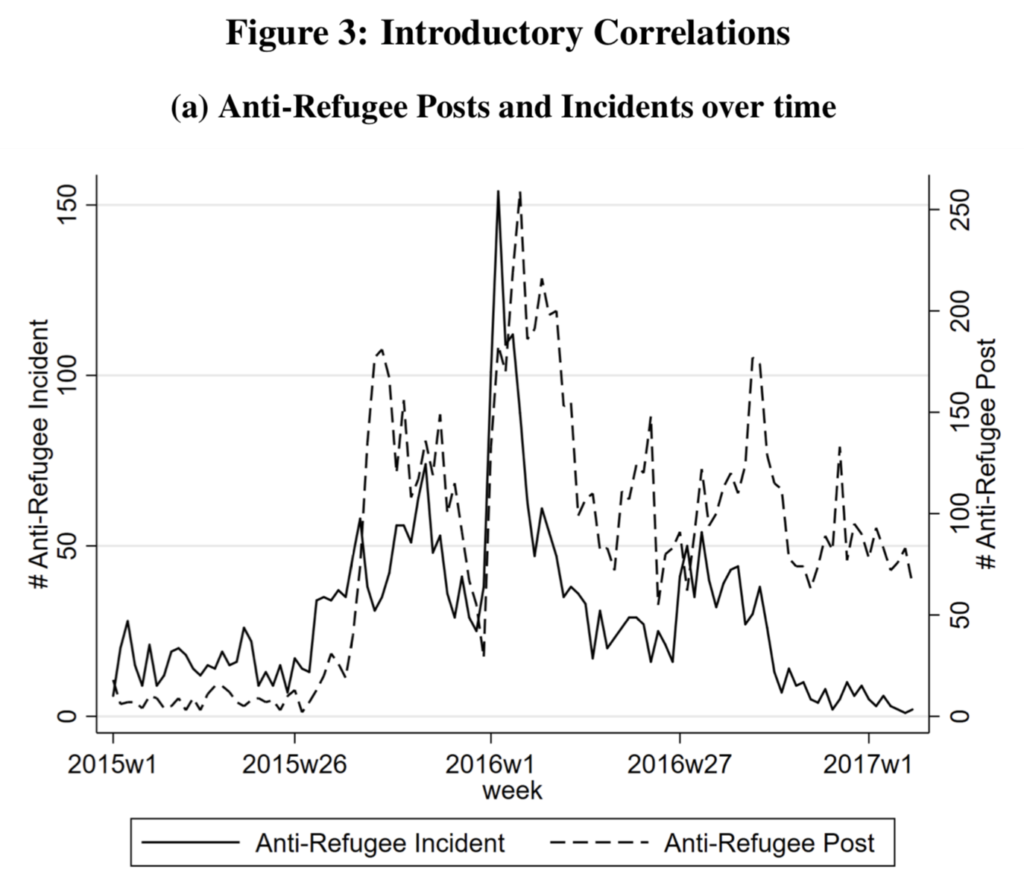 That looks pretty strong, doesn’t it? Nein! That is not how propaganda works, as an extensive literature in sociology and political psychology will indicate. That is how it looks when you measure what is essentially the same variable — or its effects — two different ways. For instance, that very big spike in the middle of the distribution? As Ben Thompson has pointed out, it represents the New Year’s harassment attacks in Cologne. Maybe that caused both Facebook activity and other attacks to spike at the same time? Will you mock me if I resort to the “blog comment cliche” that correlation does not show causation?
To continue with the excellent Ben Thompson (he is worth paying for!), the identification method used in the paper is suspect, and he focuses on this quotation from the authors:
In our setting, the share of a municipality’s population that use the AfD Facebook page is an intuitive proxy for right-wing social media use; however, it is also correlated with differences in a host of observable municipality characteristics — most importantly the prevalence of right-wing ideology. We thus attempt to isolate the local component of social media usage that is uncorrelated with right-wing ideology by drawing on the number of users on the “Nutella Germany” page. With over 32 million likes, Nutella has one of the most popular Facebook pages in Germany and therefore provides a measure of general Facebook media use at the municipality level. While municipalities with high Nutella usage are more exposed to social media, they are not more likely to harbor right-wing attitudes.
The whole result rests on assumptions about Nutella? What if you used likes for Zwetschgenkuchen? Has a robustness test been done? Was a simple correlation not good or not illustrative enough? I’ll stick with the simple hypothesis that some municipalities have both more Facebook usage, due to high AfD membership, and also more attacks on refugees, and furthermore both of those variables rise in tense times. AfD is the German party with the strongest presence on Facebook, I am sorry to say.
You will note by the way that within Germany the Nutella page has only verifiable 21,915 individual interactions, including likes (32 million is the global number of Nutella likes…die Deutschen are not that nutty), and that is distributed across 4,466 municipal areas. (If you are confused, see p.12 in the paper, which I find difficult to follow and I suspect that represents the confusion of the authors.) That should make you more worried yet about the Nutella identification strategy. They never tell us what they would have without Nutella, a better tasting sandwich I would say.
I also would note the broader literature on propaganda once again. Consider the research of Markus Prior: “…evidence for a causal link between more partisan messages and changing attitudes or behaviors is mixed at best.” These Facebook results are simply far outside of what we normally suppose to be true about human responsiveness — so maybe the company is undercharging for its ads!
Ben adds:
I am bothered by the paper’s robustness section in two ways: first, every single robustness test confirmed the results. To me that does not suggest that the initial result must be correct; it suggests that the researchers didn’t push their data hard enough. There is always a test that fails, and that is a good thing: it shows the boundaries of what you have learned. Second, there were no robustness tests applied to one of the more compelling pieces of evidence, that Internet and Facebook outages were correlated with a reduction in violence against refugees. This is particularly unfortunate because in some ways this evidence works against the filter bubble narrative: after all, the idea is the filter bubbles change your reality over time, not that they suddenly inspire you to action out of the blue.
The authors do present natural experiments from Facebook and internet outages. They find that “…for a given level of anti-refugee sentiment, there are fewer attacks in municipalities with high Facebook usage during an internet outage than in municipalities with low Facebook usage without an outage.” (p.28). Again I find that confusing, but I note also that “internet outages themselves…do not have a consistent negative effect on the number of anti-refugee sentiments.” That is the simple story, and it appears to exonerate Facebook. pp.28-30 then present a number of interaction effects and variable multiplications, but I am not sure what to conclude from the whole mess. I’m still expecting internet outages to lower the number of attacks, but they don’t.
Even if internet or Facebook outages do have a predictive effect on attacks in some manner, it likely shows that Facebook is a communications medium used to organize gatherings and attacks (as the telephone once might have been), not, as the authors repeatedly suggest, that Facebook is somehow generating and whipping up and controlling racist sentiment over time. Again, compare such a possibility to the broader literature. There is good evidence that anti-semitic violence across German regions is fairly persistent, with pogroms during the Black Death predicting synagogue attacks during the Nazi time. And we are supposed to believe that racist feelings dwindle into passivity simply because the thugs cannot access Facebook for a few days or maybe a week? By the way, in their approach if there is an internet outrage, mobile devices do not in Germany pick up the slack.
I’d also like to revisit the NYT sentence, cited above, and repeated many times on Twitter:
Wherever per-person Facebook use rose to one standard deviation above the national average, attacks on refugees increased by about 50 percent.
That sounds horrible, but it is actually a claim about variation across municipalities, not a claim about the absolute importance of the internet. The authors also reported a very different and perhaps more relevant claim to the Times:
…this effect drove one-tenth of all anti-refugee violence.
I would have started the paper with that sentence, and then tried to estimate its robustness, without relying on Nutella.
As it stands right now, you shouldn’t be latching on to the reported results from this paper.
Do Congresswomen Outperform Congressmen?
That is a 2011 AFPS paper by Sarah F Anzia and Christopher R Berry, here is the abstract:
If voters are biased against female candidates, only the most talented, hardest working female candidates will succeed in the electoral process. Furthermore, if women perceive there to be sex discrimination in the electoral process, or if they underestimate their qualifications for office, then only the most qualified, politically ambitious females will emerge as candidates. We argue that when either or both forms of sex‐based selection are present, the women who are elected to office will perform better, on average, than their male counterparts. We test this central implication of our theory by studying the relative success of men and women in delivering federal spending to their districts and in sponsoring legislation. Analyzing changes within districts over time, we find that congresswomen secure roughly 9% more spending from federal discretionary programs than congressmen. Women also sponsor and cosponsor significantly more bills than their male colleagues.
I also would consider the alternative hypothesis that the women legislators are simply more conscientious and less wrapped up in themselves. Nonetheless this result is one possible equilibrium relevant to the recent MR discussions on statistical discrimination.
Here is a paper showing female mayors have higher political skills, This paper shows that women do better in a minority party than in a polarized majority party setting.
For the pointer I thank Michelangelo L.
Wednesday assorted links
1. MIE: “Travel to the summit of Africa’s highest peak, Mount Kilimanjaro, where Three Twins Ice Cream’s founder will hand-churn a batch of ice cream with glacial ice from the mountain’s summit. The mountain’s glaciers are predicted to disappear within the next 10-15 years due to climate change – and your purchase helps raise awareness of this fact with a five-figure contribution to an African environmental non-profit. The sundae’s price also includes first class airfare to Tanzania, five-star accommodations, a guided climb, as much ice cream as you can eat and a souvenir t-shirt made from organic cotton.”
2. New South Wales town mobbed by thirsty emus.
3. Cowen’s Second Law there is a literature on everything including autistic zebrafish (110 papers).
4. It matters how seriously students take PISA testing.
5. Superb Samuel Hammond piece on codetermination.
6. Annie Lowrey on is pot too strong?
7. My Farnham Street podcast, mostly about how to reason, came out very well I thought. And you can buy a transcript at the link.
Sexy Selfies as Competition Strategy
Publicly displayed, sexualized depictions of women have proliferated, enabled by new communication technologies, including the internet and mobile devices. These depictions are often claimed to be outcomes of a culture of gender inequality and female oppression, but, paradoxically, recent rises in sexualization are most notable in societies that have made strong progress toward gender parity. Few empirical tests of the relation between gender inequality and sexualization exist, and there are even fewer tests of alternative hypotheses. We examined aggregate patterns in 68,562 sexualized self-portrait photographs (“sexy selfies”) shared publicly on Twitter and Instagram and their association with city-, county-, and cross-national indicators of gender inequality. We then investigated the association between sexy-selfie prevalence and income inequality, positing that sexualization—a marker of high female competition—is greater in environments in which incomes are unequal and people are preoccupied with relative social standing. Among 5,567 US cities and 1,622 US counties, areas with relatively more sexy selfies were more economically unequal but not more gender oppressive. A complementary pattern emerged cross-nationally (113 nations): Income inequality positively covaried with sexy-selfie prevalence, particularly within more developed nations. To externally validate our findings, we investigated and confirmed that economically unequal (but not gender-oppressive) areas in the United States also had greater aggregate sales in goods and services related to female physical appearance enhancement (beauty salons and women’s clothing). Here, we provide an empirical understanding of what female sexualization reflects in societies and why it proliferates.
From a new paper in PNAS.
The paper looks mostly at cross-sectional relationships but social media has increased the reach of sexy selfies so the payoff to advertising in this manner has gone way up. Furthermore, sexy selfies have launched more than one billionaire in recent years and not only through marriage so we would expect the trend to continue.
Azerbaijani road trip
About half the world’s mud volcanoes are in Azerbaijan, and some good ones are about an hour’s drive from the edge of Baku.

I saw a Koch Industries truck parked about ten miles down the road.
The Zoroastrian Fire Temple attracts scores of Indian tourists, unlike anything in Baku. It dates mostly from the 18th century. And:
Yanar Dag (Azerbaijani: Yanar Dağ, meaning “burning mountain”) is a natural gas fire which blazes continuously on a hillside on the Absheron Peninsula on the Caspian Sea near Baku, the capital of Azerbaijan (a country which itself is known as “the Land of Fire“). Flames jet into the air 3 metres (9.8 ft) from a thin, porous sandstone layer.

Has the space of possible political outcomes opened up?
That is the topic of my latest Bloomberg column, here is one bit:
Every now and then, one party will control all branches of government, and then the rhetoric and the expectations will be in place for some pretty big changes. Not long ago, I thought that even a 5-to-4 conservative Republican majority on the Supreme Court would essentially leave Roe v. Wade in place, for fear of taking this Republican-friendly issue off the national agenda. Now I’m not so sure. All of a sudden, Americans are getting used to the idea that extreme political change is possible, for better or worse, and that means many of them will demand it. In the Trump Era, if I may call it that, it is harder to tell your base that big changes just don’t happen that easily.
And:
There are also plenty of good ideas that don’t have a partisan tinge one way or the other. Five years ago, I thought the Federal Reserve was far away from adopting “nominal GDP targeting,” an idea supported by many economists on both the right and the left. Today it seems entirely possible that the Fed will move much further in that direction, if only because it wouldn’t be seen as such a big, radical change compared to so many other developments. Trump is probably going to tweet criticism at the Fed no matter what it does, so it might as well just go ahead and do some things it wants to do.
Do read the whole thing.
Do parents know best about schooling?
Diether W. Beuermann and C. Kirabo Jackson report:
Recent studies document that, in many cases, sought after schools do not improve student test scores. Three explanations are that (i) existing studies identify local average treatment effects that do not generalize to the average student, (ii) parents cannot discern schools’ causal impacts, and (iii) parents value schools that improve outcomes not well measured by test scores. To shed light on this, we employ administrative and survey data from Barbados. Using discrete choice models, we document that most parents have strong preferences for the same schools. Using a regression-discontinuity design, we estimate the causal impact of attending a preferred school on a broad array of outcomes. As found in other settings, preferred schools have better peers, but do not improve short-run test scores. We implement a new statistical test and find that this null effect is not due to school impacts being different for marginal students than for the average student. Looking at longer-run outcomes, for girls, preferred schools reduce teen motherhood, increase educational attainment, increase earnings, and improve health. In contrast, for boys, the results are mixed. The pattern for girls is consistent with parents valuing school impacts on outcomes not well measured by test scores, while the pattern for boys is consistent with parents being unable to identify schools’ causal impacts. Our results indicate that impacts on test scores may be an incomplete measure of school quality.
A neglected point…Arnold Kling, telephone!
Tuesday assorted links
1. The personal stylists who are training the bots to be personal stylists.
3. Man hospitalized after falling in an Anish Kapoor installation. And a short, weird excerpt from Stubborn Attachments.
5. Do self-driving cars require better pedestrians?
6. Sweetheart of the Rodeo. Roger McGuinn must have been the talent spotter in that group, with Gene Clark, Chris Hillman, David Crosby, Gram Parsons, and Clarence White as a pretty good record.
How many spies are there again? (those new service sector jobs)
Hedge funds, especially activist hedge funds, are established users of private-investigation services. Sometimes simply paying an investigator to go through publicly available information can yield valuable leverage in an investment. The hedge-fund investor Daniel Loeb, of Third Point, exposed misrepresentations on the résumé of Scott Thompson, the C.E.O. of Yahoo, who subsequently resigned. But some private-investigation firms or consultants will do much more for a well-paying client. “There are thousands of tiny shops out there, run by former C.I.A. operatives, MI6 guys, former Mossad people, or people on the fringes, who bring the tactics that they learned in the intelligence service to the investigative and corporate world,” the head of a boutique investigation firm told me. “Smaller players who will do whatever it takes.”
Here is the Sheelah Kholkatkar piece (New Yorker), via Hugo Lindgren.