Friday assorted links
2. Revisiting my 2009 Crooked Timber post on law and economics.
3. Europe’s privacy laws are so tough, they are taking names off the doorbells in Vienna. In Vienna, a doorbell isn’t just a doorbell, right?
4. A blog devoted to good podcast episodes.
5. The rich aren’t jerks after all.
6. Why doesn’t ancient fiction talk more about feelings? (or does it?)
7. There is no good system for updating genetic information (NYT).
Specialization and the Flowering of Personality, and Choice
A new paper in Science adds support to the so-called gender-equality paradox. Using a survey of some 80,000 people across 76 countries Falk and Hermle find that for a variety of preferences the differences between the genders gets larger the greater is economic development and gender equality. The basic story is here:
 As the authors put it:
In sum, greater availability of material and social resources to both women and men may facilitate the independent development and expression of gender-specific preferences, and hence may lead to an expansion of gender differences in more developed and gender-egalitarian countries.
As I pointed out in my post, Do Boys Have a Comparative Advantage in Math and Science? results like this can explain why there are proportionately fewer women entering STEM fields in richer and more gender-equal countries than in poorer and less gender-equal countries.
One point which many people are missing is that small but growing gender differences with development are only one minor effect of a much bigger phenomena. In a primitive economy, everyone does more or less the same thing, subsistence farming. Only in a market economy under the division of labor can people specialize. Specialization reflects and amplifies diverse personalities and interests. People sometimes complain about “excess” variety in a market economy but do they extend that complaint to careers, arts, and lifestyles? In a market society we get Corn Flakes, Frosted Flakes and Coconut Flakes and we get cardiologists, dermatologists and otolaryngologists and we get Chicago Blues, dub step, and K-Pop and we also get a flowering of sexual preferences and lifestyles. As Mises once said the very idea of personality as we know it today is a result of the market economy. The small gender differences some people focus on are merely the averaging by gender of much larger individual differences. Thus, I would revise the authors:
In sum, greater availability of material and social resources facilitates the independent development and expression of individual-specific preferences, and hence may lead to an expansion of individual differences in more developed and equal-opportunity countries.
*The Third Pillar: How Markets and the State Leave the Community Behind*
That is the forthcoming Raghuram Rajan book, due out February 26, 2019.

Is “political correctness” the ultimate hack of the Left?
Yes says I, in my latest Bloomberg column. Here is one bit:
To put it simply, the American left has been hacked, and it is now running in a circle of its own choosing, rather than focusing on electoral victories or policy effectiveness. Too many segments of the Democratic Party are self-righteously talking about identity politics, and they are letting other priorities slip.
Of course there is a lot of racism out there, which makes political correctness all the more tempting. Yet polling data suggests that up to 80 percent of Americans are opposed to politically correct thinking in its current manifestations. Latinos and Asian-Americans are among the groups most opposed, and even 61 percent of self-professed liberals do not like political correctness.
I give some examples (Elizabeth Warren, the Harvard lawsuit) of how these issues can harm the fortunes of the Left. Here is the basic model:
I now wonder if, in the internet era, every political movement is hackable. Political involvement requires a certain kind of ideological motivation, and ideologies are imperfectly rational. So a smart hacker can redirect the attention of groups in other, less productive directions. Just put some inflammatory words or video on the internet and you can induce the left to talk more about identity politics.
Consider that political action is a public good (bad) of sorts, motivated in part by private expressive concerns. Pursuing expressive action can lead to results-oriented value (disvalue). So find the people who are acting that way, and put a “expressive value only” version of the dog bone before them, to compete with what they have been chasing.
The correct “hacking” words, memes, and images are found by trial and error, but once the fervently expressive left-wing responses are observed, the techniques are honed and refined pretty quickly.
And what about the hacking of the Right?
Has the right-wing been hacked? I suspect so. The president himself is part of the hack, and the core motivation is the desire to “own the libs,” a phrase I didn’t hear much five years ago. We’ve now entered an era in which too many are self-obsessed and too few are effective.
Of course a few questions come to mind:
1. Are all views hackable in this manner?
No, but views which appeal to moral superiority are usually hackable, because displays of the resulting preening are often counterproductive.
2. Once a hack occurs, can you reverse it or defend against it?
Knowledge is not always as useful as you might think.
3. Has libertarianism been hacked?
Yes, it was hacked into an ill-conceived alliance with Republicans on too many issues, under the promise of some policy victories.
4. Do the hacks on each side interact?
Well, if conservatives feel they “own the libs” by irritating their sense of political correctness, the polarization can explode pretty quickly.
Addendum: There is also this paragraph in the piece:
The biggest day-to-day losers from the political correctness movement are other left-of-center people, most of all white moderate Democrats, especially those in universities. If you really believe that “the PC stuff” is irrational and out of control and making institutions dysfunctional, and that universities are full of left-of-center people, well who is going to suffer most of the costs? It will be people in the universities, and in unjust and indiscriminate fashion. That means more liberals than conservatives, if only because the latter are relatively scarce on the ground.
Recommended.
Thursday assorted links
1. Tweetstream review of Stubborn Attachments. And another, shorter one, from the child too. Thank you all for making publication day such a success.
2. Chengdu plans to launch artificial moon. (How’s that for sustainable economic growth?)
3. Harshita Arora now has a blog.
4. “white [American] liberals are [now] well to the left of the black electorate on some racial issues…”
5. How can the governing of Singapore be improved? A Reddit thread.
Raising the status of Chow Yun Fat
He is one of my favorite actors, so I was pleased to read this:
Chow Yun Fat plans to give his entire net worth of $714m to charity.
As reported by Jayne Stars, Hong Kong movie legend Chow Yun Fat will give his entire net worth of $5.6 billion HKD ($714m USD) to charity.
Despite his gargantuan wealth, Fat remains rather frugal. Only spending $800 HKD ($1o2 USD) per month, Fat is often seen taking public transport and doing charity work.
He used his first Nokia phone for over 17 years, only switching to a smartphone two years ago. Fat is known for shopping at discount stores. “I don’t wear clothes for other people. As long as I think it’s comfortable, then it’s good enough for me,” he said.
Fat often spends his free time hiking and jogging, instead of splashing out.
Here is the full story, via the excellent Benjamin Copan. And if you don’t know his performances in The Killer, a John Woo film, now is the time to check it out.
What should I ask Daniel Kahneman?
I will be having a Conversation with him on November 12, unfortunately the GMU event is already sold out. In the meantime, what do you suggest? What should I ask him?
That was then, this is now
A Cincinnati newspaper printed a malevolent editorial proclaiming that [Andrew] Jackson’s mother was a common prostitute brought to this country by British soldiers. thereupon she married a mulatto man with whom she had several children, among them Andrew Jackson. Apprised of this far-fetched, scandalous tale, [John Quincy] Adams thought it absurd, but cynically went on to comment that even if proved true it would probably not hurt Jackson. The course of the campaign seemed to substantiate all Adams’s apprehensions that fervent partisanship was demolishing reasonableness, a slugfest of calumny and lies replacing political civility. Vice was triumphing over virtue. And the cynicism expressed in his reaction to the malignant piece regarding Jackson’s mother and his birth signaled that he had begun to doubt the probity of the republic and its citizens.
That is from the very good book by William J. Cooper, The Lost Founding Father: John Quincy Adams and the Transformation of American Politics.
On hitchhiking, circa 1969, from the comments
I hitchhiked across the U.S. twice in 1969. Here’s what my 18-year-old white, male, hippie self learned:
1. Expect to get picked up and propositioned by homosexuals.
2. Everybody is really interested in drugs and wants to get their hands on some.
3. Drugs quickly went from being the pastime of a small, hip elite, to becoming the obsession of trashy, low-class types.
4. Cowboys or anyone who identified with them wants to kill hippies.
5. Mexicans want to kill hippies.
6. It’s possible to sleep in an empty lot in Seattle or Portland, but in L.A., you will be harassed.
6. Panhandling is the world’s most humiliating activity.
7. Day labor is shockingly arduous.
8. America’s roadsides are a continuous scroll of accidental beauty, dramatic vignettes, and surreal occurrences.
9. Even a single night in a small town jail is awful enough to dissuade any sane person from ever committing or coming close to committing an imprisonable offense.
10. Jesus communes and Hare Krishna people will take you in and feed you when no one else will. But they have their own problems.
11. Iowa is surprisingly beautiful.
12. We thought because we all had long hair, we were all on the same wavelength – we weren’t.
12. There are lots of smart, interesting normal people out there, and from them you learn that the best thing in life is to follow the straight and narrow, observe social conventions, work a steady job, and avoid extremes.
That is from Faze.
Words of wisdom
Lant Pritchett’s new working paper, “Alleviating Global Poverty: Labor Mobility, Direct Assistance, and Economic Growth” should be required reading for every Effective Altruist. Bottom line: Virtually all poverty reduction comes from economic growth and migration – not redistribution or philanthropy.
That is from Bryan Caplan.
Wednesday assorted links
Convergence, Big Time
In his influential 1997 paper, Divergence, Big Time, Lant Pritchett estimated:
…that from 1870 to 1990 the ratio of per capita incomes between the richest and the poorest countries increased by roughly a factor of five and that the difference in income between the richest country and all others has increased by an order of magnitude.
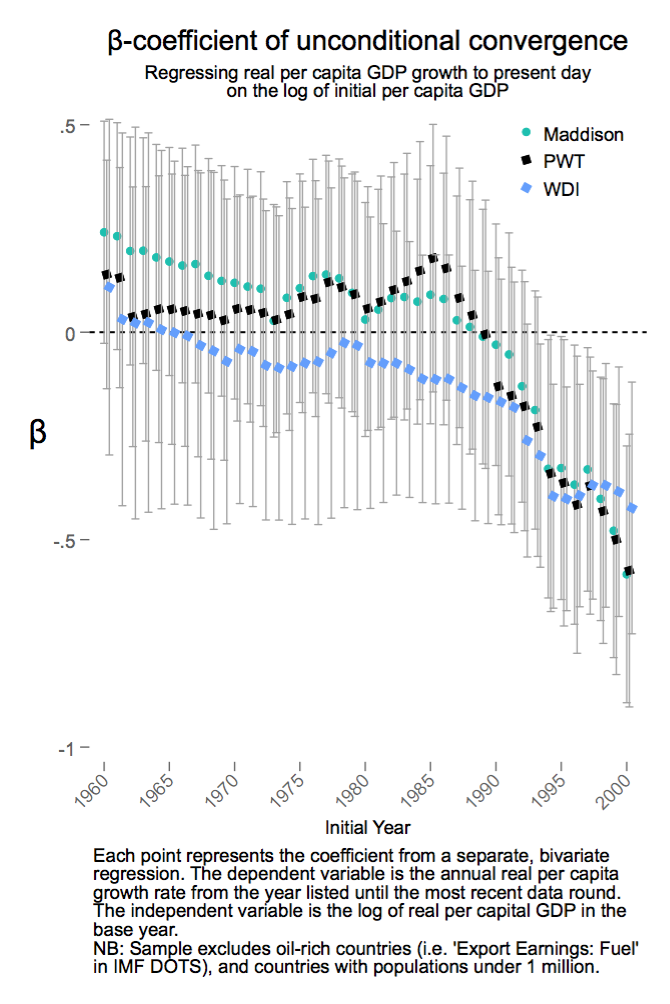
Pritchett was correct but Patel, Sandeful and Subramanian show that just where Pritchett’s study ended, convergence began!
While unconditional convergence was singularly absent in the past, there has been unconditional convergence, beginning (weakly) around 1990 and emphatically for the last two decades.
The figure above plots the coefficient (“beta”) from the plain vanilla unconditional convergence regression (relating average growth of real per capita GDP over the long run to its initial level). A statistically significant negative beta denotes convergence and divergence otherwise. Since we know from Johnson et al. (2013) that growth rates vary widely across datasets, we plot the annual betas for three such sets: the Penn World Tables (PWT), the World Development Indicators, and the Maddison Project (Bolt et al. 2014).[1] While the point estimates vary across datasets, the consistent pattern across them all is a statistically significant negative beta since around 1995 (unconditional convergence) and its lack prior to that (see also Roy, Kessler and Subramanian, 2016).
Our basic point doesn’t require regressions. Looking at the 43 countries the World Bank classified as “low income” in 1990, 65 percent have grown faster than the high-income average since 1990. The same is true for 82 percent of the 62 middle-income countries circa 1990.
Neo-liberalism has been incredibly successful, essentially delivering on all of its promises of economic growth, declines in poverty, and peace. Yet, the ideas behind what Andrei Shleifer called The Age of Milton Friedman are now under attack and in retreat.
Why intellectuals should not be afraid to like sports
That is the topic of my latest Bloomberg column, with a focus on the NBA. Here is one excerpt:
Earlier three-point innovators were called crazy, and maybe they were. The Phoenix Suns tried a fast-break, three-point offense from 2004 to 2010, and they didn’t break through with it. It was persistent foreign competition that finally drove the three points home, when European and other foreign teams, which tended to take more three-point shots, did surprisingly well against U.S. teams in the Olympics. Basketball thus teaches that innovation is not automatic, and it often pays to look abroad for inspiration, even if you are the top performer at any particular moment.
In addition to being a good default conversation topic, sports also keep us in touch with strands of American life that many of us may not encounter otherwise. Following basketball gives me new entry points into rap music, sneaker contracts, college athletics, gifs, the economics of television, even Twitter; it also helped me diagnose an injury a few years ago, when I pulled both of my rotator cuffs and knew immediately how to deal with it. A lot of the American debate over race, and over protest and proper public behavior, has played out through the medium of sports.
By the way, I have no forecasts for the NBA this year other than the trivial. As for the Lakers and LBJ, I suppose I pick them to come in seventh or so, but to go down in the first round of the playoffs.
Does law and economics matter?
This paper provides a quantitative analysis of the effects of the law and economics movement on the U.S. judiciary. Using the universe of published opinions in U.S. Circuit Courts and 1 million District Court criminal sentencing decisions linked to judge identity, we estimate the effect of attendance in the controversial Manne economics training program, an intensive two-week course attended by almost half of federal judges. After attending economics training, participating judges use more economics language, render more conservative verdicts in economics cases, rule against regulatory agencies more often, and render longer criminal sentences. These results are robust to adjusting for a wide variety of covariates that predict the timing of attendance. Comparing non-Manne and Manne judges prior to program start and exploiting variation in instructors further assuage selection concerns. Non-Manne judges randomly exposed to Manne peers on previous cases increase their use of economics language in subsequent opinions, suggesting economic ideas diffused throughout the judiciary. Variation in topic ordering finds that economic ideas were portable from regulatory to criminal cases.
That is from Elliott Ash, Daniel L. Chen, and Suresh Naidu, via Rethinking Economics and also S.
Tuesday assorted links
1. Twenty questions with Chris Kraus.
3. Me on NPR on Planet Money, including on Stubborn Attachments.
4. Are China’s provincial boundaries misaligned?