Saturday assorted links
Those new service sector jobs (Star Wars markets in everything)
Darth Vader Is in Demand at Summer Weddings
Forget flower girls. Couples want stormtroopers throwing petals, and Vader leading the congo line.
There is, however, a shortage. Note this:
Disney forbids the garrisons from participating in certain events without approval, such as gatherings that promote a local business or professional sporting events. Weddings are allowed because they’re considered “community service.”
The 501st has had to adopt an unofficial list of rules to narrow the number of wedding requests. That includes sufficient space to get dressed in costume and having drinking water available on hot days. The plastic and rubber costumes offer no ventilation. “They’re basically death traps,” said Mr. Johnson, who recently returned from a Star Wars event in Singapore where three people dressed as stormtroopers passed out from the heat.
Here is the full WSJ story, via the excellent Samir Varma.
Does the NIH fund edge science?
That is a new paper by Mikko Packalen and Jay Bhattacharya, here is the abstract:
The National Institutes of Health (NIH) plays a critical role in funding scientific endeavors in biomedicine that would be difficult to finance via private sources. One important mandate of the NIH is to fund innovative science that tries out new ideas, but many have questioned the NIH’s ability to fulfill this aim. We examine whether the NIH succeeds in funding work that tries out novel ideas. We find that novel science is more often NIH funded than is less innovative science but this positive result comes with several caveats. First, despite the implementation of initiatives to support edge science, the preference for funding novel science is mostly limited to work that builds on novel basic science ideas; projects that build on novel clinical ideas are not favored by the NIH over projects that build on well-established clinical knowledge. Second, NIH’s general preference for funding work that builds on basic science ideas, regardless of its novelty or application area, is a large contributor to the overall positive link between novelty and NIH funding. If funding rates for work that builds on basic science ideas and work that builds on clinical ideas had been equal, NIH’s funding rates for novel and traditional science would have been the same. Third, NIH’s propensity to fund projects that build on the most recent advances has declined over the last several decades. Thus, in this regard NIH funding has become more conservative despite initiatives to increase funding for innovative projects.
Friday assorted links
Presumed Consent in Wales Falls Short
In 2003, Johnson and Goldstein published what would become a famous paper in Science, Do Defaults Save Lives? The paper featured a graph which showed organ donor consent rates in opt-in countries versus those in opt-out countries. The graph is striking because it seems to suggest that a simple change in the default rule can create a massive change in organ dono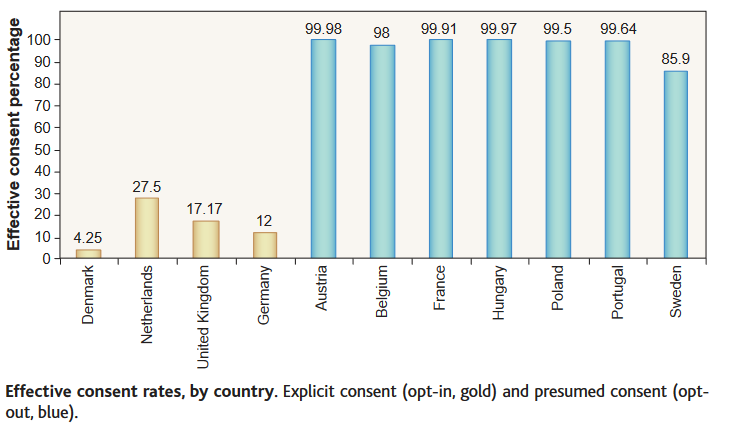 r rates and thus save thousands of lives.
The graph, however, does NOT show organ donor rates. It shows that in opt-in countries few people explicitly opt-in and in presumed consent countries few people explicitly opt-out. But when a potential organ donor dies the families of people in opt-in countries who did not opt-in are still asked whether they would like to donate their loved one’s organs and many of them say yes. Similarly, in the presumed consent countries the families of people who did not opt-out are still typically asked whether they would like to donate their loved one’s organs and some of them say no.
The actual difference in organ donation rates between opt-in and presumed consent countries is much smaller than the differences in the graph, as Johnson and Goldstein made clear later in their paper. Nevertheless, the simple story in the graph encouraged many people to put excess weight on presumed consent as the solution to low organ donor rates.
The best estimates of presumed consent suggested that switching to presumed consent might increase organ donor rates by 25%. 25% isn’t bad! But we don’t have many examples of countries that have switched from one system to another so that estimate should be taken with a grain of salt.
The latest evidence comes form Wales which switched to presumed-consent in 2013. Unfortunately, there has been no increase in donation rates.
The most significant analysis of the new system is the Impact Evaluation Report, released by the Welsh Government in November 2017. Whilst focusing on the positives, such as increased understanding among medical staff, the report cannot escape the donation statistics, which clearly show no improvement. Covering the period from January 2010 or January 2011 to September 2017, all donation data show no change since the legislation’s introduction. The 21-month period before the Act came into effect saw 101 deceased donors, whereas the same period after showed 104; an increase, but one that can be properly attributed to expected annual fluctuation.
I still favor presumed consent or better, mandated choice, but I don’t think the binding constraints on organ donation are default rules. More important are preferences and fears about donation, the existence of a professional system using people who are trained to ask for donations, an institutional organization that can use donations when they are available (minimizing waste), and, of course, incentives.
Hat tip: Frank McCormick.
Applying physics to gdp forecasting
Models developed for gross domestic product (GDP) growth forecasting tend to be extremely complex, relying on a large number of variables and parameters. Such complexity is not always to the benefit of the accuracy of the forecast. Economic complexity constitutes a framework that builds on methods developed for the study of complex systems to construct approaches that are less demanding than standard macroeconomic ones in terms of data requirements, but whose accuracy remains to be systematically benchmarked. Here we develop a forecasting scheme that is shown to outperform the accuracy of the five-year forecast issued by the International Monetary Fund (IMF) by more than 25% on the available data. The model is based on effectively representing economic growth as a two-dimensional dynamical system, defined by GDP per capita and ‘fitness’, a variable computed using only publicly available product-level export data. We show that forecasting errors produced by the method are generally predictable and are also uncorrelated to IMF errors, suggesting that our method is extracting information that is complementary to standard approaches. We believe that our findings are of a very general nature and we plan to extend our validations on larger datasets in future works.
That is from A. Tacchella, D. Mazzilli, and L Pietronero in Nature. Here is a Chris Lee story about the piece. Via John Chamberlin.
Good advice from Patrick Collison
Here is the whole post, here is one excerpt:
If you’re 10–20: These are prime years!
- Go deep on things. Become an expert.
- In particular, try to go deep on multiple things. (To varying degrees, I tried to go deep on languages, programming, writing, physics, math. Some of those stuck more than others.) One of the main things you should try to achieve by age 20 is some sense for which kinds of things you enjoy doing. This probably won’t change a lot throughout your life and so you should try to discover the shape of that space as quickly as you can.
- Don’t stress out too much about how valuable the things you’re going deep on are… but don’t ignore it either. It should be a factor you weigh but not by itself dispositive.
- To the extent that you enjoy working hard, do. Subject to that constraint, it’s not clear that the returns to effort ever diminish substantially. If you’re lucky enough to enjoy it a lot, be grateful and take full advantage!
- Make friends over the internet with people who are great at things you’re interested in. The internet is one of the biggest advantages you have over prior generations. Leverage it.
- Aim to read a lot.
- If you think something is important but people older than you don’t hold it in high regard, there’s a decent chance that you’re right and they’re wrong. Status lags by a generation or more.
- Above all else, don’t make the mistake of judging your success based on your current peer group. By all means make friends but being weird as a teenager is generally good.
Paul Krugman Explaining Macroeconomics on a Roller Coaster
No, I am not kidding. His first roller coaster. Paul’s expression at the end is priceless. I haven’t seen him so ready to throw up since he debated Ron Paul. Personally, I’d prefer to do Economists in Cars Getting Coffee but the fact that this last only 2 minutes is probably for most people a bonus.
Blueberry Earth
This paper explores the physics of the what-if question “what if the entire Earth was instantaneously replaced with an equal volume of closely packed, but uncompressed blueberries?”. While the assumption may be absurd, the consequences can be explored rigorously using elementary physics. The result is not entirely dissimilar to a small ocean-world exo-planet.
Here is the full analysis, via M.
Thursday assorted links
Are economists really extroverted?
Consistent findings across studies were that students of arts/humanities and psychology scored high on Neuroticism and Openness; students of political sc. scored high on Openness; students of economics, law, political sc., and medicine scored high on Extraversion; students of medicine, psychology, arts/humanities, and sciences scored high on Agreeableness; and students of arts/humanities scored low on Conscientiousness. Effect sizes were calculated to estimate the magnitude of the personality group differences. These effect sizes were consistent across studies comparing similar pairs of academic majors. For all Big Five personality traits medium effect sizes were found frequently, and for Openness even large effect sizes were found regularly. The results from the present review indicate that substantial personality group differences across academic majors exist.
Economics majors are also conscientious, not neurotic, less agreeable, and less open.
That is from a recent paper by Anna Vedel, via Shea Matthew Kennisher.
What I’ve been reading
1. Annie Lowrey, Give People Money: How a Universal Basic Income Would End Poverty, Revolutionize Work, and Remake the World. A very good book, one of the hot books of the year, and much deeper and broader and balanced than the subtitle might imply.
2. George Magnus, Red Flags: Why Xi’s China Is In Jeopardy. The case for pessimism, based on all possible reasons. Worth reading, but who knows?
3. Devin Fergus, Land of the Fee: Hidden Costs and the Decline of the American Middle Class. Not a balanced treatment, but a fact-rich and handy starting point for reading about this topic. You won’t learn how many of those fees are efficiency-based, but you will go around asking the question more.
4. François Cusset, How the World Swung to the Right:Fifty Years of Counterrevolutions. Full of generalizations and unsupported claims, but still a better guide to reality than most of what you will find from the other big think books. An attempt at fresh thought, in pocket-sized form.
5. Paula Fredriksen, When Christians Were Jews: The First Generation. Yet another good social and intellectual history of the early, formative period of Christianity.
Charles Silver and David A. Hyman, Overcharged: Why Americans Pay Too Much for Health Care. I find most books on this topic too painful to read, including this one, but it does appear to be comprehensive and the new go-to coverage on this topic.
The rate of gdp growth will soon decline again
Yes, comments will be reactivated, and some already are on the newly written posts. All will be back on once we work through the backlog of posts written during the “comments off” period. There is no conspiratorial explanation for the change and return, nor was anything measured either before or after. I simply got sick of reading your comments and wanted a week or so off. I had that break, plus I was traveling a good deal during that period and needed the extra time. Welcome back, oh wise ones!
What Price Fame?
A NEW GENERATION of celebrities is selling out concerts, starring in commercials, and amassing huge Instagramfollowings. But none of them exist—corporeally, anyway. In recent years, and starting in Japan, technology and social media have spawned a digital demimonde of computer-generated stars, ranging from fake musicians and models to company mascots who appear as holograms (like Betty Crocker, with AI). When they’re not entertaining you, they’re trying to convince you of their humanity, and even the more cartoonish among them have fleshed-out personalities. In a way, it’s the purest expression of celebrity, which has always been an elaborate illusion. CGI starlets, though, “are much easier to control,” says Ryan Detert, CEO of the branding firm Influential. Except when they misbehave.
There is more of interest, from Miranda Katz at Wired, via the excellent Samir Varma.
My Conversation with Michelle Dawson
Here is the transcript and audio, I am very pleased (and honored) to have been able to do this. She is an autism researcher, and so most of the discussion concerned autism, here is one excerpt:
COWEN: What would be the best understanding of autism, from your perspective?
DAWSON: The best understanding is seeing autism as atypical brain functioning, resulting in atypical processing of all information. So that’s information across domains — social, nonsocial; across modalities — visual, auditory; whatever its source, whether it’s information from your memory, information coming from the outside world, that is atypical. So that is very domain-general atypicality.
What autistic brains do with information is atypical. How it’s atypical, in my view, involves what I’ve called cognitive versatility and less mandatory hierarchies in how the brain works, such that, for example, an autistic brain will consider more possibilities, will nonstrategically combine information across levels and scales without losing large parts of it, and so on. And that applies to all information.
That is strictly my view. I’m not sure anyone would agree with me.
And:
COWEN: Now often, in popular discourse, you’ll hear autism or Asperger’s associated with a series of personality traits or features of personality psychology — a kind of introversion or people being nerdy in some regard. In your approach, do you see any connection between personality traits and autism at all?
DAWSON: There is a small literature that shows some connection. I think it’s very weak, and I say no, I don’t think autism is about personality. Autism is sort of orthogonal to personality. The two are not related. Whatever relation there is does not . . . arises from some third factor, let’s say. If there is one — and again, the evidence is, I think, very weak connecting autism to personality — so just say that maybe, if there’s something, let’s say that personality in autistics might be more high variance. That would be my totally wild guess, but I don’t think autism itself is about personality.
And here is Michelle again:
We don’t — I hope we don’t look at a blind person who is a successful lawyer and assume that he is only very mildly blind or barely blind at all, and then look at a blind person who has a very bad outcome and assume that they must be very severely blind.
We do make those kinds of judgments in autism, saying, “The more atypical the person is, the worse they must be in some sense.” That kind of bias has not only harmed a lot of autistic people, it really has impeded research.
Here is Michelle on Twitter. We discuss and link to some of her research in the discussion.