Tuesday assorted links
1. Paul Verhoeven on the Star Wars spin-offs they should be making.
2. Timothy Taylor on Peter Boettke.
4. The new and improved TLS (NYT).
5. The autistic Birmingham murder detective.
6. For tthe first time in the history of chess, the best Chinese player in the world ranking ahead of the best Russian.” And more on Komodo 12 with AlphaZero techniques.
Will Ethiopia be the next China?
That is the topic of my latest Bloomberg column, noting that they have been averaging about ten percent growth for the last decade. I basically make a “deep roots of state capacity” argument, here is one excerpt:
Ethiopia also had a relatively mature nation-state quite early, with the Aksumite Kingdom dating from the first century A.D. Subsequent regimes, through medieval times and beyond, exercised a fair amount of power. Most important, today’s Ethiopians see their country as a direct extension of these earlier political units. Some influential Ethiopians will claim to trace their lineage all the way to King Solomon of biblical times.
In other words, the process of organized, national-level governance has been underway for a long time. It was this relative strength of Ethiopian governance that allowed the territory to fend off colonialism, a rare achievement. It is also why, when you travel around the country, a lot of the basic cuisine doesn’t change much: Dishes are seen as national and not regional…
Like many Iranians, they think of themselves as a civilization and not just a country. They very self-consciously separate themselves from the broader strands of African history and culture. And, as in China, they hold an ideological belief that their country is destined to be great again.
Do read the whole thing.
A One Parameter Equation That Can Exactly Fit Any Scatter Plot
In a very surprising paper Steven Piantadosi shows that a simple function of one parameter (θ) can fit any collection of ordered pairs {Xi,Yi} to arbitrary precision. In other words, the same simple function can fit any scatter plot exactly, just by choosing the right θ. The intuition comes from chaos theory. We know from chaos theory that simple functions can produce seemingly random, chaotic behavior and that tiny changes in initial conditions can quickly result in entirely different outcomes (the butterfly effect). What Piantadosi shows is that the space traversed in these functions by changing θ is so thick that you can reverse the procedure to find a function that fits any scatter plot. He gives two examples:
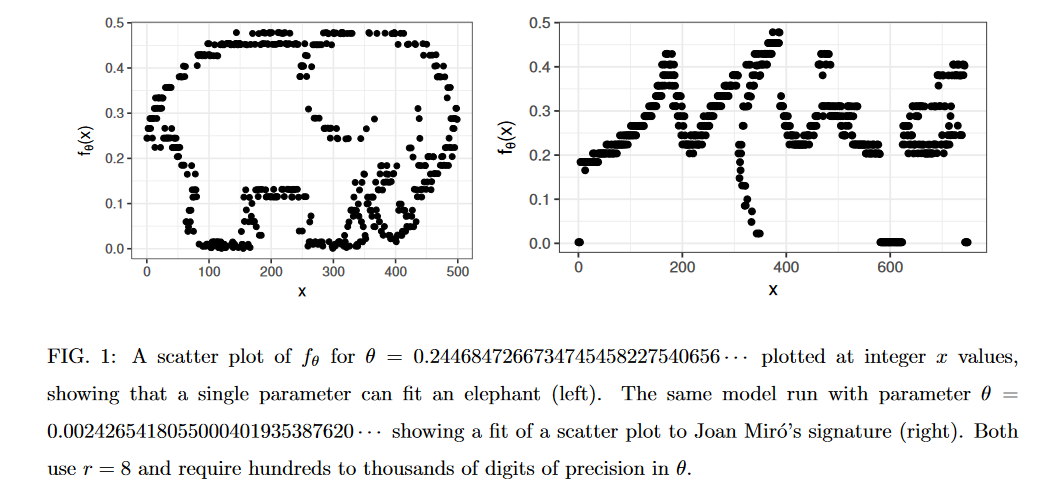
Note that he doesn’t present the actual θ’s used because they run to hundreds or thousands of digits. Moreover, if you are off by just one digit then you will quickly get a very different picture! Nevertheless, precisely because tiny changes in θ have big effects you can fit any scatter to arbitrary precision.
Aside from the wonderment at the result, the paper also tells us that Occam’s Razor is wrong. Overfitting is possible with just one parameter and so models with fewer parameters are not necessarily preferable even if they fit the data as well or better than models with more parameters. His conclusion is exactly right:
The result also emphasizes the importance of constraints on scientific theories that are enforced independently from the measured data set, with a focus on careful a priori consideration of the class of models that should be compared.
Facts about drugs, including fentanyl
But with mobile phones, texting, and social media, transactions can now be arranged electronically and completed by home delivery, reducing the buyer’s risk and travel time to near zero and even his waiting time to minimal levels. In the recent Global Survey on Drugs, cocaine users around the world reported, that their most recent cocaine order was delivered in less time, on average, than their most recent pizza order.
That is from Mark Kleiman, but most of the blog post is about fentanyl. It is one of the best posts I have read all year, recommended.
Fighting to keep your slaves
How did personal wealth affect the likelihood southerners fought for the Confederate Army in
the American Civil War? We offer competing accounts for how we should expect individual
wealth, in the form of land, and atrociously, in slaves, to affect white men’s decisions to join the Confederate Army. We assemble a dataset on roughly 3.9 million white citizens in Confederate states, and we show that slaveowners were more likely to fight in the Confederate Army than non-slaveowners. To see if these links are causal, we exploit a randomized land lottery in 19thcentury Georgia. Households of lottery winners owned more slaves in 1850 and were more likely to have sons who fought in the Confederate Army than were households who did not win the lottery. Our results suggest that for wealthy southerners, the stakes associated with the conflict’s threat to end the institution of slavery overrode the incentives to free-ride and to avoid paying the costs of war.
That is the abstract of a new paper by Andrew B. Hall, Connor Huff, and Shiro Kuriwaki, via the excellent Kevin Lewis.
Who’s complacent?
Or is he just an *******?:
An upstate New York judge Tuesday ordered a 30-year-old man to move out of his parents’ house after they went to court to have him ejected.
Michael Rotondo told the judge he knows his parents want him out of the split-level ranch they share. But he argued that as a family member, he’s entitled to six months more time.
State Supreme Court Justice Donald Greenwood rejected that as outrageous, the Post-Standard of Syracuse reported.
Rotondo told reporters he’ll appeal.
Mark and Christina Rotondo brought the court case after several eviction letters offering money and other help were ignored.
Here is the full story, via Michelle Dawson.
Monday assorted links
1. For Ethiopian Christians, Pontius Pilate is a saint.
2. “Ethiopia to allow all Africans to visit without visas “very soon.””
4. “Over the past 24 months ransomware has become increasingly commoditised with the creators of more recent variants offering revenue-sharing agreements to “affiliate partners”. There is no longer a guarantee that insureds will get their data back, even if they pay the ransom. The “professionalism” associated with earlier strains of ransomware – where call centres were provided to talk victims through accessing Bitcoins in order to pay the ransom and get their data restored – has now all but gone.” Link here.
5. Composer Charles Wuorinen is “almost a libertarian.” And he is cranky about contemporary culture (NYT). And MIE: Dark Chocolate Dessert Hummus.
6. “But if built properly, these cryptocurrencies stand to play a dramatic role in making the Internet global (again).” And I had never seen the word “cryptonanism” before.
Security Over Liberty

Picture taken and titled by Connor Tabarrok yesterday at Ronald Reagan National airport.
Minimum wage up, fringe benefits down
Gordon Tullock used to make this claim, as have I on many occasions:
This paper explores the relationship between the minimum wage, the structure of employee compensation, and worker welfare. We advance a conceptual framework that describes the conditions under which a minimum wage increase will alter the provision of fringe benefits, alter employment outcomes, and either increase or decrease worker welfare. Using American Community Survey data from 2011-2016, we find robust evidence that state-level minimum wage changes decreased the likelihood that individuals report having employer-sponsored health insurance. Effects are largest among workers in very low-paying occupations, for whom coverage declines offset 9 percent of the wage gains associated with minimum wage hikes. We find evidence that both insurance coverage and wage effects exhibit spillovers into occupations moderately higher up the wage distribution. For these groups, reductions in coverage offset a more substantial share of the wage gains we estimate.
That is from a new NBER working paper by Jeffrey Clemens, Lisa B. Kahn, and Jonathan Meer.
Carl-Henri Prophète emails me
I totally agree about Ethiopia being easy to visit. I went there last December and was baffled by how safe it was. I went outside and easily hailed a Taxi at 11 pm (the blue and white ones that everybody take in Addis not the special ones made for tourists). I’d never find a real Taxi in Port-au-Prince after 8 pm. Except the special (and very expensive) ones you can call on the phone.
What stroke me the most was how cheap Ethiopia was compared to Haiti and low income countries in Africa (especially Tchad, where my wife works). I think this is a major problem for countries like Tchad or Haiti (or Nigeria): they grew too expensive before getting even remotely rich. And this gives me hope that Ethiopia could achieve some significant success in tourism and exports in the coming years. By the way, I think that why a country like Ethiopia is cheaper than Haiti or Chad remains a question to be seriously investigated.
However, the Internet in Haiti is way better and cheaper. Cars in Haiti are also substantially cheaper (3 times cheaper at least, thanks in part to the US being so close). I also think the Internet is largely better and cheaper in Nigeria compared to Ethiopia. This made me think about something you wrote about the future of economic development, with people in countries like Haiti or Nigeria getting more satisfaction from the Internet and relatively cheap electronics instead of jobs and income. My impression is that it’s one of the very few low income country not taking this route currently…
Here is Carl-Henri on Twitter.
China Africa fact of the day America step up to the plate
Chinese travelers are the world’s top tourism spenders, shelling out almost $260 billion in 2017 alone. A growing part of that spend is now happening in Africa, encouraged by relaxed visa rules, increased interested in the continent’s cultural and historical sites, and a initiatives that seek to appeal to Chinese tourists.
Last week, the Industrial and Commercial Bank of China launched a joint loyalty program with Kenya’s Stanbic Bank, aiming to create incentives for travel, shopping, and leisure to tourists visiting the two nations. The “I Go Kenya—I Go China” scheme follows the bank’s similar program in South Africa last year, which rewarded its cardholders by offering a range of discounts and special offers from merchants across the travel, hospitality and lifestyle sectors. The state-owned financial behemoth is doing this as part of its plan to internationalize, and push its banking card product abroad.
Meanwhile, Africa is becoming increasingly attractive destination for Chinese tourists. A recent survey by the global travel platform Travelzoo found that the continent was the top destination of choice for Chinese tourists seeking more adventurous holidays in 2018, beating Japan and Australia. Visitors were especially drawn to Morocco, Tunisia, South Africa, Namibia, Madagascar, and Tanzania.
Here is more from Abdi Latif Dahir.
Sunday assorted links
1. Mosaicism and mutation in the brain (NYT). And why did brains get so big?
2. Treating overdoses as homicides? (NYT)
3. As I’ve said before, the most important thinkers of the next generation will be religious thinkers.
4. Amharic, or the language of the birds? And an Ethiopia blog, by Yves-Marie Stranger.
5. An unusual bio.
6. The vanilla wars of Madagascar.
7. “The acquisition of the Komodo comes with the release of an exciting new version of the engine called Komodo Monte Carlo, where moves are chosen by win probability and not traditional evaluation. The approach is similar to the probabilistic methods of the machine-learning chess projects AlphaZero and LeelaChess, which have fascinated chess players with their intuitive styles and fantastic success.” Link here.
Agnes Callard on why there is progress in philosophy
Here is her take, here is one excerpt:
Instead of gauging progress by asking what “we” philosophers agree about, one should ask whether someone who wants to do philosophy is in a better position to do so today than she would’ve been 10 or 100 or 1000 years ago? The answer is: certainly.
And:
But if philosophical thinking is getting better and better—more precise, truthful, articulate, deep—why should we still read Aristotle or Maimonides? The reason we need to do the history of philosophy is precisely that philosophy has made massive amounts of progress in Tyler’s sense of the word: it has filtered into, shaped and organized commonsense, ordinary thought. Indeed, it constitutes much of that thought.
And:
So you are pretty much constantly thinking thoughts that, in one way or another, you inherited from philosophers. You don’t see it, because philosophical exports are the kinds of thing that, once you internalize them, just seem like the way things are. So the reason to read Aristotle isn’t (just) that he’s a great philosopher, but that he’s colonized large parts of your mind.
Finally:
It is not the point of philosophy to end philosophy, to ‘solve’ the deep questions so that people can stop thinking about them. It is the point of people to think about these questions, and the job of philosophers to rub their faces in that fact. Of all of philosophy’s achievements, perhaps the greatest one is just sticking around in the face of the fact that, from day one, anyone who has plumbed the depths of our ambitions has either joined us or … tried to silence, stop or kill us. This is an “old debate” indeed.
There is much more at the link. And here is my original post on the topic. Here is my earlier Conversation with Agnes Callard.
Seeing *Solo* in Addis Ababa
The movie was more or less watchable, in the modest sense of that term.
The subtitles were in Arabic, and the very nice theater was about 1/5 full. And yes it was in 3-D. No one seemed to react to the film at all.
The cinematic references were to Kubrick’s Paths of Glory, Snowpiercer, various James Bond movies, Enter the Dragon, and of course the other Star Wars installments, though never in interesting ways.
One of the characters did not understand subgame perfection.
At one point in the movie they happen across a bunch of people who are dressed like they could be in rural Ethiopia.
Woody Harrelson at times looked like Peter Sellers.
The leader of the rebel alliance was the best character.
By the end of the film, I didn’t seem to mind the whole thing, though I can’t explain why not.
My opinion of George Lucas continues to rise.
The Last of the Moon Walkers
NPR May 26, 2018: Alan Bean, the fourth man to walk on the moon who later chronicled the experience as an artist, died Saturday in Houston after a short illness. He was 86.
In 2012, I wrote the following when there were 8 moon walkers yet living. Today there are 4.
Neil Armstrong, first moon walker, died yesterday.
In total, there have been twelve. Armstrong who was first, Peter Conrad who was 3rd, Alan Shepard who was 5th and James Irwin who was 8th, are gone, leaving just eight. Just eight of 7 billion. Alan Shepard was the oldest, he was born in 1923, the others were all born in the 1930s at a time when Orville Wright still lived. The youngest, Charles Duke, will be 77 this year.
Could we soon have an age where all the moon walkers are gone? Will children then wonder whether it happened at all?
