What I’ve been reading
1. Peter Sloterdijk, Selected Exaggerations: Conversations and Interviews, 1993-2012. No, he’s not a fraud, and this volume is probably the best introduction to his thought. Is there an extended argument here? I am not sure, but I did enjoy this bit:
The existential philosophers have greatly overstated homelessness. In fact, people sit in their apartments with their delusions and cushion themselves as best they can.
But why does he have to follow up with?:
Living means continuously updating the immune system — and that is precisely what foam theory can help us show more clearly than before.
In the German-speaking world he passes for one of the most important world thinkers.
2. Declan Kiberd, After Ireland: Writing the Nation from Beckett to the Present. A very high quality and original look at how Irish literature reflects the nation’s development, though it assumes a fair knowledge of the works being discussed.
3. Fred Hersch, Good Things Happen Slowly: A Life in and Out of Jazz. How someone from a previous generation a) became a star jazz pianist, b) discovered gay liberation, and c) woke from a coma to resume a miraculous career.
4. Stephen Greenblatt, The Rise and Fall of Adam and Eve. In general I am a Greenblatt fan, and not persuaded by the critics of his popularizations, but this book is not doing it for me. For the Hebrew Bible I prefer to read densely argued Straussians.
5. William Ian Miller, The Anatomy of Disgust. Miller’s books from the 1990s remain an underrated source of “stuff for smart people.” His book on disgust could be the best in that series, for me this is a reread and yes it did hold up.
A Technology Story in Three Headlines
Sunday assorted links
A City on the Hill
The Redeemed Christian Church of Nigeria has built its own private city.
A 25-megawatt power plant with gas piped in from the Nigerian capital serves the 5,000 private homes on site, 500 of them built by the church’s construction company. New housing estates are springing up every few months where thick palm forests grew just a few years ago. Education is provided, from creche to university level. The Redemption Camp health centre has an emergency unit and a maternity ward.
On Holiness Avenue, a branch of Tantaliser’s fast food chain does a brisk trade. There is an on-site post office, a supermarket, a dozen banks, furniture makers and mechanics’ workshops. An aerodrome and a polytechnic are in the works.
…“If you wait for the government, it won’t get done,” says Olubiyi. So the camp relies on the government for very little – it builds its own roads, collects its own rubbish, and organises its own sewerage systems. And being well out of Lagos, like the other megachurches’ camps, means that it has little to do with municipal authorities. Government officials can check that the church is complying with regulations, but they are expected to report to the camp’s relevant office. Sometimes, according to the head of the power plant, the government sends the technicians running its own stations to learn from them.
There is a police station on site, which occasionally deals with a death or the disappearance of a child, but the camp’s security is mostly provided by its small army of private guards in blue uniforms. They direct traffic, deal with crowd control, and stop children who haven’t paid for the wristband from going into Emmanuel Park – home to the aforementioned ferris wheel.
As in Gurgaon, India, where the government fails opportunities are opened for entrepreneurs who think big.
Why men are not earning more
“And it all starts at age 25,” Mr. Guvenen said. The decline in lifetime earnings is largely a result of lower incomes at younger ages rather than at older ages, he said, and “that was very surprising to us.”
Most younger men ended up with less because they started out earning less than their counterparts in previous years, and saw little growth in their early years. They entered the work force with lower wages and never caught up.
That is from a very good NYT piece by Patricia Cohen. And note that in spite of all the recent very good economic news, for men the basic story really hasn’t changed, namely that of stagnation as a class.
I wonder sometimes if a Malthusian/Marxian story might be at work here. At relevant margins, perhaps it is always easier to talk/pay a woman to do a quality hour’s additional work than to talk/pay a man to do the same. And so as the demand for such additional hours opens up, the gains go to women, not men. That is at least for the lower income brackets, and perhaps the very most for younger earners. In other words, especially at young ages, women might be serving as a kind of “reserve army of the underemployed.”
Peer review is younger than you think
Via Ben Schmidt, the term becomes common only in the 1970s:
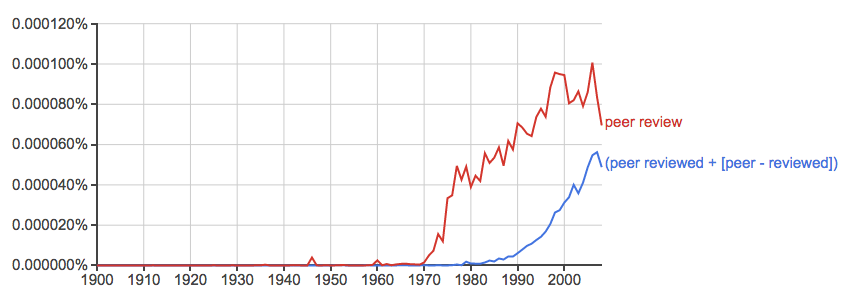
I’d like to see a detailed look at actual journal practices, but my personal sense is that editorial review was the norm until fairly recently, not review by a team of outside referees. In 1956, for instance, the American Historical Review asked for only one submission copy, and it seems the same was true as late as 1970. I doubt they made the photocopies themselves. Schmidt seems to suggest that the practices of government funders nudged the academic professions into more formal peer review with multiple referee reports.
Further research is needed (how about we ask some really old people?), at least if peer review decides it is worthy of publication. Frankly I suspect such work would stand a better chance under editorial review.
In the meantime, here is a tweet from the I didn’t know she was on Twitter Judy Chevalier:
I have just produced a 28-page “responses to reviewer and editor questions” for a 39-page paper.
I’d rather have another paper from Judy.
By the way, scientific papers are getting less readable.
Why do Swedes support their far-right parties?
This is from a job market paper at Stockholm University, by Sirus Dehdari:
This paper studies the effects of economic distress on support for far-right parties. Using Swedish election data, I show that shocks to unemployment risk among unskilled native-born workers account for 5 to 7 percent of the increased vote share for the Swedish far-right party Sweden Democrats. In areas with an influx of unskilled immigrants equal to a one standard deviation larger than the average influx, the effect of the unemployment risk shock to unskilled native-born workers is exacerbated by almost 140 percent. These findings are in line with theories suggesting that voters attribute their impaired economic status to immigration. Furthermore, I find no effects on voting for other anti-EU and anti-globalization parties, challenging the notion that economic distress increases anti-globalization sentiment. Using detailed survey data, I present suggestive evidence of how increased salience of political issues related to immigration channels economic distress into support for far-right parties, consistent with theories on political opportunity structure and salience of sociocultural political issues.
Here is Dehdari’s cv, all via Matt Yglesias.
There is a hot hand after all
This paper, “The Hot-Hand Fallacy: Cognitive Mistakes or Equilibrium Adjustments? Evidence from Major League Baseball,” delivers on both the theory and the empirics:
We test for a “hot hand” (i.e., short-term predictability in performance) in Major League Baseball using panel data. We find strong evidence for its existence in all 10 statistical categories we consider. The magnitudes are significant; being “hot” corresponds to between one-half and one standard deviation in the distribution of player abilities. Our results are in notable contrast to the majority of the hot-hand literature, which has generally found either no hot hand or a very weak hot hand in sports, often employing basketball shooting data. We argue that this difference is attributable to endogenous defensive responses: basketball presents sufficient opportunity for transferring defensive resources to equate shooting probabilities across players, whereas baseball does not. We then develop a method to test whether baseball teams do respond appropriately to hot opponents. Our results suggest teams respond in a manner consistent with drawing correct inference about the magnitude of the hot hand except for a tendency to overreact to very recent performance (i.e., the last five attempts).
That is from Brett Green and Jeffrey Zwiebel, via Rolf Degen. Here are ungated versions.
Saturday assorted links
1. Should Amish use smart phones? (NYT)
2. Versatile people are more likely to be self-employed.
3. Is giving money to poor people now considered morally questionable?
4. The long death of Product 19.
5. The Ig Noble economics prize goes to a study of the effect of saltwater-crocodiles on problem gamblers.
I find it remarkable that cement is exported at all
Below are the 15 countries that exported the highest dollar value worth of cement during 2016:
- China: US$692.4 million (7.6% of total cement exports)
- Thailand: $612.2 million (6.8%)
- United Arab Emirates: $544.4 million (6%)
- Turkey: $494.8 million (5.5%)
- Germany: $486.3 million (5.4%)
- Spain: $477.3 million (5.3%)
- Vietnam: $403 million (4.4%)
- Japan: $391.3 million (4.3%)
- Canada: $368.7 million (4.1%)
- India: $267 million (2.9%)
- Greece: $248.6 million (2.7%)
- Senegal: $209 million (2.3%)
- United States: $205.9 million (2.3%)
- Pakistan: $185.6 million (2%)
- South Korea: $162.9 million (1.8%)
Here is the link.
Food stamps and crime
We find that staggering SNAP benefits throughout the month leads to a 32 percent decrease in grocery store theft and reduces monthly cyclicity in grocery store crimes.
That is by Jillian B. Carr and Analisa Packham (pdf), via Alexander Berger.
Friday assorted links
1. What makes people dislike their doctors.
2. Kevin Hassett is now confirmed, and Richard Burkhauser is named as the third CEA member (WSJ), Tomas Philipson is the other.
4. New Hampshire was the highest earning state in 2016.
5. The new economy of excrement.
6. Stephon Marbury in China watch. And training a pitcher to throw a baseball at 95 mph (recommended).
Is the great wage stagnation over?
Possibly so, though some more good years would be nice, to say the least. To some extent this could be noise, or delayed catch-up growth. Still, there seems to be a break in the previous trend:
In 2015, median household incomes rose by 5.2 percent. That was the fastest surge in percentage terms since the Census Bureau began keeping records in the 1960s. Women living alone saw their incomes rise by 8.7 percent. Median incomes for Hispanics rose by 6.1 percent. Immigrants’ incomes, excluding naturalized citizens, jumped by over 10 percent.
The news was especially good for the poor. The share of overall income that went to the poorest fifth increased by 3 percent, while the share that went to the affluent groups did not change. In that year, the poverty rate fell by 1.2 percentage points, the steepest decline since 1999.
…The numbers for 2016 have just been released by the Census Bureau, and the trends are pretty much the same. Median household income rose another 3.2 percent, after inflation, to its highest level ever. The poverty rate fell some more. The share of national income going to labor is now rising, while the share going to capital is falling.
That is from the new David Brooks column.
The education culture that is China
Students at a major university in Beijing are now required to scan their faces upon entering dormitory buildings, a process that may soon make security guards obsolete.
Beijing Normal University has installed 44 facial scanners on its 19 dormitory buildings, for the 18,000 students on campus.
It is the boldest move taken by a Chinese university so far to apply advanced digital technologies in campus management and has drawn attention from administrators at other universities.
The machines have been placed at all entrances to dorm buildings. Students entering the building will have to pause and look at the sensor for a few seconds. They are then required to swipe their campus ID card. If the face and card match, the machine will open the gate and say “welcome home.”
The machines also come with voice recognition. Students who forget to bring their ID cards can scan their face and say the last four digits of their card number, said Yang Hailiang, general manager of Beijing Peace and Joy Technology, which produces the machines.
The system can recognize 26 Chinese dialects and has achieved an accuracy rate of 98 percent, Yang said.
Here is the full article.
A simple point about corporate tax reform
For the most part, the empirical literature suggests that “cash flow” drives investment more than does say the real interest rate; you can take the latter as one proxy for non-massive changes in rates of return. So a plan to cut “back taxes” for companies still might stimulate investment, even if it doesn’t appear to alter marginal incentives in the appropriate way. It will give corporations a higher realized cash flow over the immediately prior period, and again that has had decent predictive power over investment. But causality? That is tougher to say, but of course there are theories that self-financed investments are more attractive to managers than having to bring in additional outside monitors.
There is a genuine question whether you should side with the theory or the empirics here, and I am myself agnostic. Furthermore, perhaps the cash flow of the prior periods proxies for the expected rate of return more accurately than do our available measurements for the expected rate of return. So you don’t have to take the empirical result as documenting the importance of cash flow.
Still, if you hear someone attacking a tax reform plan as a “corporate giveaway,” just ask them how well they know this literature. There is at least some chance that “giveaways” boost investment more than do targeted marginal changes.