Results for “age of em” 17246 found
Wednesday assorted links
1. Invite a llama or goat to your next corporate Zoom meeting or video call for under $100. And new Oumuamua theory, but kind of boring.
2. Turning old shipping containers into mobile intensive care units.
3. Contemporary novels longer than 500 pages, some of them good.
5. Critique of the IHME epidemiological model, recommended. And a few more criticisms. And here is Karl T. Bergstrom, very good points. Recommended.
6. Update on French-speaking vs. German-speaking Swiss cantons. File under “heterogeneities.”
7. “But the operation can be no longer than two hours as that is how long a rhino can be safely anaesthetised.” It is hard to make a rhino.
8. Data on indoor outbreaks, striking results. Outdoors seems pretty safe.
Re-starting the economy
Will the U.S. economy re-open prematurely?:
New NBER survey of U.S. small companies nber.org/papers/w26989 Here is the percent, by industry, saying their business will still exist if the crisis lasts 6 months: All retail (except grocers): 33% Hotels: 27% Personal services: 22% Restaurants and bars: 15%
That is from Derek Thompson. Or when will the non-payment of mortgages render the banking system insolvent and beyond saving by the Fed?
At some point, irreversible, non-linear economic damage sets in, and we won’t let that happen, no matter how many times someone tells you “there is no trade-off between money and lives.”
For some time now I have thought that America will reopen prematurely, with a very partial and indeed hypocritical reopening, but a reopening nonetheless. In May, in most states but at varying speeds, including across cities.
You can see from this Chicago poll of top economists that virtually all of them oppose an early reopening. I don’t disagree with their analysis, but they are too far removed from the actual debate.
America is a democracy, and the median voter will not die of coronavirus (this sentence is not repeated enough times in most analyses). And so we will reopen pretty soon, no matter what the full calculus of lives and longer-run gdp might suggest.
Lyman Stone favors ending the lockdown. It does not matter whether you agree with him or not. Matt Parlmer predicts revolution if we don’t reopen in time. I don’t agree with that assessment, but he is thinking along the right lines by not regarding the reopening date as entirely a choice variable.
The key is to come up with a better reopening rather than a worse reopening.
Any model of optimal policy should be “what should we do now, knowing the lockdown can’t last very long?” rather than “what is the optimal length of lockdown?”
And our best hope is that the risk of an early reopening spurs America to become more innovative more quickly with masks, testing, and other methods of reducing viral and economic risk.
CA Put Construction Into Limbo
One silver lining of the crisis is that the country has been getting rid of a lot of regulations that slow things down. CA, however, has decided to slow things down even more.
REASON: Last week, the Judicial Council of California—the rule-making body for the state’s courts—issued 11 emergency rules for the judicial system during the current pandemic.
Included in the council’s rules was a blanket extension of deadlines for filing civil actions until 90 days after the current state of emergency ends. Ominously for housing construction, this extended statute of limitations applies to lawsuits filed under the California Environmental Quality Act (CEQA).
That law requires local governments to study proposed developments for potentially significant environmental impacts. CEQA also gives third parties the power to sue local governments for approving a construction project if they feel that a particular environmental impact wasn’t studied enough.
The law has become a favored tool of NIMBYs and other self-interested parties to delay unwanted developments or to extract concessions from developers. Anti-gentrification activists use CEQA to stop apartment buildings that might cast too much shadow. Construction unions use the law as leverage to secure exclusive project labor agreements.
Under normal circumstances, these CEQA lawsuits have to be filed within 30 or 35 days of a project receiving final approval.
Notice that the law doesn’t say the NIMBYs get an extra 30 or 35 days to file. It says that NIMBYs get to file until 90 days “after the current state of emergency ends.” In other words, no one can know when they are free to build so the law could put every CA construction project that hasn’t already past CEQA review into limbo.
“If I’m a builder I can’t move forward with my project until the [CEQA] statute of limitations has expired. The reason why I can’t do that is because if you do move forward, courts have the authority to order you tear down what you’ve built,” Cammarota tells Reason, explaining that “lenders today are unwilling to fund those loans for construction until the statute of limitations has expired.”
Hat tip: Carl Danner.
The new (old) federalism under coronavirus
That is the topic of my Bloomberg column, here is one bit:
As May begins, it seems highly likely that the states will be reopening at their own paces and with their own sets of accompanying restrictions, with some places not reopening at all. There is likely to be further divergence at the city and county level, with say New York City having very different policies and practices than Utica or Rochester upstate.
Such divergence in state policy is hardly new. But until now states have typically had many policies in common, on such broad issues as education and law enforcement and on narrower ones such as support for Medicaid. Now and suddenly, on the No. 1 issue by far, the states will radically diverge.
Hence the idea that America is inching closer to what it was under the Articles of Confederation, which governed the U.S. from 1781 to 1789. The U.S. constitutional order has not changed in any explicit manner, but the issues on which the states are allowed to diverge have gone from being modest and relatively inconsequential to significant and meaningful if not dominant.
And:
This divergence may create further pressures on federalism. In Rhode Island, for example, state police have sought to stop cars with New York state license plates at the border, hindering or delaying their entrance. Whether such activities are constitutional, most governors do have broad authority to invoke far-reaching emergency powers.
As some states maintain strict lockdowns while others reopen and allow Covid-19 to spread, such border-crossing restrictions could become more common — and more important. Maryland has been stricter with pandemic control than has Virginia, so perhaps Maryland will deny or discourage entry from Virginia — in metropolitan Washington, there are only a few bridges crossing the river that divides the two states. Or maybe Delaware won’t be so keen to take in so many visitors from New Jersey, while Texas will want to discourage or block migration from Louisiana.
To be clear, I think this unusual situation will recede once Covid-19 is no longer such a serious risk.
Why isn’t Sweden exploding?
…Swedish state epidemiologist Anders Tegnell remains calm: he is not seeing the kind of rapid increase that might threaten to overwhelm the Swedish health service, and unlike policymakers in the UK, he has been entirely consistent that that is his main objective.
That is from a new piece by Freddie Sayers, asserting that “the jury is still out” when it comes to Sweden. I cannot reproduce all of the graphs in that piece, but scroll through and please note that in terms of per capita deaths Sweden seems to be doing better than Belgium, France, or the United Kingdom, all of which have serious lockdowns (Sweden does not). If you measure extant trends, Sweden is in the middle of the pack for Europe. And here is data on new hospital admissions:
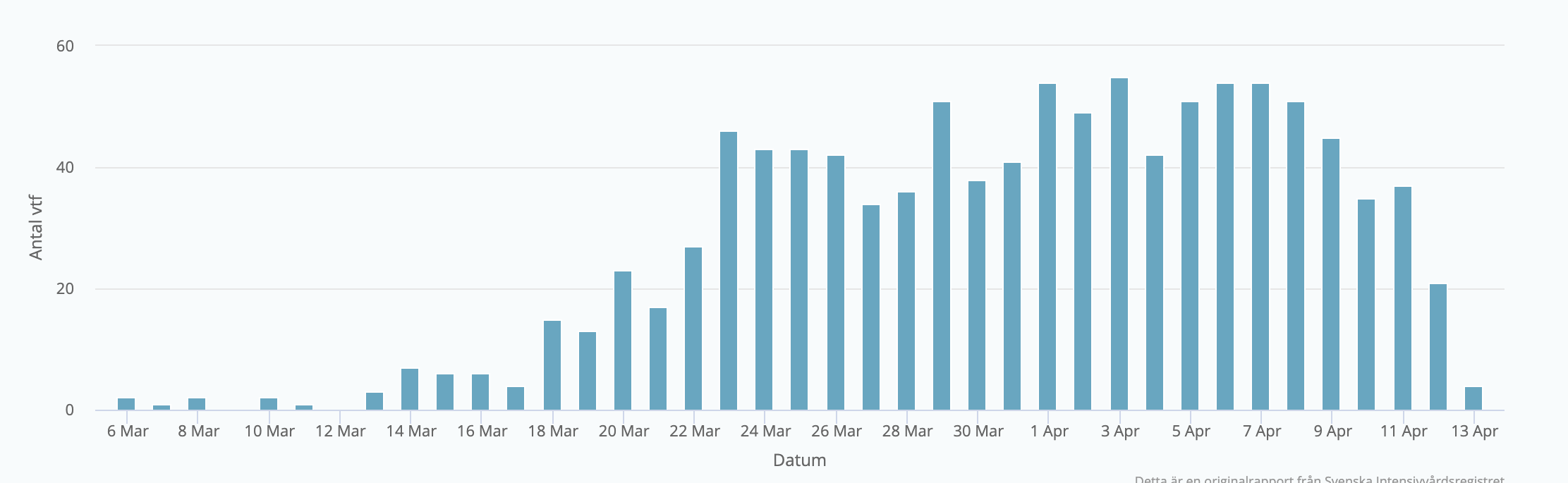
Now I understand that ideally one should compare similar “time cohorts” across countries, not absolute numbers or percentages. That point is logically impeccable, but still as the clock ticks it seems less likely to account for the Swedish anomaly.
Of course we still need more days and weeks of data.
To be clear, I am not saying the United States can or should copy Sweden. Sweden has an especially large percentage of people living alone, the Swedes are probably much better at complying with informal norms for social distancing, and obesity is much less of a problem in Sweden than America, probably hypertension too.
But I’d like to ask a simple question: who predicted this and who did not? And which of our priors should this cause us to update?
I fully recognize it is possible and maybe even likely that Sweden ends up being like Japan, in the sense of having a period when things seem (relatively) fine and then discovering they are not. (Even in Singapore the second wave has arrived, from in-migration, and may well be worse than the first.) But surely the chance of that scenario has gone down just a little?
And here is a new study on Lombardy by Daniil Gorbatenko:
The data clearly suggest that the spread had been trending down significantly even before the initial lockdown. They invalidate the fundamental assumption of the Covid-19 epidemiological models and with it, probably also the rationale for the harshest measures of suppression.
One possibility (and I stress that word possibility) is that these Lombardy data, shown at the link, are reflecting the importance of potent “early spreaders,” often family members, who give Covid-19 to their families fairly quickly, but after which the average rate of spread falls rapidly.
I’ll stand by my claim that the pieces on this one show an increasing probability of not really adding up. In the meantime, I am very happy to pull out and signal boost the best criticisms of these results.
Tuesday assorted links
2. Senators are not good at stock picking, even when related to their committee assignments.
3. Economic analysis of optimal lockdown. I definitely think this exercise is worth doing, but the researchers, as economists, ignore most of the critical public choice and sustainability issues, much as other researchers do.
4. What makes Ringo a great drummer (video). And is music getting better or worse? (data from streaming)
6. How testing works, or doesn’t work, in New Jersey.
7. An epidemiologist addresses my questions (something Twitter was unable to do), bravo to him.
8. Apichatpong Weerasethakul plum tree update. And ““This is the first transnational geopolitical Twitter war Thais have engaged in,” said Prajak Kongkirati of Bangkok’s Thammasat University.” (NYT)
9. Markets in everything: “Hamas Willing to Trade Information on Israelis Held in Gaza for Ventilators.”
10. Reopening guidelines from John Cochrane.
11. Sarah Constantin on variolation.
12. David Henderson argues for liberation from lockdown. Not my view, but I think his strongest argument is that greater freedom will induce us to rush with innovation in test and trace, masks, etc.
13. How soon does it end? Preliminary results, but very important. There is so much interesting in that link, including the possibility that California needs to worry more than does New York. Recommended. I’ll be saying more about these issues soon and of course waiting for the final results.
14. Why serology is more difficult than it looks. And look at these pictures.
16. Superspreaders (NYT): ““The MERS-CoV outbreak in South Korea was driven primarily by three infected individuals, and approximately 75 percent of cases can be traced back to three superspreaders who have each infected a disproportionately high number of contacts,” wrote George F. Gao, an immunologist and virologist at the Chinese Centers for Disease Control and Prevention in Beijing, in a recent paper.”
17. The Wolfram Physics Project, lots there.
Suppression is Working, R is Declining
The reproduction factor is declining. We need to push it below 1 for the virus to start to fade away and then we can move to safety protocols and mass testing.
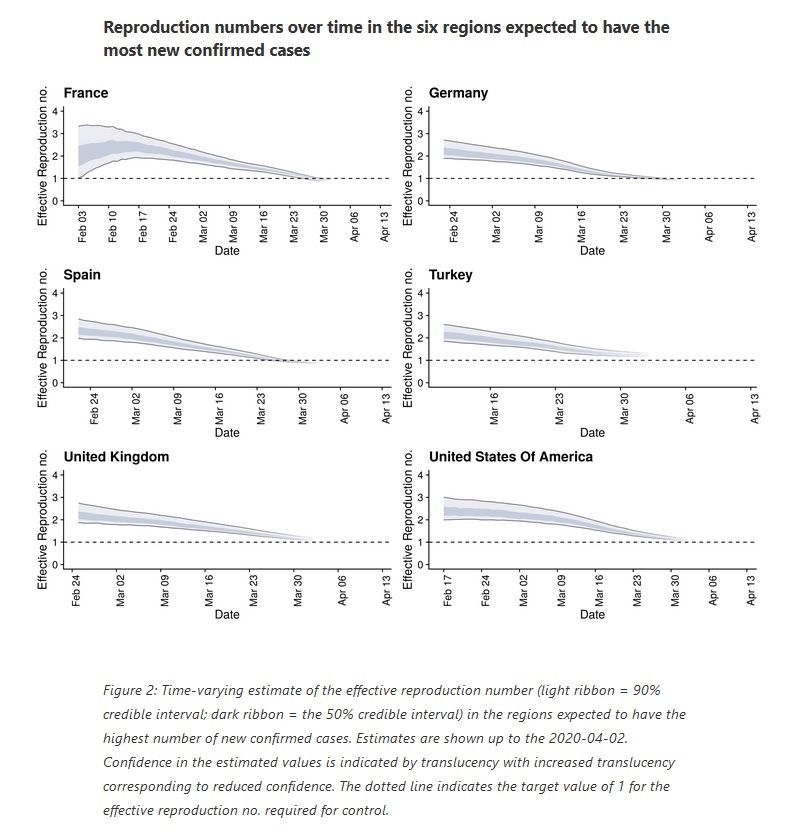
These estimates are from the Centre for the Mathematical Modelling of Infectious Diseases at the London School of Hygiene & Tropical Medicine. More details here.
Why social distancing will persist
Some 72% of Americans polled said they would not attend if sporting events resumed without a vaccine for the coronavirus. The poll, which had a fairly small sample size of 762 respondents, was released Thursday by Seton Hall University’s Stillman School of Business.
When polling respondents who identified as sports fans, 61% said they would not go to a game without a vaccine. The margin of error is plus-or-minus 3.6%.
Only 12% of all respondents said they would go to games if social distancing could be maintained, which would likely lead to a highly reduced number of fans, staff and media at games.
I doubt if that poll is extremely scientific, but the key fact here is that people go to NBA games, and most other public entertainments, in groups. Fast forward a bit and see how the group negotiations will go. Of a foursome, maybe three people would go to the game and one would not. That group is likely to end up doing something else altogether different, without 19,000 other cheering fans screaming and breathing into their faces.
If half the people say they will go, that does not mean you get half the people. It means you hardly get anybody.
By the way, what percentage of the American population will refuse or otherwise evade this vaccine, assuming we come up with one of course?
Here is the ESPN story link.
Saturday assorted links
1. MIE: “This Man Owns The World’s Most Advanced Private Air Force After Buying 46 F/A-18 Hornets.”
2. Romer tweet storm states his plan.
4. Is American innovation speeding up? (WSJ)
6. Non-exemplary lives (ouch). And what do the humanities do in a crisis?
7. Instagram strippers (NYT). And Bret Stephens: our regulatory state is failing us (NYT).
8. “Believe women,” selectively.
9. BloombergQuint on Alex and Shruti.
10. A proposal for releasing British young people (ever listen to early Clash?).
11. Arnold Kling annotates (and likes) my Princeton talk.
12. A Swede explains Sweden to an Israeli: “Some maintain that the Swedish policy can succeed only in Sweden, because of its distinctive characteristics – a country where population density is low, where a high percentage of the citizenry live in one-person households and very few households include people over 70 cohabiting with young people and children. Those are mitigating circumstances which the Swedes hope will work to their advantage.”
Discovering Safety Protocols
Walmart, Amazon and other firms are developing safety protocols for the COVID workplace. Walmart, for example, will be doing temperature checks of its employees:
Walmart Blog: As the COVID-19 situation has evolved, we’ve decided to begin taking the temperatures of our associates as they report to work in stores, clubs and facilities, as well as asking them some basic health screening questions. We are in the process of sending infrared thermometers to all locations, which could take up to three weeks.
Any associate with a temperature of 100.0 degrees will be paid for reporting to work and asked to return home and seek medical treatment if necessary. The associate will not be able to return to work until they are fever-free for at least three days.
Many associates have already been taking their own temperatures at home, and we’re asking them to continue that practice as we start doing it on-site. And we’ll continue to ask associates to look out for other symptoms of the virus (coughing, feeling achy, difficulty breathing) and never come to work when they don’t feel well.
Our COVID-19 emergency leave policy allows associates to stay home if they have any COVID-19 related symptoms, concerns, illness or are quarantined – knowing that their jobs will be protected.
Amazon is even investing in their own testing labs.
Amazon Blog: A next step might be regular testing of all employees, including those showing no symptoms. Regular testing on a global scale across all industries would both help keep people safe and help get the economy back up and running. But, for this to work, we as a society would need vastly more testing capacity than is currently available. Unfortunately, today we live in a world of scarcity where COVID-19 testing is heavily rationed.
If every person, including people with no symptoms, could be tested regularly, it would make a huge difference in how we are all fighting this virus. Those who test positive could be quarantined and cared for, and everyone who tests negative could re-enter the economy with confidence.
Until we have an effective vaccine available in billions of doses, high-volume testing capacity would be of great help, but getting that done will take collective action by NGOs, companies, and governments.
For our part, we’ve begun the work of building incremental testing capacity. A team of Amazonians with a variety of skills – from research scientists and program managers to procurement specialists and software engineers – have moved from their normal day jobs onto a dedicated team to work on this initiative. We have begun assembling the equipment we need to build our first lab (photos below) and hope to start testing small numbers of our front line employees soon.
Actions and experiments like these will discover ways to work safely till we reach the vaccine era.
Friday assorted links
1. Balaji on heterogeneities and data integration.
2. Citizen’s handbook for nuclear attack and natural disasters. Do we need a new version of this?
3. The Amazon: “We show that, starting at around 10,850 cal. yr BP, inhabitants of this region began to create a landscape that ultimately comprised approximately 4,700 artificial forest islands within a treeless, seasonally flooded savannah.”
4. How much distance do you need when exercising? And against crowded spaces.
5. Dan Wang letter from Beijing in New York magazine.
6. Trump pushing to reopen by May 1.
7. Lots of new testing results from Germany, consider these as hypotheses but still a form of evidence.
8. Good and subtle piece on Tiger King (NYT). And betting markets in everything.
9. The Vietnamese response seems pretty good so far.
10. Joe Stiglitz discusses his love of fiction (NYT)
12. Ronald Inglehart on the shift to tribalism.
13. Explaining the Fed lending programs.
14. MIT Press preprint of new Joshua Gans book on Covid-19, open for public comment.
Does working from home work?
Better than you might think. Here is a paper from a few years back, by Nicholas Bloom, James Liang, John Roberts, and Zhichun Jenny Ying:
A rising share of employees now regularly engage in working from home (WFH), but there are concerns this can lead to ‘‘shirking from home.’’ We report the results of a WFH experiment at Ctrip, a 16,000-employee, NASDAQ-listed Chinese travel agency. Call center employees who volunteered to WFH were randomly assigned either to work from home or in the office for nine months. Home working led to a 13% performance increase, of which 9% was from working more minutes per shift (fewer breaks and sick days) and 4% from more calls per minute (attributed to a quieter and more convenient working environment). Home workers also reported improved work satisfaction, and their attrition rate halved, but their promotion rate conditional on performance fell. Due to the success of the experiment, Ctrip rolled out the option to WFH to the whole firm and allowed the experimental employees to reselect between the home and office. Interestingly, over half of them switched, which led to the gains from WFH almost doubling to 22%. This highlights the benefits of learning and selection effects when adopting modern management practices like WFH.
Via Matt Notowidigdo. Of course in that paper, the schools were not all closed…
Thursday assorted links
1. “We are at a critical juncture for the market.”
2. Pandemic insurance for Wimbledon cancellation.
3. Borjas on who is undertested, from NYC data.
4. Japanese cook draws every meal he eats.
5. How to close a bag of chips with no clip.
7. How is the Swedish approach working out?
8. Re-entry stickers for the Florida Keys — get the picture?
9. Stapp and Watney, masks for all.
10. Hong Kong quarantine diary.
11. How the Faroe Islands aced it (so far).
12. “Many brands are using keyword blocklists to stop their adverts appearing next to stories about Covid-19, meaning that even though news websites are getting record traffic from readers they are barely earning any money from the clicks.” Link here.
13. The Pandemic Challenge, from Singularity University.
14. Will Covid-19 induce a decline in religiosity?
Where we stand
I thought it useful to sum up my current views in a single paragraph, here goes:
I don’t view “optimal length of shutdown” arguments compelling, rather it is about how much pain the political process can stand. I expect partial reopenings by mid-May, sometimes driven by governors in the healthier states, even if that is sub-optimal for the nation as a whole. Besides you can’t have all the banks insolvent because of missed mortgage payments. But R0 won’t stay below 1 for long, even if it gets there at all. We will then have to shut down again within two months, but will then reopen again a bit after that. At each step along the way, we will self-deceive rather than confront the level of pain involved with our choices. We may lose a coherent national policy on the shutdown issue altogether, not that we have one now. The pandemic yo-yo will hold. At some point antivirals or antibodies will kick in (read Scott Gottlieb), or here: “There are perhaps 4-6 drugs that could be available by Fall and have robust enough treatment effect to impact risk of another epidemic or large outbreaks after current wave passes. We should be placing policy bets on these likeliest opportunities.” We will then continue the rinse and repeat of the yo-yo, but with the new drugs and treatments on-line with a death rate at maybe half current levels and typical hospital stays at three days rather than ten. It will seem more manageable, but how eager will consumers be to resume their old habits? Eventually a vaccine will be found, but getting it to everyone will be slower than expected. The lingering uncertainty and “value of waiting,” due to the risk of second and third waves, will badly damage economies along the way.
So there you have it.
There’s No Such Things as a Free L̶u̶n̶c̶h Test
In a short-sighted blunder, India’s Supreme Court has ruled that private labs cannot charge for coronavirus tests:
NDTV: “The private hospitals including laboratories have an important role to play in containing the scale of pandemic by extending philanthropic services in the hour of national crisis…We thus are satisfied that the petitioner has made out a case…to issue necessary direction to accredited private labs to conduct free of cost COVID-19 test,” the court said.
Whether the private labs should be reimbursed by the government, will be decided later, Justices Ashok Bhushan and S Ravindra Bhat said in a hearing conducted via video conferencing.
The Supreme Court’s ruling will reduce the number of tests and dissuade firms from rushing to develop and field new drugs and devices to fight the coronavirus. A price is a signal wrapped up in an incentive. Instead of incentivizing investment, this order incentives firms to invest resources elsewhere.
Nor do private labs have a special obligation that mandates their conscription–an obligation to fund testing for all, falls on all.
The ruling is especially unfortunate because as Rajagopalan and Choutagunta document, India’s health care sector is predominantly private:
…India must rely primarily on the private sector and civil society to lead the response to COVID-19,…the role of the government should be financing and subsidizing testing and treatment for those who cannot afford to pay. India’s private healthcare system is better funded and better staffed than the government healthcare system, and it serves more people. It is estimated to be four times bigger in overall healthcare capacity, and it has 55 percent of the total hospital bed capacity, 90 percent of the doctors, and 80 percent of the ventilators.
The temptation to requisition private resources for state use in an emergency is ever present—but Indian policymakers must resist that temptation because it will compromise instead of increase capacity.
Benevolence is laudatory but even in a pandemic we should not rely on the benevolence of the butcher, brewer or baker for our dinner nor on the lab for our coronavirus tests. If we want results, never talk to suppliers of our own necessities, but only of their advantages.