Results for “age of em” 17224 found
The Cloud Under the Sea
The Verge: Microsoft has placed a data center in the Scottish sea to determine whether it can save energy by cooling it in the sea. Data centers typically generate a lot of heat, and big providers try to move them to cooler countries to save on energy bills. Microsoft has been experimenting with subsea data centers for around five years, and previously sunk a data center on the Californian coast for five months back in 2015.
Today’s underwater data center will be deployed for five years, and includes 12 racks with 864 servers and 27.6 petabytes of storage. That’s enough storage for around 5 million movies, and the data center is as powerful as thousands of high-end desktop PCs. The data center will be powered by an undersea cable and renewable energy from the Orkney Islands. The cable will also connect the servers back to the internet.
Hat tip: Robin Hanson.
Tuesday assorted links
1. Indian philosophy of language.
2. New Yorker covers dining in the Faroe Islands.
3. “It is easier to own a tiger than a dog that has been labelled dangerous in the state of Texas, which could have between 2,000 and 5,000 tigers.” You also can buy a tiger on-line.
4. Liberal vs. conservative notions of God?
5. Can your body itself power implantable biomedical devices?
The North Korean summit and deal
Many of you have asked what I think, so here goes:
1. There is a secret (and unenforceable) deal beneath what is reported. You may think this is good or bad, but for heaven’s sake don’t just be judging the press release.
2. If they didn’t actually agree to anything, that is fine.
3. I am reading so much yelping about how Trump “legitimized” Kim. The status quo ex ante simply was terrible, and there is no reason to think this change is for the worse. Trump’s great “virtue” in this regard was simply to be some mix of ignorant/disrespectful of the prior “expert consensus” and approach the problem afresh with a rather direct transactional and person-centered, personality-centered mentality.
4. As I tweeted: “Isn’t the whole point of the “deal” just to make them go visit Singapore? The real spectacle is not always where you are looking. And I hope someone brought them to the right chili crab place.”
The goal is to show the North Korean leadership there is a better way than playing the Nuclear Hermit Kingdom game. We won’t know for some time whether this has succeeded. Here is good FT coverage on this point. There are in fact numerous signs that the North Koreans are considering serious reforms. Of course those could be a feint, but the probabilities are rising in a favorable direction. Economic cooperation with South Korea is increasing at an astonishing pace.
5. The chance that North Korea someday becomes an unruly version of an American client state has gone up. The chance of a kind of faux, “on paper” Korean reunification has gone up too.
6. No, North Korea isn’t giving up its nuclear weapons. The more important question is to what extent they will use those weapons in the future to check China.
7. How is it that Dennis Rodman played in only two All-Star games?
8. In expected value terms, this is the biggest triumph of the Trump presidency. Most of all, however, you should be agnostic. The negative commentary I am seeing is mostly sour grapes, misplaced frustration, and it is weak in the quality of its argumentation. Here is one of Trump’s better tweets.
From the comments, Vitalik Buterin
Analyst
|
I’ll answer this one here in detail because it’s probably too technical for it to be valuable to put a good answer into a Conversation with Tyler.
> 1. In retrospect, was it a good decision to have ethereum bytecodes executed on every single mining node? And if not, would he have selected sharding and plasma or a different solution?
Ultimately the answer is, yes given the knowledge we had at the time, no given what we know today. If I was doing Ethereum back then with the knowledge that I have today, I would obviously shoot straight for exactly the design that the research team is shooting for today (Casper PoS, sharding), and I would have actively encouraged developers to work on state channels and Plasma from day 1. Layer 1 scaling (sharding) and layer 2 scaling (state channels and Plasma) are complementary; gains from the two are multiplicative with each other, so it’s not a matter of A vs B, it’s A and B.
Ultimately, for a distributed validation system to work, you need to satisfy two properties:
1. There are enough (randomly sampled) nodes on average validating any given piece of data that invalid data will under no circumstances get through.
2. There are mechanisms that can ensure that if bad data *does* get through (eg. because of a 51% attack), then clients can detect this. In a sharded system, there is obviously too much data for clients to verify directly, but there are indirect approaches that can be used that can give equivalent assurances with some additional security assumptions (STARKs, fraud proofs, data availability proofs…)> 2. How confident is he that transitioning to proof-of-stake will be successful? What are the risks of proof-of-stake?
Close to 100% confident that proof of stake is possible in principle; many chains are using (crappy versions of) it already. There’s obviously the question of how strong properties we can achieve with PoS though, and there are some edges of that that are still being worked out. The main risks that I see are (i) weird game-theoretic attacks on the specific design that we end up going with, and (ii) pool centralization.
IMO Satoshi’s PoW is really nice in part because of its sheer simplicity; the simplicity helps with decentralization because pretty much anyone can understand how it works, whereas traditional non-PoW consensus algos like PBFT are far more complex. Casper FFG was designed in part to replicate something close to PoW-style simplicity while still having the safety and liveness properties of traditional BFT consensus algos; and I’m obviously interested in minimizing complexity of the sharding design as well.
Here is the link, he offers several other “highly technical” answers in the comments.
My take on why Singapore works so well
That is the topic of my new Bloomberg column, of course I am considering only one small piece of a larger puzzle. Here is one bit:
I view the development of Singaporean civil service culture as one of the world’s great managerial and political success stories of the last 50 years, though it remains understudied and underdiscussed in the West.
Singapore also mixes many of the virtues of both small and big government. The high quality of the civil service means the country gets “good government,” which pleases many liberals and progressives. The high quality of the decision-making means Singapore often looks to market incentives – congestion pricing for the roads is one example of many – which pleases conservatives and libertarians…
Is Singapore a small government or a big government country? The correct answer is both. Government spending is about 17 percent of GDP, which makes it look small and helps hold down taxes, which is good for business and productivity. (And there are no additional state and local governments.) But if you look at stocks rather than flows, the government owns shares in many critical Singapore businesses, plus it de facto controls lucrative sovereign wealth funds. The government claims ownership of the land, although it allows for active markets for transferring rights of use. All of these resources give the government the ability and credibility to get things done.
I even take on the chewing gum caricature…do read the whole thing.
We will never disapprove of current levels of animal cruelty
Not fundamentally, no. However terrible our current treatment of animals may be, most of us don’t seem to mind very much, and I suppose that is consistent with what a Darwinian theory would predict. Here are a few facts about the sociologically specific nature of vegetarianism:
They tend to be liberal-leftist politically: in USA, we have a 52% of liberals versus a 14% of conservatives and a 34% of self-styled “neutral” [27];
They display an inclination to secular/atheist views on religion matters (e.g., Humane Research Council [27], where it is shown that about half of the American community of vegans/vegetarians is not religious—a percentage that is considerably higher than that of the general population).
Less predictable may be the fact that a rather high percentage of vegans/vegetarians revert to carnism after a certain amount of time (in US, according to Humane Research Council [27], 2% of the respondents were vegans/vegetarians, while no less than 10% were former vegans/vegetarians)…
Not by chance, of the mentioned 10%, one third dropped the lifestyle after 3 months or less, one half within a year, and therefore only less than 20% “resisted” for more than a year.
That is from a recent article
Artificial meat? Yes, yes I know. But we already have cauliflower, and drenched in yogurt sauce and green cardamom pods and garam masala that is quite delicious, and yet it doesn’t seem to matter. Vegetarian food in India already tastes better than most meat dishes consumed in the United States.
Hat tip goes to Rolf Degen.
The long-run consequences of male-biased sex ratios
From Pauline Grosjean & Rose Khattar, forthcoming, Review of Economic Studies:
We document the short- and long-run effects of male-biased sex ratios. We exploit a natural historical experiment where large numbers of male convicts and far fewer female convicts were sent to Australia in the 18th and 19th centuries. In areas with more male-biased sex ratios, women were historically more likely to get married and less likely to work outside the home. In these areas today, both men and women continue to have more conservative attitudes towards women working, and women work fewer hours outside the home. While these women enjoy more leisure, they are also less likely to work in high-ranking occupations. We demonstrate that the consequences of uneven sex ratios on cultural attitudes, labor supply decisions, and occupational choices can persist in the long run, well after sex ratios are back to the natural rate. We document the roles of vertical cultural transmission and marriage homogamy in sustaining this cultural persistence.
Hat tip goes to the excellent Kevin Lewis.
Sunday assorted links
1. What makes a country good at soccer? (The Economist)
2. The Coasean Koreas. Important.
3. The language of Mister Rogers.
4. “The 43% of Democrats who say the U.S. benefits from having a class of rich people is down significantly from six years ago, and Democrats remain much more negative than either Republicans or independents about the impact of a rich class.” Amazing.
5. Does “musical paralysis” set in after age 28? (not for me)
What I’ve been reading
Gregory Claeys, Marx and Marxism, a better than expected take on where Marxism came from and how Marx’s different intellectual periods fit into his life. One of the better introductions to Marx, noting that it does not stress issues of economic theory.
Tarjei Vesaas, The Ice Palace. Not well known in the United States, but still one of the better Norwegian novels. Short, readable, concerns a boy who goes missing.
Peter Cozzens, The Earth is Weeping: The Epic Story of the Indian Wars for the American West. Very good overall history of the post-Civil War campaigns against Native Americans, still highly relevant for understanding American foreign policy, and attitudes toward guns, among other things.
David Olusoga, Black and British: A Forgotten History. A very strong work about race relations on the other side of the Atlantic. I had not known that “Ob-La-Di, Ob-La-Da” is Yoruba for “life goes on.” The song as a whole was intended by Paul McCartney as a parable of the possibility of West Indian assimilation and it was a direct response to Enoch Powell. Definitely recommended.
Linda Yueh’s What Would the Great Economists Do?: How Twelve Brilliant Minds Would Solve Today’s Biggest Problems, is probably the closest we will come to having an updated version of Robert Heilbroner.
Joshua Keating, Invisible Countries: Journeys to the Edge of Nationhood looks at Abkhazia, Kurdistan, Somaliland, Liberland, and a Mohawk reservation straddilng the U.S.-Canada border, as well as a Pacific Island that might disappear. An interesting book for fans of alternative governance arrangements.
I’ve now see the page proofs for Steven Pearlstein’s Can American Capitalism Survive?: Why Greed is Not Good, Opportunity is Not Equal, and Fairness Won’t Make Us Poor. His view is not mine, but if you want his view this book is the place to get it…
The Economic Limits of Bitcoin and the Blockchain
From Eric Budish at the Booth School of Business at Chicago:
The amount of computational power devoted to anonymous, decentralized blockchains such as Bitcoin’s must simultaneously satisfy two conditions in equilibrium: (1) a zero-profit condition among miners, who engage in a rent-seeking competition for the prize associated with adding the next block to the chain; and (2) an incentive compatibility condition on the system’s vulnerability to a “majority attack”, namely that the computational costs of such an attack must exceed the benefits. Together, these two equations imply that (3) the recurring, “flow”, payments to miners for running the blockchain must be large relative to the one-off, “stock”, benefits of attacking it. This is very expensive! The constraint is softer (i.e., stock versus stock) if both (i) the mining technology used to run the blockchain is both scarce and non-repurposable, and (ii) any majority attack is a “sabotage” in that it causes a collapse in the economic value of the blockchain; however, reliance on non-repurposable technology for security and vulnerability to sabotage each raise their own concerns, and point to specific collapse scenarios. In particular, the model suggests that Bitcoin would be majority attacked if it became sufficiently economically important — e.g., if it became a “store of value” akin to gold — which suggests that there are intrinsic economic limits to how economically important it can become in the first place.
I like the framework of this paper, though I wonder if there shouldn’t be more on the coordination costs of mounting a “double spending” attack, namely how exactly the returns from the attack should be divided. Perhaps the most positive scenario for Bitcoin is if those coordination costs rise with the returns to the attack itself, in which case a much higher market value for Bitcoin still might be stable.
More on the Education Tax
In my post, The Education Tax Reduces Inequality and the Incentive to Work, I illustrated how the high cost of college combined with income based pricing have turned education pricing into a tax with potentially significant effects on work and savings incentives. David Henderson pointed me to a paper by Martin Feldstein in 1992, College Scholarship Rules and Private Saving which states the issues very well.
This paper examines the effect of existing college scholarship rules on the incentive to save. The analysis shows that families that are eligible for college scholarships face “education tax rates” on capital income of between 22 percent and 47 percent in addition to regular slate and federal income taxes. The scholarship rules also impose an annual tax on previously accumulated assets. Through the combination of the implied tax on capital income and the associated tax on previously accumulated assets, the scholarship rules that apply to a middle-income family reduce the value of an extra dollar of accumulated assets by 30 cents in four years. A similar family with two children who attend college in succession will see an initial dollar of assets reduced to 50 cents. Such capital levies of 30 to 50 percent are a strong incentive not to save for college expenses but to rely instead on financial assistance and even on regular market borrowing, Moreover, since any funds saved for retirement are also subject to these education capital levies. the scholarship rules discourage retirement saving as well as saving for education. The empirical analysis developed here, based on the 1986 Survey of Consumer Finances, implies that these incentives do have a powerful effect on the actual accumulation of financial assets. More specifically, the estimated parameter values imply that the scholarship rules induce a typical household with a head aged 45 years old, with two precollege children, and with income of $40,000 a year to reduce accumulated financial assets by $23,124 approximately 50 percent of what would have been accumulated without the adverse effect of the scholarship rules.
Dick and Edlin made a similar point in 1997 but, as far as I can tell, there have been only a handful of papers on this issue since that time. The cost of college, however, is about twice as high today as in the 1980s and price discrimination is much more extensive so the effects are likely larger today.
How much is deep sea fishing subsidized?
While the ecological impacts of fishing the waters beyond national jurisdiction (the “high seas”) have been widely studied, the economic rationale is more difficult to ascertain because of scarce data on the costs and revenues of the fleets that fish there. Newly compiled satellite data and machine learning now allow us to track individual fishing vessels on the high seas in near real time. These technological advances help us quantify high-seas fishing effort, costs, and benefits, and assess whether, where, and when high-seas fishing makes economic sense. We characterize the global high-seas fishing fleet and report the economic benefits of fishing the high seas globally, nationally, and at the scale of individual fleets. Our results suggest that fishing at the current scale is enabled by large government subsidies, without which as much as 54% of the present high-seas fishing grounds would be unprofitable at current fishing rates. The patterns of fishing profitability vary widely between countries, types of fishing, and distance to port. Deep-sea bottom trawling often produces net economic benefits only thanks to subsidies, and much fishing by the world’s largest fishing fleets would largely be unprofitable without subsidies and low labor costs. These results support recent calls for subsidy and fishery management reforms on the high seas.
Emphasis added, that is by Enric Sala, et.al., via Anecdotal.
Advice for possible and wanna-bee book writers
Adam Ozimek asks me:
Bleg for
@tylercowen, don’t think I asked this before but maybe I did…. advice for economists and other social scientists planning on writing a book (I’m not planning, just curious for the future)
Let me pull out those social scientists whose disciplines expect them to write books for tenure and promotion, because those are quite different cases. I’ll start with a few simple questions:
1. Should you write a book? You will always have something better to do, and thus IQ and conscientiousness are not necessarily your friends in this endeavor. And you are used to having them as your friends in so much of what you do.
2. Should anyone, other than historians (broadly construed), write a book?
3. Will you make more money from an excellent email newsletter?
4. How about some YouTube lectures? You don’t have to mention the lobster.
5. Consistently good columnists are hard to come by, and believe it or not blogs still exist.
6. Twitter is now up to 280 characters, photos too, maybe more to come.
7. Will your book idea still be fresh, given the long lags in the writing and publication cycle? Won’t DT have done so much more between now and then? Don’t his tweets obliterate interest in your book?
8. In advance, try to predict the price they will charge for your book. Also try to predict the percentage of the reading public — and I mean those who bought your book — who will get past the first ten percent.
One good reason to write a book is when you have the feeling you cannot do anything else without getting the book out of your system. In that sense, you can think of the lust to write books as a kind of disability.
Another good reason to write a book is so you can do the rounds on the podcast circuit. It doesn’t matter if no one reads your book, provided you are invited to do the right podcasts. Wouldn’t you rather talk to people anyway?
Yet another possible reason to write a book is the desire to get on “the speaker’s circuit,” noting that most book topics won’t help you with this at all. You had better be good.
Bryan Caplan is perhaps the most natural “social science book writer” I have met, besides myself of course. Not only does he want people to agree with him, he insists that they agree with him for the right reasons.
If you’re still game, start by writing every single day. No exceptions. Sooner or later, you will have something, and then you can write another one.
My Conversation with David Brooks
David was in top form, and I feel this exchange reflected his core style very well, here is the audio and transcript.
We covered why people stay so lonely, whether the Amish are happy, life in Italy, the Whig tradition, the secularization thesis, the importance of covenants, whether Judaism or Christianity has a deeper reading of The Book of Exodus, whether Americans undervalue privacy, Bruce Springsteen vs. Bob Dylan, whether our next president will be a boring manager, and last but not least the David Brooks production function.
Here is one excerpt:
COWEN: Walt Whitman, not only as a poet, but as a foundational thinker for America. Overrated or underrated?
BROOKS: I’d have to say slightly overrated.
COWEN: Tell us why.
BROOKS: I think his spirit and his energy sort of define America. His essay “Democratic Vistas” is one of my favorite essays. It captures both the vulgarity of America, but the energy and especially the business energy of America. But if we think the rise of narcissism is a problem in our society, Walt Whitman is sort of the holy spring there.
[laughter]
COWEN: Socrates, overrated or underrated?
BROOKS: [laughs] This is so absurd.
[laughter]
BROOKS: With everybody else it’s like Breaking Bad, overrated or underrated? I got Socrates.
[laughter]
BROOKS: I will say Socrates is overrated for this reason. We call them dialogues. But really, if you read them, they’re like Socrates making a long speech and some other schmo saying, “Oh yes. It must surely be so, Socrates.”
[laughter]
BROOKS: So it’s not really a dialogue, it’s just him speaking with somebody else affirming.
COWEN: And it’s Plato reporting Socrates. So it’s Plato’s monologue about a supposed dialogue, which may itself be a monologue.
BROOKS: Yeah. It was all probably the writers.
And on Milton Friedman:
BROOKS: I was a student at the University of Chicago, and they did an audition, and I was socialist back then. It was a TV show PBS put on, called Tyranny of the Status Quo, which was “Milton talks to the young.” So I studied up on my left-wing economics, and I went out there to Stanford. I would make my argument, and then he would destroy it in six seconds or so. And then the camera would linger on my face for 19 or 20 seconds, as I tried to think of what to say.
And it was like, he was the best arguer in human history, and I was a 22-year-old. It was my TV debut — you can go on YouTube. I have a lot of hair and big glasses. But I will say, I had never met a libertarian before. And every night — we taped for five days — every night he took me and my colleagues out to dinner in San Francisco and really taught us about economics.
Later, he stayed close to me. I called him a mentor. I didn’t become a libertarian, never quite like him, but a truly great teacher and a truly important influence on my life and so many others. He was a model of what an academic economist should be like.
Recommended. (And I actually thought David did just fine in that early exchange with Friedman.)
The Education Tax Reduces Inequality and the Incentive to Work
At the NYTimes David Leonhardt breaks families down into six income classes from the poor to the very affluent, defined as follows:
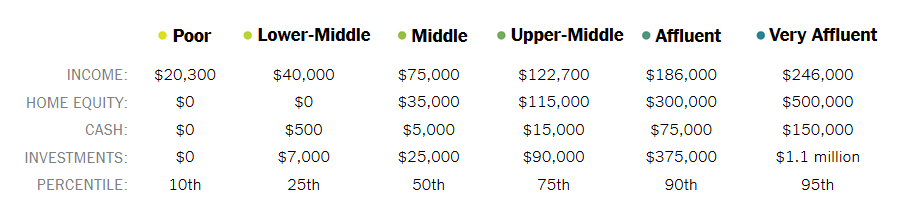
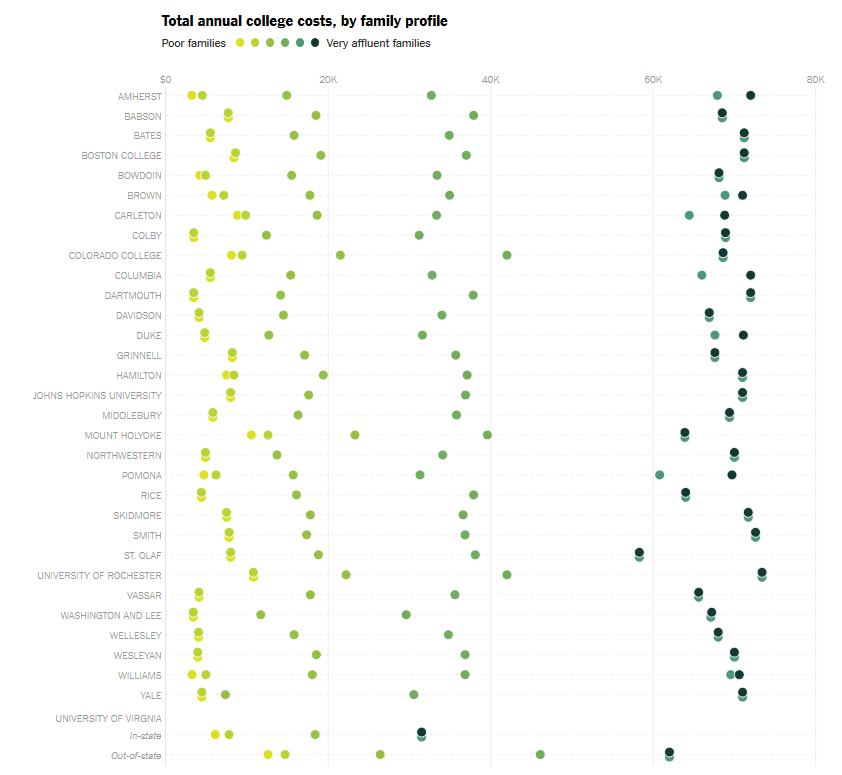
Using a tuition calculator he then estimates tuition (including room and board) by income class at 32 colleges and universities (see below–the darker dots indicate the richer income classes). At many private colleges and universities it is not unusual for some students to be paying $70,000 per year while others pay less than $5,000, for exactly the same education. (Tyler and I provide some similar data on college price discrimination in Modern Principles.) Leonhardt’s point is that a poor student can afford an expensive education and might actually save money by going to an elite private university rather than to a state college.
Price discrimination in education has two other, less recognized, consequences. It reduces income inequality and it reduces the incentive to work. If every firm charged twice as much to someone who earned twice as much, there would no consumption inequality despite high measured income inequality. The rich don’t pay more than the poor when they buy the same basket of goods at the grocery store but they do pay much more for the same education.The Affluent pay approximately $70 thousand for education at the colleges Leonhardt examines while the Upper-Middle pay about half that. The effect on inequality is significant for families with kids in college. An Affluent person is 52% richer than an Upper-Middle income person (186/122=1.52) but an Affluent person with a kid in college is only 33% richer than an Upper-Middle income person with a kid in college (((186-70)/(122-35)=1.33). Shockingly, an Affluent person with two kids in college is actually poorer than an Upper-Middle income person with two kids in college! ((186-140)/(122-70)=0.88.
Under income-based pricing the education tax becomes an income tax with all the negative aspects of income taxes on behavior such as diminished work incentives. Let’s take a closer look at an Upper-Middle income parent earning $122 thousand per year. If this parent gets a promotion or takes on extra work that bumps their salary by $64 thousand, they move from being Upper-Middle income to Affluent. At least on paper. At an income of $122 thousand the parent will be paying approximately $35 thousand to send their child to college but at $186 thousand they will have to pay $70 thousand for the same college so the increase in salary of $64 thousand is an effective increase of only $29 thousand. If the Upper-Middle income parent has two children in college, earning more money actually results in a net loss. For an Upper-Middle income family with two kids spaced in age a few years apart the education tax could be a very severe work disincentive for up to a decade.
The education tax is a peculiar tax as it is often paid to private organizations rather than to the government but it is still a tax and for those of Upper-Middle income the education tax is a very significant tax.
The consequences of the education tax on inequality and work incentives are neither well studied nor well understood.
1. In retrospect, was it a good decision to have ethereum bytecodes executed on every single mining node? And if not, would he have selected sharding and plasma or a different solution?
2. How confident is he that transitioning to proof-of-stake will be successful? What are the risks of proof-of-stake?