Results for “age of em” 17274 found
What is new at the World Bank?
Trained as an anthropologist and medical doctor, Mr. Kim now says that the world of high finance is “some of the coolest stuff I have ever looked at.”
And:
Mr. Kim is, by nature, a cheery person, but there was no mistaking the edge to his voice when he started talking about the World Bank economists whose pay is tied to how many loans they churn out. In his view, the bank needs to reward staff, Wall Street-style, for devising innovative financial solutions.
“One of the most difficult things to do in a large bureaucracy is to change incentives,” Mr. Kim told the financiers. “And if you have a large bureaucracy full of economists it is especially hard, because it turns out that economists really hate it when you change the incentives.”
That is from Landon Thomas Jr. at the NYT, there is much more in the story. And in case you hadn’t heard, Paul Romer is no longer working there.
Diversity versus Equality
The Australian Behavioural Economics Team conducted a randomized trial of hiring in which applications for senior positions in the Australian Public Service were reviewed and ranked. By comparing outcomes in treatments in which gender, minority status and indigenous status could be inferred with outcomes using de-identifyed applications the researchers were able to test for bias and the effect of de-identification.
We found that the public servants engaged in positive (not negative) discrimination towards female and minority candidates:
Participants were 2.9%
more likely to shortlist female candidates and 3.2%
less likely to shortlist male applicants when they were identifiable, compared with when they were de-identified.Minority males were 5.8%
more likely to be shortlisted and minority females were 8.6%
more likely to be
shortlisted when identifiable compared to when applications were de-identified.The positive discrimination was strongest for Indigenous female candidates who were 22.2% more likely to be
shortlisted when identifiable compared to when the applications were de-identified.Interestingly, male reviewers displayed markedly more positive discrimination in favour of minority candidates than
did female counterparts, and reviewers aged 40+ displayed much stronger affirmative action in favour for both
women and minorities than did younger ones.
The study was small and the participants knew they were in a study (although not what the study was studying).
This reminds me of the important Williams and Ceci paper which also found positive gender discrimination in academic hiring (with one notable exception of equal treatment):
The underrepresentation of women in academic science is typically attributed, both in scientific literature and in the media, to sexist hiring. Here we report five hiring experiments in which faculty evaluated hypothetical female and male applicants, using systematically varied profiles disguising identical scholarship, for assistant professorships in biology, engineering, economics, and psychology. Contrary to prevailing assumptions, men and women faculty members from all four fields preferred female applicants 2:1 over identically qualified males with matching lifestyles (single, married, divorced), with the exception of male economists, who showed no gender preference.
NYT sentences to ponder
Kaia Gerber’s Dad Was a Model, Too
Rande Gerber is married to Cindy Crawford, is a father to the teenage supermodels Kaia and Presley Gerber, and is a tequila baron (with his pal George Clooney).
That is the front-page header for this NYT piece, you will note it is not a critique of the wealthy or famous. Recommended, interesting throughout, and don’t forget to check out the photos…
Oh, and here is the closer:
The Gerbers can sound a little corny, and that’s because they are. Nothing confounds a celebrity profile like a happy family. They are four golden figures that, even viewed up close, seem to be constantly dissolving into a Malibu sunset.
“When I meet people from my past, they’re not really shocked where my life has taken me,” Mr. Gerber said, clinking his Casamigos and ice, flanked by his wife and equally symmetrical daughter.
“Most people just figured I would have been successful,” he said, and shrugged.
Where is talent optimized?
Madhav Nandipati writes to me:
Hi Professor Cowen, I’ve been a follower of MR for many years. I have a question that you may have some insights on: in what industry do you think the professional talent is closest to the best/optimal talent, and why? Similarly, what industry do you think the professional talent has the furthest gap from the best/optimal talent?
For example, if you consider cooking, the best chefs of Indian cuisine may actually be mothers cooking for their families at home; the professional talent is not as good as it could be. My guess where the professional talent is closest to optimal is in an industry that:
1) is relatively open (along different demographic dimensions)
2) is somewhat lucrative (to attract people to that industry)
3) uses a filtering mechanism (interviews, grades, etc.) that properly identifies talent
Maybe surgery (and to a lesser extent) acting fit those criteria?
I don’t have a way of using or citing evidence to resolve this question, but here are my intuitions:
Good at finding the best talent:
1. Highly paid professional sports (those who care can play them in high school)
2. Finance and management consulting (lots of people from top schools consider these careers, and we get enough, even if non-elites are somewhat “locked out”)
3. Nerdy tech stuff (so many people are exposed to this at a young age and can be autodidactic)
4. Real estate agents (not as smart as Bill Gates, but as good as they need to be)
In these areas very often performance can be measured fairly readily.
Bad at finding the best talent:
4. Education and teaching and religious leaders
5. Humanities scholars
6. Journalists
In general think about areas where performance is hard to measure, good producers are underpaid, and getting a start requires early social connections and mentoring. I wonder also if “management” fits into this category.
You could take the separate tack of focusing on women and minorities, and asking in which sectors they are most likely to be unjustly excluded, and also in which sectors further talent might be needed. (Perhaps they are excluded from some segments of finance, but perhaps also we have enough of that.) This will mean that swimming and tennis attract the best talent less than many other sports do, because you need to have attended a high school with the proper facilities. Or try running an art gallery or being a museum curator or writing an etiquette guide. National politics strikes me as one area where quite a bit of talent is unjustly excluded, both women and minorities, but there are many others, including leadership positions more generally across many different sectors.
Tax Design

Dutch canal houses are another classic example of how rules and regulations can shape structures. Taxed on their canal frontage rather than height or depth, these buildings grew in tall and thin. In turn, this typology evolved narrower staircases, necessitating exterior hoist systems to move furniture and goods into and out of upper floors.
That’s from an excellent post by Kurt Kohlstedt at 99% Invisible who gives many other examples of taxes having long-lasting effects on the built environment.
Hat tip: Devon Zuegel.
What is stochastically the best book to read about Canada?
Here are reader suggestions, I am aggregating this information, do not think of these as independent recommendations from me:
Canada: A Story of Challenge by J. M. S. Careless
For Canada, read “A Fair Country” by John Ralston Saul, “Clearing the Plains” by James William Daschuk, and pretty much any of Pierre Berton’s books.
I recommend “Right Honourable Men” by Michael Bliss for Canada.
Yeah, Vimy is the standard “coming of a nation” book for Canadians – although too oversentimental. The underappreciated element of that book is some weird attempt to recover Hughes’ tarnished image as a proto-Canadian.
Definitenly recommend it to non-Canadians to get a sense of common denominator Canadian “nationalism”
I would second “A Fair Country” but suggest it as part of a field entry with Saul’s “Louis-Hippolyte-Lafontaine and Robert Baldwin”. Though neither works are above criticism, taken together they represent the best attempt available to answer the questions “Why, and how is Canada different from the United States (and western Europe).
Saul’s work is influenced by Harold Innis, particularly “The Fur Trade in Canada” (1930). This also remains worthwhile, if you feel robust enough to handle Innis’ drier-than-the-Sahara prose, and the fact that it is literally a history of the fur trade in Canada.
Canada is a hard one, esp because of the French/English duality — there’s by definition no single overarching narrative. There’s also no single overarching meta-narrative. But to get the sense of what’s up with English Canada, you could do worse than read George Grant’s Lament for a Nation, particularly the 40th anniversary edition with intro by, er, me. The issue isn’t that Grant got it right, it’s that the ways in which he was wrong, and why he remains so wrong influential, are crucial to understanding the anxieties of English speaking Canada. https://www.amazon.ca/Lament-Nation-Canadian-Nationalism-Anniversary/dp/077353010X/ref=sr_1_1?ie=UTF8&qid=1515422833&sr=8-1&keywords=lament+for+a+nation
For Canada, I’d suggest “The Patriot Game” by Peter Brimelow or “Lament for a Nation” by George Grant.
Canada – “The Vertical Mosaic”
For Canada, I recommend “How to be Canadian” or binge watching TSN will suffice. Also check out, trailer park boys and corner gas.
The best book about Canada is “The Patriot Game” by Peter Brimelow. Though Brimelow is now a mostly fringe figure associated with the alt-right and white nationalism, for many years he was a perfectly respected mainstream Canadian journalist who wrote for all the big newspapers and magazines up here. As a Brit, he saw Canada with a certain degree of aloof detachment, and “The Patriot Game” was his effort to write a “Unified Theory of Canada,” that focuses heavily on how Canadian politics, and the “game” of manufacturing a sense of nationalism for a rather curious, anachronistic country (he famously called it “one of the toadstools of history” — that is, something that grew up unexpectedly) provides the essence of Canadian identity. Even as Brimelow’s own reputation has declined, it is still a very widely-quoted book, and was particularly influential in the life of former Prime Minister Stephen Harper.
As a Canadian, I’d like to know an answer to this question. Growing up, history seemed to be a series of microaggressions (e.g. Boer war, endless fur trade disputes). It would be nice to read a more overarching narrative!
Note that several other commentators expressed displeasure with the work of John Ralston Saul. What else might you recommend as the stochastically best book to read about Canada?
I will be aggregating information for some other countries and regions soon.
Friday assorted links
The Jordan Peterson Moment
That is the new David Brooks column, here is one excerpt:
Much of Peterson’s advice sounds to me like vague exhortatory banality. Like Hobbes and Nietzsche before him, he seems to imagine an overly brutalistic universe, nearly without benevolence, beauty, attachment and love. His recipe for self-improvement is solitary, nonrelational, unemotional. I’d say the lives of young men can be improved more through loving attachment than through Peterson’s joyless and graceless calls to self-sacrifice.
But the emphasis on strength of will, the bootstrap, the calls to toughness and self-respect — all of this touches some need in his audience. He doesn’t comfort. He demands: “Stop doing what you know to be wrong. … Say only those things that make you strong. Do only those things that you could speak of with honor.”
There is much more at the link.
Police Union Privileges
Earlier I wrote about how police unions around the country give to every officer dozens of “get out of jail” cards to give to friends, family, politicians, lawyers, judges and other connected people. The cards let police on the street know that the subject is to be given “professional courtesy” and they can be used to get out of speeding tickets and other infractions. Today, drawing on the Police Union Contracting Project, I discuss how union contracts and Law Officer “Bill of Rights” give police legal privileges that regular people don’t get.
In 50 cities and 13 states, for example, union contracts “restrict interrogations by limiting how long an officer can be interrogated, who can interrogate them, the types of questions that can be asked, and when an interrogation can take place.” In Virginia police officers have a right to at least a five-day delay before being interrogated. In Louisiana police officers have up to 30 days during which no questioning is allowed and they cannot be questioned for sustained periods of time or without breaks. In some cities, police officers can only be interrogated during work hours. Regular people do not get these privileges.
The key to a good interrogation is that the suspect doesn’t know what the interrogator knows so the suspect can be caught in a lie which unravels their story. Thus, the Florida Police Bill of Rights is stunning in what it allows police officers:
The law enforcement officer or correctional officer under investigation must be informed of the nature of the investigation before any interrogation begins, and he or she must be informed of the names of all complainants. All identifiable witnesses shall be interviewed, whenever possible, prior to the beginning of the investigative interview of the accused officer. The complaint, all witness statements, including all other existing subject officer statements, and all other existing evidence, including, but not limited to, incident reports, GPS locator information, and audio or video recordings relating to the incident under investigation, must be provided to each officer who is the subject of the complaint before the beginning of any investigative interview of that officer.
By knowing what the interrogators know, the suspect can craft a story that fits the known facts–and the time privilege gives them the opportunity to do so.
Moreover, how do you think complainants feel knowing that the police officer they are complaining about “must be informed of the names of all complainants.” I respect and admire police officers but frankly I think this rule is dangerous. Would you come forward?
How effective would criminal interrogations be if the following rules held for ordinary citizens?
The law enforcement officer or correctional officer under interrogation may not be subjected to offensive language or be threatened with transfer, dismissal, or disciplinary action. A promise or reward may not be made as an inducement to answer any questions.
What does it say about our justice system that the police don’t want their own tactics used against them?
In the United States if you are arrested–even for a misdemeanor or minor crime, even if the charges are dropped, even if you are found not guilty–you will likely be burdened with an arrest record that can increase the difficulty of getting a job, an occupational license, or housing. But even in the unlikely event that a police officer is officially reprimanded many states and cities require that such information is automatically erased after a year or two. The automatic erasure of complaints makes it difficult to identify problem officers or a pattern of abuse.
Louisiana’s Police Officer Bill of Rights is one of the most extreme. It states that police have the right to expunge any violation of criminal battery and assault and any violation of criminal laws involving an “obvious domestic abuse.” Truly this is hard to believe but here is the law (note that sections (2)(a) and (b) do not appear, as I read it, to be limited to anonymous or unsubstantiated complaints).
A law enforcement officer, upon written request, shall have any record of a formal complaint made against the officer for any violation of a municipal or parish ordinance or state criminal statute listed in Paragraph (2) of this Subsection involving domestic violence expunged from his personnel file, if the complaint was made anonymously to the police department and the charges are not substantiated within twelve months of the lodging of the complaint. (2)(a) Any violation of a municipal or parish ordinance or state statute defining criminal battery and assault. (b) Any violation of other municipal or parish ordinances or state statutes including criminal trespass, criminal damage to property, or disturbing the peace if the incident occurred at either the home of the victim or the officer or the violation was the result of an obvious domestic dispute.
In an excellent post on get out of free jail cards, Julian Sanchez writes:
…beyond being an affront to the ideal of the rule of law in the abstract, it seems plausible that these “get out of jail free” cards help to reinforce the sort of us-against-them mentality that alienates so many communities from their police forces. Police departments that want to demonstrate they’re serious about the principle of equality under the law shouldn’t be debating how many of these cards an average cop gets to hand out; they should be scrapping them entirely.
Equality under the law also requires that privileges and immunities extend to all citizens equally.
Hat tip: Tate Fegley.
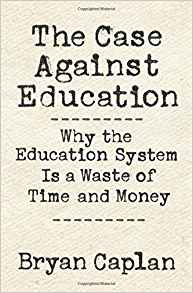
*The Case Against Education*
Bryan Caplan’s new book is now out!
Wednesday assorted links
1. Should investors eschew masculine hedge fund managers?
2. Selling and renting out private jets (NYT, interesting).
3. Unusual story, involves stealing wine from the boss on a rather large scale.
4. Yana, Kyle, and Spinoza in the news, as indeed they should be every day.
5. Stripe is ending Bitcoin support.
6. Information on Mercatus graduate fellowships, including visiting and short-term arrangements.
Tyler Cowen’s 12 rules for life
After reading Jordan Peterson’s 12 rules, a few people asked me what my list would look like. I would stress that what follows is not a universal or eternally valid account, but rather a few ideas that strike me in the here and now, perhaps as the result of recent conversations. I suspect the same is true for everyone’s rules lists, so please keep this in perspective. Here goes:
1. Assume your temperament will always be somewhat childish and impatient, and set your rules accordingly, knowing that you cannot abide by rules for rules sake. Hope to leverage your impatience toward your longer-run advantage.
2. Study the symbolic systems of art, music, literature. and religion, if only to help yourself better understand alternative points of view in political and intellectual discourse. Don’t just spend time with the creations you like right away. Avoid “devalue and dismiss.”
3. When the price goes up, buy less. Try to understand what the price really is, however, and good luck with that.
4. Marry well.
5. Organize at least some significant portion of your knowledge of the world in terms of place, whether by country, region, or city. If you do that, virtually every person will be interesting to you, if only because almost everyone has some valuable knowledge of particular places.
6. When shooting the basketball, give it more arc than you think is necessary. Consistently.
7. Learn how to learn from those who offend you.
8. Cultivate mentors, and be willing to serve as mentors to others. This never loses its importance.
9. I don’t know.
10. Heed Cowen’s Three Laws.
11. Do not heed Cowen’s Three Laws.
12. Every now and then read or reread Erasmus, Montaigne, Homer, Shakespeare, or Joyce’s Ulysses, so that you do not take any rules too seriously. The human condition seems to defeat our attempts to order it.
Why are professors poorly paid?
Using Current Population Survey data, I demonstrate a 15-percentage point wage disadvantage among academics compared to all other doctorate-holders with the same demographics. Time-diary data show that academics’ work hours are distributed more evenly over the week and day, although their total workweeks are equally long. This smoother distribution of work time accounts for as much as one-third of the wage disadvantage. Survey data (of economists only) indicate that flexible scheduling is an attraction, but only fourth among the characteristics of academic life.
Hamermesh then speculates the remaining difference may result from selection, namely that some people enjoy being less accountable to their superiors than do others.
Housing Hypergamy
NYTimes: Thanks to the now-abandoned one-child policy, China has more young men than young women, setting off a male-led surge to buy homes to make themselves more appealing husbands. Shang-Jin Wei, a Columbia University business professor, found that rising real estate price increases in 35 big cities were strongly correlated with lopsided gender ratios.
CNN tells us that “When it comes to dating, homeownership can be the ultimate aphrodisiac,” so the effect may not be confined to China.
How to reform the Foreign Corrupt Practices Act
That is the topic of my latest Bloomberg column, here is an excerpt:
Like it or not, this law is not going away — and there are some good reasons to have it. The U.S. has been the world leader in taking on corruption, and we shouldn’t give up that position without a fight. There has been a payoff, as other countries move in the American direction with tougher anti-bribery measures. Getting rid of the FCPA now would send the very worst possible message to the world. Furthermore, some aspects of the FCPA are useful in helping U.S. multinationals limit the demand for bribes, by claiming they are unable to comply for legal reasons.
Rather than junking the FCPA, we should consider reforming it, lowering its costs while simultaneously making it harder to use as an instrument of political retribution…
To improve the law, commentators have recommended adding a “willfulness” requirement for corporate criminal liability, limiting liabilities from the activities of subsidiaries or from previous acquisitions, clarifying exactly who counts as a “foreign official,” and more generally swinging the presumption back closer to innocence, especially for companies with active and responsible compliance programs. All of those changes could build in more safeguards for ambiguous cases and for companies that are basically engaged in honest business. Recently announced Department of Justice guidelines do take some steps in these directions, for instance by encouraging voluntary disclosure and remediation of infractions.
The column has plenty of information about how many companies violate FCPA — lots — and what is their chance of prosecution. We would have to make the penalties at least eight times stiffer to make compliance profit-maximizing, at least on average.