Year: 2016
I, medical device robotic pancreas
Third-grader Andrew Calabrese carries his backpack everywhere he goes at his San Diego-area school. His backpack isn’t just filled with books, it is carrying his robotic pancreas.
The device, long considered the Holy Grail of Type 1 diabetes technology, wasn’t constructed by a medical-device company. It hasn’t been approved by regulators.
It was put together by his father.
Jason Calabrese, a software engineer, followed instructions that had been shared online to hack an old insulin pump so it could automatically dose the hormone in response to his son’s blood-sugar levels. Mr. Calabrese got the approval of Andrew’s doctor for his son to take the home-built device to school.
The Calabreses aren’t alone. More than 50 people have soldered, tinkered and written software to make such devices for themselves or their children. The systems—known in the industry as artificial pancreases or closed loop systems—have been studied for decades, but improvements to sensor technology for real-time glucose monitoring have made them possible.
The Food and Drug Administration has made approving such devices a priority and several companies are working on them. But the yearslong process of commercial development and regulatory approval is longer than many patients want, and some are technologically savvy enough to do it on their own.
Here is the Kate Linebaugh story, interesting throughout, via Adam Thierer and Eli Dourado.
Life Expectancy is Increasing and Health Inequality is Down
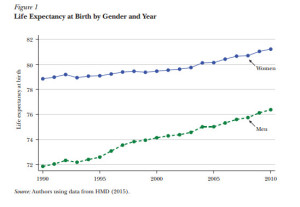
We have heard a great deal about increases in mortality among white, non-hispanic, middle-aged Americans (especially women) but to state the case is also to note that this is one group among many. In an excellent new paper, Currie and Schwandt discuss the good news overall–life expectancy is up and health inequality is down, in some cases dramatically. Here, for example, is life expectancy at birth by gender and year.
 Even more impressive is that life expectancy has increased significantly across all poverty groups (as measured by county poverty levels). In the graph below, for example, the blue triangles indicate life expectancy in 1990 (men on the left, women on the right). Note that as the poverty level of the county increases along the horizontal axis life expectancy falls. The green dots are life expectancy in 2010. Once again, as poverty increases, life expectancy falls. What’s remarkable, however, is how much life expectancy increased between 1990 and 2010 in counties of all poverty levels.
The news is good and may get better. Between 1990 and 2010 mortality rates for children ages 0-4 fell especially dramatically and especially so in poor counties. Moreover, since mortality at older ages is often baked in 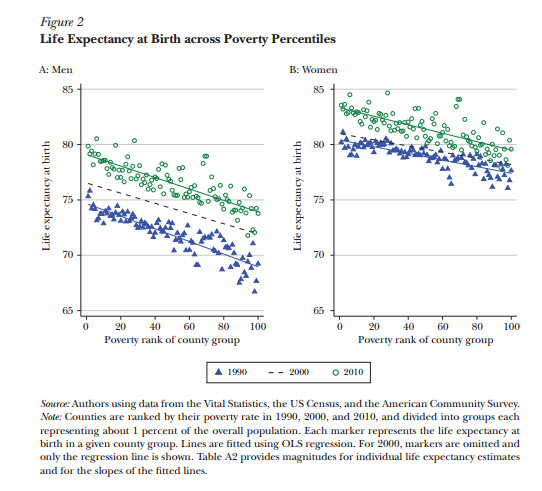 by poor health at younger ages there is significant opportunity for these gains to persist over time.
The New York Times also reported yesterday on inequality in life expectancy across race. It’s down.
Infant mortality is down by more than a fifth among blacks since the late 1990s, double the decline for whites. Births to teenage mothers, which tend to have higher infant mortality rates, have dropped by 64 percent among blacks since 1995, faster than for whites.
Blacks are still at a major health disadvantage compared with whites. But evidence of black gains has been building and has helped push up the ultimate measure — life expectancy. The gap between blacks and whites was seven years in 1990. By 2014, the most recent year on record, it had shrunk to 3.4 years, the smallest in history, with life expectancy at 75.6 years for blacks and 79 years for whites.
Part of the reason has been bad news for whites, namely the opioid crisis. The crisis, which has dominated headlines — some say unfairly, given racial disparities — has hit harder in white communities, bringing down white life expectancy and narrowing the gap.
But there also has been real progress for blacks. The rate of deaths by homicide for blacks decreased by 40 percent from 1995 to 2013, according to Andrew Fenelon, a researcher with the National Center for Health Statistics, compared with a 28 percent drop for whites. The death rate from cancer fell by 29 percent for blacks over that period, compared with 20 percent for whites.
The Currie and Schwandt paper is also very good on describing how these estimates are produced and some of the data issues with making these estimates. It’s a must read for those interested in these issues.
Does Facebook suppress conservative news and views?
That’s the hullaballoo of the day (NYT here):
Facebook workers routinely suppressed news stories of interest to conservative readers from the social network’s influential “trending” news section, according to a former journalist who worked on the project. This individual says that workers prevented stories about the right-wing CPAC gathering, Mitt Romney, Rand Paul, and other conservative topics from appearing in the highly-influential section, even though they were organically trending among the site’s users.
That’s not exactly what I would have suppressed, but I can’t say I am broken up about this. Most media bias in journalism is demand-driven, and I suspect this feature of the article selection and elevation “algorithm” is perceived by Facebook as demand-driven as well. Overall I think of Twitter as radicalizing, and Facebook as calming and connecting. The “censored” right wing sources don’t fit the chummy, nostalgic socializing mood so well, and therefore Facebook wanted to keep them away. A clear minority is sufficiently interested in those stories to get them trending initially, but that’s not the overall image Facebook wants to present to either its marginal or median user.
Maybe such algorithms mean that social ideas are too slow to change, because user demand depends in part on what Facebook pushes. Right now I’m more worried about American ideas getting worse than American ideas getting better, so a status quo, don’t offend anybody bias I can live with. And frankly, a lot of right-wing news sources just aren’t very good — I suppress them myself, without any aid from Facebook.
There is also this:
“People stopped caring about Syria,” one former curator said. “[And] if it wasn’t trending on Facebook, it would make Facebook look bad.” That same curator said the Black Lives Matter movement was also injected into Facebook’s trending news module. “Facebook got a lot of pressure about not having a trending topic for Black Lives Matter,” the individual said. “They realized it was a problem, and they boosted it in the ordering. They gave it preference over other topics. When we injected it, everyone started saying, ‘Yeah, now I’m seeing it as number one’.” This particular injection is especially noteworthy because the #BlackLivesMatter movement originated on Facebook, and the ensuing media coverage of the movement often noted its powerful social media presence.
In those two cases I see the change in coverage as bringing net content gain rather than loss. The cynical underlying reality is that Facebook does not wish to appear heartless, but does not (yet) have the more subtle manipulative institutions that newspapers and TV stations have developed over decades or even centuries. They clumsily act in a politically correct manner, without proper institutional camouflage, and now they are being called on it. They will refine their bias, and make it subtler and harder to criticize, thereby becoming more like most other media outlets. Ultimately this is more of a social conformity story than a monopoly power dilemma. I am more worried about pervasive ennui and complacency than the political bias per se.
Demand curves slope downward, opiod edition
Deaths from opioid pain reliever overdose in the United States quadrupled between 1999 and 2013, concurrent with an increase in the use of the drugs. We used data from the Medical Expenditure Panel Survey to examine trends in opioid pain reliever expenditures, financing by various payers, and use from 1999 to 2012. We found major shifts in expenditures by payer type for these drugs, with private and public insurers paying a much larger share than patients in recent years. Consumer out-of-pocket spending on opioids per 100 morphine milligram equivalents (a standard reference measure of strength for various opioids) declined from $4.40 to $0.90 between 2001 and 2012. Since the implementation of Medicare Part D in 2006, Medicare has been the largest payer for opioid pain relievers, covering about 20–30 percent of the cost. Medicare spends considerably more on these drugs for enrollees younger than age sixty-five than it does for any other age group or than Medicaid or private insurance does for any age group. Further research is needed to evaluate whether payer strategies to address the overuse of opioids could reduce avoidable opioid-related mortality.
That is from Zhou, Florence, and Dowell, via the excellent Kevin Lewis.
Monday assorted links
1. In a major study, greater price transparency did not reduce health care spending.
2. From the world of OKCupid: “…we examined the relationship between Zodiac sign and every other variable. We found very scant evidence of any influence…”
3. “There’s no point in writing it all down if nobody ever reads it.”
4. Beer markets in everything belly button yeast.
5. Timothy Lee on the end of economic growth.
6. How many top Republicans will be willing to work for Trump?
The Solow Model Animated!
 Modern Principles of Economics was the first principles textbook to make the Solow model of economic growth easily accessible to undergraduates. By focusing on simple mathematics that the students already know, like the square root function, we made the Solow model easy to understand without losing the power of the model to explain the world.
Modern Principles is the only textbook with the Super Simple Solow model! And now we’ve brought the model to life with a series of fun videos in our Principles of Macroeconomics class at MRUniversity. You’ve never seen the Solow model taught like this!
Introduction to the Solow Model introduces the questions and the “characters” that drive the story. Physical capital and diminishing returns explains the idea of a production function and diminishing returns. We then introduce capital depreciation and focus in on the most important idea for understanding the Solow model, the steady state:
I’ll cover some more videos in the Solow series later this week.
Your TA Will Be Jill Watson
WSJ: One day in January, Eric Wilson dashed off a message to the teaching assistants for an online course at the Georgia Institute of Technology.
“I really feel like I missed the mark in giving the correct amount of feedback,” he wrote, pleading to revise an assignment.
Thirteen minutes later, the TA responded. “Unfortunately, there is not a way to edit submitted feedback,” wrote Jill Watson, one of nine assistants for the 300-plus students.
Last week, Mr. Wilson found out he had been seeking guidance from a computer.
…Last year, a team of Georgia Tech researchers began creating Ms. Watson by poring through nearly 40,000 postings on a discussion forum known as “Piazza” and training her to answer related questions based on prior responses. By late March, she began posting responses live.
Don’t confuse Ms. Watson with the customer-service chatbots used online by airlines and other industries. Mr. Goel boasts that she answers only if she has a confidence rate of at least 97%.
“Most chatbots operate at the level of a novice,” Mr. Goel said. “Jill operates at the level of an expert.”
In our paper on online education Tyler and I wrote about AI Tutors:
Feedback from interactive systems will be more immediate and more informative (Skinner 1958). Adaptive tutoring systems are already nearly as effective as human tutors in many circumstances and much cheaper to scale (VanLehn 2011).
Singapore (India) fact of the day
…it [Singapore] draws more travelers than countries such as India, Indonesia and Philippines.

Here is the story.
I sometimes say that large, populous places mostly will get better, so visit them later. Small countries, islands, and regions will become worse to visit, losing their ethos to massive crowds, so see them now before it is too late.
The small Singapore, with its weird mix of hyper-modernity and charming retro, is an exception to this rule. It may well be more interesting to visit ten years from now, by extending its modernity, even if it loses more of its retro. But you cannot say the same about Bali, Tahiti, or Split, Croatia. Amsterdam already has been ruined, more or less, by the crowds, Venice too during many times of the year.
Twenty years from now, Java, India, and Nigeria will be splendid to visit. They will be easier to deal with, but won’t have lost much of their style and flair. Sheer numbers locks that in. So some of you should just wait. That said, if you follow my advice and visit the small units now, you only make this problem worse.
Soviet Union (China) fact of the day
In its first three decades, the Soviet Union urbanized at about the same rate as China since 1978.
That is from Arthur Kroeber, China’s Economy: What Everyone Needs to Know, a new and useful introductory guide to what the title suggests. This parallel of course is one reason why the early years of Soviet communism went as well economically as they did.
Sunday assorted links
1. Evan Soltas on pro-business reforms and growth.
2. Older people with non-family roommates is becoming more common (NYT).
3. The Evangelical roots of American economics.
4. Rose Wilder Lane vs. Lorie Tarshis and his early Keynesian textbook (pdf).
5. What legal authority does the Fed need during a financial crisis? By Eric Posner.
Trump voters are fairly well off
Trump voters’ median income exceeded the overall statewide median in all 23 states, sometimes narrowly (as in New Hampshire or Missouri) but sometimes substantially. In Florida, for instance, the median household income for Trump voters was about $70,000, compared with $48,000 for the state as a whole. The differences are usually larger in states with substantial non-white populations, as black and Hispanic voters are overwhelmingly Democratic and tend to have lower incomes. In South Carolina, for example, the median Trump supporter had a household income of $72,000, while the median for Clinton supporters was $39,000.
Furthermore:
However, while Republican turnout has considerably increased overall from four years ago, there’s no sign of a particularly heavy turnout among “working-class” or lower-income Republicans. On average in states where exit polls were conducted both this year and in the Republican campaign four years ago, 29 percent of GOP voters have had household incomes below $50,000 this year, compared with 31 percent in 2012.
About 44 percent of Trump supporters have a college degree, compared to 29 percent for the nation as a whole.
That is from Nate Silver, by the way here is my conversation with Nate, transcript, audio, and video at the link.
To what extent are business cycles just random?
Let’s ask Guido Menzio, who perhaps knows something about random. Here is one of his papers, with Mikhail Golosov (pdf):
We propose a new business cycle theory. Firms need to randomize over firing or keeping workers who have performed poorly in the past, in order to give them an ex-ante incentive to exert effort. Firms have an incentive to coordinate the outcome of their randomizations, as coordination allows them to load the firing probability on states of the world in which it is costlier for workers to become unemployed and, hence, allows them to reduce overall agency costs. In the unique equilibrium, firms use a sunspot to coordinate the randomization outcomes and the economy experiences endogenous and stochastic aggregate fluctuations.
In other words, by coordinating with each other, if only implicitly, employers make the firing threat more fearful. You don’t have to interpret this paper literally as an entire explanation for cyclical unemployment, only that it may have something to do with the story.
And here is his about to appear JPE piece with Greg Kaplan (pdf):
We propose a novel theory of self-fulfilling unemployment fluctuations. When a firm increases its workforce, it increases the demand facing other firms—as employed workers spend more than unemployed workers—and decreases the extent of competition facing other firms—as employed workers have less time to search for low prices than unemployed workers. In turn, the increase in demand and the decline in competition induces other firms to hire more labor in order to scale-up their presence in the product market. The feedback between employment and product market conditions generates multiple equilibria—and the possibility of self-fulfilling fluctuations—if the differences in the shopping behavior of employed and unemployed workers are large enough. Empirical evidence on spending, shopping and prices paid suggests that this is the case.
In general, not enough popular macro discourse asks the question of how much of the cycle results from self-fulfilling prophecies. Furthermore what does that imply for policy? yes, “confidence” can be important, but confidence in what exactly?
Discrimination by party is rising in import
A study published in The American Journal of Political Science underscored how powerful political bias can be. In an experiment, Democrats and Republicans were asked to choose a scholarship winner from among (fictitious) finalists, with the experiment tweaked so that applicants sometimes included the president of the Democratic or Republican club, while varying the credentials and race of each. Four-fifths of Democrats and Republicans alike chose a student of their own party to win a scholarship, and discrimination against people of the other party was much greater than discrimination based on race.
That is from Nicholas Kristof, there is more at the link (NYT).
Saturday assorted links
1. Alligator wrestling markets in everything. And MIE: KFC-flavored nail polish.
2. James Palmer on minority survival in China. And China to test first hybrid power train.
3. I agree with Scott Sumner on Brexit.
4. David Samuels on Ben Rhodes and Obama’s foreign policy, in case you haven’t already read it (NYT). Interesting along numerous dimensions.
5. “It turns out that we’re very bad at judging who our friends are…” Paper here.
Me at the Milken Institute panel “Does capitalism need saving?”
The idea of a general confusion about the nature of capitalism and what its alternatives really look like was revisited later on by Tyler Cowen.
“I would focus most of all on the issue of ideas,” he said. “Do the people of this country still believe in capitalism? And I know that if you listen to Bernie Sanders, or look at some polls, a lot of young people have more sympathy for what they call ‘socialism’ than ever before, but I don’t think they mean real socialism. If you ask Americans questions such as ‘Do you support trade?’ the answers are more positive today than they were five years ago. …So if you look at a lot of basic issues of tolerance, belief in the system, people accepting consumerism, heralding innovation, I think, mostly, people here believe in capitalism.
Here is the full report, also including John Taylor and Alan Krueger and others. Here is Fortune’s take on me on Trump and Sanders. They caught me on an optimistic day. Here is the video link for the whole session.
If you’re ever invited to the Milken Institute Los Angeles conference, I recommend it highly. They have about the highest quality presentations and presenters I can recall hearing in a long time, maybe ever. One reason for this is simply that they do not let people go on for too long.