Rent Control Creates Ghost Apartments
Adam Lehodey writing at City Journal:
In New York City, making a profit on real estate has become increasingly difficult. Rent-stabilization laws built on the mantra that “housing is a human right,” a dysfunctional housing court, and myriad other interventions have driven thousands of units off the market, giving rise to the phenomenon of New York’s “ghost apartments.”
The city now has nearly 50,000 empty units, absent from the market either because their operating costs exceed legal rents or because they require considerable renovations.
…Take a building on East 6th Street as an example. A mere five-minute walk from Tompkins Square, the building is a convenient home for students and young professionals.
One-bedroom units in the building average $3,500— except two of them, subject to the city’s rent-stabilization laws, which hold rents below $900 per month.
As a result, both units have been allowed to fall into disrepair, because the cost of restoring them to habitability is greater than what they’d generate in rent.
…Much of the predicament at the East 6th Street building and the apartments on Valentine Avenue can be traced back to one piece of legislation: the 2019 Housing Stability and Tenant Protection Act (HSTPA). Passed by a Democratic majority in the state legislature, HSTPA eliminated landlords’ abilities to raise rents after units were vacated, or when they exceeded $2,775 per month. In doing so, it also eliminated their ability to make improvements profitably and reset the stabilized rent.
Recall from the recent review by Kholodilin that “the published studies are almost unanimous with respect to the impact of rent control on the quality of housing….[namely] that rent control leads to a deterioration in the quality of those dwellings subject to regulations.”
Voices From 2099
Great little video. Winner of the Foresight Institute’s $10,000 prize for Existential Hope. Go Bryan Johnson!
Robot Lab
Google’s Deep Mind Lab is going to build a materials science lab in the UK, manned by robots and humans:
To help turbocharge scientific discovery, we will establish Google DeepMind’s first automated laboratory in the UK in 2026, specifically focused on materials science research. A multidisciplinary team of researchers will oversee research in the lab, which will be built from the ground up to be fully integrated with Gemini. By directing world-class robotics to synthesize and characterize hundreds of materials per day, the team intends to significantly shorten the timeline for identifying transformative new materials.
This is a very big deal. Gemini won’t just read papers. It will design the experiments, run the experiments, learn from the successes and failures and then recursively improve. It’s an attempt to learn the game of material science in the same way AlphaGo learned the game of Go.
Growth Matters
Between 2011 and 2023 India’s GDP per capita grew at a rate of about 4.8% per year so in those 12 years GDP per capita, a good measure of the standard of living, nearly doubled (77%). Shamika Ravi and Sindhuja Penumarty look at what this means on the ground.
The percentage of the budget spent on food has declined–dropping below 50% for the first time ever–and that has enabled significant purchases of consumer durables.
It will perhaps not be surprising that mobile phones have become universal among both the poor and the rich but vehicle ownership is also converging with rural ownership of a vehicle (2 or 4 wheeler) nearly tripling from (19% to 59%).
Another standout is refrigerators which reflects growing income and reliable electricity. In the 12 years across the survey, refrigerator ownership in rural areas more than tripled from 9.4% circa 2011 to 33.2% in 2023. In urban areas refrigerator ownership went from less than half (43.8%) to more than two-thirds (68.1%) of urban households. Overall, only two states Bihar (37.1%) and Odisha (46.3%), had less than 50% of urban households owning a refrigerator in 2023-24.
Economists are often accused of “line go up” thinking but the truth is that line go up matters. The 4.8% annual growth matters because it shows up as a broad, visible upgrade in how people live.
Gans and Doctorow on AI Copyright
Josh Gans had written what I think is the first textbook of AI. Instead of the “big issues” like will AI result in the singularity or the end of the human race, Gans treats AI as a tool for improving predictions. What will better predictions do in legal markets, economic markets, political markets? He generally avoids conclusions and instead explores models of thinking.
I especially enjoyed the chapter on intellectual property rights which maps out a model for thinking about copyright in training and in production, how they interact and the net costs and benefits.
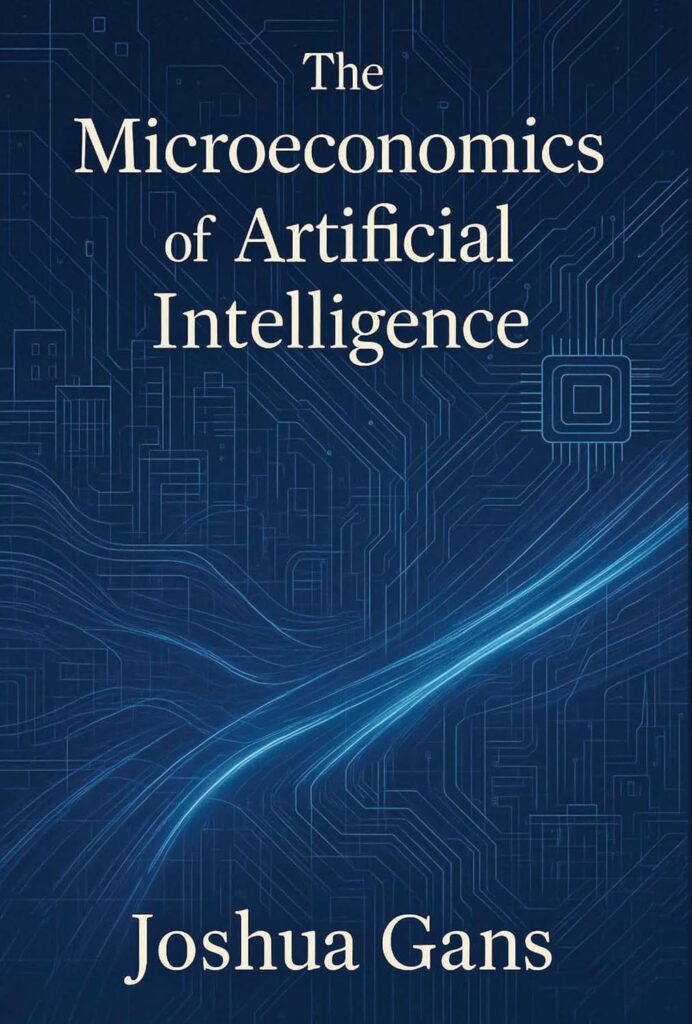
Gans’s chapter usefully pairs with Cory Doctorow’s screed on AI. It’s a great screed despite being mostly wrong. I did like this bit, however:
Creative workers who cheer on lawsuits by the big studios and labels need to remember the first rule of class warfare: things that are good for your boss are rarely what’s good for you.
…When Getty Images sues AI companies, it’s not representing the interests of photographers. Getty hates paying photographers! Getty just wants to get paid for the training run, and they want the resulting AI model to have guardrails, so it will refuse to create images that compete with Getty’s images for anyone except Getty. But Getty will absolutely use its models to bankrupt as many photographers as it possibly can.
…Demanding a new copyright just makes you a useful idiot for your boss, a human shield they can brandish in policy fights, a tissue-thin pretense of “won’t someone think of the hungry artists?…
We need to protect artists from AI predation, not just create a new way for artists to be mad about their impoverishment.
And incredibly enough, there’s a really simple way to do that. After 20+ years of being consistently wrong and terrible for artists’ rights, the US Copyright Office has finally done something gloriously, wonderfully right. All through this AI bubble, the Copyright Office has maintained – correctly – that AI-generated works cannot be copyrighted, because copyright is exclusively for humans. That’s why the “monkey selfie” is in the public domain. Copyright is only awarded to works of human creative expression that are fixed in a tangible medium.
And not only has the Copyright Office taken this position, they’ve defended it vigorously in court, repeatedly winning judgments to uphold this principle.
The fact that every AI created work is in the public domain means that if Getty or Disney or Universal or Hearst newspapers use AI to generate works – then anyone else can take those works, copy them, sell them, or give them away for free. And the only thing those companies hate more than paying creative workers, is having other people take their stuff without permission.
The US Copyright Office’s position means that the only way these companies can get a copyright is to pay humans to do creative work. This is a recipe for centaurhood. If you’re a visual artist or writer who uses prompts to come up with ideas or variations, that’s no problem, because the ultimate work comes from you. And if you’re a video editor who uses deepfakes to change the eyelines of 200 extras in a crowd-scene, then sure, those eyeballs are in the public domain, but the movie stays copyrighted.
AI should not have to pay to read books any more than a human. At the same time, making AI created works non-copyrightable is I think the right strategy at the present moment. Moreover, it’s the most practical suggestion I have heard for channeling AI in a more socially beneficial direction, something Acemoglu has discussed without much specificity.
Mass Incarceration and Mass Crime
In our Marginal Revolution Podcast on Crime in the 1970s, I pointed out that blacks were often strongly in favor of tough on crime laws:
Tabarrok: [P]eople think that mass incarceration is a peculiarly American phenomena, or that it came out of nowhere, or was due solely to racism. Michelle Alexander’s, The New Jim Crow, takes this view.
…[But] back then, the criminal justice system was also called racist, but the racism that people were pointing to was that black criminals were let back on the streets to terrorize black victims, and that black criminals were given sentences which were too light. That was the criticism back then. It was black and white victims together who drove the punishment of criminals. I think this actually tells you about two falsehoods. First, the primary driver of mass imprisonment was not racism. It was violent crime.
Second, this also puts the lie, sometimes you hear from conservatives, to this idea that black leaders don’t care about black-on-black crime. That’s a lie. Many Black leaders have been, and were, and are tough on crime. Now, it’s true, as crime began to fall in the 1990s, many blacks and whites began to have misgivings about mass incarceration. Crime was a huge problem in the 1970s and 1980s, and it hit the United States like a brick. It seemed to come out of nowhere. You can’t blame people for seeking solutions, even if the solutions come with their own problems.
A new paper The Racial Politics of Mass Incarceration by Clegg and Usmani offer more evidence challenging the now conventional Michelle Alexander view:
Public opinion data show that not just the white but also the black public became more punitive after the 1960s. Voting data from the House show that most black politicians voted punitively at the height of concern about crime. In addition, an analysis of federally mandated redistricting suggests that in the early 1990s, black political representation had a punitive impact at the state level. Together, our evidence suggests that crime had a profound effect on black politics. It also casts some doubt on the conventional view of the origins of mass incarceration.
As the authors note, the fact that blacks supported tough-on-crime laws doesn’t mean racism was absent. Racial overtones surely influenced the specific ways fear of crime was translated into policy. But the primary driver of mass incarceration wasn’t racism—it was mass crime.
Crime and the Welfare State
Several recent papers claim that expanding programs like Medicaid reduces crime (e.g. here). I’ve been skeptical, not because of weaknesses in any particular paper, but just because the results feel a bit too aligned with social-desirability bias and we know that the underlying research designs can be fragile. As a result, my priors haven’t moved much. The first paper using a genuine randomized controlled trial now reports no effect of Medicaid expansion on crime.
Those involved with the criminal justice system have disproportionately high rates of mental illness and substance-use disorders, prompting speculation that health insurance, by improving treatment of these conditions, could reduce crime. Using the 2008 Oregon Health Insurance Experiment, which randomly made some low-income adults eligible to apply for Medicaid, we find no statistically significant impact of Medicaid coverage on criminal charges or convictions. These null effects persist for high-risk subgroups, such as those with prior criminal cases and convictions or mental health conditions. In the full sample, our confidence intervals can rule out most quasi-experimental estimates of Medicaid’s crime-reducing impact.
Finkelstein, Miller, and Baicker (WP).
It could still be the case that very targeted interventions–say making sure that released criminals get access to mental health care–could do some good but there’s unlikely to be any general positive effect.
A similar story is found in Finland where a large RCT on a guaranteed basic income found zero effect on crime
This paper provides the first experimental evidence on the impact of providing a guaranteed basic income on criminal perpetration and victimization. We analyze a nationwide randomized controlled trial that provided 2,000 unemployed individuals in Finland with an unconditional monthly payment of 560 Euros for two years (2017-2018), while 173,222 comparable individuals remained under the existing social safety net. Using comprehensive administrative data on police reports and district court trials, we estimate precise zero effects on criminal perpetration and victimization. Point estimates are small and statistically insignificant across all crime categories. Our confidence intervals rule out reductions in perpetration of 5 percent or more for crime reports and 10 percent or more for criminal charges.
My 2011 Review of Contagion
I happened to come across my 2011 review of the Steven Soderberg movie, Contagion and was surprised at how much I was thinking about pandemics prior to COVID. In the review, I was too optimistic about the CDC but got the sequencing gains right. I continue to like the conclusion even if it is a bit too clever by half. Here’s the review (no indent):
Contagion, the Steven Soderberg film about a lethal virus that goes pandemic, succeeds well as a movie and very well as a warning. The movie is particularly good at explaining the science of contagion: how a virus can spread from hand to cup to lip, from Kowloon to Minneapolis to Calcutta, within a matter of days.
One of the few silver linings from the 9/11 and anthrax attacks is that we have invested some $50 billion in preparing for bio-terrorism. The headline project, Project Bioshield, was supposed to produce vaccines and treatments for anthrax, botulinum toxin, Ebola, and plague but that has not gone well. An unintended consequence of greater fear of bio-terrorism, however, has been a significant improvement in our ability to deal with natural attacks. In Contagion a U.S. general asks Dr. Ellis Cheever (Laurence Fishburne) of the CDC whether they could be looking at a weaponized agent. Cheever responds:
Someone doesn’t has to weaponize the bird flu. The birds are doing that.
That is exactly right. Fortunately, under the umbrella of bio-terrorism, we have invested in the public health system by building more bio-safety level 3 and 4 laboratories including the latest BSL3 at George Mason University, we have expanded the CDC and built up epidemic centers at the WHO and elsewhere and we have improved some local public health centers. Most importantly, a network of experts at the department of defense, the CDC, universities and private firms has been created. All of this has increased the speed at which we can respond to a natural or unnatural pandemic.
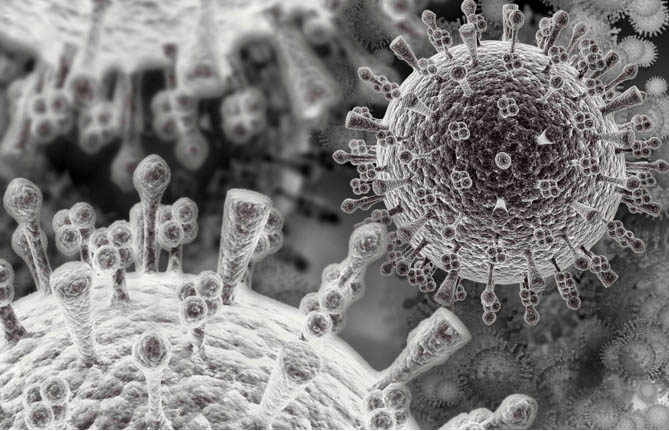
In 2009, as H1N1 was spreading rapidly, the Pentagon’s Defense Threat Reduction Agency asked Professor Ian Lipkin, the director of the Center for Infection and Immunity at Columbia University’s Mailman School of Public Health, to sequence the virus. Working non-stop and updating other geneticists hourly, Lipkin and his team were able to sequence the virus in 31 hours. (Professor Ian Sussman, played in the movie by Elliott Gould, is based on Lipkin.) As the movie explains, however, sequencing a virus is only the first step to developing a drug or vaccine and the latter steps are more difficult and more filled with paperwork and delay. In the case of H1N1 it took months to even get going on animal studies, in part because of the massive amount of paperwork that is required to work on animals. (Contagion also hints at the problems of bureaucracy which are notably solved in the movie by bravely ignoring the law.)
It’s common to hear today that the dangers of avian flu were exaggerated. I think that is a mistake. Keep in mind that H1N1 infected 15 to 30 percent of the U.S. population (including one of my sons). Fortunately, the death rate for H1N1 was much lower than feared. In contrast, H5N1 has killed more than half the people who have contracted it. Fortunately, the transmission rate for H5N1 was much lower than feared. In other words, we have been lucky not virtuous.
We are not wired to rationally prepare for small probability events, even when such events can be devastating on a world-wide scale. Contagion reminds us, visually and emotionally, that the most dangerous bird may be the black swan.
Welcome to the Crazy CAFE
To let Americans buy smaller cars, Trump had to weaken fuel-efficiency standards. Does that sound crazy? Small cars, of course, have much higher fuel efficiency. Yet this is exactly how the Corporate Average Fuel Economy (CAFE) standards work.

Since 2011, fuel-economy targets scale with a vehicle’s “footprint” (wheelbase × track width). Big vehicles get lenient targets; small vehicles face demanding ones. A microcar that gets 40 MPG might be judged against a target of 50-60 MPG, while a full-size truck doing 20 MPG can satisfy a 22 MPG requirement.. The small car is clearly more efficient, yet it fails the rule that the truck passes.
The policy was meant to be fair to producers of large vehicles, but it rewards bloat. Make a car bigger and compliance gets easier. Add crash standards built around heavier vehicles and it’s obvious why the US market produces crossovers and trucks while smaller and much less expensive city-cars, familiar in Europe and Asia, never show up. At a press conference rolling back CAFE standards, Trump noted he’d seen small “kei” cars on his Asia trip—”very small, really cute”—and directed the Transportation Secretary to clear regulatory barriers so they could be built and sold in America.
Trump’s rollback—cutting the projected 2031 fleet average from roughly 50.4 MPG to 34.5 MPG—relaxes the math enough that microcars could comply again. Only Kafka would appreciate a fuel-economy system that makes small fuel-efficient cars hard to sell and giant trucks easy. Yet the looser rules remove a barrier to greener vehicles while also handing a windfall to big truck makers. A little less Kafka, a little more Tullock.
Innovations in Health Care
The latest issue of the journal Innovations focuses on health care and is excellent. It’s a very special issue–a double Tabarrok issue!
My paper, Operation Warp Speed: Negative and Positive Lessons for New Industrial Policy, asks what can learn from the tremendous success of OWS about an OWS for X? What are the opportunities and the dangers?
My son Maxwell Tabarrok’s paper is Peptide-DB: A Million-Peptide Database to Accelerate Science. Max’s paper combines economics and science policy. Open databases are a public good and so are underprovided. A case in point is that there is no big database for anti-microbial peptides despite the evident utility of such a database for using ML techniques to create new antibiotics. The NIH and other organizations have successfully filled this gap with databases in the past such as PubChem, the HGP, and ProteinDB. A million-peptide database is well within their reach:
The existing data infrastructure for antimicrobial peptides is tiny and scattered: a few thousand sequences with a couple of useful biological assays are scattered across dozens of data providers. No one in science today has the incentives to create this data. Pharma companies can’t make money from it and researchers can’t produce any splashy publications. This means that researchers are duplicating the expensive legwork of collating and cleaning all of this
data and are not getting optimal results, as this is simply not enough information to take full advantage of the ML approach. Scientific funding organizations, including the NIH and the NSF, can fix this problem. The scientific knowledge required to massively scale the data we have on antimicrobial peptides is well established and ready to go. It wouldn’t be too expensive or take too long to get a clean dataset of a million peptides or more, and to have detailed information on their activity against the most important resistant pathogens as well as its toxicity to human cells. This is well within the scale of the successful projects these organizations have funded in the past, including PubChem, the HGP, and ProteinDB.
Naturally, I am biased towards Tabarrok-articles but another important paper is Reorganizing the CDC for Effective Public Health Emergency Response by Gowda, Ranasinghe, and Phan. As Michael Lewis wrote in The Premonition by the time of COVID the CDC had became more akin to an academic department than a virus fighting agency:
The CDC did many things. It published learned papers on health crises, after the fact. It managed, very carefully, public perception of itself. But when the shooting started, it leapt into the nearest hole, while others took fire.
Gowda, Ranasinghe, and Phan agree.
The COVID-19 pandemic revealed significant weaknesses in the CDC’s response system. Its traditional strengths in testing, pathogen dentification, and disease investigation and tracking faltered. The legacy of Alexander Langmuir, a pioneering epidemiologist who infused the CDC with epidemiological principles in the 1950s, now seems a distant memory. Tasks as basic as collecting and providing timely COVID-19 data, along with data analysis and epidemiological modeling—both of which should have been the core capability of the CDC—became alarmingly difficult and had to be handled by nongovernmental organizations, such as the Johns Hopkins University Coronavirus Resource Center.
A closer examination of the CDC’s workforce composition reveals the root cause: a mere fraction of its employees are epidemiologists and data scientists. The agency has seen an increasing emphasis on academic exploration at the expense of on the-ground action and support for frontline health departments. (Armstrong & Griffin, 2022).
The authors propose to reinvigorate the CDC by integrating it with the more practical and active U.S. Public Health Service. This is a very good suggestion.
For one more check out Bai, Hyman and Silver as a primer on Improving Health Care. The entire issue is excellent.
The MR Podcast: Debt!
On The Marginal Revolution Podcast this week, Tyler and I discuss the US debt. This is our final podcast of the year. Here’s one bit:
TABARROK: I do agree that it is puzzling that the interest rate on bonds is so low. Hanno Lustig and his co-authors have an interesting paper on this. They point out that not only is it the case that we have all of this debt with no plans to pay it, as far as we can tell right now, but the debt is not a very good asset in the sense that when will the debt be paid? If it is going to be paid, it’s going to be paid when the times are good. That means that you’re being paid when GDP is higher and the marginal utility money is low.
When is the debt not paid? When does it get bigger? It means when the economy is doing poorly. The debt as an asset has the opposite kind of structure than you would want. It’s not like gold, which arguably goes down in good times and goes up in bad times. You get some nice covariance to even out your portfolio. The debt as an asset is positively correlated with good times, and that’s bad. You should expect the interest rates to be much, much higher than they actually are.
COWEN: The easy out there is just to say it’s always going to be paid. Let me give you a way of reconceptualizing the problem. The Hanno Lustig paper, which is called “US Public Debt Valuation Puzzle,” like a lot of work on debt, it focuses on flows. There’s the rate of interest, there’s government spending. If you look at stocks, look at the stock of wealth in the United States. A common estimate from the past was wealth is six to eight times higher than GDP. That’s a little misleading. How do you value all the wealth? How liquid is it?
Still, we all know there’s a lot more wealth than GDP. If your economy stays at peace, if anything, that ratio rises. You build things, they’re pretty durable. None of it is destroyed by bombs. We’re just headed to having more and more wealth. If you take, say, 100% debt-to-GDP ratio, and you think wealth is six to eight times higher, what’s our debt-to-wealth ratio? Well, it’s going to depend what kind of wealth, how liquid, blah, blah, blah. Let’s say it’s like 20%. Let’s say you had a debt ratio of 20% to your wealth at some point in the history of your mortgage. I bet you did. You weren’t worried. Why should the US be worried?
TABARROK: The US is a much longer-lived entity, presumably, than I am.
COWEN: That’s right. You could have 200% debt-to-GDP ratio. In terms of your debt-to-wealth ratio, again, it’s somewhat arbitrary, but say it’s 40% to 50% that might be on the high side. It’s not pleasant, but I’ve been in that situation with mortgages.
Here’s the episode. Subscribe now to take a small step toward a much better world: Apple Podcasts | Spotify | YouTube.
The Dells add to Trump Accounts
I wrote that Trump Accounts Are A Big Deal. These accounts give U.S. citizen’s born between January 1, 2025, and December 31, 2028, $1000 invested in a low-cost, diversified U.S. stock index fund. Well, the accounts just got bigger. Michael and Susan Dell are donating $6.25 billion to seed accounts with $250 for children born before Jan. 2025, up to ten years of age:
The Dells have committed to seed Trump accounts with $250 for children who are 10 or under who were born before Jan. 1, 2025. According to Invest America, the pledged funds will cover 25 million children age 10 and under in ZIP codes with a median income of $150,000 or less.
“We want to help the children that weren’t part of the government program,” Dell said.
The People’s Republic of Santa Monica
Here’s a video from real estate investor and youtuber Graham Stephan. He’s explaining (starting at 7:23) why he is selling a home in Santa Monica instead of renting it out–it’s the rent control laws, of course. The laws are strongly biased against landlords. Perhaps landlords should be a protected class.
Everything he says about the law, by the way, is accurate. I was initially skeptical (as was Google Gemini) that homes had to be rented unfurnished. Why would that stupidity be a law? But no, it’s accurate. Apparently, the idea is to make it more difficult to rent to temporary residents.
To preserve rental housing for permanent residents, all rental units must be rented unfurnished for an initial term of not less than one year and only to natural persons intending to use the unit as their primary residence.
Here’s Google Gemini summarizing, once I corrected it on the unfurnished home law.
The speaker’s understanding of the Santa Monica Rent Control and Just Cause laws is highly accurate in almost all respects:
Subject to Rent Control (7:50): Accurate. A non-primary residence built before 1979 is typically subject to the law.
Indefinite Tenancy (8:50): Accurate. Tenants gain “permanent right” to occupancy as eviction is limited to specific “just causes.”
Rent Increase Limit ($60/AGI) (8:13): Accurate. The annual rent increase is capped by a fixed, low dollar amount (the AGI), which closely aligns with the speaker’s figure.
No Eviction to Sell (8:57): Accurate. Selling the property is not a “just cause” for eviction.
Owner Move-In (OMI) Requirements (9:14):Accurate. Eviction for OMI requires paying substantial relocation fees, re-offering the unit if re-rented within two years, and prohibits eviction during the school year.
Furnished Home Prohibition (9:56):Accurate. Santa Monica requires rental units to be initially rented unfurnished to permanent residents.
Hat tip: Naveen Nvn who also says this video is worth watching.
Make Africa Healthy Again
In the late 1990s, South Africa’s President Thabo Mbeki decided that mainstream science had AIDS wrong. A small circle of “truth-tellers” convinced him that AIDS came from poverty and malnutrition, not a virus. He warned that anti-retroviral therapy (ART) was toxic and that pharmaceutical companies were poisoning Africans for profit.
His government stalled the rollout of ART. Health Minister Manto Tshabalala-Msimang pushed garlic, beetroot, and lemon as medicine. “Nutrition is the basis for good health,” she said, insisting that exercise and diet, not Western drugs, were the real treatment. She warned that antiretrovirals had side effects, including cancer, that the establishment was hiding. When scientists showed data, she waved it off: “No churning of figures after figures will deter me from telling the truth to the people of the country.”
The result was a public health disaster: hundreds of thousand of preventable deaths (see also here and here).
A reminder of what happens when authority trades evidence for ideology.
Against We
I propose a moratorium on the generalized first-person plural for all blog posts, social media comments, opinion writing, headline writers, for all of December. No “we, “us,” or “our,” unless the “we” is made explicit.
No more “we’re living in a golden age,” “we need to talk about,” “we can’t stop talking about,” “we need to wise up.” They’re endless. “We’ve never seen numbers like this.” “We are not likely to forget.” “We need not mourn for the past.” “What exactly are we trying to fix?” “How are we raising our children?” “I hate that these are our choices.”
…“We” is what linguists call a deictic word. It has no meaning without context. It is a pointer. If I say “here,” it means nothing unless you can see where I am standing. If I say “we,” it means nothing unless you know who is standing next to me.
…in a headline like “Do we need to ban phones in schools?” the “we” is slippery. The linguist Norman Fairclough called this way of speaking to a mass audience as if they were close friends synthetic personalization. The “we” creates fake intimacy and fake equality.
Nietzsche thought a lot about how language is psychology. He would look askance at the “we” in posts like “should we ban ugly buildings?” He might ask: who are you that you do not put yourself in the role of the doer or the doing? Are you a lion or a lamb?
Perhaps you are simply a coward hiding in the herd, Martin Heidegger might say, with das Man. Don’t be an LLM. Be like Carol!
Hannah Arendt would say you’re dodging the blame. “Where all are guilty, nobody is.” Did you have a hand in the policy you are now critiquing? Own up to your role.
Perhaps you are confusing your privileged perch with the broader human condition. Roland Barthes called this ex-nomination. You don’t really want to admit that you are in a distinct pundit class, so you see your views as universal laws.
Adorno would say you are selling a fake membership with your “jargon of authenticity,” offering the reader membership in your club. As E. Nelson Bridwell in the old Mad Magazine had it: What do you mean We?
…If you are speaking for a very specific we, then say so. As Mark Twain is said to have said, “only presidents, editors, and people with tapeworms ought to have the right to use we.”
I could go on. But you get the drift. The bottom line is that “we” is squishy. I is the brave pronoun. I is the hardier pronoun. I is the—dare I say it—manly pronoun.
I agree.