Intrade Manipulation Fail
Brad Plumer at the Wonkblog discusses a recent attempt to manipulate Intrade.
On Monday night, after the debate, Barack Obama was leading Romney on Intrade by around 60 percent to 40 percent. But at around 10:00 a.m. on Tuesday morning, Romney surged to 48 percent. Was this evidence that the conventional wisdom was wrong? Had Romney actually won the debate handily? Or, alternatively, was the nosedive in the stock markets putting a dent in Obama’s re-election chances?
Neither. As economist Justin Wolfers pointed out on Twitter, the huge swing toward Romney appears to have been driven by a single trader who spent about $17,800 buying up Romney shares and pushing the Republican candidate’s chances on Intrade up to 48 percent. But the surge only lasted a few minutes before other traders whittled the price back down to what they saw as a more accurate valuation. Romney’s odds of winning are currently back at around 41 percent.
…As Wolfers pointed out, this mysterious trader ended up overpaying by about $1,250 for shares that quickly collapsed in value. Was this just someone who made a bad trade? Or was somebody trying to influence Intrade odds in order to sway perceptions of the race? And if so, was it worth $1,250 to jolt the markets for less than 10 minutes?
Plumer quotes me from 2008 discussing an earlier attempted manipulation:
This supports Robin Hanson’s and Ryan Oprea’s finding that manipulation can improve (!) prediction markets – the reason is that manipulation offers informed investors a free lunch. In a stock market, for example, when you buy (thinking the price will rise) someone else is selling (presumably thinking the price will fall) so if you do not have inside information you should not expect an above normal profit from your trade. But a manipulator sells and buys based on reasons other than expectations and so offers other investors a greater than normal return. The more manipulation, therefore, the greater the expected profit from betting according to rational expectations.
Addendum: Justin Wolfers offers more comment.
New Videos at MRU
Lots of new material at MRU this week. In earlier videos we look at the relatively direct effect of geography on development, e.g. factors such as malaria and access to the coast. In videos released today we look at how geography can influence growth indirectly through the choice of institutions. We also provide background material on measuring GDP and PPP, using the Rule of 70, and we prepare the way for next week’s more technical videos on the Solow model with a brief, non-technical review of the Solow model.
A Macro Homework Question: Answer in the Style of…
I just returned from a trip to South Korea. Today, to prepare for the next trip, I took my jacket to the dry cleaners. Turning the pockets out, I discovered a substantial number of South Korean won. The transaction costs of exchanging the won for dollars are now very high. I will keep the won as souvenirs.
Question: What are the consequences of my decision for the South Korean economy? Answer in the style of a well-known economist. What would Scott Sumner say? (almost too easy!) What about Keynes? Krugman? Cowen? Prescott?

Not from The Onion
AFP, Damascus: President Bashar al-Assad of Syria, where more than 33,000 people have been killed in 19 months of conflict, issued a law on GM food Thursday to preserve human life, state-run SANA news agency reported.
Marginal Revolution University has been Banned in Minnesota!
Minnesota has banned MRUniversity and other online education services from providing content to Minnesota residents. This seems like a joke but it is not from The Onion. Coursera, one of the larger players in this field, has rewritten its terms of service to prohibit Minnesota residents from taking its courses:
Coursera has been informed by the Minnesota Office of Higher Education that under Minnesota Statutes (136A.61 to 136A.71), a university cannot offer online courses to Minnesota residents unless the university has received authorization from the State of Minnesota to do so. If you are a resident of Minnesota, you agree that either (1) you will not take courses on Coursera, or (2) for each class that you take, the majority of work you do for the class will be done from outside the State of Minnesota.
Tyler and I wish to be perfectly clear: unlike Coursera, we will not shut down MRU to the residents of Minnesota. We are prepared to defend our rights under the First Amendment to teach the good people of Minnesota all about the Solow Model, water policy in Africa, and the economics of garlic–even if we have to do so from a Minnesota jail!
Eric Maskin on Patents
From a letter to the NYTimes:
… in the software industry, progress is highly sequential: progress is typically made through a large number of small steps, each building on the previous ones. If one of those steps is patentable, then the patent holder can effectively block (or at least slow down) subsequent progress by setting high license fees.
Moreover, like any other monopolist, it has the incentive to set such fees.
Thus, in an industry with highly sequential innovation, it may be better for society to scrap patents altogether than try to tighten them.
ERIC S. MASKIN
Cambridge, Mass., Oct. 8, 2012The writer, a professor of economics at Harvard, is a 2007 Nobel laureate in economics.
Water Economics
The next set of lessons in MRUniversity’s development economics course is on water economics. Water is one of the most important issues in developing countries for many reasons, including agriculture, health, and wealth. Every year, millions of people die because of lack of access to clean and safe water. It is estimated that over 1 billion people in the world don’t have adequate access to such an essential resource, and the poor pay the biggest price.
In this section, we cover:
- The effects water monopolies can have on consumers
- The pros and cons of water privatization in developing nations, including major examples from Buenos Aires, Bolivia, Saudi Arabia and Yemen
- Why it’s so hard to regulate private water companies effectively
- What can happen to the price of water when it is interfered with through subsidies and price controls
- The tragedy of the commons in water economics
- How water ethics influences the actual supply of water
- And finally, what happens when countries engage in trading water commodities
Noble Matching
In honor of the Nobel prizes to Al Roth and Lloyd Shapley, here is a primer on matching theory. Matching is a fundamental property of many markets and social institutions. Jobs are matched to workers, husbands to wives, doctors to hospitals, kidneys to patients.
The field of matching may be said to start with the Gale-Shapley deferred choice algorithm. Here is how it works, applied to men and women and marriage (n.b. the algorithm can also work for gay marriage but it’s a little easier to explain and implement with men and women). Each man proposes to his first ranked choice. Each woman keeps her top-ranked suitor but defers accepting the proposal. Each woman also rejects her lower ranked suitors. Each rejected man proposes to his second ranked choice. Each woman rejects again any lower-ranked suitors, which may include previous suitors who have now become lower-ranked. The process repeats until no further proposals are made; each woman then accepts her top-ranked suitor and the matches are made.
A similar process works when proposal receivers may accept more than one suitor, not that useful for marriage in most of the United States but very useful for when students are applying to schools and each school accepts many students.
Now what is good about this algorithm? First, Gale and Shapley proved that the algorithm converges to a solution for a very wide range of preferences. Second, the algorithm is stable in the sense that there is no man and no woman who would rather be matched to each other than to their current match. There are of course, men who would prefer to marry other women and there are women who would prefer to marry other men but no mutually preferable match is possible. Thus, the algorithm produces a stable match.
The application to men and women is somewhat fanciful, although Match.com should clearly adopt this idea!, but the application to students and schools is very real. Gale and Shapley concluded their paper by writing:
It is our opinion, however, that some of the ideas introduced here might usefully be applied to certain phases of the admissions problem.
Indeed, this is exactly what has happened. Students in New York and in Boston are now matched to schools using versions of this algorithm. Even before Gale and Shapley the algorithm had been used, without much theorizing, by doctors allocating residents to hospitals and since Gale-Shapley and Roth the idea has been used much more extensively all over the world .The algorithm, by the way, has been picked up and extended by computer scientists notably including Knuth.
I said above that the men propose to the women–this matters because when the women propose to the men you also get a stable match but it may be a somewhat different match and in general it is better to be the one proposing. Matching becomes more difficult when, as in modern times, both men and women may propose. Fortunately, in many problems, such as with students and schools, the proposers and receivers can be fixed.
Another question is whether the algorithm can be strategically manipulated. In an Impossibility Theorem with much the same flavor as Arrow’s Theorem and the Gibbard-Satterthwaite theorem, Roth and Roth and Sotomayor proved that there is always some possibility for manipulation but the G-S algorithm can be said to minimize the opportunity for strategic manipulation; in particular for the proposers, men or say students applying to schools. it is a dominant strategy to reveal one’s true preferences.
The importance of a stable matching algorithm can be seen in what happens when such algorithms are not used. In trying to allocate residents to hospitals, for example, what typically happens when a stable algorithm is not used is unraveling and chaos. Unraveling occurs when offers are made earlier and earlier in an attempt to get a jump on the competition. Prior to the currently used National Residency Matching Program, for example, hospitals were making offers to residents up to two years in advance! All kinds of chaos arose as hospitals would make exploding offers, accept now or the offer explodes! Such offers would inevitable lead to recriminations and backing out of the offers as better matches were sought.
What Roth has done is extend the Gale-Shapley algorithm to more complicated matches and to actually design such algorithms to solve real problems. In the 1970s, for example, the medical residency algorithm began to run into trouble because of a new development, the dual career couple. How to match couples, both doctors, to hospitals in the same city? By the 1990s assortative matching in the marriage market was beginning to derail matching in the doctor-hospital market! Roth was called in to solve the problem and moved from being a theorist to a market designer. Roth and Peranson designed the matching algorithm that is now used by Orthodontists, Psychologists, Pharmacists, Radiologists, Pediatric surgeons and many other medical specialties in the United States.
Most famously, Roth has worked on improving kidney allocation. I first wrote about this in 2004 (see also these posts):
Your spouse is dying of kidney disease. You want to give her one of your kidneys but tests show that it is incompatible with her immune system. Utter anguish and frustration. Is there anything that you can do? Today the answer is yes. Transplant centers are now helping to arrange kidney swaps. You give to the spouse of another donor who gives to your spouse. Pareto would be proud. Even a few three-way swaps have been conducted.
But why stop at three? What about an n-way swap? Let’s add in the possibility of an exchange that raises your spouse on the queue for a cadaveric kidney. And let us also recognize that even if your kidney is compatible with your spouse’s there may be a better match. Is there an allocation system that makes all donors and spouses better off (or at least no worse off) and that maximizes the number of beneficial swaps? In an important paper (Warning! Very technical. Requires NBER subscription.) Alvin Roth and co-authors describe just such a mechanism and show that it could save many lives. Who says efficiency is a pedestrian virtue?
Since that time we have seen many such swaps including this record of 60 people and 30 kidneys. Truly a noble match.

Minor editing Oct. 23.
Nobel Prizes: Al Roth and Lloyd Shapley
Great choices. Al Roth for matching and the design of new types of markets. Lloyd Shapley for fundamental contributions to game theory and mathematical economics including the Gale-Shapley algorithm which is a cornerstone of the matching methods Al Roth pioneered. I am especially pleased about this because of Roth’s great work on improving kidney allocation. Here is Roth’s blog, Market Design and here he is giving a talk at Google. Here is what I wrote in 2010 about Roth
Roth has applied heavy-duty theory to the very practical problems of matching doctors to residency programs, children to schools, economists to departments and kidneys to patients in a way that is stable, incentive-compatible, and maximizes the gains from exchange. In my view, Roth is the most influential economist working today. Influential among other economists? Yes. But what I really mean is influential in the world.
Previous posts on MR about Roth (also here). Roth’s papers.
More soon.
A Brief Visit to North Korea
Tyler is in North Korea, Alex is in South Korea.
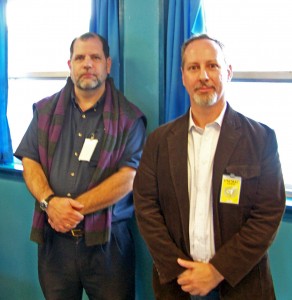
Alex is in North Korea, Tyler is in South Korea.

If we look a little tense it was because it was tense, perhaps even more than usual since just days before a North Korean soldier had killed two of his commanding officers while defecting to the South. North Korea also appears to be undergoing greater food shortages than in many years which no doubt adds to the tension. I had not realized, by the way, that you can see North Korea from a major highway in South Korea and the land is clearly stripped bare of trees which have been cut down for firewood and what little nutrition the bark offers.

Here are the North Koreans watching and photographing us to put into their permanent records.

Paradoxes of Internet Regulation–Korea Edition
Google’s maps of Seoul are peculiar, they offer public transit directions but not driving directions. Turns out that this is due to Korean law (the Measurement Act) which prohibits the export of Korean map data without obtaining government approval. (The distinction appears to be that driving directions are “new” maps and thus unapproved while transit directions are fixed and can be approved in advance of generation.)
Local versions of Google satellite imagery are also much lower resolution in South Korea due to military restrictions. Google has argued that by satisfying the law within a country it satistifes that country’s law, a policy rule on Google’s part that I applaud, but this policy does lead to the paradox that the images of South Korea available in South Korea are not as high resolution as those available in North Korea!
More generally, however, the bigger Google gets the more countries it has a physical presence in (servers, sales staff and support etc.) and thus the more leverage individual countries, especially large countries, will have to degrade the services that Google offers not just within-country but to the world.
Reason TV Interviews Alex on MRU
Lunch with Tyler in Seoul
Tyler and I are here in Seoul for different conferences but we arranged to meet for lunch in Insadong. I arrived early and found a restaurant which didn’t look at all like it was frequented by tourists. Feeling pleased, I met with Tyler and indicated my suggestion.
“Looks ok,” he said, not sounding enthused.
“But Tyler,” I replied slightly miffed, “look inside, no one is smiling or laughing. It must be good.”
“Excellent point,” he conceded “but come look at this place” and he proceeded to walk behind a row of stores and down a small alleyway pointing to a tiny restaurant, “Do you see the sign?” I read the sign he was pointing to, “No English.”
“Ah,” I replied, “a good signal” and, after looking inside, “and no chairs either.”
Needless to say, the meal was delicious.
Truth Bounties
The Truth Market is an interesting combination of prediction markets, bounty hunting and crowd funding that aims to separate the wheat from the chaff of truth claims. Here is how it works:
You hear a statement that you think is bogus (or you hear the denial of something that you think is true). You open a challenge in which you offer to pay a truth bounty of $x if someone can prove that the bogus statement is true (or prove false the statement that you think is true). Other people can join your challenge, adding to the bounty. If the total bounty exceed a significant threshold the challenge goes live.
Once a challenge is live, anyone can earn the bounty if their evidence for or against the claim meets the standards of a neutral, professional, scientifically trained group of adjudicators (provided by TruthMarket). If within a given time-frame no one wins the bounty the bounties are returned to the contributors minus 20% which goes to the initial sponsor of the challenge. The initial sponsor can now also trumpet that despite significant cash no one was able to prove the bogus claim (or refute the true claim).
Thus, there are incentives to offer challenges, incentives to answer challenges, and incentives to pay attention to the results. TruthMarket has some serious people on its management team and advisory board. There are already challenges about global warming, cell phones, defensive gun use and other issues.
Will the Truth Market work? In order to work, TruthMarket will need a track record of significant money bounties and adjudicated claims. As of yet, I don’t see many (any? the site is unclear although this is the most important part of the process).
Most important, people have to regard winning a bounty and the failure to win a bounty as informative. My experience, however, is that the people who regard betting as informative are already rational and well-informed about other issues so the bounty isn’t necessary to prosecute the truth claim.
The Amazing Randi’s one million dollar prize for “evidence of any paranormal, supernatural, or occult power or event,” was first offered in 1964 but has never been claimed. In theory, that tells us a lot. In practice, the failure of the prize to be won does not seem to have changed many people’s beliefs.
Shared Creation
From Joshua Gans’s Information Wants to be Shared.
Economic theory has not quite caught up with this interesting area of
shared information. I can speculate on future business models for books and
the news because they fall within baseline economic motives. But when
it comes to shared creation, nonmonetary motives loom larger and the
economist’s toolkit is harder to rely upon. Wikipedia is a prime example.
More than just a content platform, it is built on and maintained by an army of anonymous volunteers. Back in 2001, when it started, economists would
not have predicted Wikipedia’s success; nor can they really explain it now.Other social scientists have not waited for economists to catch up. But
perhaps no person has examined the notion that broad, shared creation can
be effective more than MIT professor Eric von Hippel. One of the great
facts from his research is this: a vast number of useful innovations come
not from some scientist and engineer tinkering in a lab, but from users
solving their own problems. Examples abound, from scientific instruments,
to mountain bikes and, of course, to open source software. In some cases,
the innovations were the work of lone innovators, while for others, local
communities together produced advances. It is the latter that interests us
here.
Economists thought that Wikipedia couldn’t work because of problems of motivation but what turned out to matter most was not motivation but transaction costs. With 7 billion people and low transaction costs what other forms of shared creation become possible?