The skills necessary to ride a bike are multifaceted, complex and not at all obvious or even easily explicable to the conscious mind. Once you learn, however, you never forget–that is the power of habit. Without the power of habit, we would be lost. Once a routine is programmed into system one (to use Kahneman’s terminology) we can accomplish great skills with astonishing ease. Our conscious mind, our system two, is not nearly fast enough or accurate enough to handle even what seems like a relatively simple task such as hitting a golf ball–which is why sports stars must learn to turn off system two, to practice “the art of not thinking,” in order to succeed.
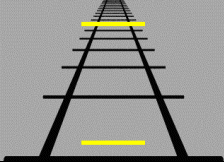
Habits, however, can easily lead one into error. In the picture at right, which yellow line is longer? System one tells us that the line at the top is longer even though we all know that the lines are the same size. Measure once, measure twice, measure again and again and still the one at top looks longer at first glance. Now consider that this task is simple and system two knows with great certainty and conviction that the lines are the same and yet even so, it takes effort to overcome system one. Is it any wonder that we have much greater difficulty overcoming system one when the task is more complicated and system two less certain?
You never forget how to ride a bike. You also never forget how to eat, drink, or gamble–that is, you never forget the cues and rewards that boot up your behavioral routine, the habit loop. The habit loop is great when we need to reverse out of the driveway in the morning; cue the routine and let the zombie-within take over–we don’t even have to think about it–and we are out of the driveway in a flash. It’s not so great when we don’t want to eat the cookie on the counter–the cookie is seen, the routine is cued and the zombie-within gobbles it up–we don’t even have to think about it–oh sure, sometimes system two protests but heh what’s one cookie? And who is to say, maybe the line at the top is longer, it sure looks that way. Yum.
System two is at a distinct disadvantage and never more so when system one is backed by billions of dollars in advertising and research designed to encourage system one and armor it against the competition, skeptical system two. Yes, a company can make money selling rope to system two, but system one is the big spender.
Habits can never truly be broken but if one can recognize the cues and substitute different rewards to produce new routines, bad habits can be replaced with other, hopefully better habits. It’s habits all the way down but we have some choice about which habits bear the ego.
Charles Duhigg’s The Power of Habit, about which I am riffing off here, is all about habits and how they play out in the lives of people, organizations and cultures. I most enjoyed the opening and closing sections on the psychology of habits which can be read as a kind of user’s manual for managing your system one. The Power of Habit, following the Gladwellian style, also includes sections on the habits of corporations and groups (hello lucrative speaking gigs) some of these lost the main theme for me but the stories about Alcoa, Starbucks and the Civil Rights movement were still very good.
Duhigg is an excellent writer (he is the co-author of the recent investigative article on Apple, manufacturing and China that received so much attention) It will also not have escaped the reader’s attention that if a book about habits isn’t a great read then the author doesn’t know his material. Duhigg knows his material. The Power of Habit was hard to put down.
At 9, he settled a dispute with a pistol. At 13, he lit out for the Amazon jungle.
At 20, he attempted suicide-by-jaguar. Afterward he was apprenticed to a pirate. To please his mother, who did not take kindly to his being a pirate, he briefly managed a mink farm, one of the few truly dull entries on his otherwise crackling résumé, which lately included a career as a professional gambler.
From the NYTimes obit of John Fairfax and oh did I mention he rowed across the Atlantic…and the Pacific.
In a rare display of function, Congress extended the payroll tax cut and in the same deal they arranged to sell more spectrum, both good ideas and ones that I have arguedfor extensively. Frankly, I am pleased but surprised. Any inside knowledge on how this was accomplished?
The Hill: Six House Democrats, led by Rep. Dennis Kucinich (D-Ohio), want to set up a “Reasonable Profits Board” to control gas profits.
The Democrats, worried about higher gas prices, want to set up a board that would apply a “windfall profit tax” as high as 100 percent on the sale of oil and gas, according to their legislation.
…The Gas Price Spike Act, H.R. 3784, would apply a windfall tax on the sale of oil and gas that ranges from 50 percent to 100 percent on all surplus earnings exceeding “a reasonable profit.” It would set up a Reasonable Profits Board made up of three presidential nominees that will serve three-year terms.
And here directly from the proposed bill:
(4) REASONABLE PROFIT.—The term ‘reasonable profit’ means the amount determined by the Reasonable Profits Board to be a reasonable profit on the sale.
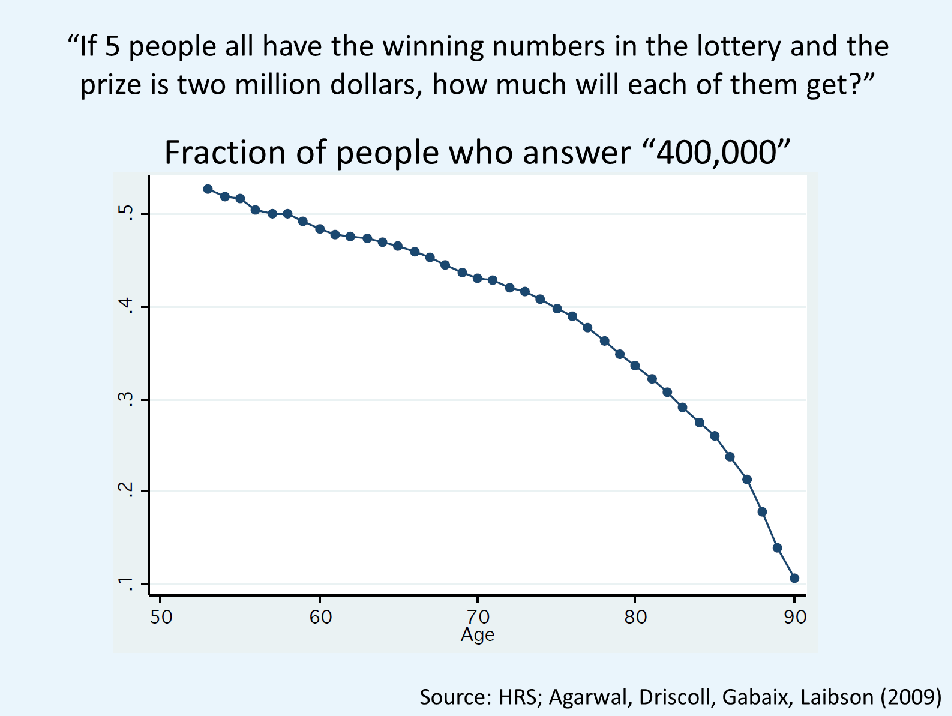
I don’t know which is scarier the height of the curve around age 50 or the slope of the curve (fyi, my guess is cohort effects are small). The slide is from David Laibson who has much more on aging and dementia; also raises issues of the value of medical care that maintains the body but not the mind.
The joke going around last week was that a liberal, a conservative and a moderate walk into a bar. “Hi Mitt,” says the bartender. Here’s Mitt proving the point:
“This week, President Obama will release a budget that won’t take any meaningful steps toward solving our entitlement crisis,” Romney said in a statement e-mailed to reporters. “The president has failed to offer a single serious idea to save Social Security and is the only president in modern history to cut Medicare benefits for seniors.”
The government safety net was created to keep Americans from abject poverty, but the poorest households no longer receive a majority of government benefits.
…Dozens of benefits programs provided an average of $6,583 for each man, woman and child in the county in 2009, a 69 percent increase from 2000 after adjusting for inflation.
…The recent recession increased dependence on government, and stronger economic growth would reduce demand for programs like unemployment benefits. But the long-term trend is clear. Over the next 25 years, as the population ages and medical costs climb, the budget office projects that benefits programs will grow faster than any other part of government, driving the federal debt to dangerous heights.
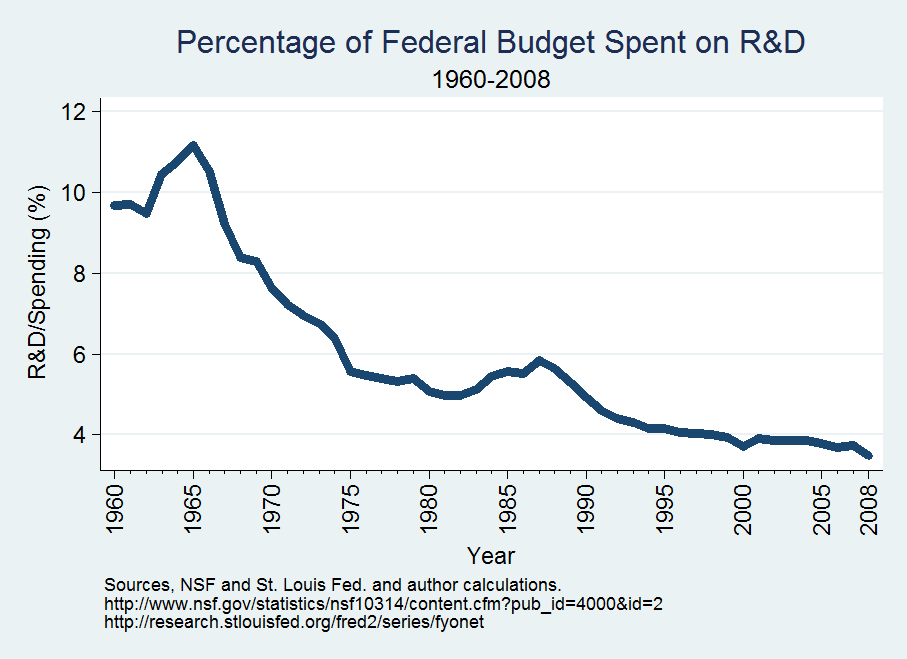
In Launching the Innovation Renaissance (and here) I argue that the warfare-welfare state is crowding out other areas of spending, even when such spending could be highly valuable.
Bryan Caplan has a very good post on the human capital and signalling models of education. The key point is this, under the human capital model someone who forgets knowledge is no better than someone who failed to learn the same knowledge. Under the signaling model, however, failing and forgetting are very different. Bryan illustrates:
If I’d failed Spanish, I couldn’t have gone to a good college, wouldn’t have gotten into Princeton’s Ph.D. program, and probably wouldn’t be a professor. But since I’ve merely forgotten my Spanish, I’m sitting in my professorial office, loving life.
In our principles textbook, Modern Principles: Macroeconomics, Tyler and I illustrate the importance of property rights with the incentive effects of collective farming and the secret agreement of Xiaogang village. We write:
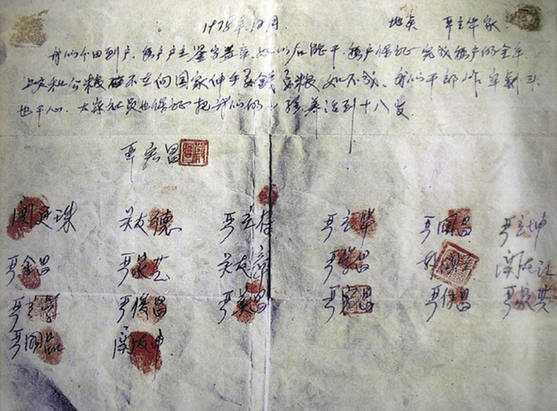
Farmers from 18 households in Xiaogang signed a secret life-and-death agreement ending collective farming with their thumbprints. (From Cowen and Tabarrok, Modern Principles: Macroeconomics)
The Great Leap Forward was a great leap backward – agricultural land was less productive in 1978 than it had been in 1949 when the communists took over. In 1978, however, farmers in the village of Xiaogang held a secret meeting. The farmers agreed to divide the communal land and assign it to individuals – each farmer had to produce a quota for the government but anything he or she produced in excess of the quota they would keep. The agreement violated government policy and as a result the farmers also pledged that if any of them were to be killed or jailed the others would raise his or her children until the age of 18. [The actual agreement is shown at right.]
The change from collective property rights to something closer to private property rights had an immediate effect, investment, work effort and productivity increased. “You can’t be lazy when you work for your family and yourself,” said one of the farmers.
Word of the secret agreement leaked out and local bureaucrats cut off Xiaogang from fertilizer, seeds and pesticides. But amazingly, before Xiaogang could be stopped, farmers in other villages also began to abandon collective property. In Beijing, Mao Zedong was dead and a new set of rulers, seeing the productivity improvements, decided to let the experiment proceed.
For more background, NPR’s Planet Money has a great story on this secret agreement including this:
“Back then, even one straw belonged to the group,” says Yen Jingchang, who was a farmer in Xiaogang in 1978. “No one owned anything.”
At one meeting with communist party officials, a farmer asked: “What about the teeth in my head? Do I own those?” Answer: No. Your teeth belong to the collective.
In theory, the government would take what the collective grew, and would also distribute food to each family. There was no incentive to work hard — to go out to the fields early, to put in extra effort, Yen Jingchang says.
“Work hard, don’t work hard — everyone gets the same,” he says. “So people don’t want to work.”
…Before the contract, the farmers would drag themselves out into the field only when the village whistle blew, marking the start of the work day. After the contract, the families went out before dawn.
“We all secretly competed,” says Yen Jingchang. “Everyone wanted to produce more than the next person.”
It was the same land, the same tools and the same people. Yet just by changing the economic rules — by saying, you get to keep some of what you grow — everything changed.
Law #1: People will get jobs doing things that computers can’t do. Law #2: A global market place will result in lower pay and fewer opportunities for many careers. (But also in cheaper and better products and a higher standard of living for American consumers.) Law #3: Professional people will more likely be freelancers and less likely to have a steady job.
[But]…Laws #1 & 2 predict that there will likely be fewer STEM jobs in the future – they are both easily computerized and tradable. People will always be employed in STEM disciplines, many of them highly paid, but they’ll be paid for smarts rather than education. The disciplines will be much more competitive, with older and less talented workers left on the sidelines. Tom Friedman and Alex Tabarrok, reflecting conventional wisdom, are mistaken in maintaining that increasing STEM education is a key to future economic competitiveness.
Jelski instead recommends English lit and psychology, at least if you are young and hot! The logic–computers don’t write well and people don’t want to have sex with or be counseled by computers (yet!),–seems strong but wage rates and unemployment levels don’t support the argument. Jelski is correct about demand but forgets to take into account supply. Thus, the way to go is to be a hot engineer who can write well and get along with other people. (Jelski also forgets that my argument for STEM was in large part about the spillover effects).
I am in strong agreement with Jelski, however, that education is only the first step to success. Education is a tool; to truly succeed one must have skills developed with grit and applied with passion.
A full page anti-immigration ad taken out in a Hong Kong newspaper is making waves. The ad (shown at right; note the locust) reads:
Do you want Hong Kong to pay 1 million HKD per 18 minute raising illegitimate child from mainland?
Hong Kong people have had enough of it!
We understand that you suffer from contaminated milk powder, so we tolerate your raid upon our milk powder; we understand that you don’t have freedom, so we receive you over here through “free pass”; we understand that your education is poor, so we share our educational resource with you; we understand that you don’t read traditional Chinese, so we use “cripple” Chinese character (simplified Chinese) in the following: “Please respect our local culture when you are here, without Hong Kong you are all doomed.”
Strongly demand the government to amend the 24th clause of Basic Laws!
Stop the massive invasion of double negative pregnant women from mainland. (double negative = none of the woman’s parents are from HK)
The ad then went viral with versions of the ad created for Beijing, Shanghai and Guangzhou [text here was corrected, AT] but the Shenzhen version took a different approach. The text here reads:
You are one of us if you come to Shenzhen.
Welcome to Shenzhen!
Because we are all away from home, so welcome here; because this is a big circle Grandpa Deng drew for all of us (metaphor for making Shenzhen special economic region), so welcome here; because you are part of the momentum that keeps Shenzhen going, so welcome here; because of you are the reason behind our 30 years of prosperity, so welcome here; because we want the whole world to know this, so we use English the say the next: “welcome to hometown Shenzhen”.
Warmly welcome every hard worker to Shenzhen!
We wish all Shenzhen people a happy new year and may all your wishes come true!
Good piece in the New York Times making three points about foreign students in U.S. universities 1) State budgets for education have been slashed, 2) foreign students are way up and because they are paying much higher tuition than in-state students they are supporting education for citizens, 3) selling education services is one way our trade deficit with China is balanced.
This is the University of Washington’s new math: 18 percent of its freshmen come from abroad, most from China. Each pays tuition of $28,059, about three times as much as students from Washington State. And that, according to the dean of admissions, is how low-income Washingtonians — more than a quarter of the class — get a free ride.
Not everyone is happy, however. Here is one (ironic?) complaint:
“Morally, I feel the university should accept in-state students first, then other American students, then international students,” said Farheen Siddiqui, a freshman from Renton, Wash., just south of Seattle.
Paul Howard of the Manhattan Institute talks with me about innovation in a fun podcast (mp3) and here is my earlier Econ Talk with Russ Roberts. I was also interviewed by Davin O’Dwyer for the Irish Times. Launching also has a new cover, shown at right. Here is one bit from the Irish Times:
The new normal is that we’re going to go back to where China and India are going to be playing huge roles. That definitely means that our relative status is going to fall. We’re not going to be, either the US or Europe, the powerhouse we once were. We’re not going to be the giant in the land of the Lilliputians. But, in an absolute sense, we can continue to do well and even better than before. I like to say that if you invent a cure for cancer, that’s great, that’s fantastic. If your neighbour invents a cure for cancer, that’s almost as great.
Nick Schulz has an interesting introduction to recent work on immigration and human capital that includes this figure:
The human capital stock is probably over-estimated since it imputes the value of non-market time at market wages but even counting non-market time at zero (not correct either) would give a human capital stock of $212 trillion, about 5 times the physical capital stock. Thinking about human capital reminds us that debates about immigration and education are debates about investment.
 ine at the top is longer even though we all know that the lines are the same size. Measure once, measure twice, measure again and again and still the one at top looks longer at first glance. Now consider that this task is simple and system two knows with great certainty and conviction that the lines are the same and yet even so, it takes effort to overcome system one. Is it any wonder that we have much greater difficulty overcoming system one when the task is more complicated and system two less certain?
 great when we don’t want to eat the cookie on the counter–the cookie is seen, the routine is cued and the zombie-within gobbles it up–we don’t even have to think about it–oh sure, sometimes system two protests but heh what’s one cookie? And who is to say, maybe the line at the top is longer, it sure looks that way. Yum.
 A full page anti-immigration ad taken out in a Hong Kong newspaper is making waves. The ad (shown at right; note the locust) reads:

 Paul Howard of the Manhattan Institute talks with me about innovation in a fun podcast (mp3) and here is my earlier Econ Talk with Russ Roberts. I was also interviewed by Davin O’Dwyer for the Irish Times. Launching also has a new cover, shown at right. Here is one bit from the Irish Times:
