Time Preference, Parenthood and Policy Preferences
Using a small sample of couples before and after they have children, Alex Gazmararian finds that support for climate change policy increases after people have children. People also become more future-orientated when primed to think of children.
The short time horizons of citizens is a prominent explanation for why governments fail to tackle significant long-term public policy problems. Actual evidence of the influence of time horizons is mixed, complicated by the difficulty of determining how individuals’ attitudes would differ if they were more concerned about the future. I approach this challenge by leveraging a personal experience that leads people to place more value on the future: parenthood. Using a matched difference-in-differences design with panel data, I compare new parents with otherwise similar individuals and find that parenthood increases support for addressing climate change by 4.3 percentage points. Falsification tests and two survey experiments suggest that longer time horizons explain part of this shift in support. Not only are scholars right to emphasize the role of individual time horizons, but changing valuations of the future offer a new way to understand how policy preferences evolve.
It’s a little tricky to say that the driving force is time preference per se, maybe it’s just caring about (some) future people. Suppose a white man marries an African American woman. He subsequently may become more interested in civil rights, just as having children may make people more interested in the(ir) future. Or suppose that medical technology extends life expectancy, leading people to save more. Is this due to lower time preference or increased-self love?
We do see more parenthood driving future-oriented behavior on many margins. I am reminded, for example, of More Pregnancy, Less Crime which showed huge drops in criminal activity as people learn that they will be mothers and fathers. Criminals are very present-oriented so this effect is also consistent with parenthood driving lower time preference, although other stories are also possible. It’s difficult to distinguish these explanations and as far as policy and behavior is concerned perhaps the distinction between caring about the future and caring about future people doesn’t really matter.
How Many Workers Did It Take to Build the Great Pyramid of Giza?
The Great Pyramid of Giza was built circa 2600 BC and was the world’s tallest structure for nearly 4000 years. It consists of an estimated 2.3 million blocks with a weight on the order of 6-7 million tons. How many people did it take to construct the Great Pyramid? Vaclav Smil in Numbers Don’t Lie gives an interesting method of calculation:
The Great Pyramid’s potential energy (what is required to lift the mass above ground level) is about 2.4 trillion joules. Calculating this is fairly easy: it is simply the product of the acceleration due to gravity, the pyramid’s mass, and its center of mass (a quarter of its height)…I am assuming a mean of 2.6 tons per cubic meter and hence a total mass of about 6.75 million tons.
People are able to convert about 20 percent of food energy into useful work, and for hard-working men that amounts to about 440 kilojoules a day. Lifting the stones would thus require about 5.5 million labor days (2.4 trillion/44000), or about 275,000 days a year during [a] 20 year period, and about 900 people could deliver that by working 10 hours a day for 300 days a year. A similar number might be needed to emplace the stones in the rising structure and then smooth the cladding blocks…And in order to cut 2.6 million cubic meters of stone in 20 years, the project would have required about 1,500 quarrymen working 300 days per year and producing 0.25 cubic meters of stone per capita…the grand total would then be some 3,300 workers. Even if we were to double that in order to account for designers, organizers and overseers etc. etc….the total would be still fewer than 7,000 workers.
…During the time of the pyramid’s construction, the total population of Egypt was 1.5-1.6 million people, and hence the deployed force of less than 10,000 would not have amounted to any extraordinary imposition on the country’s economy.
I was surprised at the low number and pleased at the unusual method of calculation. Archeological evidence from the nearby worker’s village suggests 4,000-5,000 on site workers, not including the quarrymen, transporters and designers and support staff. Thus, Smil’s calculation looks very good.
What other unusual calculations do you know?

Doggerels for Deplorables
From Doggerels for Deplorables by D.M. Charette, with inspiration from Marginal Revolution.
Hope III: Assortative Mating
I hear how you proclaim the fault
for unequal shares in wealth
arises from the greediness
rich enjoy at poor’s expense.
But if you go through white papers [7,8]
you’ll notice one more factor
when you marry in your class
you increase the income gap.
Now let me call upon you all
who declare as liberal
to regard the bigger picture
when deciding on your future:
Seek outside of your career
ask out the single cashier
skip out on the grad event
hit the bar beside the plant
don’t inquire on film noir
learn to spot a muscle car
pass up on that back-stage tour
plant yourself in the bleachers.
So to decrease income division
you’ll marry someone not envisioned
but since you’re not a hypocrite
I’m certain you’ll be fine with it.
Addendum: Here is me on assortative mating in the economics profession and here is much more.
How the German welfare state punishes performance
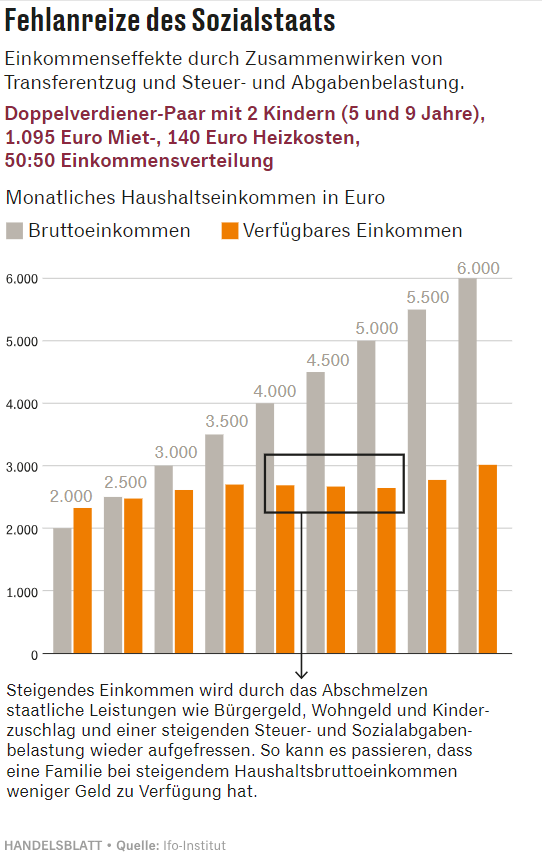 The German welfare state is generous but this leads to implicit tax rates for those on welfare that can exceed 100%. Here’s a useful summary from the German newspaper Handelsblatt. (The original is in German, this is a Google translation.)
Poorly coordinated state benefits such as the citizen’s allowance, housing benefit or child allowance often mean that additional work is not worthwhile or, in extreme cases, even leads to lower net income. The Ifo Institute has calculated this for various household types for the Handelsblatt newspaper – and shown how anti-performance the system sometimes is.
..A dual-income couple with two children aged five and nine, who work full-time and each earn 2000 euros gross per month, have a net income of 2686 euros with rent and heating costs of 1235 euros.
The couple therefore only has 887 euros more at their disposal per month than the household receiving citizen’s allowance. The absurd thing is that if the model working couple increases their joint income to 5,000 euros, the household’s net income falls by 43 euros to 2,643.
The graph shows that from a gross monthly income of 2000 Euro ($2150) (gray bars) to 6000 Euro ($6450) the net income gradient (orange bars) is nearly flat and in some regions it actually falls–meaning the couple would be better off by not working.
It’s hard to solve these problems. A negative income tax in which benefits would fall more slowly with income can restore incentives but at the price of having many more people on some welfare and a a much higher budgetary cost.
The Gary Becker Papers
The Gary Becker Papers (117.42 linear feet, 223 boxes) are now open at the University of Chicago:
The collection documents much of Gary Becker’s intellectual history. One of his autobiographical essays, “A Personal Statement About My Intellectual Development” (see Box 120, Folder 10 and Box 189, Folder 1), traces his academic career from his youth to his origins as a student at Princeton University, to his graduate student years and professorship at the University of Chicago, and his extra collegial engagement on corporate advisory boards, political participation, and governmental councils. The essay could have been written based on some of the records collected here. The collection documents an intellectual trajectory primarily through intellectual productions, research files, and communications. His approach to the research and writing, his publishing history, his engagement with others in the field of economics and other individuals in public service and global politics are contained here. Though the collection primarily concerns his professional life, there is also mention of his relationship with Guity Nashat, his wife, as they traveled together to the many conferences and events in the United States and abroad, and other incidents of his life for a minor study or treatment of his biography.
The collection materials include Becker’s handwritten and printed copies of his scholarship, including notes (and bibliographic cards), papers (and drafts), diagrams and charts, data sheets, correspondence, periodical reprints, magazines, newspapers and clippings, grant documents, reports, referee files, course and instructional materials, photographs, VHS tapes, DVD’s, and related ephemera.
Hat tip: Peter Istzin.
Nuclear is Not Best Everywhere
Australia is having a debate over nuclear power. Hamilton and Heeney weigh in with an important perspective:
On the basis of many conversations about Australian energy policy over the years, we can divide the proponents of nuclear energy into three groups.
The first might be called the “ideologues”. They favour nuclear not because of its zero emissions, but despite it. Indeed, many are climate sceptics. They hate renewables because the left loves them, and they favour nuclear because the left hates it.
The second might be called the “engineers”. They favour nuclear energy because it’s cool. Like a Ferrari, they marvel at its performance and stability. They see it as the energy source of the future. The stuff of science fiction.
The third might be called the “pragmatists”. They are not super attentive or highly informed about the intricacies of energy policy. They superficially believe nuclear can serve as a common-sense antidote to the practical shortcomings of renewables.
Conspicuously absent are those who might be called the “economists”. They couldn’t care less about exactly how electrons are produced. They simply want the cheapest possible energy that meets a minimum standard of reliability and emissions.
On the basis of the economics, Hamilton and Heeney conclude that nuclear is expensive for Australia:
The CSIRO estimates the cost of 90 per cent renewables, with firming, transmission, and integration costs included, at $109 per megawatt hour. Based on South Korean costs (roughly one-third of the US and Europe), a 60-year lifespan, a 60 per cent economic utilisation rate (as per coal today), and an eight-year build time (as per the global average), nuclear would cost $200 per megawatt hour – nearly double.
The same electrons delivered with the same reliability, just twice as expensive under what is a fairly optimistic scenario.
Note–this is taking into account that nuclear is available when the sun doesn’t shine and the winds don’t blow–so are batteries.
I suspect that Hamilton and Heeney are right on the numbers but it’s this argument that I find most compelling:
If you need external validation of these basic economics, look no further than the opposition’s own announcement. Rather than lift the moratorium and allow private firms to supply nuclear energy if it’s commercially viable, the opposition has opted for government to be the owner and operator. A smoking gun of economic unviability if ever there were one.
I am optimistic about the potential of small modular reactors (SMRs) based on innovative designs. These reactors can ideally be located near AI facilities. As I argued in the Marginal Revolution Theory of Innovation, innovation is a dynamic process; success rarely comes on the first attempt. The key to innovation is continuous refinement and improvement. These small reactors based on different technologies give as an opportunity to refine and improve. To achieve this, we must overhaul our regulatory framework, which has disproportionately burdened nuclear energy—our greenest power source—with excessive regulation compared to more hazardous and less environmentally friendly technologies.
Electrons are electrons. We should allow all electricity generation technologies to compete in the market on an equal footing. Let the best technologies win.
Testing for Bird Flu is Too Slow
Remember my warnings about the FDAs takeover of lab developed tests?
…Lab developed tests have never been FDA regulated except briefly during the pandemic emergency when such regulation led to catastrophic consequences. Catastrophic consequences that had been predicted in advanced by Paul Clement and Lawrence Tribe. Despite this, for reasons I do not understand, the FDA plan is marching forward but many other people are starting to warn of dire consequences.
Well the plan marched forward and here we are. Regarding tests for bird flu:
KFFNews: Clinical laboratories have also begun to develop their own tests from scratch. But researchers said they’re moving cautiously because of a recent FDA rule that gives the agency more oversight of lab-developed tests, lengthening the pathway to approval. In an email to KFF Health News, FDA press officer Janell Goodwin said the rule’s enforcement will occur gradually.
However, Susan Van Meter, president of the American Clinical Laboratory Association, a trade group whose members include the nation’s largest commercial diagnostic labs, said companies need more clarity: “It’s slowing things down because it’s adding to the confusion about what is allowable.”
One of the motivations for Operation Warp Speed and my work during the pandemic on things like advance market commitments was that firms wouldn’t invest enough in tests because diseases might fizzle out. The extreme costs of shutting down the economy, however, mean that it’s well worth paying for some tests for diseases that fizzle out if tests are ready when a disease doesn’t fizzle out.
Creating tests for the bird flu is already a risky bet, because demand is uncertain. It’s not clear whether this outbreak in cattle will trigger an epidemic or fizzle out. In addition to issues with the CDC and FDA, clinical laboratories are trying to figure out whether health insurers or the government will pay for bird flu tests.
We need a pandemic trust fund to ramp up advance market commitments when necessary.
On the plus side, I do approve of the new program to pay farmers and farm workers for testing. For example:
Friday’s incentives announcement included a $75 payment to any farm worker who agrees to give blood and nasal swab samples to the CDC.
“Bird flu” has now infected more than 50 types of mammals. To be clear, bird flu may yet fade but every potential pandemic pathogen is a test of readiness and we still are getting a C+ at best.
Economic Freedom, Even More Important Than You Think!
Economic freedom, as measured by say the Fraser Institute’s EF Index correlates highly with GDP per capita. Alvarez, Geloso and Scheck show that once you take into account the fact that dictators lie, the correlation is even higher!
SSRN: The literature connecting economic freedom indexes to income levels and growth generally points in the direction of a positive association. In this paper, we argue that this finding is a highly conservative as the data is heavily biased against finding any effects. The bias emerges as a result of the tendency of dictatorial regimes to overstate their GDP level. Dictatorships also tend to have lower scores of economic freedom. This downwardly biases any estimations of the relation between income and economic freedom. In this paper, we use recent corrections to GDP numbers — based on nighttime light intensity — to estimate the bias. We find that the true effects of economic freedom at its component on income levels are between 1.1 and 1.33 times greater than commonly estimated. For economic growth, the bias is far smaller and only appears to be relevant for some individual components such as size of government and property rights.
Why We Can’t Have Nice Things, Part XXIV
WashingtonTimes: Residents in rural America are eager to access high-speed internet under a $42.5 billion federal modernization program, but not a single home or business has been connected to new broadband networks nearly three years after President Biden signed the funding into law, and no project will break ground until sometime next year.
A big part of the problem is the piling on to any government program a host of progressive wish-list items including:
• Preference for hiring union workers, who are scarce in some rural areas.
• Requiring providers to prioritize “certain segments of the workforce, such as individuals with past criminal records,” when building broadband networks.
• Requiring eligible entities to “account not only for current [climate-related] risks but also for how the frequency, severity, and nature of these extreme events may plausibly evolve as our climate continues to change over the coming decades.”
If this sounds familiar, recall my post on Building Back Key Bridge Better (note the date).
By the way, the FCC estimates that 7.2 million locations, i.e. houses and businesses, don’t have broadband access. $42.5 billion is enough to give all 7.2 million locations a 4-year subscription to Starlink (7.2 million locations * $120 per month * 48 months=$42.7 billion), and I am sure Elon would give us a discount so I didn’t include set up costs. Of course, the FCC decided that Starlink was not eligible for the program citing “SpaceX’s failure to successfully launch its Starship rocket.” Note that the FCC made their decision in 2022, years before the program was to rollout.
Accelerating India’s Development
 What will India look like in 2047? Combining projections of economic growth with estimates of the elasticity of outcomes with respect to growth, Karthik Muralidharan in Accelerating India’s Development reports:
Even with a strong GDP per capita growth rate of 6 per cent, projections for 2047 paint a sobering picture if we maintain our current course. While India’s infant mortality is projected to halve from 27 per 1000 births to 13 in 2047, it will still be well above China’s current rate of 8. Child stunting will only decrease from 35.5 to 25 per cent, which is only a 10.5 percentage point or 30 per cent reduction in nearly 25 years. In rural India, 16 per cent of children in Class 5 will still not be able to read at a Class 2 level, and 55 per cent of them will still not be able to do division at the Class 3 level.
Bear in mind that this is assuming an optimistic 6% growth rate in GDP per capita. Even more telling is that if growth increased to 8%, infant mortality would only fall to 10 per 1000 (instead of 13). Growth is great. It’s the single most important factor but it’s not everything. If India can double the elasticity of infant mortality with respect to growth, for example, then at the same 6% growth rate infant mortality would fall to just 6 per 1000 by 2047–that’s millions of lives saved. The big argument of Muralidharan’s Accelerating India’s Development is that India can get more development from the same level of growth by increasing the total factor productivity of the state.
There are many “big think” books on growth–Landes’ Wealth and Poverty of Nations, Acemoglu and Robinson’s The Narrow Corridor, Koyama and Rubin’s How the World Became Rich–but these books are primarily historical and descriptive. The big think books don’t tell you how to develop. Create institutions to strike “a delicate and precarious balance between state and society” isn’t much of a guide to development. Accelerating India’s Development is different.
“Accelerating” opens with two excellent chapters on the political economy of politicians and bureaucrats, outlining the constraints any reforms must navigate. It concludes with two chapters on the future, including ideas like ranked choice voting, representing its aspirations. It’s in-between the constraints and the aspirations, however, that Accelerating India’s Development is unique. I know of no other book that offers such a detailed, analytical, and comprehensive examination and evaluation of a country’s institutions and processes.
Muralidharan’s recommendations are often based on his own twenty years of research, especially in education, health and welfare, and when not based on his own research Muralidharan has read everyone and everything. Yet, he offers not a laundry list but a well-thought out, analytic, set of recommendations that are grounded on political and economic realities.
To give just one example, India’s bureaucracy is far over-paid relative to India’s GDP per capita or wages in the private sector. With wages too high, the bureaucracy is too small–a reflection of the concentrated benefits (wages to government workers), diffuse costs (delivering services to citizens) problem. Lowering wages for government workers is a non-starter but Muralidharan argues persuasively that it is possible to hire new workers from local communities at prevailing wages on renewable contracts. The Integrated Child Development Services (ICDS), for example, is India’s main program for delivering early childhood education. There are 1.35 million anganwadi centers (AWCs) across India and typically a single anganwadi worker is responsible for both nutrition and pre-school education but they spend most of their time on paperwork!
A simple, scalable way to improve early childhood education is to add a second worker to AWCs to focus on preschool education….In a recent study, my co-authors and I found that adding an extra, locally hired, early-childhood care and education facilitators to anganwadis in Tamil Nadu doubled daily preschool instructional time…we found large gains in students’ maths, language and executive function skills. We also found a significant reduction in child stunting and malnutrition…We estimate the social return on this investment was around thirteen times the cost….the ECCE facilitators typically had only a Class 10 or Class 12 qualification and received only one week of training, and were still highly effective.
The example illustrates Muralidharan’s methods. First, the recommendation is based on a large, credible, multi-year study run in India with the cooperation of the government of Tamil Nadu. Second, the study is chosen for the book because it fits Muralidharan’s larger analysis of India’s problems, India has too few government workers which leads to high potential returns, yet the workers are paid too much so these returns are fiscally unachievable. But hiring more workers on the margin, at India’s-prevailing wages, is feasible. India has lots of modestly-educated workers so the program can scale–this is not a study about adding AI-driven computers to Delhi schools under the management of IIT trained educators, a program which would be subject to the heroes aren’t replicable problem. The program is also politically feasible because it leaves rents in place and by hiring lots of workers, even at low wages, it generates its own political support. Finally, note that India’s ICDS is the largest early childhood development program in the world so improving it has the potential to make millions of lives better. Which is why I have called Muralidharan the most important economist in the world.
One of the reasons state capacity in India is so low is premature load bearing. Imagine if the 19th-century U.S. government had attempted to handle everything today’s U.S. government does—this is the situation in India. When State Capacity/Tasks < 1, what should be done? In premature imitation, Rajagopalan and I advocate for reducing Tasks–an idea best represented by Ed Glaeser’s quip that “A country that cannot provide clean water for its citizens should not be in the business of regulating film dialogue.” Accelerating India’s Development focuses on increasing State Capacity but without being anti-market. In fact, Muralidharan proposes making the state more effective by leveraging markets more extensively.
Indian policy should place a very high priority on expanding the supply of high-quality service providers, regardless of whether they are in the public or private sector.
Hence, Muraldiharan wants to build on India’s remarkably vibrant private schools and private health care with ideas like vouchers and independent ratings. Free to choose but free to choose in an information-rich environment. My own inclinations would be to push markets and also infrastructure more–we still need to get to that 6% growth! But I have few quibbles with what is in the book.
Accelerating India’s Development is an exceptionally rich and insightful book. Its comprehensive analysis and innovative recommendations make it an invaluable resource. I will undoubtedly reference it in future discussions and writings. This book is a must-read for anyone interested in understanding and improving life in the world’s largest democracy.
The Pentagon’s Anti-Vax Campaign
During the pandemic it was common for many Americans to discount or even disparage the Chinese vaccines. In fact, the Chinese vaccines such as Coronavac/Sinovac were made quickly and in large quantities and they were effective. The Chinese vaccines saved millions of lives. The vaccine portfolio model that the AHT team produced, as well as common sense, suggested the value of having a diversified portfolio. That’s why we recommended and I advocated for including a deactivated vaccine in the Operation Warp Speed mix or barring that for making an advance deal on vaccine capacity with China. At the time, I assumed that the disparaging of Chinese vaccines was simply an issue of national pride or bravado during a time of fear. But it turns out that in other countries, the Pentagon ran a disinformation campaign against the Chinese vaccines.
Reuters: At the height of the COVID-19 pandemic, the U.S. military launched a secret campaign to counter what it perceived as China’s growing influence in the Philippines, a nation hit especially hard by the deadly virus.
The clandestine operation has not been previously reported. It aimed to sow doubt about the safety and efficacy of vaccines and other life-saving aid that was being supplied by China, a Reuters investigation found. Through phony internet accounts meant to impersonate Filipinos, the military’s propaganda efforts morphed into an anti-vax campaign.
… Tailoring the propaganda campaign to local audiences across Central Asia and the Middle East, the Pentagon used a combination of fake social media accounts on multiple platforms to spread fear of China’s vaccines among Muslims at a time when the virus was killing tens of thousands of people each day. A key part of the strategy: amplify the disputed contention that, because vaccines sometimes contain pork gelatin, China’s shots could be considered forbidden under Islamic law.
…To implement the anti-vax campaign, the Defense Department overrode strong objections from top U.S. diplomats in Southeast Asia at the time, Reuters found. Sources involved in its planning and execution say the Pentagon, which ran the program through the military’s psychological operations center in Tampa, Florida, disregarded the collateral impact that such propaganda may have on innocent Filipinos.
“We weren’t looking at this from a public health perspective,” said a senior military officer involved in the program. “We were looking at how we could drag China through the mud.”
Frankly, this is sickening. The Pentagon’s anti-vax campaign has undermined U.S. credibility on the global stage and eroded trust in American institutions, and it will complicate future public health efforts. US intelligence agencies should be banned from interfering with or using public health as a front.
Moreover, there was a better model. It’s often forgotten but the elimination of smallpox from the planet, one of humanities greatest feats, was a global effort spearheaded by the United States and….the Soviet Union.
…even while engaged in a pitched battle for influence across the globe, the Soviet Union and the United States were able to harness their domestic and geopolitical self-interests and their mutual interest in using science and technology to advance human development and produce a remarkable public health achievement.
We could have taken a similar approach with China during the COVID pandemic.
More generally, we face global challenges, from pandemics to climate change to artificial intelligence. Addressing these challenges will require strategic international cooperation. This isn’t about idealism; it’s about escaping the prisoner’s dilemma. We can’t let small groups with narrow agendas and parochial visions undermine collaborations essential for our interests and security in an interconnected world.
Enhancing FDA Information Sharing for Neglected Tropical Diseases
Many countries look to the US FDA for guidance on approval decisions. In fact the FDA will sometimes receive and evaluate drugs and vaccines whose primary market is in less developed countries. Fexinidazole, for example, is a drug for treating African trypanosomiasis, i.e. sleeping sickness. We don’t get many cases of sleeping sickness in the US but there are many such cases in the Democratic Republic of Congo.
Thus, the US FDA is providing a useful service, both to US pharmaceutical firms and especially to developing countries. That’s great. But Jacob Trefethen of OpenPhil notes that for odd bureaucratic and legal reasons we redact a lot of information that could be useful to the countries that actually will use these treatments. Here, for example, is an excerpt from the approval decision for Fexinidazole:
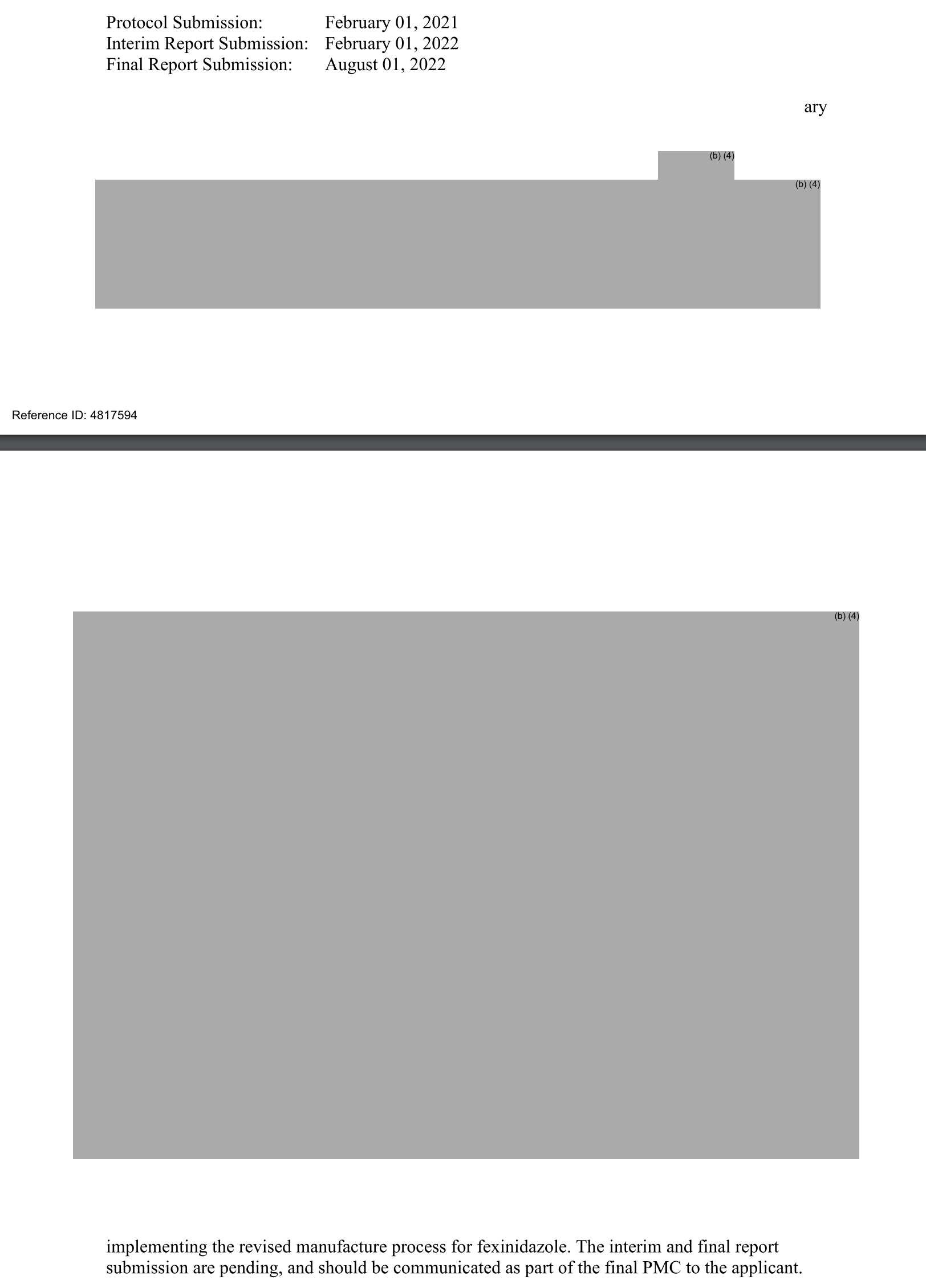
What’s especially strange here is that as far as Trefethen, or I, can tell, no one wants this! The FDA has no reason to hide this information, the company submitting the proposal surely wants as much information as possible sent to the countries where they will ultimately need to get approval (remember this is successful applications!) and the medical agencies in the developing countries would like to get context to have confidence in the FDA’s decisions. Instead, it seems that these drugs are getting caught in rules intended to protect pharmaceutical firms in other contexts. Thus, Trefethen makes two suggestions:
let’s create a track for products on the Neglected Tropical Disease list, sharing assessments with few or no redactions with the WHO Pre-Qualification (PQ) system, and allow PQ to share those documents further with regulators in partner countries.
Such an approval track already exists in the EU:
[The EU] have an approval track for products that are mostly going to be used elsewhere. If you apply using that track, they loop in regulators from those countries too. They share the documents assessing your clinical data and inspecting your manufacturing site with the WHO prequalification (PQ) team – the team whose stamp of approval speeds things up for many countries with less experienced national regulators. Gavi and the Global Fund need a product to be prequalified in order to buy it through the UN procurement agencies (e.g. UNICEF, for children’s vaccines).
Even without an approval track there are other small changes in priority and emphasis that could improve information sharing. The FDA is not unaware of these information sharing issues, for example, and there are procedures in place for confidentiality agreements with other countries. Trefethen suggests these could be given greater priority.
FDA leadership should set aggressive goals to complete more two-way Confidentiality Commitments with lower- and middle-income country regulators.
Extend the scope of existing commitments, when they’re limited, to allow sharing in more areas – especially related to drug approvals.
Extend 708(c) authority to more country agreements, not just those with European countries, to allow sharing of full documents that include trade secrets.
I’ve long advocated for peer approval, Trefethen gets into the weeds to point to specific ideas to make this a more useful idea, especially for developing countries. See Trefethen for more ideas!
Muller on Capitalism
Jerry Z. Muller, author of the classic , is my favorite intellectual historian. Evidently I am not alone as the Journal of Applied Corporate Finance has brought together Five Essays by Muller, these are:
- The Neglected Moral Benefits of the Market
- Capitalism and Inequality
- Capitalism and Nationalism
- The Threat of Democracy to Capitalism
- Capitalism and the Jews Revisited
All are excellent and to the point. Here is one bit from The Neglected Benefits of the Market (no indent);
Adam Smith famously wrote that
It is not from the benevolence of the butcher, the brewer, or the baker, that we expect our dinner, but from their regard to their own interest. We address ourselves, not to their humanity but to their self-love, and never talk to them of our own necessities but of their advantages. Nobody but a beggar chooses to depend chiefly upon the benevolence of his fellow-citizens.
This passage is almost invariably cited as a statement of the potential social efficacy of self-interest. But notice the strength of its suggestion that dependence upon the benevolence of others is morally degrading and, hence, something to be avoided if possible. Thomas Carlyle—and later Marx and Engels—would deplore this system of mutual appeals to self-interest as evidence of the tyranny of “the cash nexus.” But the flip side of the cash nexus is, first of all, the freedom and self-determination that comes from having cash. Second, the fact that relations based on cash do not involve the total subordination of one individual to the will of another represents significant progress when set against the older, prevailing characteristic forms of human relations under slavery, serfdom, or indentured servitude. Nor does the use of cash involve the subordination of the individual to the will of the state and its officials, one of the defining characteristics of socialism. That is why Hegel, who certainly appreciated the role of the state, insisted that supporting oneself by earning a living is one of the most important ways in which men get a sense of themselves as autonomous individuals. What Hegel called “the ethic of bourgeois society,” includes a commitment to “the activity of supporting oneself through reason and industriousness.
AI and Truth Evasion
A good insight from Eliot Higgins, the head of the intelligence service Bellingcat.
When a lot of people think about AI, they think, “Oh, it’s going to fool people into believing stuff that’s not true.” But what it’s really doing is giving people permission to not believe stuff that is true. Because they can say, “Oh, that’s an AI-generated image. AI can generate anything now: video, audio, the entire war zone re-created.” They will use it as an excuse.
From an extensive interview in Wired.
Addendum: A case in point.
Haan, goonda hai, magar hamara goonda hai
In India it’s common for politicians to have criminal cases against them. Why do voters vote for criminals?
One compelling explanation provided by political scientist Milan Vaishnav is that voters often care less about their represntative’s ability to deliver broad-based development or draft good laws, and more about the effectiveness at helping them access limited stated resources. So, a corrupt or crime-accused politician may be seen as effective because he can deliver benefits for his community.
…Colloquially, voters are known to say: Haan, goonda hai, magar hamara goonda hai (Yes, he is a gangster, but he is our gangster.)
From Karthik Muralidharan’s great book on improving state capacity in a failing state.
Addendum: See also my post There Is No Such Thing as Development Economics.