In Praise of Non-conformity
In this age, the mere example of nonconformity, the mere refusal to bend the knee to custom, is itself a service. Precisely because the tyranny of opinion is such as to make eccentricity a reproach, it is desirable, in order to break through that tyranny, that people should be eccentric. Eccentricity has always abounded when and where strength of character has abounded; and the amount of eccentricity in a society has generally been proportional to the amount of genius, mental vigour, and moral courage which it contained. That so few now dare to be eccentric, marks the chief danger of the time.
I saw this quote on Facebook and thought immediately of my friend Bryan Caplan. Bryan’s book of essays, is an excellent guide not simply to Bryan’s non-conformism but also on how to be a successful non-conformist in a conformist world.
Conditional Approval for Human Drugs
Recently a new drug to extend lifespan was granted conditional approval by the FDA–the first drug ever formally approved to extend lifespan! (By the way, the entrepreneur behind this breakthrough, Celine Halioua, is an emergent ventures winner for her earlier work rapidly expanding COVID testing. Tyler knows how to spot Talent!)
Great news, right? Yes, but there are two catches. First catch: the drug is for extending the lifespan of dogs. Second catch: Conditional approval is only available for animal drugs. Conditional approval was permitted for animal drugs beginning in 2004 for minor uses and/or minor species (fish, ferrets etc.) and then expanded in 2018 to include major uses in major species. What does conditional approval allow?
Conditional Approval (CA) allows potential applicants (referred to from this point as “sponsors”) to make a new animal drug product commercially available after demonstrating the drug is safe and properly manufactured in accordance with the FDA approval standards for safety and manufacturing, but before they have demonstrated substantial evidence of effectiveness (SEE) of the conditionally approved product. Under conditional approval, the sponsor needs to demonstrate reasonable expectation of effectiveness (RXE). A drug sponsor can then market a conditionally approved product for up to five years, through annual renewals, while collecting substantial evidence of effectiveness data required to support an approval.
Here is where it gets even more interesting. Why does the FDA say that conditional approval is a good idea?
First, it’s very expensive for a drug company to develop a drug and get it approved by FDA. Second, the market for a MUMS [Minor Use, Minor Species, AT] drug is too small to generate an adequate financial return for the company. The combination of the expensive drug approval process and the small market often makes drug companies hesitant to spend a lot of resources to develop MUMS drugs when there is so little return on their investment.
By allowing a drug company to legally market a MUMS drug early (before it is fully approved), conditional approval makes the drug available sooner to be used in animals that may benefit from it. This early marketing also helps the company recoup some of the investment costs while completing the full approval.
…Similar to conditional approval for MUMS drugs, the goal of expanded conditional approval is to encourage drug companies to develop drugs for major species for serious or life-threatening conditions and to fill treatment gaps where no therapies currently exist or the available therapies are inadequate.
 Sound familiar? These are exactly some of the points that I have been raising about the FDA approval process for years. In particular, by bringing forward marketing approval by up to 5 years, conditional approval makes it profitable to research and develop many more new drugs.
Conditional approval is very similar to Bart Madden’s excellent idea of a Free to Choose Medicine track, with the exception that Madden makes the creation of a public tradeoff evaluation drug database (TEDD) a condition of moving to the FTCM track. Thus, FTCM combines conditional approval with the requirement to collect and make public real-world prescribing information over time.
But why is conditional approval available only for animal drugs? Conditional approval is good for animals. People are animals. Therefore, conditional approval is good for people. QED.
Ok, perhaps it’s not that simple. One might argue that allowing animals to use drugs for which there is a reasonable expectation of effectiveness but not yet substantial evidence of effectiveness is a good idea but this is just too risky to allow for humans. But that cuts both ways. We care more about humans and so don’t want to impose risks on them that we are willing to impose on animals but for the same reasons we care more about improving the health of humans and should be willing to risk more to save them (Entering a burning building to save a child is heroic; for a ferret, it’s foolish.)
I think that the FDA’s excellent arguments for conditional approval apply to human drugs as well as to (other) animal drugs and even more so when we recognize that human beings have rights and interests in making their own choices. The Promising Pathways Act would create something like conditional approval (the act calls it provisional approval) for drugs treating human diseases that are life-threatening so there is some hope that conditional approval for human drugs becomes a reality.
Dare I say it, but could the FDA be lumbering in the right direction?
Surgery is Not FDA Regulated
What would happen if the FDA regulated pharmaceuticals much less than currently? I have pointed to one useful comparison, new uses of old drugs do not have to go through FDA required efficacy trials in the new use. In other words, new uses of old drugs are regulated for safety-only. Thus,
“off-label prescribing” provides a window on to what a world of safety-only FDA regulation would look like. Off-label prescribing surely results in errors and problems but overall physicians tell us that off-label prescribing is highly beneficial and critical to good medical care.
Maxwell Tabarrok points to another useful comparison, surgery. Surgery is not FDA regulated, despite having many of the same asymmetric information problems as pharmaceuticals. Some surgical procedures are surely ineffective and unsafe. Yet, once again, the FDA-absent surgery market appears beneficial overall and like other markets it improves over time with greater safety and more efficacy. For example,
In the US, the death rate from medical and surgical care complications declined by 39% from 1999 to 2009.
Would we be better off if every new surgical procedure had to go through FDA-required efficacy trials before it could be offered to consumers?
Neither of these comparison proves that a world with less FDA regulation would be a better world but both refute the stories of a world run amuck in the absence of the FDA. In essence, the reason is that the world contains many sources of approval, recommendation, certification and review beyond the FDA and these would grow in scope and stature absent the FDA.
See Maximum Progress for more.
Addendum: More excellent Tabarrok material: The Spice Must Flow: The Dutch-Portuguese War-Part 1.
Two Updates on the Value of Vaccines
1) From the recent annual meeting of the American Society of Tropical Medicine & Hygiene (abstract 6949) we learn that the R21/Matrix-M malaria vaccine maintained it’s efficacy over 4 seasons.
…Importantly, maintained high efficacy over four malaria seasons with only four doses is demonstrated, with no concerns to date of rebound in those who have not received repeated booster doses of the malaria vaccine. These data show that the R21/MM vaccine could significantly reducing malaria cases and deaths in children living in malaria endemic areas by inducing well maintained protective immunity.
This is excellent news and further supports my call for rapid, emergency distribution of malaria vaccines.
2) Glennerster, Kelly, McMahon, and Snyder estimate the value of a universal coronavirus vaccine. The COVID vaccines have been very valuable (see our Science paper) but each new variant of concern causes a spike in death rates. As new variants emerge, we modify the vaccines but that takes time and happens only after the death rate spikes. In addition, no one is thrilled with boosters. A universal coronavirus vaccine, and there are dozens in the works, could preclude the need to adjust vaccines on the fly and avoid or greatly ameliorate the death spikes. Based on reduced US mortality alone, Glennerster et al. estimate that a universal vaccine would be very valuable–so much so that an Advance Market Commitment on the order of $6-$10 billion would easily pass a cost-benefit test even if it had just say a 40% chance of accelerating a universal vaccine.
As I said repeatedly during COVID, billions<<Trillions.
Rent Controls
Ryan Bourne has a good rundown on rent controls in Argentina. In 2020 Argentina introduced a relatively mild form of rent control; rent increases during tenancy were capped at a weighted average of inflation and wage growth, tenancy was a minimum of 3 years and it became very difficult to end a tenancy. In ordinary times, this might have had only mild negative effects but in a high inflation rate scenario everything was accelerated (and the controls got worse over time, most notably in 2023 rent increases were capped at the minimum of inflation and wage growth).
….The results of all this were predictable. Around the policy’s introduction, it’s estimated that 45% of landlords stopped renting to instead sell their properties, not least because most home sales were made in dollars [it was illegal to rent in dollars, AT]. A lot of landlords shifted to short-term rentals on AirBnB too. In 2019, Buenos Aires had 10,000 properties listed on AirBnB; now it’s over 29,500. There have thus been no end of stories about a rental housing crisis, with tenants unable to find rental accommodation, despite the Financial Times reporting late last year that energy use implies ‘one in seven homes’ in Buenos Aires, the capital, laid empty.
This supply crunch led to soaring rents. Bloomberg reported that rents jumped sharply after tenancy rent controls were announced, as landlords opted out of the market or front-loaded rent increases to protect against inflation. Having been falling in real terms through 2018 and 2019, and tracking inflation for most of the previous decade, rents in Buenos Aires grew at 1.7 times the pace of inflation in 2020, broadly tracked inflation in 2021 and 2022, and then accelerated much faster than inflation again in 2023 as the rate which rents could be increased within tenancies was tightened further to the lower of wage growth or inflation.
As a result, the average rent for a two bedroom apartment in Buenos Aires has surged from 18,000 pesos per month at the end of 2019 to 334,000 pesos today, far above the 210,000 pesos if prices had merely tracked broader inflation, as used to happen. This relative price hike obviously hurts the poor most, because they cannot easily afford deposits to buy homes, or more expensive shorter-term dollar rentals.
Controls on rents within tenancies also soured landlord-tenant relations, incentivising landlords to forgo expensive maintenance (thus allowing the value of the property to fall towards its regulated price or to encourage tenants to leave). Misallocation of properties was rife. Reports in Buenos Aires described friends having to share apartments further out of the city centre, meaning cramped conditions and longer commutes. Under such controls, people enjoying sub-market rents are incentivized to stay in properties ill-suited for them, while others must leave properties they can afford prematurely when rents adjust sharply before their wages rise.
Milei’s Decree 70/2023, translated as ‘Foundations for the Reconstruction of the Argentine Economy,’ eliminated rent controls, including allowing contracting in dollars. Even though it has been only a matter of months, early signs are very positive:
Already the reduced risks to landlords is leading a rebound in the rental supply. Broker Soledad Balayan has shown a 50% rise in notices for traditional rentals since the decree. A host of other sources, including the Argentine Real Estate Chamber, have confirmed large supply jumps. Perhaps unsurprisingly, reports show new rental prices falling, by between 20 and 30% so far.
Dose Optimization Trials Enable Fractional Dosing of Scarce Drugs
During the pandemic, when vaccines doses were scarce, I argued for fractional dosing to speed vaccination and maximize social benefits. But what dose? In my latest paper, just published in PNAS, with Phillip Boonstra and Garth Strohbehn, I look at optimal trial design when you want to quickly discover a fractional dose with good properties while not endangering patients in the trial.
[D]ose fractionation, rations the amount of a divisible scarce resource that is allocated to each individual recipient [3–6]. Fractionation is a utilitarian attempt to produce “the greatest good for the greatest number” by increasing the number of recipients who can gain access to a scarce resource by reducing the amount that each person receives, acknowledging that individuals who receive lower doses may be worse off than they would be had they received the “full” dose. If, for example, an effective intervention is so scarce that the vast majority of the population lacks access, then halving the dose in order to double the number of treated individuals can be socially valuable, provided the effectiveness of the treatment falls by less than half. For variable motivations, vaccine dose fractionation has previously been explored in diverse contexts, including Yellow Fever, tuberculosis, influenza, and, most recently, monkeypox [7–12]. Modeling studies strongly suggest that vaccine dose fractionation strategies, had they been implemented, would have meaningfully reduced COVID-19 infections and deaths [13], and perhaps limited the emergence of downstream SARS-CoV-2 variants [6].
…Confident employment of fractionation requires knowledge of a drug’s dose-response relationship [6, 13], but direct observation of both that relationship and MDSE, rather than pharmacokinetic modeling, appears necessary for regulatory and public health authorities to adopt fractionation [15, 16]. Oftentimes, however, early-phase trials of a drug develop only coarse and limited dose-response information, either intentionally or unintentionally. A speed-focused approach to drug development, which is common for at least two reasons, tends to preclude dose-response studies. The first reason is a strong financial incentive to be “first to market.” The majority of marketed cancer drugs, for example, have never been subjected to randomized, dose-ranging studies [17, 18]. The absence of dose optimization may raise patients’ risk. Further, in an industry sponsored study, there is a clear incentive to test the maximum tolerated dose (MTD) in order to observe a treatment effect, if one exists. The second reason, observed during the COVID-19 pandemic, is a focus on speed for public health. Due to ethical and logistical challenges, previously developed methods to estimate dose-response and MDSE have not routinely been pursued during COVID-19 [19]. The primary motivation of COVID-19 clinical trial infrastructure has been to identify any drug with any efficacy rather than maximize the benefits that can be generated from each individual drug [3, 18, 20, 21]. Conditional upon a therapy already having demonstrated efficacy, there is limited desire on the part of firms, funders, or participants to possibly be exposed to suboptimal dosages of an efficacious drug, even if the lower dose meaningfully reduced risk or extended benefits [16]. Taken together, then, post-marketing dose optimization is a commonly encountered, high-stakes problem–the best approach for which is unknown.
…With that motivation, we present in this manuscript the development an efficient trial design and treatment arm allocation strategy that quickly de-escalates the dose of a drug that is known to be efficacious to a dose that more efficiently expands societal benefits.
The basic idea is to begin near the known efficacious dose level and then deescalate dose levels but what is the best de-escalation strategy given that we want to quickly find an optimal dosage level but also don’t want to go so low that we endanger patients? Based on Bayesian trials under a variety of plausible conditions we conclude that the best strategy is Targeted Randomization (TR). At each stage, TR identifies the dose-level most likely to be optimal but randomizes the next subject(s) to either it or one of the two dose-levels immediately below it. The probability of randomization across three dose-levels explored in TR is proportional to the posterior probability that each is optimal. This strategy balances speed of optimization while reducing danger to patients.
Read the whole thing.
Miss Information
Miss America, Miss United States and Miss USA are three different people.
No One’s Name Was Changed at Ellis Island
No one’s family name was changed, altered, shortened, butchered, or “written down wrong” at Ellis Island or any American port. That idea is an urban legend.
Many names did get changed as immigrants settled into their new American lives, but those changes were made several years after arrival and were done by choice of someone in the family. The belief persists, however, that the changes were done at the entry point and that the immigrants were unwilling participants in the modifications. Sophisticated family history researchers have long rolled their collective eyes at the “Ellis Island name change” idea. In genealogy blogs and online publications, they wearily repeat the correction—names were not changed at Ellis Island; immigrants changed their own names, usually during the citizenship process. But the belief persists, perhaps because people need to explain surname changes in a way that satisfies them (thinking that their immigrant ancestors made the changes themselves apparently does not do so).
The explanation for this is pretty obvious when you think about it. Just as today, people bought tickets and their names were written on the tickets:
It’s vital to remember that the people coming over from Europe and other places were paying passengers, not cattle. They weren’t shoved onto ships and then dumped onto American shores to be newly cataloged by harried immigration officials. The shipping companies were running a business, much as airlines do today—they sold tickets to people who could afford to purchase them (even a steerage class ticket cost almost a thousand dollars in today’s currency)….Agents quoted ticket prices to the would-be traveler, accepted payment, and then recorded each traveler’s name and other identifying information (the specific information collected varied over the years). The information taken down by the agents was sent to the home office, where it was transferred by shipping company clerks onto large blank sheets provided by the US government. Those sheets became the passenger lists which later were used by American port officials.
After all the tickets for a particular voyage had been sold and the manifest was complete, it was turned over to the ship’s captain. On departure day, crew members checked people’s names against the list as they came on board. The crew allowed past them only those people whose names were on the list, i.e., those who had paid for a ticket….Captains were required by the 1819 Steerage Act to sign a statement printed on the manifest verifying that the names on each list matched the names of those people disembarking. Any discrepancies resulted in fines for the shipping company. Thus it was in the shipping company’s interest to make sure no one stepped onto American soil whose name was not already on a manifest.
When the ship arrived at an American port, the captain signed the manifest and delivered it to the chief immigration official. That official checked it and then gave the manifest to officers called registry clerks who questioned each traveler and verified the information recorded on the lists…Obviously then, despite what the Godfather film conveys, the officials at Ellis Island did not record travelers’ names—they had pages with the names already filled in. The task of the registry clerks was to do the same thing the ship’s crew had done: check each person’s stated name against the name recorded on the manifest.
…no federal officer at an American port ever carelessly or maliciously altered an immigrant’s name because it was too difficult to spell or sounded too foreign. On a side note, the belief that immigration officials changed names to make them less “foreign” presumes that the Ellis Island officials were of different ethnicities than the immigrants and were openly hostile to them. In fact, officials were often hired because they spoke multiple languages.
From an excellent debunking by Rosemary Meszaros and Katherine Pennavaria. Many people will continue to deny the obvious but if you still have doubts you can find the original manifests through the National Archives. The urban legend that names were changed at Ellis Island comes from a scene in the Godfather movie and perhaps because people with Americanized names today like to think that someone other than their ancestor changed their name.
Get Out of Jail Cards, 2
“Courtesy cards,” are cards given out by the NYC police union (and presumably elsewhere) to friends and family who use them to get easy treatment if they are pulled over by a cop. I was stunned when I first wrote about these cards in 2018. I thought this was common only in tinpot dictatorships and flailing states. The cards even come in levels, gold, silver and bronze!
A retired police officer on Quora explains how the privilege is enforced:
The officer who is presented with one of these cards will normally tell the violator to be more careful, give the card back, and send them on their way.
…The other option is potentially more perilous. The enforcement officer can issue the ticket or make the arrest in spite of the courtesy card. This is called “writing over the card.” There is a chance that the officer who issued the card will understand why the enforcement officer did what he did, and nothing will come of it. However, it is equally possible that the enforcement officer’s zeal will not be appreciated, and the enforcement officer will come to work one day to find his locker has been moved to the parking lot and filled with dog excrement.
A NYTimes article discusses the case of Mathew Bianchi, a traffic cop who got sick of letting dangerous speeders go when they presented their cards.
By the time he pulled over the Mazda in November 2018, drivers were handing Bianchi these cards six or seven times a day. (!!!, AT)
…[He gives the ticket]…The month after he stopped the Mazda, a high-ranking police union official, Albert Acierno, got in touch. He told Bianchi that the cards were inviolable. He then delivered what Bianchi came to think of as the “brother speech,” saying that cops are brothers and must help each other out. That the cards were symbols of the bonds between the police and their extended family and friends.
Bianchi was starting to view the cards as a different kind of symbol: of the impunity that came with knowing someone on the force, as if New York’s rules didn’t apply to those with connections. Over the next four years, he learned about the unwritten rules that have come to hold sway in the Police Department.
Bianchi is reassigned, given shit jobs, isn’t promoted etc. Mayor Adams and police chief Chief Maddrey protect this utterly corrupt system.
World’s First Dominant Assurance Contract Platform
In September I alerted you to a crowdfunding campaign to produce a dominant assurance contract/refund bonus platform. Many of you stepped up and it’s now and up and running! The platform is called EnsureDone. It’s starting up small, with just a few projects, but already the projects are quite interesting. MakeSunsets, for example, had a campaign to raise $1000 to fund a test of seeding the atmosphere with sulfur to increase reflection. That campaign failed which meant the people who had agreed to contribute earned a refund bonus! The UX could also use some work. Still, it’s nice to see this idea being tested in the wild and I have inside info that another such platform will launch soon.
Hester Peirce on the SEC
As she did on the LBRY case (n.b. I was a LBRY advisor), SEC Commissioner Hester Peirce released a statement about the failings of the SEC with regards to the recently approved Bitcoin spot ETPs. It’s rare to read something this brutal coming from the inside.
We squandered a decade of opportunities to do our job. If we had applied the standard we use for other commodity-based ETPs, we could have approved these products years ago, but we refused to do so until a court called our bluff.
…Today’s order does not undo the many harms created by the disparate treatment of spot bitcoin products.
First, our arbitrary and capricious treatment of applications in this area will continue to harm our reputation far beyond crypto. Diminished trust from the public will inhibit our ability to regulate the markets effectively. This saga will taint future interactions between the industry and our staff and will dampen the rich, informative dialogue that best protects investors.
Second, our disproportionate attention on these filings has diverted limited staff resources away from other mission critical work. Over ten years, likely millions of dollars of staff time has gone toward blocking these applications.
Third, our actions here have muddied people’s understanding of what the SEC’s role is. Congress did not authorize us to tell people whether a particular investment is right for them, but we have abused administrative procedures to withhold investments that we do not like from the public.
Fourth, by failing to follow our normal standards and processes in considering spot bitcoin ETPs, we have created an artificial frenzy around them. Had these products come to market in the way other comparable products typically have, we would have avoided the circus atmosphere in which we now find ourselves.
Fifth, we have alienated a generation of product innovators within our space. Our unreasonable approach to these applications has signaled that regulatory prejudice against new products and services can lead us to sidestep the law and unreasonably delay product launches. The industry has logged hundreds of meetings, has filed submissions, withdrawals and amendments, and ultimately had to resort to a costly legal battle to get us to today.
Although this is a time for reflection, it is also a time for celebration. I am not celebrating bitcoin or bitcoin-related products; what one regulator thinks about bitcoin is irrelevant. I am celebrating the right of American investors to express their thoughts on bitcoin by buying and selling spot bitcoin ETPs.[10] And I am celebrating the perseverance of market participants in trying to bring to market a product they think investors want. I commend applicants’ decade-long persistence in the face of the Commission’s obstruction.
Back to the Future: Power Dishwashers!
Why do today’s dishwashers typically take more than 2 hours to run through a normal cycle when less than a hour was common in the past? The reason is absurd energy and water “conservation” rules. These rules, imposed on dish and clothes washers, have made these products perform worse than in the past, cleaning less well or much more slowly. One of the best things that the Trump administration did (other than Operation Warp Speed, of course) was creating a product class–superwashers!–that cleaned in under an hour and were not subject to energy and water conservation standards. The Biden administration reversed these rules but the 5th circuit just ruled that the reversal was “arbitrary and capricious.”
The ruling notes
…the record contains historical evidence that dishwasher cycle time has increased from around one hour at the advent of DOE’s conservation program to around two and a half hours in 2020. See CEI Petition, 83 Fed. Reg. at 17773–74. DOE does not appear to contest this data; in fact, DOE in 2020 appeared to agree that the frustratingly slow pace of modern dishwashers caused consumer substitution away from dishwashers and toward handwashing. See 2020 Dishwasher Rule, 85 Fed. Reg. at 68729; see also Record App’x 3 (noting consumers supported efficacious dishwashers by a margin of 2,200 to 16). And nothing wastes water and energy like handwashing: DOE itself estimated in 2011 that handwashing consumes 350% more water and 140% more energy than machine washing. See Record App’x 5 (citing U.S. Dep’t of Energy, Technical Support Document Docket EE-2006-STD-0127: National Impact Analysis 16 (2011), https://perma.cc/849K-NCX8).
…What did DOE say in response? Basically nothing: It acknowledged the concern and moved on. But bare acknowledgment is no substitute for reasoned consideration.
…the Repeal Rule is arbitrary and capricious for two principal reasons. (1) It failed to adequately consider appliance performance, substitution effects, and the ample record evidence that DOE’s conservation standards are causing Americans to use more energy and water rather than less. (2) It rested instead on DOE’s view that the 2020 Rules were legally “invalid”—but even if true, that does not excuse DOE from considering other remedies short of repealing the 2020 Rules in toto.
More generally AnechoicMedia on twitter wrote:
Water usage restrictions on home dishwashers are a complete non-issue from an environmental standpoint and our inability to overthrow this petty regime is why this country sucks. You cannot provide abundance and prosperity while retaining this wartime rationing mindset.
A position with which I wholeheartedly agree.
The Everything Token
If you want to understand NFTs and where they are going, The Everything Token by web entrepreneur Steve Kaczynski and Harvard Business school professor Scott Duke Kominers is by far the best guide. 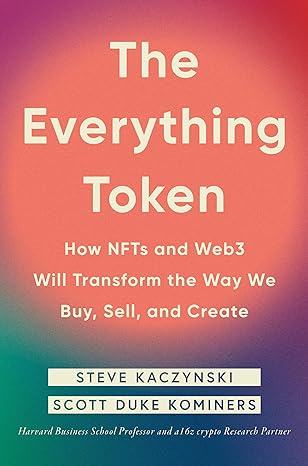 Kaczynski and Kominers emphasize that NFTs are more than deeds to digital art they are an ideal way to create communities.
Community formation around shared interests has been happening forever, of course. But NFTs turn it up to eleven because of what we call their embedded network superpower:…becoming the owner of an NFT is to some degree an act of affiliation with the brand. Yet NFT ownership doesn’t just connect you with the brand itself, but also with the entire network of individuals who are similarly affiliated….The holders of a given NFT comprise a network of brand enthusiasts just waiting to be activated.
The Everything Token is all about advising brands on what NFTs are, how to understand and navigate the design space and how to active brand enthusiasm. Now you may find ‘activating brand enthusiasm’ pedestrian, perhaps even a little dystopian but Kaczynski and Kominers are correct that this is where the NFT market is going.
When the internet first exploded into public consciousness there was a lot of talk about declaring independence and creating a civilization of the Mind. If you bought into that (I did not, despite lauding the goals) then maybe you think that the internet as we know it today, Google, Amazon, Facebook, Twitter, Spotify and all the rest are a big disappointment. I don’t. I love the new world, even if it isn’t the libertarian paradise that some once promised.
In the same way, NFTs won’t lead to a revolution of the creator class but they are poised to be increasingly adopted by corporations. Corporate adoption will ‘domesticate’ the underlying cryptographic technology. That is, as corporations infuse NFTs into mainstream business models, NFTs will become more user-friendly and accessible and much like the seamless integration into our daily lives of technologies such as Google Maps and digital payments, they will become a ubiquitous part of the digital economy. As NFTs become embedded in various sectors ranging from finance to entertainment, they will reshape how we perceive and interact with digital assets offering innovative and versatile applications that extend well beyond their current scope. It will be fun but don’t expect to liberate the means of production.
A City Not a Museum
Good Binyamin Appelbaum piece on the difficulties of building in NYC. The data will be familiar but I especially appreciate this vibe which we need more of:
I hope someday I’ll be walking with my children on the Lower East Side or the Upper West Side or Brooklyn Heights. We’ll pass one of the places where my ancestors lived, and the building will be gone. In its place will stand an apartment building, housing a new generation of New Yorkers.
See also my piece Against Historical Preservation where I wrote:
…a confident nation builds so that future people may look back and marvel at their ancestor’s ingenuity and aesthetic vision. A nation in decline looks to the past in a vain attempt to “preserve” what was once great. Preservation is what you do to dead butterflies.
Uber and Traffic Fatalities
Abstract: Previous studies of the effect of ridesharing on traffic fatalities have yielded inconsistent, often contradictory conclusions. In this paper we revisit this question using proprietary data from Uber measuring monthly rideshare activity at the Census tract level. Using these more detailed data, we find a consistent negative effect of ridesharing on traffic fatalities. Impacts concentrate during nights and weekends and are robust across a range of alternative specifications. Overall, our results imply that ridesharing has decreased U.S. traffic fatalities by 5.4% in areas where it operates. Based on conventional estimates of the value of statistical life the annual life-saving benefits are $6.8 billion. Back-of-the-envelope calculations suggest that these benefits are of similar magnitude to producer surplus captured by Uber shareholders or consumer surplus captured by Uber riders.
The authors, Michael Anderson and Lucas Davis, note that alcohol involvement is reported in approximately 30% of fatal crashes, which is an amazingly high number unless you think a lot of people are driving drunk. I am reminded of a clever paper by Levitt and Porter who use the proportion of crashes involving two drunk drivers to estimate that it is not that lots of people are driving drunk but rather that “drivers with alcohol in their blood are seven times more likely to cause a fatal crash” and “legally drunk drivers pose a risk 13 times greater than sober drivers.” Thus, substituting a sober driver for a drunk driver is a very good thing and so it’s plausible to me that Uber significantly reduces traffic fatalities.
Consider this a public service announcement.