Category: Current Affairs
Poker Bot Battles Humans to a Draw
NBC: A poker showdown between professional players and an artificial intelligence program has ended with a slim victory for the humans — so slim, in fact, that the scientists running the show said it’s effectively a tie .The event began two weeks ago, as the four pros — Bjorn Li, Doug Polk, Dong Kim and Jason Les — settled down at Rivers Casino in Pittsburgh to play a total of 80,000 hands of Heads-Up, No-Limit Texas Hold ’em with Claudico, a poker-playing bot made by Carnegie Mellon University computer science researchers.
…No actual money was being bet — the dollar amount was more of a running scoreboard, and at the end the humans were up a total of $732,713 (they will share a $100,000 purse based on their virtual winnings). That sounds like a lot, but over 80,000 hands and $170 million of virtual money being bet, three-quarters of a million bucks is pretty much a rounding error, the experimenters said, and can’t be considered a statistically significant victory.
The computer bluffed and bet against the best poker players the world has ever known and over 80,000 hands the humans were not able to discover an exploitable flaw in the computer’s strategy. Thus, a significant win for the computer. Moreover, the computers will get better at a faster pace than the humans.
In my post on opaque intelligence I said that algorithms were becoming so sophisticated that we humans can’t really understand what they are doing, quipping that “any sufficiently advanced logic is indistinguishable from stupidity.” We see hints of that here:
“There are spots where it plays well and others where I just don’t understand it,” Polk said in a Carnegie Mellon news release….”Betting $19,000 to win a $700 pot just isn’t something that a person would do,” Polk continued.
Polk’s careful wording–he doesn’t say the computer’s strategy was wrong but that it was inhuman and beyond his understanding–is a telling indicator of respect.
German magazine markets in everything
The Vangardist, a German men’s magazine, is printing an entire issue using HIV-infected blood in a quest to educate the public and eliminate misconceptions about HIV and AIDS.
Of course, there’s also the issue of taking this approach to raise the magazine’s literary and commercial value. The Vangardist‘s May issue is already being considered a collector’s item since just 3,000 copies featuring the HIV-positive ink blood have been printed.
There is further information here.
Two new and excellent short e-Books
Jonathan Rauch, Political Realism: How Hacks, Machines, Big Money, and Back-Room Deals Can Strengthen American Democracy. The tag “self-recommending” was made for books like this one. According to Rauch, transparency is overrated and politics should be more transactional.
Jeffrey Towson and Jonathan Woetzel, The One Hour China Consumer Book: Five Short Stories That Explain the Brutal Fight for One Billion Customers. The short tale of why the most successful beer companies are the state-owned enterprises is alone worth the price of this book.
And I just downloaded Hugo Dixon’s The In/Out Question, which argues the UK should try to stay in the European Union…
What would a Tory victory mean?
The exit polls are predicting a solid Conservative victory, as is most of my Twitter feed and most importantly the bookies. If indeed this comes to pass, it has (at least) two pretty simple implications:
1. A people “wise enough” to opt for government-owned hospitals and single-payer health care have decided they want government smaller, not bigger. You will note “UK public spending was 36.6% of gdp in 2000, and had edged up over 50% by 2009 and 2010 and now [2013] is still in the range of 49% or so.” The Tories are indeed the party for smaller government.
2. The verdict is sufficiently positive on the “austerity experiment” (not what I prefer to call it, but that is a different story). I know this is literally unfathomable to the authors of the 7,243 blog posts I have read criticizing or perhaps even savagely attacking UK austerity, but here’s the nub of the matter: If indeed the UK should have a smaller government relative to gdp, in the medium term it will make up all of the relevant lost ground, and then some. A lot of UK voters understand that, a lot of American and British intellectuals do not, even though the latter are the ones who have studied the Solow model. I do not a priori dismiss the “labor market scarring story,” but if there is any country where it does not seem to apply it is the UK, which has had quite a rapid labor market bounce back.
Anyway, electoral events may yet surprise us, but at the very least the Tories are still in the running. Scott Sumner comments as well. By the way, if SNP really did take 58 out of 59 Scottish seats, it does seem to me that Great Britain will split up, much to my chagrin. So I am not overall cheered by the exit poll.
Which students repay their student loans?
Fans of Game of Thrones know that “a Lannister always pays his debts.” So too do nearly all alumni from Notre Dame, Vassar, Harvey Mudd, and Brigham Young, at least when it comes to federal student loans.
There is more here, from Brookings, via Matthew C. Klein. Ahem…and for whatever reason, students from St. Johns do well too…
Deaths in police custody, research results
The limited data available do not suggest a recent overall increase in the number of homicides by police or the racial composition of those killed, despite the high-profile cases and controversies of 2014-2015, according to a New York Times analysis. But a January 2015 report published in the Harvard Public Health Review, “Trends in U.S. Deaths due to Legal Intervention among Black and White men, Age 15-34 Years, by County Income Level: 1960-2010,” suggests persistent differences in risks for violent encounters with police: “The rate ratio for black vs. white men for death due to legal intervention always exceeded 2.5 (median: 4.5) and ranged from 2.6 (95% confidence interval [CI] 2.1, 3.1) in 2001 to 10.1 (95% CI 8.7, 11.7) in 1969, with the relative and absolute excess evident in all county income quintiles.”
And this:
For the most recent period where statistics are available (2003-2009), the BJS found that 4,813 persons “died during or shortly after law enforcement personnel attempted to arrest or restrain them… About 60% of arrest-related deaths (2,931) were classified as homicides by law enforcement personnel.” However, among these 2,931 homicides by law enforcement personnel, 75.3% were reported to have taken place in response to a violent offense — constituting a force-on-force situation, such as an intervention with an ongoing assault, robbery or murder: “Arrests for alleged violent crimes were involved in three of every four reported homicides by law enforcement personnel.” Still, 7.9% took place in the context of a public-order offense, 2.7% involved a drug offense, and among 9.2% of all homicides by police no specific context was reported.
There is much more of interest at the Harvard Kennedy School link.
The ongoing rise of temping
The ever larger “staffing industry” may be having a similar effect. It is important across a much wider swathe of the economy than is often realised; having started out in the 1960s supplying office temps, today temping companies like Kelly Services, Adecco and Randstad mainly supply light manufacturing and industrial workers. In 2013 Kelly Services was America’s second-largest private-sector employer, after Walmart, with 750,000 staff. America’s 2.9m temps account for 2% of its jobs.
Temping is flourishing across the G7. In Japan, once the land of the shûshin koyô, or job for life, transient employment is ever more common; in 2014 Recruit, the country’s largest temp agency, listed for $19 billion on the Tokyo stock exchange. In Britain everything from the Olympics on down comes with temporary security guards supplied by G4S and temporary caterers provided by Compass, the country’s largest and third-largest private employers, respectively.
The industry provides flexibility for both workers and firms, and its ability to match workers on its databases to jobs may be very helpful: the 2010 Nobel prize was awarded for work showing how better job search and matching could lower unemployment. But labour aggregators that compete for business on the basis of helping lower clients’ staff costs have an incentive to keep pay low. In 2014 a report by Rebecca Smith and Claire McKenna of the National Employment Law Project, an American lobby group, claims that staffing agencies cut temps’ bargaining power.
The feature story is of interest more generally, much of it on when real wages will start to rise again by significant amounts.
How disruptive will the Tesla battery be?
Ramez Naam has an opinion, backed up by some reasonable estimates:
For most of the US, this battery isn’t quite cheap enough. But it’s in the right ballpark. And that means a lot. Net Metering plans in the US are filling up. California’s may be full by the end of 2016 or 2017, modulo additional legal changes. That would severely impact the economics of solar. But another factor of 2 price reduction in storage would make it cheap enough that, as Net Metering plans fill up or are reduced around the country, the battery would allow solar owners to save power for the evening or night-time hours in a cost effective way.
That is also a policy tool in debates with utilities. If they see Net Metering reductions as a tool to slow rooftop solar, they’ll be forced to confront the fact that solar owners with cheap batteries are less dependent on Net Metering.
That same factor of 2 price reduction would also make batteries effective for day-night electricity cost arbitrage, wherein customers fill up the battery with cheap grid power at night, and use stored battery power instead of the grid during the day. In California, where there’s a 19 cent gap between middle of the night power and peak-of-day power, those economics look very attractive.
And the cost of batteries is plunging fast. Tesla will get that 2x price reduction within 3-5 years, if not faster.
Read the whole thing, and note the discussion of India too.
Jon Stewart Wrong on Education in Baltimore
“If we are spending a trillion dollars to rebuild Afghanistan’s schools, we can’t, you know, put a little taste Baltimore’s way. It’s crazy.”
–Jon Stewart, “The Daily Show,” April 28, 2015
The Fact Checker column at the Washington Post rightly awards Jon Stewart four Pinocchios for this howler. It’s not close to being true and even as hyperbole it lends support to the common misperception that foreign aid is a large percentage of the Federal budget.
Let’s forget the off-the-cuff comparison to Afghanistan, however, and focus on a more relevant comparison. Is it true, as Stewart suggests, that Baltimore schools are underfunded relative to other American schools? The National Center for Education Statistics reports the following data on Baltimore City Public Schools and Fairfax County Public Schools, the latter considered among the best school districts in the entire country:
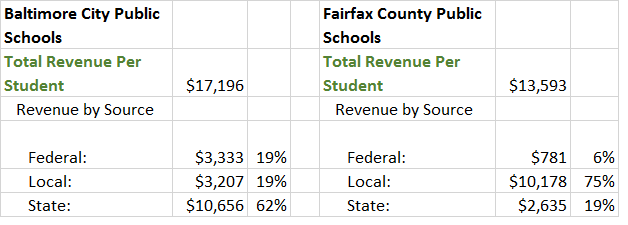
Baltimore schools spend 27% more than Fairfax County schools per student and a majority of the money comes not from the city but from the state and federal government. Thus, when it comes to education spending, Baltimore has not been ignored but is a recipient of significant federal and state aid.
Will the Black Panthers make a comeback?
In my spare time I was reading some Huey Newton, and it struck me how contemporary his ideas were in some regards, in particular the risk of arbitrary violence at the hands of the police. Here is an excerpt from Revolutionary Suicide:
As our forces built up, we doubled the patrols, then tripled them; we began to patrol everywhere — Oakland, Richmond, Berkeley, and San Francisco. Most patrols were a part of our normal movement around the community. We kept them random, however, so that the police could not set a network to anticipate us. They never knew when or where we were going to show up…The chief purpose of the patrols was to teach the community security against the police, and we did not need a regular schedule for that. We knew that no particular area could be totally defended; only the community could effectively defend and eventually liberate itself. Our aim simply was to teach them how to go about it. We passed out our literature and ten-point program to the citizens who gathered, discussed community defense, and educated them about their rights concerning weapons.
By the way, Hillary Clinton worked as a young intern for the Huey Newton legal defense team (he was accused of shooting a policeman).
How will Canada be a part of the knowledge economy?
Me:
Some economic sectors are distributed everywhere, like every city has its dentist[s], and other sectors are quite clustered. Banking is pretty clustered — New York, London, Hong Kong. Tech has been evolving in a pretty clustered way; I don’t mean simple software support, which is more like dentistry, but big, grand projects — the next Google, the next Facebook, Uber. We see those come out of quite a small number of places, so Skype coming from Estonia is quite the exception. Even then, it was improved by people in the clusters.
I think any location, not just Canada, has to ask itself, ‘are we going to be one of those clusters or not’? And the correct answer may be ‘no’. It may also be the sector evolves so it’s less clustered and more like dentistry, and then everywhere including Canada would partake. But maybe the future is Canada will have a knowledge sector doing small-scale things like software design for local projects but not anything like its own Silicon Valley. I guess at this point that seems likely — that Canada will not be a huge innovative part of the knowledge economy.
That is from my interview with the excellent Eva Salinas, mostly about other topics, such as what a great egalitarian age we live in and also where the World Bank and IMF stand, among other issues. A few of the comments make more sense if you know that the interviewer is Chilean and we were discussing Chile before the formal interview started.
How bad are the investor arbitration clauses in TPP?
Mood affiliation aside, these clauses do not constitute a significant reason to oppose the treaty, in my view. Gary Hufbauer has a good discussion:
ISDS provisions enable a foreign investor to seek compensation in an amount determined by an impartial panel of arbitrators, if a host government expropriates its property, or regulates its business in an arbitrary or discriminatory manner. Such protections have been deemed necessary in agreements going back at least to a Germany-Pakistan accord in 1959, and they have successfully protected US investments overseas in many countries.
Often these ISDS provisions are part of bilateral investment treaties (BITs), of which more than 2,200 are now in force worldwide. The United States has 41 BITs with countries near and far, and is actively negotiating a BIT with China, aimed at strengthening the rights of investors in a country that has not always been fair. Starting with the North American Free Trade Agreement (NAFTA) in 1994, the United States has also included ISDS in the investment chapters in nearly all its free trade agreements (FTAs), now numbering 20. Given this rich history, Senator Warren should be able to cite actual examples of the multiple abuses that she claims have occurred. She has not done so, because she cannot. Senator Warren makes a big deal about the hypothetical outcome of the old Methanex case against California’s regulations on gasoline additives, but the case was decided against the Canadian corporation.
The record shows that, far from a record of multinational corporations trampling sovereign states, investors have won fewer than a third of the cases resolved by the ISDS process.1 Arbitration procedures were formalized in 1996, when the World Bank created the International Center for the Settlement of Investment Disputes (ICSID) as a neutral forum to handle ISDS claims. Similar fora are based in London, Paris, and Stockholm, but ICSID oversees the vast majority of claims. To date, ICSID has handled almost 500 cases.2 Of these, 36 percent were settled between the parties before going to arbitration. The arbitrators declined to hear 16 percent of claims for want of jurisdiction. They dismissed 19 percent of claims for lack of merit. Only in 29 percent of cases did the arbitrators uphold some or all of the business claims.
The full post is here.
Prosperity Notes
ABC: The Treasury Department recently sold 44,000 one-dollar bills to one person — at a price of $5.95 apiece.
The bills weren’t even all that special — they weren’t very old, and they didn’t have any major flaws that made them valuable to collectors.
What they did have though, was four number eights in a row in their serial numbers — a sign of luck to many people of Asian descent.
And that’s made the bills popular. The Treasury’s Bureau of Engraving and Printing says it has sold over 70,000 such “prosperity notes” to thousands of people around the world — not including the huge sale to one individual.
Now that is a high rate of seigniorage. You can buy your own lucky bills from the Treasury. Westerners may prefer the 777 series. There is a discount for bulk orders, but you will still be paying more than a dollar for a dollar. That doesn’t feel lucky to me.
Hat tip: The Blacklist.
My favorite things Baltimore
I’m passing through Baltimore on the train today (a talk at U. Penn and chatting with Ashok Rao), so I have license to do this. Here goes:
1. Author: There is plenty to choose from here, including Poe, James Cain, Dashiell Hammett, Frank O’Hara, and H.L. Mencken. I do not love F. Scott Fitzgerald as many do, same with Upton Sinclair, but they deserve mention. I’ll opt for Poe, with Gold-Bug as my favorite story. Hammett’s Red Harvest I also enjoy and have taught a few times, delicious incoherence. Anne Tyler has a few good books, but stop reading after one or two of them.
2. Philosopher: John Rawls, though since we’re talking about Baltimore I feel I should call him Jack.
3. Painter: Morris Louis or Grace Hartigan? I feel I can do better, help out people.
4. Popular music: Tori Amos grew up in Baltimore, I like her Little Earthquakes and various singles, live cuts, and cover versions, available only in scattered form as far as I know. Is Dan Deacon popular? Frank Zappa is a remarkable musical talent, but I don’t actually enjoy listening to him.
5. Jazz: Eubie Blake, there is also Bill Frisell and Billie Holiday.
6. Classical music: Philip Glass was born there, though I associate him with NYC.
7. Baseball: I still remember that old Orioles rotation with Cuellar, McNally, Palmer, and Dobson, all twenty-game winners in the same year.
8. Soviet spy: Alger Hiss.
9. Movie, set in: I don’t love Diner or Avalon, how about The Accidental Tourist, or Twelve Monkeys? The first half of Silence of the Lambs is excellent.
For good measure toss in Thurgood Marshall, Tim Page, Babe Ruth, The Wire, Walters Art Museum, the underrated BSO, and Brooks Robinson. Who or what else am I forgetting?
The bottom line: Lots for one city! Let’s hope it gets better soon.
My China questions for you, yes you
Which VPNs are working these days? What other advice do you have for me, when it comes to accessing the internet? Is accessing some sites easier with a Mac? Can GMU email be accessed without a VPN? WordPress? MR? Is there a difference between iPhones and iPads and laptops in these regards?
I thank you all in advance for your assistance.