Category: Economics
The JPE is going monthly in 2020
Here is the announcement. Presumably they wish to claw back some of the quantity going to the ever-multiplying number of AEA journals and to thus avoid being an afterthought. Will the average quality of JPE article decline? I suppose by one definition it has to, but in such a rapidly specializing discipline, who will notice? Is it really so clear which pieces come close but don’t quite deserve to belong in the JPE? I for one could not pass this “blind taste test” in my role as a JPE reader, and I have been following the rag for decades.
As a polar experiment, what if they put out an issue every day, and in essence the top journals took all the published pieces? Then the notion of having a “top three” hit (or whatever) would dwindle and people actually would have to judge the work. A modest move in that direction should be just fine, said the daily blogger.
In the meantime, the leading lights of the profession — most of all in the earlier parts of their careers — should be prepared for that much more refereeing. Ay!
Chernobyl
 Chernobyl, HBO’s taut 5-part mini-series, is excellent and it sticks close to the facts (although one female character played by Emily Watson is clearly made up). By all accounts, the series accurately represents life in the former Soviet Union and through a variety of means from color palette to casting and dialogue it does a remarkable job at capturing the political economy. One thing I learned (so far, it hasn’t all appeared yet) is that it could have been much, much worse but the Russians avoided the worst scenario with a combination of bravery, smarts and luck.
The number of cancer deaths from Chernobyl appears to be quite low. The WHO estimated an additional 9,335 deaths with about half of those coming from workers and nearby residents and other half more distant impacts, other estimates are higher. More recent analysis, however, suggests that Chernobyl and its aftermath had relatively small but significant effects across a large number of people. Here are two recent papers:
Chernobyl’s Subclinical Legacy: Prenatal Exposure to Radioactive Fallout and School Outcomes in Sweden by Almond, Edlund and Palme.
Abstract: We use prenatal exposure to Chernobyl fallout in Sweden as a natural experiment inducing variation in cognitive ability. Students born in regions of Sweden with higher fallout performed worse in secondary school, in mathematics in particular. Damage is accentuated within families (i.e., siblings comparison) and among children born to parents with low education. In contrast, we detect no corresponding damage to health outcomes. To the extent that parents responded to the cognitive endowment, we infer that parental investments reinforced the initial Chernobyl damage. From a public health perspective, our findings suggest that cognitive ability is compromised at radiation doses currently considered harmless.
and The long-run consequences of Chernobyl: Evidence on subjective well-being, mental health and welfare by Danzer and Danzer.
Abstract: This paper assesses the long-run toll taken by a large-scale technological disaster on welfare, well-being and mental health. We estimate the causal effect of the 1986 Chernobyl catastrophe after 20 years by linking geographic variation in radioactive fallout to respondents of a nationally representative survey in Ukraine according to their place of residence in 1986. We exclude individuals who were exposed to high levels of radiation—about 4% of the population. Instead, we focus on the remaining majority of Ukrainians who received subclinical radiation doses; we find large and persistent psychological effects of this nuclear disaster. Affected individuals exhibit poorer subjective well-being, higher depression rates and lower subjective survival probabilities; they rely more on governmental transfers as source of subsistence. We estimate the aggregate annual welfare loss at 2–6% of Ukraine’s GDP highlighting previously ignored externalities of large-scale catastrophes.
Hat tip: Jennifer Doleac and Wojtek Kopczuk.
Revisiting the Global Decline of the (Non-Housing) Labor Share
That is a new paper by Germán Gutiérrez and Sophie Pitony. I am on the road and have not had a chance to go through this, but the abstract is of interest:
We identify two undocumented measurement challenges affecting corporate sector labor shares outside the United States: the inclusion of dwellings and the inclusion of self-employed workers in the corresponding sectoral accounts. Both issues have become more important over time, biasing corporate labor shares downward. We propose two methods to correct for these challenges and obtain `true’ non-housing labor share series. Contrary to common wisdom, the corrected series exhibit stable labor shares across all major economies, except the US, where the corrected labor share declines by 6 percentage points since 1980.
For the pointer I thank Ilya Novak.
Girardian sentences to ponder
We also find that stronger peer effects are exerted by more price-sensitive individuals. This positive correlation suggests that the elasticity of aggregate demand is substantially larger than the elasticity of individual demand. Through this channel, peer effects reduce firms’ markups and, in many models, contribute to higher consumer surplus and more efficient resource allocation.
That is from a new NBER working paper by Michael Bailey, Drew M. Johnston, Theresa Kuchler, Johannes Stroebel, and Arlene Wong.
Bloat Does Not Explain the Rising Cost of Education
In Why Are The Prices So D*mn High? Helland and I examine lower education, higher education and health care in-depth and we do a broader statistical analysis of 139 industries. Today, I will make a few points about education. First, costs in both lower and higher education are rising faster than inflation and have been doing so for a very long time. In 1950 the U.S. spent $2,311 per elementary and secondary public school student compared with $12,673 in 2013, over five times more (both figures in $2015). The rate of increase was fastest in the 1950s and 1960s–a point to which I will return later in this series.
College costs have also increased dramatically over time. For this book, we are interested in costs more than tuition because we want to know what society is giving up to produce education rather than who, in the first instance, is paying for it. Costs are considerably higher than tuition even today, although in recent years tuition has been catching up. Essentially students and their parents have been paying an increasing share of the increasing cost of higher education. Moreover, as with lower education, costs have been rising for a very long period of time.
I will take it as given that the explanation for higher costs isn’t higher quality. The evidence on tests scores is discussed in the book:
It is sometimes argued that how we teach has not changed but that what we teach has improved in quality. It is questionable whether studies of Shakespeare have improved, but there have been advances in biology, computer science, and physics that are taught today but were not in the past. However, these kinds of improvements cannot explain increases in cost. It is no more expensive to teach new theories than old. In a few fields, one might argue that lab equipment has improved, which it certainly has, but we know from figure 1 that goods in general have decreased in price. It is much cheaper today, for example, to equip a classroom with a computer than it was in the past.
The most popular explanation why the cost of education has increased is bloat. Elizabeth Warren and Chris Christie, for example, have both blamed climbing walls and lazy rivers for higher tuition costs. Paul Campos argues that the real reason college costs are growing is “the constant expansion of university administration.” Redundant administrators are also commonly blamed for rising public school costs.
 The bloat theory is superficially plausible. The lazy rivers do exist! But the bloat theory requires longer and lazier rivers every year, which is less plausible. It’s also peculiar that the cost of education is rising in both lower and higher education and in public and private colleges despite very different competitive structures. Indeed, it’s suspicious that in higher education bloat is often blamed on competition–the “amenities arms race“–while in lower education bloat is often blamed on lack of competition! An all-purpose theory doesn’t explain much.
More importantly, the data reject the bloat theory. Figure 8 shows spending shares in higher education. Contrary to the bloat theory, the administrative share of spending has not increased much in over thirty years. The research share, where you might expect to find higher lab costs, has fluctuated a little but also hasn’t risen much. The plant share which is where you might expect to find lazy rivers has even gone down a little, at least compared to the early 1980s.
 Nor is it true that administrators are taking over the public schools, see Figure 10.
Compared with teachers and other staff, the number of principals and administrators is vanishingly small, only 0.4 per 100 students over the 1950–2015 period. It is true, if one looks closely, that the number of principals and administrators doubled between 1970 and 1980. It is unclear whether this is a real increase or a data artifact (we only have data for 1970 and 1980, not the years in between during this period). But because the base numbers are small, even a doubling cannot explain much. A bloated little toe cannot explain a 20-pound weight gain. Moreover, the increase in administrators was over by 1980, but expenditures kept growing.
If bloat doesn’t work, what is the explanation for higher costs in education? The explanation turns out to be simple: we are paying teachers (and faculty) more in real terms and we have hired more of them. It’s hard to get costs to fall when input prices and quantities are both rising and teachers are doing more or less the same job as in 1950.
We are not arguing, however, that teachers are overpaid!
Indeed, it is part of our theory that teachers are earning a normal wage for their level of skill and education. The evidence that teachers earn substantially above-market wages is slim. Teachers’ unions in public schools, for example, cannot explain decade-by-decade increases in teacher compensation. In fact, most estimates find that teachers’ unions raise the wage level by only approximately 5 percent. In other words, teachers’ unions can explain why teachers earn 5 percent more than similar workers in the private sector, but unions cannot explain why teachers’ wages increase over time.
If the case for unions as a cause of rising teacher compensation in public schools is weak, it is nonexistent for increased compensation for college faculty, for whom wage bargaining is done worker by worker with essentially no collective bargaining whatsoever.
A signal to where we are heading is this:
If increasing labor costs explain the increasing price of education but teachers are not overpaid relative to similar workers in other industries, then increasing labor costs must lead to higher prices in the education industry more than in other industries.
Read the whole thing. Next up, health care.
Addendum: Other posts in this series.
The minimum wage and migration decisions
This paper investigates the local labor supply effects of changes to the minimum wage by examining the response of low-skilled immigrants’ location decisions. Canonical models emphasize the importance of labor mobility when evaluating the employment effects of the minimum wage; yet few studies address this outcome directly. Low-skilled immigrant populations shift toward labor markets with stagnant minimum wages, and this result is robust to a number of alternative interpretations. This mobility provides behavior-based evidence in favor of a non-trivial negative employment effect of the minimum wage. Further, it reduces the estimated demand elasticity using teens; employment losses among native teens are substantially larger in states that have historically attracted few immigrant residents.
That is from a 2014 paper by Brian C. Cadena, and here is Jorge Pérez Pérez:
I find that areas in which the minimum wage increases receive fewer low-wage commuters. A 10 percent increase in the minimum wage reduces the inflow of low-wage commuters by about 3 percent.
And here is one bit from a research paper by Terra McKinnish:
Low wage workers responded by commuting out of states that increased their minimum wage.
Via the excellent Jonathan Meer, you don’t hear about this evidence as much as you should.
Viral Markets in Everything

The Persistence of Chaos is an Airgapped Samsung 10.2-Inch Blue Netbook (2008) that is running Windows XP SP3 and 6 pieces of malware that collectively caused some $95 billion in damages. One of the worms trapped on the computer, for example, is:
SoBig was a worm and trojan that circulated through emails as viral spam. This piece of malware could copy files, email itself to others, and could damage computer software/hardware. This piece of malware caused $37B in damages and affected hundreds of thousands of PCs.
The terms of sale include the following:
The sale of malware for operational purposes is illegal in the United States. As a buyer you recognize that this work represents a potential security hazard. By submitting a bid you agree and acknowledge that you’re purchasing this work as a piece of art or for academic reasons, and have no intention of disseminating any malware. Upon the conclusion of this auction and before the artwork is shipped, the computer’s internet capabilities and available ports will be functionally disabled.
The current high bid is over $1,200,750.
Hat tip: Paul Kedrosky.
Yes there has been an American male culture collapse
During the last 50 years, the earnings of prime-age men in the United States have stagnated and dispersed across the education distribution. At the same time, the labor-force participation rates of men without a college education have steadily declined. While wage and participation trends are often linked for this population, we have argued that this connection cannot solely be the result of an inward labor demand shift across a stable and elastic labor supply curve. The uncompensated labor supply elasticities implied by the twin declines of wages and participation during the 1970s, 1980s, and 2000s appear too large to be plausible. Moreover, labor-force participation continued to decrease in the 1990s while wages were rising. While the increasing availability of disability benefits and the increase in the fraction of the population with prior incarceration exposure may help explain some of the participation decline, we doubt either factor can explain the bulk of the decline.
We have argued that more plausible explanations for the observed patterns involve feedbacks from male labor demand shocks, which often involve substantial job displacement, to worker adjustment frictions and to family structure. Marriage rates, and corresponding male labor supply incentives, have also fallen for reasons other than changing labor demand. Moreover, we have noted interactions between labor demand and disability benefit take-up, and between mass incarceration and family structure. These factors have all converged to reduce the feasibility and desirability of stable employment, leading affected men—who may not often be eligible for disability or other benefits—to participate sporadically in the labor market and depend primarily on family members for income support.
That is from the concluding remarks of Ariel J. Binder and John Bound, in the most recent Journal of Economic Perspectives. I’ll just highlight one bit again, bolded by me:
At the same time, the labor-force participation rates of men without a college education have steadily declined. While wage and participation trends are often linked for this population, we have argued that this connection cannot solely be the result of an inward labor demand shift across a stable and elastic labor supply curve.
In case you missed it.
Why Are the Prices So D*MN High?
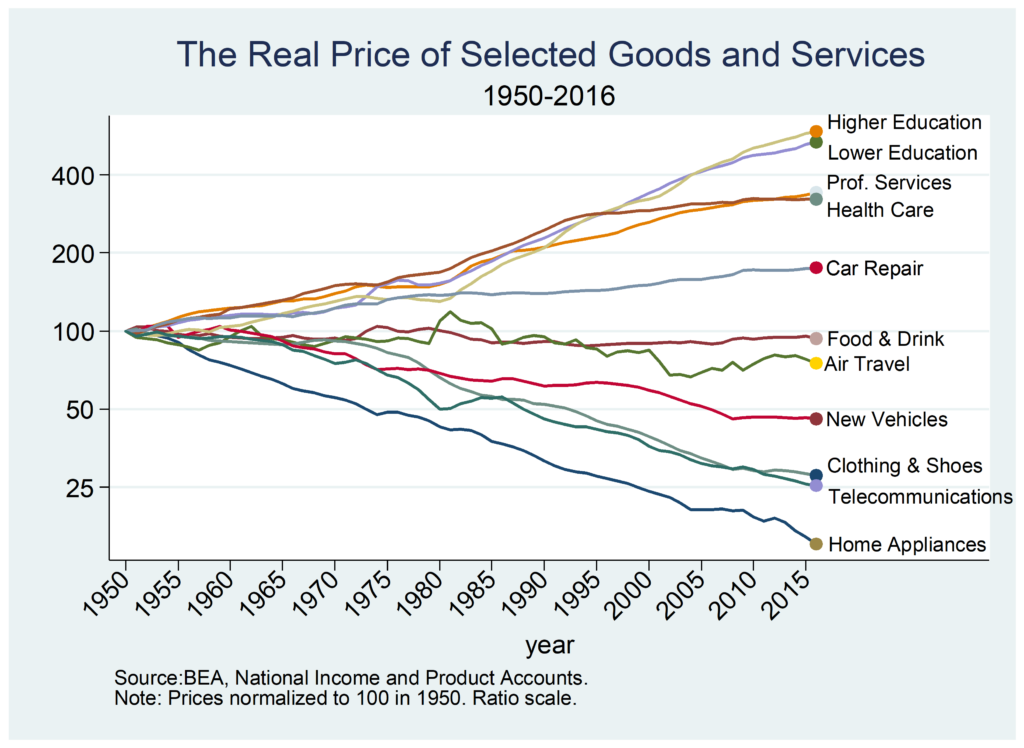
Why have some prices increased since 1950 by a factor of four while other prices have decreased by a factor of four? Technology is making so many goods and services much cheaper than in the past–that seems to be the normal situation–so why do some industries seem not only to be not progressing but actually retrogessing? As Scott Alexander put it, why are some industries so weird?
Those are the questions that motivated my latest piece, a short book with Eric Helland just released by the Mercatus Center titled, Why are the Prices so D*mn High?
In approaching this question I had some ideas in mind. I assumed that regulation, bloat and bureaucracy, monopoly power and the Baumol effect would each explain some of what is going on. After looking at this in depth, however, my conclusion is that it’s almost all Baumol effect. That conclusion radically changes one’s evaluation of price increases and decreases over the long run and it changes what, if anything, one might try to do to address such price changes.
Next week I will examine some of the evidence that pushes me towards this verdict. I’ll also take a closer look at the Baumol effect, which is mistakenly called the cost disease.
Let’s note here, however, what we need to explain. For the most part, we don’t see quick, big changes in prices that then level off. That in itself is interesting since policy tends to be discontinuous. We might expect a big regulation, for example, to cause a big increase in prices as industries adjust but then growth should return to normal. Instead, what we see and need to explain is slow, steady rising relative prices that happens over decades. Indeed, in some cases, such as education, prices have been increasing faster than average for more than a century! Puzzle over that over the long weekend. More next week!
Addendum: Other posts in this series.
Shipping the good economists out?
How many of you even get that reference these days? Here is the latest from DOA, from Liz Crampton at Politico:
The Agriculture Department is moving nearly all its researchers into the economic effects of climate change, trade policy and food stamps – subjects of controversial Trump administration initiatives – outside of Washington, part of what employees claim is a political crackdown on economists whose assessments have raised questions about the president’s policies.
Since last year, employees in the department’s Economic Research Service have awaited news of which members of their agency would be forced to relocate, after Agriculture Secretary Sonny Perdue stunned them by declaring he was moving most of the agency to a location outside the capital. The announcement sparked claims that Perdue was trying to pressure economists into leaving the agency rather than move their families.
On March 5, the department began notifying people who were allowed to stay in Washington, but didn’t provide a comprehensive list, only telling employees in person if they made the cut.
But current and former employees compiled one anyway, covering all 279 people on staff, 76 of whom are being allowed to stay in Washington…
A USDA spokesman declined to directly address the employees’ allegation of political bias, but provided a written statement from Perdue saying that the moves were not prompted by the work being done by ERS.
In general I am reluctant to post this kind of report, because I find it difficult to know what is truly going on here, so do read this with an open mind. Still, it seemed newsworthy.
I thank John Chamberlin for the pointer.
State and local policy is the real immigration policy
That is the central claim of my latest Bloomberg column, here is one excerpt:
State and local governments are making immigration policy all the time, mostly for the worse, and often Democrats are more restrictionist than Republicans.
Obviously the law can deter potential illegal migrants from entering the U.S. But so can the high cost of living. Even though there are much higher wages in the U.S. than in its neighbors to the South, a lot of those higher wages are eaten up by much higher rents — especially if the immigrant moves to a major city, as is often the case. I once wrote a book based on fieldwork in rural Mexico, and I found that, for those who had migrated temporarily to the U.S., high rent was typically their biggest complaint. It therefore follows that policies which raise rents tend to discourage immigrants, particularly poorer immigrants.
And:
The minimum wage is another tool of anti-immigration policy, at least for less skilled immigrants. Say a city sets a minimum wage of $15 an hour. That means a potential migrant whose work is worth only $12 an hour won’t be able to get a legal job in that city. That will deter migration, both legal and illegal. Furthermore, a worker in, say, Honduras may not find it possible to improve his or her skills to be worth $15 an hour, at least not without arriving in the U.S.
America’s Cities Are Unlivable. Blame Wealthy Liberals
Farhad Manjoo writing in the New York Times brings the fire:
Then there is the refusal on the part of wealthy progressives to live by the values they profess to support at the national level. Creating dense, economically and socially diverse urban environments ought to be a paramount goal of progressivism. Cities are the standard geographical unit of the global economy. Dense urban areas are quite literally the “real America” — the cities are where two-thirds of Americans live, and they account for almost all national economic output. Urban areas are the most environmentally friendly way we know of housing lots of people. We can’t solve the climate crisis without vastly improving public transportation and increasing urban density. More than that, metropolises are good for the psyche and the soul; density fosters tolerance, diversity, creativity and progress.
Yet where progressives argue for openness and inclusion as a cudgel against President Trump, they abandon it on Nob Hill and in Beverly Hills. This explains the opposition to SB 50, which aimed to address the housing shortage in a very straightforward way: by building more housing. The bill would have erased single-family zoning in populous areas near transit locations. Areas zoned for homes housing a handful of people could have been redeveloped to include duplexes and apartment buildings that housed hundreds.
…Reading opposition to SB 50 and other efforts at increasing density, I’m struck by an unsettling thought: What Republicans want to do with I.C.E. and border walls, wealthy progressive Democrats are doing with zoning and Nimbyism. Preserving “local character,” maintaining “local control,” keeping housing scarce and inaccessible — the goals of both sides are really the same: to keep people out.
I applaud the fire, although it’s amusing to me that Manjoo treat this as big discovery (“I am struck by an unsettling thought.”). Look, this isn’t new! Progressives created zoning and other housing regulations to exclude people they didn’t like from “their” neighborhoods. Nor, by the way, is the desire to exclude limited to “wealthy” liberals (Manjoo surely knows this but is afraid of punching down). It’s also amusing that Steve Sailer has been making exactly the same point about hypocritical Malibu liberals for years, the only difference being that Manjoo wishes to shame liberals into giving up NIMBYism while Sailer wants to shame them into giving up national diversity. I call a pox on both their houses and support individual property rights at both the local and national levels.
Incentives matter, installment #1437
A US jury has found that a former Uber driver living in Virginia committed acts of torture during Somalia’s civil war in the late 1980s.
Somali citizen Farhan Tani Warfaa testified last week in the Washington DC suburbs that ex-Somali colonel Yusuf Abdi Ali shot and tortured him.
Ali was a commander in the national army and supporter of dictator Mohamed Siad Barre, say court documents.
Until this month, Ali drove for Uber, with a high 4.89 rating.
Here is the full story by Holly Honderich, via Ian Bremmer.
Raj Chetty’s empirical restructuring of Harvard’s undergraduate economics
Here is good coverage from Dylan Matthews, here is one excerpt:
[Chetty’s] Ec 1152 is an introduction to that kind of economics. There’s little discussion of supply and demand curves, of producer or consumer surplus, or other elementary concepts introduced in classes like Ec 10. There is no textbook, only a set of empirical papers. The material is relatively cutting-edge. Of the 12 papers students are required to read, 11 were released in 2010 or after. Half of the assigned papers were released in 2017 or 2018. Chetty co-authored a third of them.
Why not excerpt the cameo of me?:
…fellow traditionalist Tyler Cowen…told me he’s excited about the class. “I am for experimentation, and more of it in academia, and for that reason I approve,” he writes. “Of course it was not what I do, which is more traditional micro, more theory, less overlap with sociology. If the instructor is great, that is really what matters.”
There is much more at the link. And here is Daniel Simonsen, Norwegian comic.
My Conversation with Ezekiel Emanuel
Very much a fun one, here is the audio and transcript, here is part of the opening summary:
Do we overrate the importance of doctors? What’s the importance of IQ versus EQ in the practice of medicine? What are the prospect for venture capital in biotech? How should medical training be changed? Why does he think the conventional wisdom about a problem tends to be wrong? Would immortality be boring? What would happen if we let parents genetically engineer their kids?
Tyler questions Emanuel on these topics and more, including the smartest thing his parents did while raising him, whether we have right to medical self-defense, healthcare in low- versus high-trust institutions, and much more.
Here is one excerpt:
COWEN: How can we improve medical education?
EMANUEL: Cut it down. Make it shorter.
COWEN: Cut it down? Why does that make it better? Or does it just make it cheaper?
EMANUEL: No, I think it will make it better. So, we have a lot of memorization, a lot of . . . So, let’s go back to the start. The four years of medical school: two years of preclinical in the classroom learning about biochemistry, genetics, anatomy, microbiology; and the two years of clinical time in the hospital, on the wards.
That dates from 1910. We haven’t really updated it much, except in this one way: we’ve cut down the preclinical time because — less of it — and it changes so fast, by the time you learn it in medical school, get out as a doctor, it’s out of date, A; and B, it’s more or less irrelevant to managing most patients…
And then, by the way, in med school, spending your time in a hospital is not the future. The future of American medicine is out of the hospital. So we need more rotations, more experiences for students out of the hospital.
No med school has made that big shift, and those are the shifts that are going to have to happen over the next 15 or so years.
And:
COWEN: Is there a right to medical self-defense that should override FDA bans on drugs and medical devices? I want to try something that’s not approved —
EMANUEL: No. I don’t like that.
COWEN: I’m saying it’s my body. But why don’t you like it?
EMANUEL: No, no, no, no, no, no, no, no, no, Tyler.
Finally:
COWEN: Now, you’ve written a much-misunderstood article about how hard you would try yourself to live past the age of 75. Would not the suspense of world and national history always keep you wanting a bit more extra time?
So, say I’m 75. I’ve decided I agree with you, but the NBA Finals aren’t over yet. I want to see game seven. I want the Mueller report to come out. Isn’t there always something?
And then, it’s kind of intransitivity of indifference. Every day there’s something, and you just keep on hanging on, even if one accepts your arguments in the abstract. Can you talk me out of that?
EMANUEL: No, no, Tyler, I think you’re exactly right. That’s why people do hang on. It’s because . . . you know, so I talked to my father, who — he says, “Zeke, you’re absolutely right. I’ve become slower, physically slower, mentally slower. My life” . . . what ends up happening is your life cones down, and you begin to overvalue certain small things. Like the NBA Finals. Like what’s in the Mueller report.
We all know, from any cosmic standpoint — even not a cosmic standpoint, just a 2,000-foot standpoint — most of those things are not irrelevant. It’s really cool to know.
You often ask — and this happens to me all the time. I teach undergraduates. Pretty smart undergraduates. Very smart undergraduates. MBA students, nurses, doctors, right? They have no understanding of history. So, whoever finishes in the NBA Finals, in five years, people have forgotten.
Recommended, interesting throughout.