Category: Economics
Why don’t people care more about economic inequality?
That is the topic of my latest Bloomberg column, here is one bit:
One possibility is that a lot of talk about inequality gives the audience the impression that it is inevitable, and thereby renders potential remedies less urgent. Another speculation is that human beings are constantly evaluating the status of others. To the extent analysts reiterate that some group of citizens doesn’t have as much, maybe they’re actually reminding us that those citizens hold a lower social status. Perhaps subconsciously, we then respond by thinking those citizens deserve less, or by downgrading the urgency of their needs.
Another possibility is that talk about economic inequality increases political polarization, which lowers the chance of effective action. Or that criticizing American society may cause us to feel less virtuous, which in turn may cause us to act with less virtue. Perhaps if critics of inequality praised this nation more for what is has done to redress inequality, rather than criticizing it for the gaps, that might cement a self-image of Americans who are capable of tackling this problem, and thus spur interest in additional progress. That mechanism shouldn’t sound so strange to anyone who has tried to raise children.
When I bring up such points in dialogue, I’ve found that a lot of my fellow academicians retreat to the moral platitude that the “good guys” simply need to fight harder against the special interest groups. Maybe so, or maybe that response is just another way of digging in deeper to what so far has been a losing battle. The reality is that income inequality has gone up a great deal since the early 1980s, and we haven’t done so much to reverse the basic trend. The potentially egalitarian effects of tax increases under the past two Democratic presidents and Obamacare have been outweighed by globalization, which benefits most those individuals who can access global markets, and by increases in the returns to highly skilled labor. The reality is that government expenditures have not become radically more poverty-reducing over the last few decades, although we do send more resources to the elderly.
Do read the whole thing, the various biting comments about other academics are in other parts of the piece.
The Chinese influence on Hollywood box office
Two years later, the quota of imported movies permitted into China was raised to 34 from 20 in a deal negotiated between then-Vice President Joe Biden and then-Vice President Xi. The deal all but guaranteed that most big-budget Hollywood features—except those with content deemed objectionable—would be shown in China.
“I prefer to watch Hollywood films because the chance of a domestic film being crappy is much bigger than a Hollywood film,” said Liu Jing, a 25-year-old postgraduate student studying finance policy in Beijing.
Ms. Jing said she became a fan of superhero films from Marvel Studios as a high-school student and now goes to movie theaters at least once a month.
Hollywood executives can rattle off the rules for getting a movie approved by Chinese censors: no sex (too unseemly); no ghosts (too spiritual). Among 10 prohibited plot elements are “disrupts the social order” and “jeopardizes social morality.” Time travel is frowned upon because of its premise that individuals can change history.
U.S. filmmakers sometimes anticipate Chinese censors and alter movies before their release. The Oscar-winning alien-invasion drama “Arrival” was edited to make a Chinese general appear less antagonistic before the film’s debut in China this year.
The superhero hit “Logan” was 14 minutes shorter in China after Chinese censors cut scenes of beheading and impalement.
For “Passengers,” the space adventure starring Chris Pratt and Jennifer Lawrence, a scene showing Mr. Pratt’s bare backside was removed, and a scene of Mr. Pratt chatting in Mandarin with a robot bartender was added.
Here is the full Eric Schwartzel WSJ piece.
State income tax matters for sports team performance, Miami Heat edition bet against the Raptors
State- and local-income tax rates differ across locations, giving low-tax teams a competitive advantage when bidding for players. I investigate the effect of income tax rates on professional team performance between 1977 and 2014 using data from professional baseball, basketball, football, and hockey in the United States. Regressing income tax rates on winning percentage, I find little evidence of income tax effects prior to 1994, but since then a ten percent increase in income taxes is associated with a three percent decline in winning percentage. A robustness check using within state variation in income taxes affirms this result. The income tax rate effect varies by league, with the largest effect in professional basketball, where teams in states without income tax win 4.5 more games each year relative to high-tax states. The income tax effect is smallest in major league baseball, which could be explained by greater team payroll disparity. Placebo tests using college team performance find no evidence of an income tax effect.
The pointer is from the excellent Kevin Lewis.
Las Vegas average is over no arbitrage condition
Now operators have started scrutinizing complimentary drinks, introducing new technology at bars that track how much someone has gambled—and rewards them accordingly with alcohol. It’s a shift from decades of more-informal interplay between bartenders and gamblers.
Sports books have capitalized on big events, too. During March Madness, a five-person booth at the Harrah’s Las Vegas sports book cost $375 per person, which included five Miller Lite or Coors Light beers a person. In the past, seating at most sports books was free and first-come, first-served, even during big events. Placing a small bet or two could get you free drinks.
“The number-crunchers, the bean-counters have ruined Las Vegas,” said Brad Johnson, who lives in North Carolina and has come to Las Vegas almost every year since the early 1970s. “There’s no value to it; there’s no benefit.”
Casinos on the Strip now derive a smaller share of revenue from gambling. In 1996, more than half of annual casino revenue on the Strip came from gambling. Last year, the share was down to about a third, according to the University of Nevada-Las Vegas. More of the revenue comes from hotels, restaurants and bars.
That is from Chris Kirkham at the WSJ, via Annie Lowrey.
What will Bretton Woods 3.0 look like?
Nigel, a loyal MR reader, asks me:
Is it possible for the US to abuse the dollar’s privileged position, and do you expect a monetary conference to take place in the future that would alter the post-Bretton Woods arrangement in ways less favorable to the US?
A good question, but at current margins I don’t see many directions for movement. I don’t know whether such a monetary conference will take place, but it is unlikely to be a decisive event for shaping actual outcomes. I see these as the relevant questions:
1. Will China move to a true “free float”? And if so, what is the collateral damage along the way?
2. Will some countries leave the eurozone? (and if they do, it is a big deal for them, but probably not a big deal for the global monetary order, unless it is Italy or France)
3. Will more countries attach to the euro (Iceland?) or to the U.S. dollar (additional parts of Latin America?)
4. How many additional countries will institute capital controls?
For the most part, those questions will be decided at the national level, although for potential euro leavers the nature of the proposed EU alternative (another bailout?) will be significant.
The most likely outcome is that more countries will institute partial capital controls, and in that regard we will move closer to some aspects of the initial Bretton Woods 1.0, in which capital controls were an integral feature. Capital controls may come to keep a euro peg (already happened in Cyprus), to try to keep domestic jobs (ha, but recall Trump and Carrier), to prevent an imminent explosive capital outflow (China), to strengthen or preserve a banking system, to limit wild currency swings, or simply because governments will try all kinds of policies before admitting they have failed. Other forms of “capital controls” may come through tax reforms and regulatory barriers designed to keep capital at home.
My best guess on China is that capital outflow pressures eventually will force a free float, but only briefly, and then they will return to capital controls in some form.
So my forecast for the future is much more in the way of capital controls, but without the hegemonic/cooperative international architecture that characterized Bretton Woods 1.0.
Hedging FDA Risk?
In the words of a recent article, the FDA’s rejection of a recent drug application was a stunning setback. Stunning setbacks are by definition unpredictable and unpredictable risks aren’t correlated with other risks which means that they can be easily priced and bought and sold. The all-star team of Adam Jørring, Andrew W. Lo, Tomas J. Philipson, Manita Singh and Richard T. Thakor propose just this in Sharing R&D Risk in Healthcare via FDA Hedges.
The idea is to create FDA Hedges that pay out a fixed fee if a drug fails to be approved and zero otherwise. Pharmaceutical firms could then buy some of these contracts and reduce their risk exposure which in turn would increase their incentive to invest in R&D.
The idea is clever but firms and even more so firm owners already have many ways to diversify and its not clear what the value of an additional source of diversification is, even one that is more closely tuned to the firm’s profits. It’s also not clear how much additional R&D would be driven by offloading these risks. Pharmaceutical R&D is valuable, however, so even small increases in R&D are welcome even if more fundamental changes would be better. Prices in these markets would also provide useful information.
I also worry that we are asking a lot of FDA reviewers and firm insiders to keep their inside information private. Information about FDA approval decisions is already very valuable and there have been a few cases where insiders trade on their information or leak it to make millions. FDA Hedges might make this problem worse which should be balanced against the possible gains.
Celebrities give (mostly good) financial advice don’t ask for a piano
Here is Rufus Wainwright:
What’s the biggest financial mistake you’ve made?
Signing a publishing deal years ago and asking them to throw in a piano. I thought they were gifting me a piano, when in fact I was just paying for the piano. I was confused by the big leagues—financially, it was a no-man’s land. That happens to most musicians. They get screwed by the industry. It’s a rite of passage. Don’t ask for a piano!
Here is Lee Daniels:
What do you wish you’d known about money before getting into showbiz?
That half of it goes directly to the government. And another 20 percent goes to your representatives, so that’s 70 percent of your income right there. You’d better make some money, honey! You’ve got to put $15 of that $30 away for your retirement.Is that what you did?
No, of course not! That was the learning experience. It took me 34 years to find that out!
It is striking that none of them refer to “The d word,” namely diversification. (Priyanka Chopra does mention she bought land in Goa and Mumbai, and that it worked out very well for her.) Though you also have to wonder if that is not part of the reason why they rose to the top of their respective crafts. Rather than setting for a sufficiently happy and complacent normal existence, perhaps many kept doubling down on what might have been fundamentally unsound bets.
Here is the full piece from Bloomberg.
The concentration of cities claims about Mongolia
From Lyman Stone:
…no matter the adjustment, the US is always one of the lowest-concentration countries, along with China, India, Brazil, Germany, and Japan. We have a very diversified metropolitan ecology, as do those countries.
Third, I’ve highlighted Nordic (purple) and Anglo (orange) countries. Notice that all of the Nordics are much more concentrated than the United States, as are all of the Anglo countries! That one was surprising to me, as I expected large countries like Australia and Canada to be much more comparable to the US. As it is, in terms of population concentration, Poland is more American than Canada.
…my most concentrated countries are indeed Mongolia and Peru. Not kidding here. Both results surprised me given that both countries are fairly large and have big rural populations and, in Peru’s case, my impression was that there were a good number of meaningfully sized cities. But it turns out that, in Peru, Lima metro area alone is almost 30% of the population, and then the other cities are pretty small by comparison; and Lima is, of course, also the capital. In Mongolia, Ulaanbaatar metro area is over half of the nation’s population!
So. If you want to know what country is the most city-state-ish, I would have to answer… it’s Mongolia.
Here is the full essay, noting that Singapore is normalized as a polar option at 100% and thus cannot win the competition. Also scroll down to the interesting graph on “State and Local Taxes Collected as a Share of GDP”: I am surprised to see Sweden come in at number one. For all the talk of American federalism, we are just at the OECD average and in fact slightly behind Iceland in these rankings.
The West Virginia productivity miracle
You heard it right, and that is the topic of my latest column at Bloomberg. Here is the key idea:
In contrast, per capita income in France or Japan, by purchasing power parity measures, is in the range of $40,000 to $41,000. In other words, if we consider that living in West Virginia is especially cheap, its people may have real incomes roughly equal to the French or Japanese.
I have found that even raising such a comparison provokes outrage. After all, we are told, France and Japan have higher-quality public goods, and West Virginia has an opioid epidemic, one of the lowest rates of labor-force participation in the U.S., and one of the highest rates of uptake on disability insurance.
But that’s exactly what I mean by the West Virginia productivity miracle. The more burdened some of the state’s residents are, the higher productivity must be for those who are hard at work.
And:
Most of the major industries in West Virginia have added workers since 1990, and the state’s population is up by about 50,000 people. Again, that performance is hardly an incredible one, but the state isn’t exactly falling into the dustbin.
And this:
It’s not that economic development for this region is mainly about turning meth-snorting squirrel hunters into steady workers; rather, it’s that West Virginia needs to build upon its existing strengths.
There is much more detail at the link.
Can Uber make it in India?
From Farhad Manjoo at the New York Times:
India’s cellular networks can be spotty and slow, and banking, credit cards and other financial mainstays cannot be taken for granted. More than that, vast differences in education and wealth create a social dynamic between riders and drivers that cannot be smoothed over by improving an app interface.
Not only are many of Uber’s drivers here unfamiliar with smartphones, some are illiterate. Often, drivers and riders don’t speak the same language. Many drivers need financial help to purchase or lease cars, and then require continuing help to manage their finances and other details of their small businesses.
On top of all this is competition. Uber faces an aggressive and well-funded Indian rival, Ola Cabs, which operates in 100 cities and offers a wider range of services than Uber does.
…The companies must also spend time educating drivers on the social dynamics of working for themselves. Many drivers arrive after working as private drivers for middle- and upper-class Indians; those jobs can be grueling — drivers work long hours, are expected to be constantly on call, and often aren’t accorded much respect for their work. When they come to Uber and Ola, the same drivers have to adjust to a job in which they finally have some agency, and the change can be terrifying.
Those are all good points, but I don’t think they get at the two main reasons why Uber will continue to have a hard time making money in India. First, in major cities you never will know when your ride actually is coming. The vehicle could be around the bloc, but still take thirty minutes to arrive. In the meantime, should you just wait? Second, if it is immediacy you value, there is almost always an auto-rickshaw nearby.
By the way, it turns out that about 80 percent of Uber transactions in India are cash-based.
A Twisted Tale of Rent Control in the Maximum City
Walking around Mumbai it’s common to see some lovely, older buildings (circa 1920s perhaps) that are  in a great state of disrepair. A well maintained building can last for hundreds of years so why are these buildings falling apart? The answer is rent control. Bombay passed a rent control act in 1947 that froze rents at 1940 levels.
More than fifty years later, rents remained frozen at 1940 levels. It wasn’t until 1999 that the Act was modified slightly to lift controls on some new construction and to allow rent increases of 4% per year. After a fifty two year freeze, however, a 4% increase was a pittance. Thus, even today there are thousands of flats where tenants are paying rents of 400-500 rupees a month (that’s $6 to $8 a month!)–far, far below market rates.
The rent control law meant that there was virtually no construction of rental housing (WP) for decades and a slowly dilapidating housing stock. (Ironically, the only free market in rental housing is in the 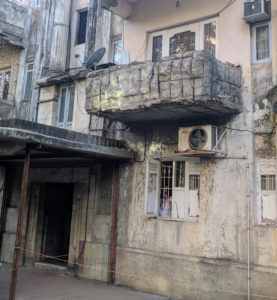 slums.)
The nominal landlords have neither the incentive nor the funds to maintain the buildings so every year during monsoon season some of the buildings collapse and people die. As the World Bank put it, the monsoons are Natural Hazards but the collapses are Unnatural Disasters:
Rent controls in Mumbai may have initially benefited tenants at the expense of landlords, but over time everyone suffers. Rent controls cause landlords to forgo maintenance and neglect their properties, and tenants not only live in dilapidated buildings but die when they collapse in heavy rains. Even if tenants are willing to either pay higher rents or to maintain the building, each tries to not pay his share of the expense (free riding), especially if appropriate retrofitting involves structural changes to the entire residential structure and not to individual apartments. Tenants also may lack the legal authority to make changes to their building’s structure.
Consider the photo at top, it’s an elegant building on a nice plot in a highly desirable part of town but take a closer look and you can see that it is falling apart (second photo). Several businesses and flats operate in the building. Now read the sign on the wall.
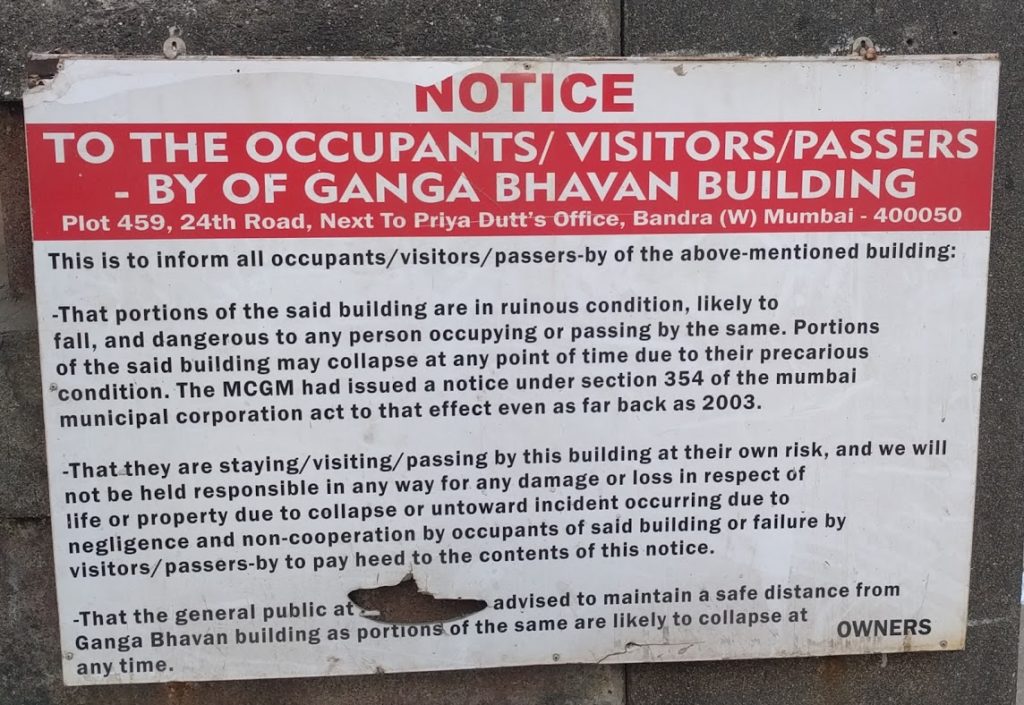 I don’t doubt that the sign is largely accurate but it also illustrates another aspect of rent control. Rent control transforms a mutually profitable exchange into a zero-sum war of misery. As I discovered in my investigations, a remarkable and sometimes hilarious example is illustrated by this very building.
The tenant, called the “victim lady”, in the Bombay High Court case that she initiated alleges that her landlord has vexed her with many frivolous lawsuits and harassed her in various and sundry ways:
It is alleged that the Respondent, on the pretext of reading books and doing meditation, continues to sit near the window of the victim lady reading law books and passing unwanted remarks stating that he will become a better lawyer by reading law books and will teach the victim lady a lesson. The Respondent is also alleged to have killed the kitten to whom the victim lady regularly used to feed. He is also alleged to have called three men to remove coconuts from the coconut tree and in the process broke number of flower pots belonging to the victim lady and destroyed the garden maintained by her.
In addition, and the judges of the High Court find this especially distasteful, the landlord “has also cast aspersions on the judiciary by making certain statements” about the “inefficiency of the judicial system”. Indeed, in his affidavit-in-reply, the respondent doubled down arguing:
…”the judiciary is perceived as inefficient by most citizens of India” as a justification for what he had stated.
Where could the respondent have gotten such absurd ideas? How dare he claim to know what most citizens think!
The Respondent may be free to express his views about the judiciary, but obviously had no right to project his views as of “most citizens in India”. What survey or research has been made by the Respondent to ascertain the views of “most citizens in India”, has not been disclosed, and considering the number of the citizens in India it is impossible to believe that the Respondent has made any survey or research on these aspects, so as to be able to make an authoritative statement of what “most citizens” feel. The impropriety is so obvious that we do not wish to comment upon the same any further…[to which, of course, the judges then proceed to comment further, AT]
The landlord does come off as a troublesome fellow but dig a little deeper and it’s not hard to see the source of his frustration. The judges, to give credit where credit is due, careful sift through the history of the case and they learn that the landlord has not actually filed many lawsuits against the plaintiff. Instead of many lawsuits, it turns out that there is only one very, very lengthy lawsuit.
Now, coming to the details given in part-B of the petition classified as “facts of the case”, there is reference of the suit bearing RAE No.537/4434/63, but this suit has, admittedly, not been filed by the Respondent and apparently the same has been filed by the grandfather [emphasis added, AT] of the Respondent….It is clear from the averments in the petition itself that the legal proceedings are pending between the parties since the year 1963.
Since landlord junior “came in picture in the year 1998 only”, and was only filling in the shoes of landlord father, who was only filling in the shoes of landlord grandfather, junior can’t be said to have initiated many lawsuits against the tenant. Thus, despite the landlord’s clearly outrageous comments about the inefficiency of the judiciary and whatever else junior may have done to the kitten, the judges throw out the tenant’s petition. The lawsuit that began in 1963 moves forward! Perhaps to be taken up by the next generation.
Addendum: I talk rent control in Mumbai with Amit Varma on his excellent podcast, The Seen and the Unseen.
How to invest to fight global warming
Here is a query from a loyal MR reader:
If you had net assets in the six figures, and were very concerned about global warming (some combination of wanting a good life for your children, and believing human civilization is valuable over a time horizon longer than your lifetime), how would you invest those assets?
Some thoughts I’ve had:
Invest in renewable energy companies: Extremely hard industry to figure out where your money would have most value added. Not easy to invest in Tesla.
Invest in water utilities: a lot of the problems with water are regulatory rather than investment.
Buy a house in an urban center: NIMBYism means that this likely just crowds out someone else, with unclear impact on carbon reduction
Housing ETF: Might have more political impact than personal purchase but difficult industry to figure out.
Give money to politicians: Does money actually impact political results?
Buy a house with access to water and a lot of guns: Not an ideal solution
Quit your job and become an activist: seems to have been moderately effective in recent years.
What non-complacent answers am I missing? How would your answer change if someone had 5 figure assets? 7 figures? 8 figures?
My answer is pretty simple: invest in fighting indoor air pollution in developing nations. (Here are further research sources.) The burning of wood indoors, for instance, leads to pretty significant carbon emissions, as does the burning of charcoal, dung, and plant residue. These burnings are also harmful to human health, accounting for perhaps as many as four million (!) deaths last year, maybe more. Some of the problem is inadequate ventilation, but also safer and cleaner gas stoves, among other technologies, represent a better and environmentally friendlier option for many of these households. Pilot projects in India, Kenya, and China have shown positive results.
The nice thing about this target is that you can save lives even if global warming can’t really be stopped. And rather than (implicitly or explicitly) taxing poor people in poor countries, you are helping them out. The broad steps one wishes to take are consistent with these locales become wealthier rather than poorer regions. Here is a paper on indoor air pollution and carbon emissions in Nigeria.
That said, I do not know which are the best non-profits or commercial projects in these areas — could any of you help out in the comments?
Another option would be to continue to apply pressure to Indonesia to limit the burning of their forests: “Indonesia’s carbon emissions from the 2015 forest fires were bigger than the daily emissions rate of the whole European Union, a study reveals.” This would involve working through international organizations and perhaps NGOs in Indonesia itself, again your suggestions are welcome.
The Spirit of the Law
To get around the Indian Supreme Court’s ban on selling alcohol within 500 meters of a highway, a bar in Kerala added some distance. Here is one case where obeying the letter of the law is producing the spirit of the law. As an added bonus it will be easier to enter the bar than to exit.

Hat tip: Anjan Rao.
Old globalization, meet the new globalization…
France is careening toward a nail-biter presidential election this month that pits a crowded field against anti-E.U. titan Marine Le Pen. But E.U. funds pay her salary, support her assistants, and underwrite the conferences and books she churns out to attack the 28-nation bloc. Key British leaders of the successful Brexit campaign got their financial lifeline from Brussels euros. Elsewhere in Europe, self-identified fascists are paying for rallies to further the future of the “white race” by breaking up the E.U. — all thanks to E.U. money.
…[these parties] get millions because of their heft in elections for the European Parliament, an institution that is short on power but flush with cash.
Here is the Washington Post story by Michael Birnbaum. I say that Hegel, and works of Continental philosophy that use the word “totalizing,” should be raised in status!
Addendum: Here is more from Farrell and Newman.
When usury laws are counterproductive
We study the effects of interest rate ceilings on the market for automobile loans. We find that loan contracting and the organization of the loan market adjust to facilitate loans to risky borrowers. When usury restrictions bind, automobile dealers finance a greater share of their customers’ purchases, which allows them to price credit risk through the mark-up on the product sale rather than the loan interest rate. Despite having little effect on who receives credit, usury limits therefore have a substantial effect on who provides credit and on the terms of credit granted. Usury limits may harm defaulting borrowers, who face greater liabilities in default than they would if loan contracts were unconstrained.
That is from a new paper by Brian Melzer and Aaron Schroeder, via Kevin Lewis.