Category: Economics
Eight top young economists on where the field is going
It starts with Nicholas Bloom and Raj Chetty, and includes Ali Wyne and Peter Leeson and Justin Wolfers, among other luminaries, courtesy of Big Think. Here is Bloom:
I do not think that any one single breakthrough will happen. The progress is likely to be heavily empirical—simply because more and more data is becoming available, and it is easy to analyze with fast computers (so empirics is now advancing faster than theory)—and spread across many hundreds of topics. So economics has gone from Victorian science, where one genius in his shed could invent the steam engine over the weekend, to industrial science, where innovation comes in thousands of tiny steps made by dozens of research teams.
Here is Wolfers:
Economic theory will become a tool we use to structure our investigation of the data. Equally, economics is not the only social science engaged in this race: our friends in political science and sociology use similar tools; computer scientists are grappling with “big data” and machine learning; and statisticians are developing new tools. Whichever field adapts best will win. I think it will be economics.
China piranha arbitrage
The local government of Liuzhou in southern China’s Guangxi Zhuang autonomous region has ended its hunt for rogue piranha fish after offering a reward which attracted thousands of hopeful fishers to local rivers. The quest to capture the troublesome fish — whose presence in the river is unexplained — has become farcical, with online retailers offering to sell and deliver piranhas to the region for 12 yuan (US$1.80) apiece.
The story is here and for the pointer I thank Peter Metrinko.
What if there is a rain delay?
Slim and bespectacled, Elmendorf could play a college professor on TV. “A quiet man who thinks carefully about everything,” the New York Times once said of him. Indeed, he deliberately chose a baseball game for one of his first dates with his future wife. “You want to be sure there’s something going on to fill the lull in the conversation but not like a movie where you can’t talk,” he explained.
That is from David Wessel’s Red Ink: Inside the High-Stakes Politics of the Federal Budget, which I enjoyed very much.
The value of microfoundations
Here is Noah Smith on microfoundations, responding to Matt Yglesias (here and here, here is also a Krugman post on the topic). I am usually pro-microfoundations, though without any particular philosophy of science-derived attachment to the idea. Here is why:
1. In some very important, simple, and intuitive models, there is nominal stickiness but money is still neutral. Caplin and Spulber 1980 is one of my favorite pieces and time spent studying their model will be repaid with value. I don’t think the model applies to 2007-2009, or say 1929-1933, when we have “out of the ordinary” shocks, but it may apply to many other time periods.
2. Often the data suggest that money is neutral or roughly neutral or at least the data are not inconsistent with neutrality. I know that one does not hear much about that in today’s economics blogosphere, but I kid you not. Again, I differ strongly from this literature for “the times which really matter,” such as 2007-2009 or 1929-1933, but still I take the data seriously. Try this relatively “atheoretical” piece by Harald Uhlig, which does not reject monetary neutrality (nor does it cover 2007-2009). Nominal stickiness models have trouble explaining why money doesn’t matter more than in fact it does. Understanding microfoundations will keep you out of the trouble you will get in if you keep trying to use money to expand output.
3. We can try to nudge people into more flexible wages, but again that requires some understanding of microfoundations. The Fed can prevent any risk of a deflationary downward spiral, and please note it is no coincidence we are in the two percent inflation range. You don’t have to view this as a high return activity to favor it (it is funny how the mere mention of wage nudges will cause many people to suddenly turn against the nudge idea, at least temporarily.)
4. Microfoundations don’t have to mean intertemporal maximization with extreme assumptions about rational or well-behaved preferences. George Akelof has written some of the best papers on microfoundations. Nor do microfoundations have to mean staking out an extreme position on the Lucas critique.
5. There are plenty of flex-wage professions which still have been seeing high unemployment. Like real estate agents. Or what happened to all those Mexicans who used to stand around on street corners? Were their wages sticky too? I don’t think so. Does their return to unemployment or underemployment in Puebla refute the sticky wage model? I personally don’t think so, but it’s hard to answer that question — an obvious one to a critical observer — without a clear sense of microfoundations.
6. Just how bad is monopoly? We wish to know when designing a competition policy. Under some microfoundations models, the existence of market power is essential for ongoing stickiness, in other models not. This question matters, and we need microfoundations to better resolve it.
7. Should a government subsidize, tax, or be neutral toward contract indexation? Try answering that question, or even getting started on it, without some sensible microfoundations.
8. If you are trying to end a hyperinflation or high rate of inflation, do you need to get fiscal policy right, in some kind of credible manner, before enacting monetary restraint? It is hard to imagine answering this question without good microfoundations.
I could go on. I am worried that people are rejecting microfoundations because they think microfoundations imply objectionable attitudes toward macro policy. But note: if those attitudes are objectionable and indeed wrong, they won’t be implied! It is entirely defensible to argue “we should have a more expansionary monetary policy today, even without the microfoundations to support that view.” It is much tougher to argue “economics should deemphasize microfoundations altogether.” The broader the range of questions one considers, the more important microfoundations turn out to be.
Iceland and Ireland
From a new Mercatus working paper by David Howden, here is the conclusion:
When the tale of these two crises is told, the conclusion is typically that one set of policies was more beneficial than the other. In this paper we have shown that the truth lies somewhere in the middle. Icelanders have benefited by evading a debt overhang through an undue bank bailout that has shielded entrepreneurs and investors from losses. The Irish commitment to open capital flows and willingness to reduce domestic prices to regain competitiveness has allowed prices to return to levels necessary for entrepreneurs to use as signals to invest. Countries facing similar crises—be they currency, banking, or general economic crises—would be well-advised to heed these two lessons when drafting recovery plans of their own.
From Scott Sumner (I agree)
It’s beginning to look like Keynes was wrong about liquidity traps, at least when he argued that there’s a certain minimum nominal yield that government bond investors demand, and that long term rates can be reduced no further. Wherever people draw a line, bond yields just seem to plunge right through, to one record low after another. And we know from Japan that they can go even lower. But what does this mean?
It probably means multiple things. For instance it suggests that the Keynesian/market monetarist AD pessimists and the Great Stagnation AS pessimists are both right. We are looking at BOTH low inflation and low real GDP growth for many years to come. Why don’t I think AD explanations are enough? Partly because even the 20 year T-bond now has a negative real yield. Indeed it suggests the Bernanke “global savings glut” hypothesis is also correct, a point I’ve argued previously. Japan is the future of the world.
Here is more. And this:
The rate of nominal GDP growth in the US over the past 3 years has been above 4%, which is considerably higher than in Japan. I would have thought that might well be enough. (The fact that it wasn’t makes me think Japan is light years away from exiting the zero bound.)
Gary Gorton’s *Misunderstanding Financial Crises*
Everything by Gary Gorton is worth reading. I am not sure when this book is due out (Amazon claims Nov.2012), but it is not out yet. The link is here.
Imagine a rewriting of earlier American financial history, though the lens of our recent financial crisis and extant ideas about bank runs through the shadow banking system. Here are two short bits:
And interestingly, the figure below shows that capital input was actually higher in countries that did not have capital requirements.
…Bank capital was not the focus of bank regulation until recently. In the 1980s regulators began focusing on bank capital as a buffer against idiosyncratic bank failures and associated losses that could have bankrupted the deposit insurance fund. But it has been recognized that historically systemic bank crises are about cash. They can be prevented or mitigated by the design of regulatory infrastructure, whether it is public or private. They cannot be prevented by bank capital.
Recommended!
There Will Be Blood
Economists often reduce complex motivations to simple functions such as profit maximization. Writing in The Economist, Buttonwood ably criticizes such simplifications. Buttonwood is too quick, however, to conclude that simplification falsifies. For example, Buttonwood argues:
If there is a shortage of blood, making payments to blood donors might seem a brilliant idea. But studies show that most donors are motivated by an idea of civic duty and that a monetary reward might actually undermine their sense of altruism.
As loyal readers of this blog know, however, the empirical evidence is that incentives for blood donation actually work quite well. Mario Macis, Nicola Lacetera, and Bob Slonim, the authors of the most important work on this subject (references below), write to me with the details:
The decision to donate blood involves complex motivations including altruism, civic duty and moral responsibility. As a result, we agree with Buttonwood that in theory incentives could reduce the supply of blood. In fact, this claim is often advanced in the popular press as well as in academic publications, and as a consequence, more and more often it is taken for granted.
But what is the effect of incentives when studied in the real world with real donors and actual blood donations?
We are unaware of a single study of real blood donations that shows that offering an incentive reduces the overall quantity or quality of blood donations. From our two studies, both in the United States covering several hundred thousand people, and studies by Goette and Stutzer (Switzerland) and Lacetera and Macis (Italy), a total of 17 distinct incentive items have been studied for the effects on actual blood donations. Incentives have included both small items and gift cards as well as larger items such as jackets and a paid-day off of work. In 16 of the 17 items examined, blood donations significantly increased (and there was no effect for the one other item), and in 16 of the 17 items studied no significant increase in deferrals or disqualifications were found. No study has ever looked at paying cash for actual blood donations, but several of the 17 items in the above studies involve gift cards with clear monetary value.
Although many lab studies and surveys have found differing evidence focusing on other outcomes than actual blood donations (such as stated preferences), the empirical record when looking at actual blood donations is thus far unambiguous: incentives increase donations.
Given the vast and important policy debate regarding addressing shortages for blood, organ and bone marrow in developed as well as less-developed economies, where shortages are especially severe, it is important to not only consider more complex human motivations, but to also provide reliable evidence, and interpret it carefully. The recent ruling by the 9th Circuit Court of Appeals allowing the legal compensation of bone marrow donors further enhances the importance of the debate and the necessity to provide evidence-based insights.
Here is a list of references:
Goette, L., and Stutzer, A., 2011: “Blood Donation and Incentives: Evidence from a Field Experiment,” Working Paper.
Lacetera, N., and Macis, M. 2012. Time for Blood: The Effect of Paid Leave Legislation on Altruistic Behavior. Journal of Law, Economics and Organization, forthcoming.
Lacetera N, Macis M, Slonim R 2012 Will there be Blood? Incentives and Displacement Effects in Pro-Social Behavior. American Economic Journal: Economic Policy 4: 186-223.
Lacetera N, Macis M, Slonim R.: Rewarding Altruism: A natural Field Experiment, NBER working paper.

*The Economist’s Voice 2.0*
Edited by Aaron Edlin and Joseph Stiglitz, the book has many fine short essays by various luminaries…
Thiel v. Schmidt
Peter Thiel, taking the pessimistic view, and Eric Schmidt of Google, taking the optimistic view, both made good points in their debate over technology but Thiel had the knockout punch:
PETER THIEL: …Google is a great company. It has 30,000 people, or 20,000, whatever the number is. They have pretty safe jobs. On the other hand, Google also has 30, 40, 50 billion in cash. It has no idea how to invest that money in technology effectively. So, it prefers getting zero percent interest from Mr. Bernanke, effectively the cash sort of gets burned away over time through inflation, because there are no ideas that Google has how to spend money.
ERIC SCHMIDT: [talks about globalization]
The moderator repeats Thiel’s point:
ADAM LASHINSKY: You have $50 billion at Google, why don’t you spend it on doing more in tech, or are you out of ideas? And I think Google does more than most companies. You’re trying to do things with self-driving cars and supposedly with asteroid mining, although maybe that’s just part of the propaganda ministry. And you’re doing more than Microsoft, or Apple, or a lot of these other companies. Amazon is the only one, in my mind, of the big tech companies that’s actually reinvesting all its money, that has enough of a vision of the future that they’re actually able to reinvest all their profits.
ERIC SCHMIDT: They make less profit than Google does.
PETER THIEL: But, if we’re living in an accelerating technological world, and you have zero percent interest rates in the background, you should be able to invest all of your money in things that will return it many times over, and the fact that you’re out of ideas, maybe it’s a political problem, the government has outlawed things. But, it still is a problem.
ADAM LASHINSKY: I’m going to go to the audience very soon, but I want you to have the opportunity to address your quality of investments, Eric.
ERIC SCHMIDT: I think I’ll just let his statement stand.
ADAM LASHINSKY: You don’t want to address the cash horde that your company does not have the creativity to spend, to invest?
ERIC SCHMIDT: What you discover in running these companies is that there are limits that are not cash. There are limits of recruiting, limits of real estate, regulatory limits as Peter points out. There are many, many such limits. And anything that we can do to reduce those limits is a good idea.
PETER THIEL: But, then the intellectually honest thing to do would be to say that Google is no longer a technology company, that it’s basically ‑‑ it’s a search engine. The search technology was developed a decade ago. It’s a bet that there will be no one else who will come up with a better search technology. So, you invest in Google, because you’re betting against technological innovation in search. And it’s like a bank that generates enormous cash flows every year, but you can’t issue a dividend, because the day you take that $30 billion and send it back to people you’re admitting that you’re no longer a technology company. That’s why Microsoft can’t return its money. That’s why all these companies are building up hordes of cash, because they don’t know what to do with it, but they don’t want to admit they’re no longer tech companies.
ADAM LASHINSKY: Briefly, and then we’re going to go to the audience.
ERIC SCHMIDT: So, the brief rebuttal is, Chrome is now the number one browser in the world.
In my mind, the revealed preference of our technological leaders is the best and most depressing argument for the great stagnation.
Clifford Whinston on driverless cars
Here is one good point of many:
Driverless cars don’t need the same wide lanes, which would allow highway authorities to reconfigure roads to allow travel speeds to be raised during peak travel periods. All that is needed would be illuminated lane dividers that can increase the number of lanes available. Driverless cars could take advantage of the extra lane capacity to reduce congestion and delays.
Another design flaw is that highways have been built in terms of width and thickness to accommodate both cars and trucks. The smaller volume of trucks should be handled with one or two wide lanes with a road surface about a foot thick, to withstand trucks’ weight and axle pressure. But the much larger volume of cars—which apply much less axle pressure that damages pavement—need more and narrower lanes that are only a few inches thick.
Building highways that separate cars and trucks by directing them to lanes with the appropriate thickness would save taxpayers a bundle. It would also favor the technology of driverless cars because they would not have to distinguish between cars and trucks and to adjust speeds and positions accordingly.
The full piece is here.
ZLB questions that are rarely asked
In the IS/LM framework many…are using, doesn’t this mean that we are getting “growth” by firms investing in projects with a negative NPV now made profitable by an even more negative discount rate?
Here is more from Angus.
Econ Memes
Art Carden has created a page of econ-related memes. Here is one of my favorites:

Firefighters Don’t Fight Fires
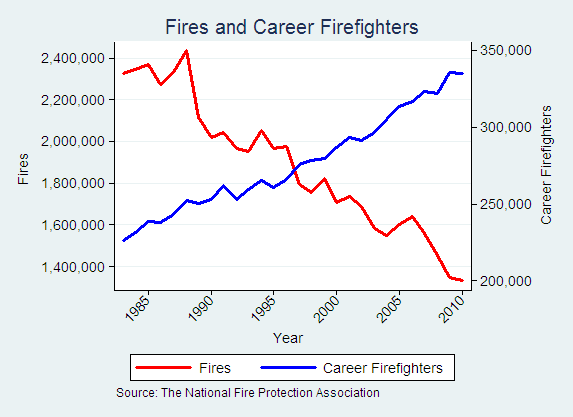
Over the past 35 years, the number of fires in the United States has fallen by more than 40% while the number of career firefighters has increased by more than 40% (data).
(N.B. Volunteer firefighters were mostly pushed out of the big cities in the late 19th century but there are a surprising number who remain in rural areas and small towns; in fact, more in total than career firefighters. The number of volunteers has been roughly constant and almost all of them operate within small towns of less than 25,000. Thus, you can take the above as approximating towns and cities of more than 25,000.)
The decline of demand has created a problem for firefighters. What Fred McChesney wrote some 10 years ago is even more true today:
Taxpayers are unlikely to support budget increases for fire departments if they see firemen lolling about the firehouse. So cities have created new, highly visible jobs for their firemen. The Wall Street Journal reported recently, “In Los Angeles, Chicago and Miami, for example, 90% of the emergency calls to firehouses are to accompany ambulances to the scene of auto accidents and other medical emergencies. Elsewhere, to keep their employees busy, fire departments have expanded into neighborhood beautification, gang intervention, substitute-teaching and other downtime pursuits.” In the Illinois township where I live, the fire department drives its trucks to accompany all medical emergency vehicles, then directs traffic around the ambulance—a task which, however valuable, seemingly does not require a hook-and-ladder.
Here’s some data. Note that medical calls dwarf fire calls. Twenty five years ago false alarms were half the number of fires, today false alarms significantly exceed the number of fires.
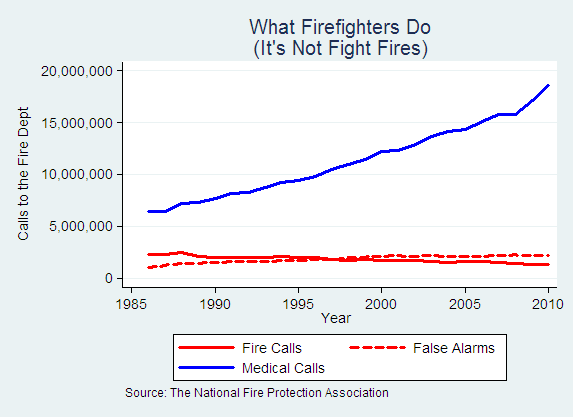
According to Nightline it costs $3,500 every time a fire truck pulls out of a fire station in Washington, DC (25 calls in a 24 hour shift is not uncommon so this adds up quickly). Moreover, most of the time the call is not for a fire but for a minor medical problem. In many cities, both fire trucks and ambulances respond to the same calls. The paramedics do a great job but it is hard to believe that this is an efficient way to deliver medical care and transportation. A few locales have experimented with more rational systems. For example:
For calls that are not a life or death, Eastside Fire and Rescue stations [in WA state] will no longer send out a fire truck but instead an SUV with one certified medic firefighter.
Sounds obvious, but it’s hard to negotiate with heroes especially when they are unionized with strong featherbedding contracts.
Optimal product durability (Pakistani markets in everything)
…many rallies end in the same way: the burning of an American flag.
…The man who dominates much of the supply chain of American flags to religious groups, 30-year-old Mamoon-ur-Rasheed – who’s been publishing anti-American placards and hand-made stars and stripes since his school days, when he was angered by the Clinton administration’s sanctions on Pakistan following its nuclear weapons testing in 1998 – is now remarkably dispassionate about his services, as well as about the short shelf-life of his flammable goods.
“We work hard for our product, and we get paid for our product,” says Rasheed, clad in a camouflage baseball cap and seated behind a desk that takes up most of the space in his eight-by-six-foot office in Gulashan-e-Iqbal, one of the city’s oldest working class neighborhood.
“So what if it burns? The purpose of the flag is to last for an hour. It’s unfortunate, but if the demand is for an hour, then the supplier must meet such demand too,” he says.
The story is here, and for the pointer I thank Jake McGuire.