Category: Economics
Relative to baseline forecasts, ACA and otherwise
Ruritania is fighting a war, and the status quo setting is that 90,000 lives will be lost each year. General Blythe comes up with a plan that increases the chance of winning the war, but is likely to cost 120,000 lives a year. He claims his plan costs only 30,000 lives a year, relative to baseline. General Smythe has a war plan which on net costs only 80,000 lives a year, so he argues that his plan saves 10,000 lives a year.
In comparative terms these claims are not incorrect, and there are obvious reasons why bureaucracies should draw up such estimates. Yet an anti-war group, SDS, argues that the real cost of the war is 90,000 lives each year, and that the one alternative plan costs 120,000 lives a year and the other 80,000 lives a year. If you are rethinking the entire war, the SDS estimates are relevant.
If we are going to keep at the war no matter what, the estimates of the Generals may be more useful. In the meantime, the generals get upset that SDS is stepping out of the framework of policy discourse and refusing to offer or accept numbers “relative to baseline.” Discourse fractures and names are flung.
To translate that into 2012, the “war” is the joint view — extremely common in America — that a) tax revenues are on an acceptable track, and b) we should spend more and more on health care each year at high rates, including in per capita terms.
If you think that dual project is sustainable, you may be relatively interested in estimates relative to baseline. If, like me, you think that project is like a failed and failing war, a success “relative to baseline” won’t much impress you. In fact it may scare you all the more to hear about success relative to baseline, as that can be taken as a signal that there is no really good plan behind the scenes. Here are a few factors which could radically upset current mainstream baselines:
1. Rates of growth stay in the range of 1 to 1.5 percent, see the work of Stock and Watson, top macro econometricians. Try redoing budget projections with those numbers.
2. Real rates of growth are higher than that, but they take the form of non-taxable pecuniary benefits.
3. Growth rates are acceptable, but more and more of economic growth is captured by private capital, which is difficult to tax for either mobility or political economy reasons.
4. The United States may need to fight a major war, or prepare to do so. (I do favor cutting the defense budget now, but we can’t be sure that cuts can last.)
5. The political economy of revenue hikes and/or spending cuts becomes or remains intractable. Buchanan and Wagner have been stressing this point for decades. A decision to borrow forty cents of a dollar spent, right now, may end up as more or less permanent, at least for as long as markets allow. Ezra’s excellent posts about how far “right” the Democratic Party has moved on taxes are along these lines.
6. Another major recession may arrive, perhaps from abroad.
7. Life expectancy goes up a few more years than we had thought, yet productivity for the elderly doesn’t rise in lockstep. You don’t have to think of that as “bad news,” but it still would be a major fiscal problem.
Maybe none of those are modal forecasts, but add them all up and I say the probability of being way off baseline is greater than 0.5, and possibly more than one of those problems will kick in. In expected value terms, the costs of those possible fiscal scenarios loom very, very large (yet suddenly the modern liberal desire to think in terms of “worst case scenarios” has diminished).
Imagine people sitting around in Spain, in 2006, debating various scenarios relative to the “baseline budget.” Maybe that’s America today, though we do not face the same particular problems or timing that Spain did.
Now enter Chuck Blahous, who wrote an article charging that ACA is likely to prove very costly, and that we are spending our cost savings on Medicare and other programs in advance, when we in fact need those cost savings to restore fiscal sanity. You will find responses here from Ezra Klein, Kevin Drum, Paul Krugman and there were many others, accessible through Google, Blahous counters here.
I have reread the Blahous article carefully, with an eye toward judging whether Blahous is simply playing “baseline games,” as some of the critics allege. I do not see that he is. He stresses that he is making economic, practical, causal, and public choice arguments, and that those trump baseline games in importance. He is trying to get us out of an obsessive focus on the baseline game, not play it in some misleading way.
To be sure, my view, or at least my emphasis, is different from that of Blahous in at least two ways. First, he is more worried about the political economy of Congressional responses when the trust funds are exhausted, whereas I am more worried about the list immediately above (that said, Blahous very clearly does discuss several other major concerns besides double-counting and he may well agree with these broader worries too). Second, my inclination is to focus on the entire budget, as a unified entity, and not so much stand-alone ACA (or Social Security, as in other debates) per se. I suspect Blahous may well agree with me, but as a more active budget analyst/specialist than I am he is forced into debates on stand-alone analyses, whereas I can play the role of aloof blogger. In any case, “fixing” this difference of emphasis would strengthen rather than weaken the overall thrust of his argument.
At the end of the day, I agree with the basic point of Blahous, which is that ACA, should it stand, is spending potentially available budget savings which we will need for other purposes. I also would argue, though I do not have space to do so here, that this has become standard practice in American politics, with Democrats too.
Here are some choice words from Steven Rattner, who worked at Treasury under Obama:
Given that context, the government’s accounting practice — counting $748 billion of cost savings and $259 billion of revenue increases toward both Medicare and the cost of the Obama plan — is particularly troubling. Moreover, this problem is largely hidden from public view.
Under Washington’s delusional rules, budget crunchers in both the White House and Congress credit this $1 trillion twice: once in calculating that the care law will generate more revenues than costs, and again in concluding that the Obama plan will chip away at the Medicare problem.
You can argue that Rattner isn’t quite correctly describing CBO procedures in his piece, but on the economic and causal arguments he, like Blahous, is essentially correct.
At the end of the day, economic models do not use a “relative to baseline” framework. The effect of “Delta G,” “Delta T,” or any other variable, depends on realized and expected values of that variable and others, and not that the size of that variable relative to what other people are proposing. As I mentioned above, “relative to baseline” does have legitimate bureaucratic and accounting uses. But we should not let it blind us to a) the divorce of that mode of reasoning from traditional economics, b) the likely unsustainability of our current fiscal path, and c) that the actual reality of ACA and other policies that we are spending “cost savings” as soon as we create them or even sooner.
Addendum: I am happy to call out the various Ryan budget proposals as unworkable fiscal disasters, most of all on the revenue side. I also refused to endorse the 43 Bush “tax cuts” at the time, though I was sent one of those pieces of paper to sign. No point in throwing the “Team Republican” charge, which in any case disrupts discourse rather than advancing it.
The Internet in Estonia
Free Wi-Fi is everywhere, and has been for a decade.
Viik says you could walk 100 miles – from the pastel-coloured turrets here in medieval Tallinn to the university spires of Tartu – and never lose internet connection.
…Last year, 94% of tax returns were made online, usually within five minutes. You can vote on your laptop (at the last election, Ilves did it from Macedonia) and sign legal documents on a smartphone. Cabinet meetings have been paperless since 2000.
Doctors only issue prescriptions electronically, while in the main cities you can pay by text for bus tickets, parking, and – in some cases – a pint of beer. Not bad for country where, two decades ago, half the population had no phone line.
Estonia is also at the forefront of privacy issues. Everyone in Estonia has a national ID card, which might frighten some Americans–although we already have essentially the same thing, but everyone in Estonia also knows who else has accessed their records. Thus, compared to the United States, Estonia is in many ways a more transparent society. Estonia is also on the forefront of dealing with cyber-terrorism with their own national “electronic” guard.
More at The Guardian.
Economic themes in *Girls*, the new HBO show
The comic timing is very good, and the show also explains:
1. Why the “Rotten Kid theorem” fails and why theories of strategic bequest are unlikely to work,
2. The longer-term consequences of a slow job market for youth, and
3. What life is like when your IQ is high but the shadow value of your labor is low.
The first episode is now on YouTube.
Toward a 21st-Century FDA?
In a WSJ op-ed, Andrew von Eschenbach, FDA commissioner from 2005 to 2009, is surprisingly candid about how the FDA is killing people.
When I was commissioner of the Food and Drug Administration (FDA) from 2005 to 2009, I saw firsthand how regenerative medicine offered a cure for kidney and heart failure and other chronic conditions like diabetes. Researchers used stem cells to grow cells and tissues to replace failing organs, eliminating the need for expensive supportive treatments like dialysis and organ transplants.
But the beneficiaries were laboratory animals. Breakthroughs for humans were and still are a long way off. They have been stalled by regulatory uncertainty, because the FDA doesn’t have the scientific tools and resources to review complex innovations more expeditiously and pioneer regulatory pathways for state-of-the-art therapies that defy current agency conventions.
Ultimately, however, von Eschenbach blames not the FDA but Congress:
Congress has starved the agency of critical funding, limiting its scientists’ ability to keep up with peers in private industry and academia. The result is an agency in which science-based regulation often lags far behind scientific discovery.
Should we not, however, read the following ala Strauss?
The FDA isn’t obstructing progress because its employees are mean-spirited or foolish.
…For example, in August 2010, the FDA filed suit against a company called Regenerative Sciences. Three years earlier, the company had begun marketing a process it called Regenexx to repair damaged joints by injecting them with a patient’s own stem cells. The FDA alleged that the cells the firm used had been manipulated to the point that they should be regulated as drugs. A resulting court injunction halting use of the technique has cast a pall over the future of regenerative medicine.
A peculiar example of a patient-spirited and wise decision, no? And what are we to make of this?
FDA scientists I have encountered do care deeply about patients and want to say “yes” to safe and effective new therapies. Regulatory approval is the only bridge between miracles in the laboratory and lifesaving treatments. Yet until FDA reviewers can be scientifically confident of the benefits and risks of a new technology, their duty is to stop it—and stop it they will. (emphasis added).
von Eschenbach ends with what sounds like a threat or perhaps, as they say, it is a promise. Unless Congress funds the FDA at higher levels and lets it regulate itself:
…we had better get used to the agency saying no by calling “time out” or, worse, “game over” for American companies developing new, vital technologies like regenerative medicine.
Frankly, I do not want to “get used” to the FDA saying game over for American companies but nor do I trust Congress to solve this problem. Thus, von Eschenbach convinces me that if we do want new, vital technologies like regenerative medicine we need more fundamental reform.
Comovement
Is the lap dancer sector being brought down by finance? Is the British knowledge base being eroded?
The study by Teela Sanders and Kate Hardy from Leeds University warns of “de-skilling” across the industry. Dr Sanders said many dancers had “never even used a pole”.
Researchers carried out a survey of 200 lap dancers, the largest study of its kind in the UK, it was reported.
Dr Sanders said there had been a “real change” to the “aesthetics of the dancers” as well as “the skills of flirting and chatting”.
The study is due to be presented today at the British Sociological Association’s annual conference in Leeds, according to The Times.
Here is much more, and I thank a loyal MR reader, WM, for the pointer.
Robert Mundell’s tips on how to accept a Nobel Prize
The Chicago School
In Launching the Innovation Renaissance I wrote:
In the United States, “vocational” programs are often thought of as programs for at-risk students, but that’s because they are taught in high schools with little connection to real workplaces. European programs are typically rigorous because the training is paid for by employers who consider apprentices an important part of their current and future work force. Apprentices are therefore given high-skill technical training that combines theory with practice—and the students are paid!
In the United States there are some experimental programs moving in this direction. One of the most interesting is being pushed by Chicago mayor Rahm Emanuel:
Chicago Public Schools (CPS) students will have the opportunity to attend five Early College STEM Schools (ECSS) that focus on technology skills and career readiness – as well as earn college credits– under a partnership agreement with five technology companies, CPS and City Colleges of Chicago, Mayor Rahm Emanuel announced…
The five technology companies, IBM, Cisco, Microsoft Corporation, Motorola Solutions and Verizon Wireless, will help develop a unique curriculum at each new school to teach students the skills required in that marketplace, as well as provide mentors and internships. Upon graduating from these tailored programs, the students will be prepared for careers in science and technology.
…All of the new schools will open in September 2012 with a class of ninth graders. Each student will be able to graduate in four-years with a high school diploma with college credits, with a goal of graduating within six years with an Associate of Science (AS) degree in Computer Science or an Associate in Applied Science (AAS) in Information Technology. The college courses will be taught by professors from CCC.
Emanuel is also redesigning the City Colleges of Chicago along similar lines:
Rahm fired almost all the college presidents, hired replacements after a national search, and decreed that six of the seven city-run colleges would have a special concentration. Corporations pledging to hire graduates will have a big hand in designing and implementing curricula. “You’re not going for four years, and you’re not going for a Nobel Prize or a research breakthrough,” he says. “This is about dealing with the nursing shortage, the lab-tech shortage. Hotels and restaurants will take over the curriculum for culinary and hospitality training.” Already AAR, a company that has 600 job openings for welders and mechanics, is partnering with Olive-Harvey College; Northwestern Memorial Hospital is designing job training in health care for Malcolm X College.
It’s too early to judge these developments but Emanuel’s op-ed on this subject was surprisingly good. The key question, which I haven’t yet seen answered, is whether the the companies will have real skin in the game, which I see as critical to success.
Hat tip: Ben Casnocha.
Exponential economist meets Physicist
Here is an imaginary dialogue between a physicist and an economist who is not Georgescu-Roegen. The physicist is skeptical about the prospect for continued exponential growth, excerpt:
Physicist: Well, we could (and do, somewhat) beam non-thermal radiation into space, like light, lasers, radio waves, etc. But the problem is that these “sources” are forms of high-grade, low-entropy energy. Instead, we’re talking about getting rid of the waste heat from all the processes by which we use energy. This energy is thermal in nature. We might be able to scoop up some of this to do useful “work,” but at very low thermodynamic efficiency. If you want to use high-grade energy in the first place, having high-entropy waste heat is pretty inescapable.
…we’re too close to an astounding point for me to leave it unspoken. At that 2.3% growth rate, we would be using energy at a rate corresponding to the total solar input striking Earth in a little over 400 years. We would consume something comparable to the entire sun in 1400 years from now. By 2500 years, we would use energy at the rate of the entire Milky Way galaxy—100 billion stars! I think you can see the absurdity of continued energy growth. 2500 years is not that long, from a historical perspective. We know what we were doing 2500 years ago. I think I know what we’re not going to be doing 2500 years hence.
For the pointer I thank Sam Penrose, Jim Nichols, Jason Ketola, and Mark Weaver. It is interesting throughout, though I expect war to intervene at some point to break the exponential growth.
Addendum: Here is a related paper by Robin Hanson.
The continuing course of Canadian monetary innovation
Canadian money authorities just can’t sit still. Like a hyperactive kid, they have revamped Canadian cash, first introducing plastic bills and then killing the penny. Now they want people to play with glow-in-the-dark quarters.
The Royal Canadian Mint’s latest collectible coin features a dinosaur whose skeleton shines at night from beneath its scaly hide.
It’s actually two images on one face, which could be a world’s first. The other side depicts Queen Elizabeth. Her Majesty does not glow in the dark.
Made of cupronickel, the coin has a face value of 25 cents but is much larger than a regular Canuck quarter.
Here is more, and for the pointer I thank Eva Vivalt.
Mysteries of growth
Matt writes:
To me the most pointed contrast is between the Soviet Bloc and pre-reform China. Why was East Germany so much poorer than West Germany? That’s easy—Communism! And that’s why North Korea is poorer than South Korea. It’s also why Taiwan is richer than China. But Communism hardly explains why the Soviet Union was always much richer than China. But it was a lot richer despite broadly similar political systems and ideological commitments, and the human suffering involved in the PRC’s failure to implement Communism as successfully as the USSR was enormous.
I would say this: Stalin favored industrialization (albeit of a strange sort) more than did the Chinese communists, China had a more damaging heritage of conquest and civil war, Russia was far more urbanized, Russia had greater access to European ideas (some of them bad of course), and the Russian experience of nation-building was mostly behind them, whereas China is still going through this process. For Russia/Soviet Union, the major structures of 20th century European growth were largely in place, though “liberal institutions” were rejected. Russia had an advanced European educational system in place, albeit not for everyone. If you look at the economic history of the more Asiatic “Stans,” which of course were part of the Soviet Union communist experience, the importance of already-industrializing and European connections looks all the more stronger. The relative prosperity of Estonia also bears out this thesis, though it would be interesting to ponder Kaliningrad/Königsberg in this regard.
The wisdom of David Brooks
As Tyler Cowen reports in a fantastic article in The American Interest called “What Export-Oriented America Means,” American exports are surging.
Here is much more, read the whole thing. Here is one more bit:
A rift is opening up. The first, globalized sector is producing a lot of the productivity gains, but it is not producing a lot of the jobs. The second more protected sector is producing more jobs, but not as many productivity gains. The hypercompetitive globalized economy generates enormous profits, while the second, less tradable economy is where more Americans actually live.
Revised TFP growth for Singapore looks much better
From Chang-Tai Hsieh, plucked out of the 2002 AER, via @dtimesd:
This paper presents dual estimates of total factor productivity growth (TFPG) for East Asian countries. While the dual estimates of TFPG for Korea and Hong Kong are similar to the primal estimates, they exceed the primal estimates by 1 percent a year for Taiwan and by more than 2 percent for Singapore. The reason for the large discrepancy for Singapore is because the return to capital has remained constant, despite the high rate of capital accumulation indicated by Singapore’s national accounts. This discrepancy is not explained by financial market controls, capital income taxes, risk premium changes, and public investment subsidies.
The initial context is given here. Via Dave Backus, here is another relevant paper.
Addendum: Scott Sumner adds comment.
New Cities
In 2009, the percentage of the planet’s population living in urban areas crossed the 50% threshold…this year the population of the world’s cities will grow by a further 65 million people, equal in size to the total population of France…
As recently as 1990 the United States had the highest number of one million plus inhabitant urban agglomerations globally with a total of 33….by the year 2020 China will lead the world with 121 followed by India with 58…
Remarkably, in 2009 China generated some 40.9% of GDP from just 16.6% of its population living in the 35 largest cities.
From an interesting Credit Suisse report, Opportunities in an urbanizing world (pdf).
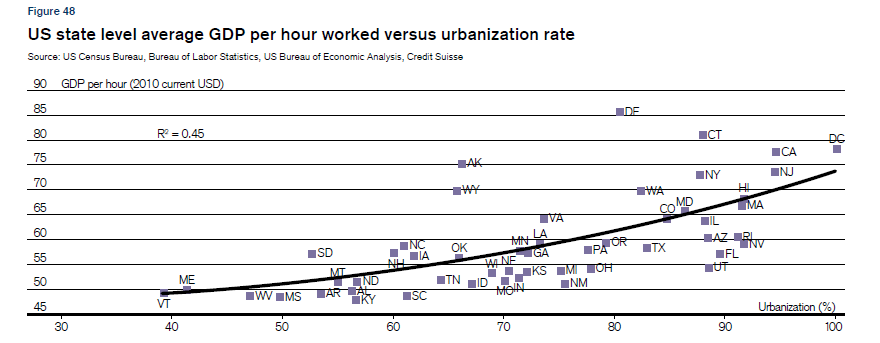
I was surprised at how close the association is between state level GDP and the urbanization rate (Ryan Avent in The Gated City and Matt Yglesias in The Rent is Too Dammed High make similar points.)
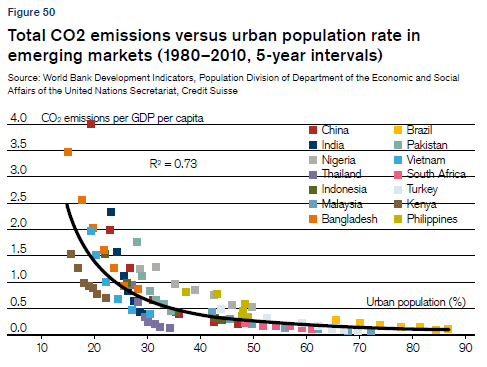
Urban dwellers also have much lower levels of carbon dioxide production than rural dwellers [Addendum: this seems to be per unit of GDP]. Moreover, the half of the world’s population that lives in cities occupies only approximately 2.7% of the world’s land area.
Hat tip: Gulzar at Urbanomics.
Markets in Everything: Prison Consultants
NYTimes: Mr. Levine is a prison consultant. The business — which entails advising people who are facing jail time on how to prepare for life on the inside, deal with medical issues, transfer to other prisons and even reduce their sentences…The consultants [also] teach prison etiquette.
For example? “Never walk across a wet floor,” Mr. Mulholland advised, saying you might mess up the work of the prisoner manning the mop. And then he might kill you.
Prison consultancy seems to be one of the few businesses where the owners aggressively advertise their criminal record:
Mr. Levine said he thought the competition would thin out over time because the competitors lack marketing smarts. Besides, he argued, he has the criminal CV to back up the marketing.
If they handed out diplomas for prison savvy, he said, “These guys have maybe an associate degree. I have like a Ph.D. or above.”
Indeed, “some prison consultants say that others are so lacking in expertise that their businesses are practically criminal enterprises.”
From the pen of Interfluidity
Post-Keynesians did predict a crisis, on broadly the terms that we actually experienced. They argue that there are adverse side effects to using monetary policy to manage aggregate demand. Although in theory this might be avoidable, post-Keynesians point out that in practice monetary stabilization, even above the zero-bound, seems to engender increasing indebtedness and financial fragility, and to distort activity towards overspecialization in finance and real estate. They pay much more attention to the details of financing arrangements than the other schools, and emphasize that vertiginous collapses of aggregate demand are nearly always accompanied by malfunctions in these arrangements. Aggregate demand, post-Keynesians argue, cannot be managed without concrete attention to the operation of financial institutions and the conditions that lead to their fragility. Post-Keynesians make the deep and underappreciated point that fiscal policy, even if it is conventionally tax-financed, can deleverage the private sector and reduce financial fragility in a way that monetary operations cannot. Monetary operations, if you follow the cash flows, amount to debt finance of the private sector by the public sector. The central bank advances funds today, in exchange for diverting precommitted streams of future cash from the private sector entities to the central bank. Fiscal expansion is more like equity finance of the private sector by the public sector. Public funds are advanced, and captured by parties with weak balance sheets as well as strong. But taxes are not withdrawn on a fixed schedule. They are recouped “countercyclically”, in good times, when private sector agents are most capable of paying them without financial distress. Further, the private sector’s tax liability is distributed according to ex post cash flows realized by individuals and firms, while debt obligations are distributed according to ex ante hopes, expectations, and errors. So tax-financed fiscal policy acts as a kind of balance-sheet insurance. Both by virtue of timing and distribution, taxation is less likely than monetary-policy induced debt service to provoke disruptive insolvency in the private sector. Plus, during a depression, fiscal expansions may never need to be offset by increased taxation…Never-to-be-taxed-back fiscal expenditures, if they are not inflationary, shore up weak private-sector balance sheets without putting even a dent into the financial position of the strong. They represent a free lunch both in real and financial terms.
Here is more, and it is insightful throughout. I would add two points, both in the skeptical direction:
1. I so rarely hear the post Keynesians utter the word “Congress” in discussions such as this.
2. Fiscal policy does best when it is obvious what should be produced, and there is a political consensus to make that stick, as was the case in 1940-45 for instance.