Category: Education
Let’s privatize the ban on pennies

For the photo I thank Jacob Ma-Weaver. I joined this privatization effort some time ago, as I take pleasure in throwing my pennies away (much to the consternation of my wife).
The high price of land in Singapore, educational Morlocks edition
At N.T.U., a group of researchers has spent the past year gathering available data on the university’s surface topography and subsurface geology.
The preliminary survey, completed late last month, found that the campus, which is in western Singapore, offers opportunities for underground space development. Extensive investigations indicated that rock strata 20 to 30 meters, or 66 to 98 feet, below the surface, are suited for cavern construction with spans as wide as 20 meters wide.
“In the long term, the university may need to go underground” to accommodate projected increases in the student population, said Zhao Zhiye, one of four researchers who worked on the study.
…Designed for both learning and socializing, the learning complex — a group of interconnected caverns — would include the university’s main library, a museum, study rooms, cafeterias and conference halls. The sports hall, beneath the existing university sports complex, would house basketball, badminton and table tennis courts, swimming pools and spectator stands.
There is more here, and here is the previous installment in the series.

http://www.macrodigest.com/
The site is here, and it presents recent macro discussions on an issue-by-issue basis in easy to use, easy to scan form. Furthermore it covers links which I otherwise would not see. I not only visit the site every day (or more), I use it every day, and there are no more than half a dozen aggregator sites where I would say that.
Definitely recommended, and it comes from the LSE Department of Economics.
Markets in everything
University of Toronto students desperate for scarce seats in fully booked classrooms are offering cash to classmates willing to give up a spot, turning registration into a bidding war.
“$100 to whomever drops (History of Modern Espionage),” posted Christopher Grossi on Facebook Tuesday. “I really need this course.”
The third-year history student said the 180-person course filled up before his designated registration time. After talking to the professor without success, he said offering money was his last chance to coax someone to trade with him.
Here is more information, and supposedly, after some point in the process, a near-simultaneous drop and add will in fact allow the trade to take place.
For the pointer I thank Larry Deck.
A change in culture or a failure of memory and a glorification of the past?
From Great Britain:
A bedtime story used to be a way for children and parents to bond at the end of the day, but the tradition has undergone a dramatic decline in a single generation.
A poll of 2,000 mothers with children aged 0-7 years, carried out by the clothing and homeware retailer Littlewoods, highlighted the extent of the change. Only 64% of respondents said they read their children bedtime stories, even though 91% were themselves read bedtime stories when young.
The survey also found that in previous generations, parents who read bedtime stories did so more regularly than their modern counterparts. Only 13% of respondents read a story to their children every night, but 75% recall being read to every night when they were kids. On average, today’s parents read bedtime stories to their children three times a week.
The findings are all the more surprising since 87% of those polled believe that bedtime reading is vital to children’s education and development.
The poll discovered that 9% feel “too stressed” to read bedtime stories; 13% admit that they haven’t enough time.
There is more here.
Martian Terroir (there is no great stagnation)
Earlier this summer, Carlos Monleon-Gendall, exhibiting as part of the always-intriguing Royal College of Art Design Interactionsend-of-year show, explored the process of wine-making as if on Mars.
In his specially designed growth chamber, a lonely vine, from a species chosen for its cold tolerance, sends its roots down into a Martian soil analogue (a hand-pulverised mix of volcanic rocks and glasses as well as ferromagnesia clays), while extending its leaves toward a Martian sun.
Monleon-Gendall’s Martian micro-environment accurately simulates UVA and UVB radiation levels as well as seasonal shifts in the red planet’s sunset and sunrise by using a NASA app developed by the scientists at the Jet Propulsion Laboratory in Pasadena, California. (“UVC radiation is not modeled for human health and safety reasons,” the narrator of his project video intones, reassuringly.)
There is more of interest at the link, and this seems to be the bottom line:
Such a vocabulary will help with the palate re-training necessary in order to achieve the project’s goal: to help humans “acquire a taste for other planets.”
The “markets in everything” angle is this:
To help humans catch up to his prickly, potato pioneers, Keats also sold bottles of Martian mineral water.
“The minerals, including pyroxene and ulvospinel and pigeonite, will be used by your body to make bone and tissue,” Keats explained toWired. “Exploring Mars in this way, you’ll start to go native.”
From Nicola, here is more, with good photos, and for the pointer I thank Walter Olson.
Arnold Kling reviews *Average is Over*
The review is here, here is one excerpt:
For me, the most interesting chapter was the one on education. Tyler points out that the content-supplying and testing/grading functions of a professor can be automated relatively easily. The main role for humans is to supply motivation, coaching, and inspiration. I am reminded of an experiment in India in which grandmothers with no subject-matter knowledge are recruited to encourage young children to learn by praising their work.
The problem
One reason that many Americans believe Medicare does not contribute to the deficit is that the majority thinks Medicare recipients pay or have prepaid the cost of their health care. Medicare beneficiaries on average pay about $1 for every $3 in benefits they receive…However, about two-thirds of the public believe that most Medicare recipients get benefits worth about the same (27%) or less (41%) than what they have paid in payroll taxes during their working lives and in premiums for their current coverage.
Here is more, via Amitabh Chandra.
The assumption of “free disposal,” as applied to children
This rather horrifying link has been making the rounds on Twitter, here is the bottom line:
When a Liberian girl proves too much for her parents, they advertise her online and give her to a couple they’ve never met. Days later, she goes missing.
The practice is called “private re-homing,” and it seems plenty of it goes on, and without government scrutiny (in many cases a simple notarized statement may accompany the handover).
Maybe I’ve read too much Walter Block ($2.99 on Kindle) in my day, but well, um, well…you know. Is the solution to make the initial adopting parents keep the girl? That seems doubtful. Are the children better off being sent back to an orphanage rather than being re-gifted? Possibly so, but this is not obvious. From a legal point of view, for sure. But as for the utilitarian and Benthamite angle? A lot of evil parents might keep their newly adopted children (and to the detriment of those children) because return to the orphanage could be bureaucratic, costly, and also humiliating, at least compared to giving them away rather rapidly over the internet.
Should we screen adopting parents more rigorously, so as to prevent lemon parents from adopting in the first place? Well, maybe, and if you read the article you will see some cases where better upfront screening would have been highly desirable. But tougher screening as a general rule? I don’t know. Adoption is already costly and bureaucratic, it is on average welfare-enhancing, and maybe we can’t easily screen out most of the lemon parents anyway. Etc.
On the other side of the issue, limiting free disposal likely would improve the average quality of adopting parent through positive selection. Quite possibly that effect will predominate but I would ask for the same standards of evidence here that we apply to other policy decisions.
I say we don’t yet know the proper policy response to this issue, but it’s worth thinking this through with more rigor than a simple “mood affiliation” response might suggest.
The five cognitive distortions of people who get things done
I would call this speculative, but it is nonetheless of interest, let me pull from Jason Kottke:
This is a presentation and therefore missing a bunch of key context, but Michael Dearing’s The Five Cognitive Distortions of People Who Get Stuff Done is interesting reading nonetheless. The five distortions are:
1. Personal exceptionalism
2. Dichotomous thinking
3. Correct overgeneralization
4. Blank canvas thinking
5. SchumpeterianismThat last one is likely a head-scratcher to those of us without economics backgrounds; here’s what Dearing has to say about it:
Definition – sees creative destruction as natural, necessary, and as their vocation
Benefits – fearlessness, tolerance for destruction and pain
Deadly risk – heartless ambition, alienation
Diane Coyle reviews *Average is Over*
The review is entitled “Not Average At All,” here is one excerpt:
Tyler Cowen has followed up the best-selling The Great Stagnation with another profoundly interesting book on the impact of new technology on the economy and beyond. Average is Over: Powering America Beyond the Age of the Great Stagnation picks up the theme of the disruption technological change and the consequent restructuring of business and focuses on the effects on individual jobs and what people might be able to do to safeguard their livelihood.
The rest of the review is here, and it is interesting throughout. This was one of my favorite sentences:
Steadily, without discussion, a moral framework is becoming encoded into the machines around us, and by the habits of use that are developing.
Our new MRUniversity class on International Trade
The class is here and the videos are going up week by week. The summary is this:
This course takes a look at the basic theories of international trade and the consequences of trade in today’s global economy. You’ll have the opportunity to learn more about fundamental ideas such as comparative advantage, increasing returns to scale, factor endowments, and arbitrage across borders. The consequences we discuss include the effects of offshoring, how trade has shaped the economies of China, Mexico, and Korea, when foreign direct investment is desirable, and the history of free trade and tariffs, among other topics. Trade is a topic of increasing importance and this material will give you a better grasp on the theories and empirics as they have been developed by economists.
The iTunes podcasts are here.
I am also using these videos in conjunction with the International Trade class I am teaching, you can find the reading list here.
A dearth of investment in young workers
Here is my latest New York Times column, excerpt:
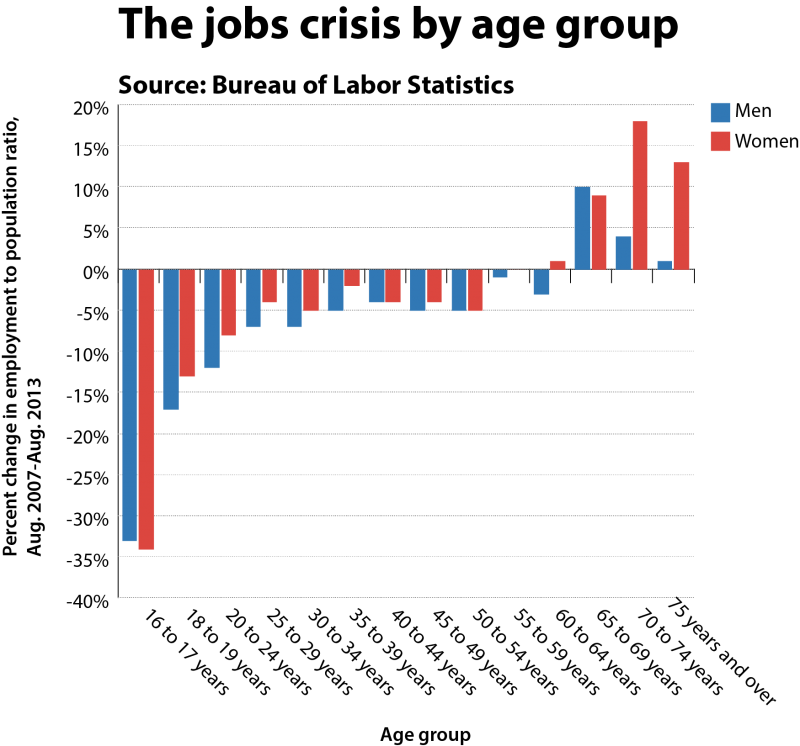
For Americans aged 16 to 24 who aren’t enrolled in school, the employment picture is grim. Only 36 percent are working full time, down 10 percentage points from 2007. Longer term, the overall labor-force participation rate for that age group has dropped 20 percentage points for men and 14 points for women since 1989.
This lack of jobs will damage the long-term careers of a big chunk of the next working generation. Not working after you finish school very often means missing out on developing the skills and habits that will serve you well later on. The current employment numbers are therefore like a telescope into the future labor market: a 23-year-old who is working part time as a dog walker, yoga instructor or retail clerk may be having fun, but perhaps will receive fewer promotions as a 47-year-old.
And:
Employers appear to be more risk-averse, more concerned about overhead costs and less willing to invest in developing young workers’ skills. And that seems true across a wide variety of sectors.
In the legal profession, for instance, there is less interest in hiring junior associates and grooming them for partner status. Colleges and universities are often more interested in hiring adjuncts than tenure-track young faculty members. And publishing houses, instead of providing a big advance upfront and investing in young authors over a series of books, now expect many writers to earn their share of a book’s revenue through royalties.
There are further relevant points in the article. And here is an FT article about more and more young British people living at home.
Here is a compelling visual from Wonkbook:
Designing robots to work with humans
Here is the good news:
Workers generally warm to collaborative robots quickly. Employees are keen to offload the “mindless, repetitive stuff”, as one roboticist puts it. And because workers themselves do the programming, they tend to regard the robots as subordinate assistants. This is good for morale, says Esben Ostergaard, UR’s technology chief. In late 2012 Mercedes-Benz began equipping workers who assemble gearboxes at a Stuttgart plant with lightweight “third hand” robots initially designed for use in space by the German Aerospace Centre. The German carmaker’s parent company, Daimler, is expanding the initiative, which it describes as “robot farming” because workers shepherd the robots “just like a farmer tending sheep”.
This is interesting too:
It turns out, for example, that people are more trusting of robots that use metaphors rather than abstract language, says Bilge Mutlu, the head of the robotics laboratory at the University of Wisconsin-Madison. He has found that robots are more persuasive when they refer to the opinions of humans and limit pauses to about a third of a second to avoid appearing confused. Robots’ gazes must also be carefully programmed lest a stare make someone uncomfortable. Timing eye contact for “intimacy regulation” is tricky, Dr Mutlu says, in part because gazes are also used in dialogue to seize and yield the floor.
When a person enters a room, robots inside should pause for a moment and acknowledge the newcomer, a sign of deference that puts people at ease, says the University of British Columbia’s Dr Croft. Robots also appear friendlier when their gaze follows a person’s moving hands, says Maya Cakmak of Willow Garage, the California-based maker of the PR2, a $400,000 robot skilled enough to make an omelette—albeit slowly.
This is more discomforting:
The world’s largest compiler of voluntary industrial standards, the International Organisation for Standardisation (ISO) in Geneva, has yet to work out safety standards for collaborative robots, such as how much force a robot can safely apply to different parts of a human worker’s body.
The story is interesting throughout, hat tip goes to FT Alphaville. By the way, humans prefer working with robots which sometimes make mistakes.
Chile fact of the day
…the average eighth grader in Ghana has a test score that would place her in the bottom 0.2 percent of US students. Even in considerably richer developing countries, the learning gap is large: the average Chilean student would be in the bottom 6.4 percent of US students, based on TIMSS scores.
That is from the Center for Global Development, via Charles Kenny, via Reihan, there is more here. By the way, here is the teacher response to recent educational reforms in Mexico.