Category: Law
Privatize Federal Land!
I’ve long advocated selling off some federal land—an idea that reliably causes mass fainting spells among the enlightened. How could we possibly part with our national patrimony, our land, our sacred wilderness? Calm down. Most of this “public land” is never used by the public. Selling some of it would actually make it more accessible and useful to real people.
Moreover, most of you wailing about selling some Federal land are probably very happy we sold the “public” airwaves for your private cell phone use. Privatizing the airwaves made them much more useful to the public. (Thank you Reed!).
AEI has an excellent map of the lands that could be sold and developed in the Mike Lee bill. Here’s their conclusion:
The data show a significant opportunity. Our analysis finds that developing just 135-180 square miles of the most suitable BLM land, a minuscule fraction of the total, could yield approximately 1 million new homes over ten years. This would substantially address the West’s housing shortage while generating an estimated $15 billion for the U.S. Treasury from land sales.
Here’s an example of the some of the land potentially developable around Las Vegas.
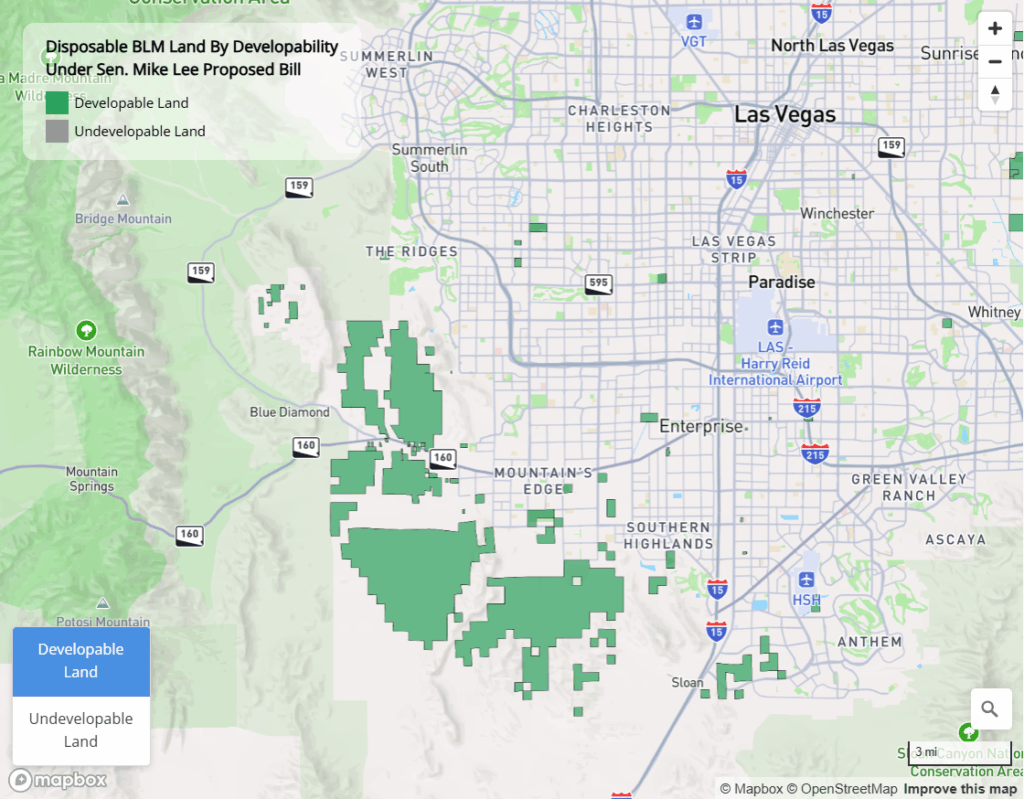
Here’s a Google satellite image of the bit around Mountain’s Edge. Enjoy your fishing on these public lands!

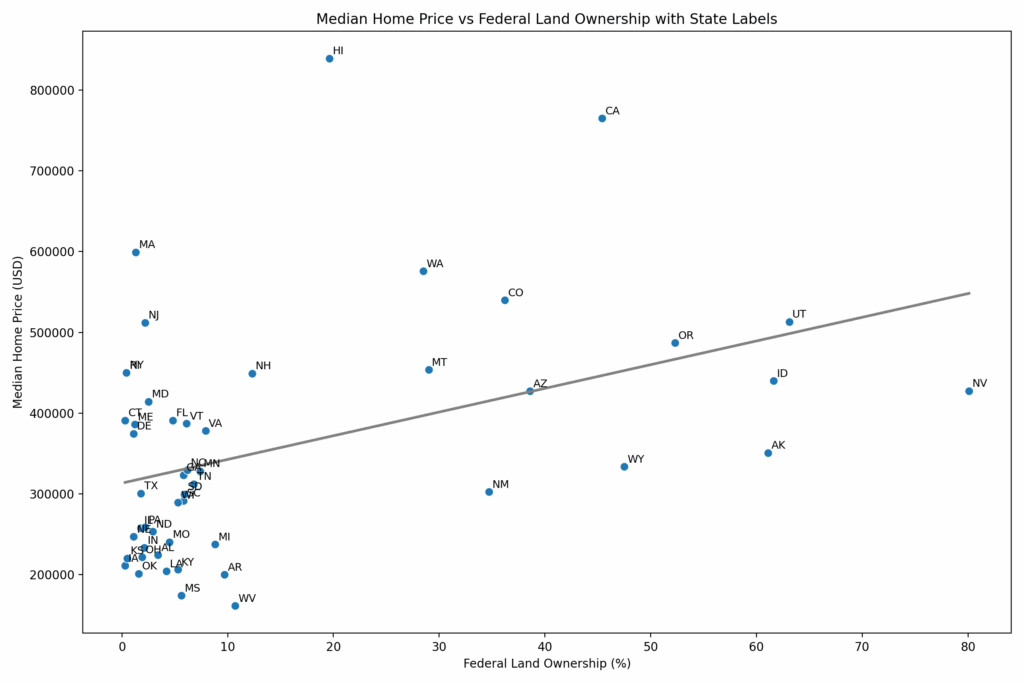
And here’s a very crude but useful scatter plot showing the correlation between median home prices in a state and Federal land ownership. Should home prices in Utah (63.1% Federally owned) really be 71% higher than in Texas (1.8% Federally owned)? Of course, Texas is famously an urban hellscape with no parks, no open space, and nowhere to hunt or fish.
C’mon British people, you can do better than this…
I’ve seen estimates that thirty people a day are arreested in the UK for things they say on social media. Other anecdotes of varying kinds continue to pile up:
Describing a middle-aged white woman as a “Karen” is borderline unlawful, a judge has said amid a bitter row at a mental health charity.
The slang term, used increasingly since the pandemic, refers to middle-aged white women who angrily rebuke those they view as socially inferior. Sitting in an employment tribunal, a judge has now said that the term is pejorative because it implies the woman is excessively and unreasonably demanding.
The woman who used the term nonetheless was acquitted, though barely. Here is the article from Times of London. And this:
The government’s new Islamophobia definition could stop experts warning about Islamist influence in Britain, a former anti-extremism tsar has warned.
Lord Walney said that a review being carried out by Angela Rayner’s department should drop the term Islamophobia, or risk “protecting a religion from criticism” rather than protecting individuals.
Ministers launched a “working group” in February aimed at forming an official definition of what is meant by Islamophobia or anti-Muslim hatred within six months.
Here is The Times link. British people, it is not just J.D. Vance who is upset. You are embarrassing yourselves with all this! Please stop. Even enemies of free speech think you are going about this in a pretty stupid way.
Who in California opposes the abundance agenda?
Labor unions are one of the culprits, environmental groups are another:
Hours of explosive state budget hearings on Wednesday revealed deepening rifts within the Legislature’s Democratic supermajority over how to ease California’s prohibitively high cost of living. Labor advocates determined to sink one of Newsom’s proposals over wage standards for construction workers filled a hearing room at the state Capitol mocking, yelling, and storming out at points while lawmakers went over the details of Newsom’s plan to address the state’s affordability crisis and sew up a $12 billion budget deficit.
Lawmakers for months have been bracing for a fight with Newsom over his proposed cuts to safety net programs in the state budget. Instead, Democrats are throwing up heavy resistance to his last-minute stand on housing development — a proposal that has drawn outrage from labor and environmental groups in heavily-Democratic California.
Here is the full story, via Josh Barro. To be clear, I am for the abundance agenda.
Flying on Frying Oil
The ever-excellent Matt Levine points us to the amusing economic policies that connect the international jet-set to Malaysian street hawkers of fried noodles. The EU and the US have created strong economic incentives to create sustainable aviation fuel (SAF) and a good way to do this is to recycle used cooking oil (UCO). What could be better, right? Take a waste product and turn it into jet fuel! The EU and US policies, however, are so strong that all the EU and US used cooking oil cannot meet the demand. Here’s a great sentence, “Europe simply cannot collect enough used cooking oil to fly its planes.”
In the US, credits under the Inflation Reduction Act can account for up to $1.75 to $1.85 per gallon of SAF. Meanwhile cooking oil is subsidized in some  parts of the world. The result?
It turns out that restaurants, street food stalls and home cooks in Malaysia — which is “among the world’s leading suppliers of both UCO and virgin palm oil” — will pay less for fresh cooking oil than the international market will pay for used cooking oil. Fresh cooking oil is more useful to cooks than used cooking oil (it tastes better), but it is less useful to refiners and airlines than used cooking oil (it doesn’t reduce their carbon impact). Also fresh cooking oil is subsidized by the government in Malaysia: “Subsidised cooking oil sells for RM2.50 per kg versus the UCO trading price of up to RM4.50 per kg.” So if you run a restaurant, you can buy fresh cooking oil for about $0.60 (USD), use it to fry food a few times, and then sell it to a refiner for $1, which is a nice little subsidy for the difficult, risky, low-margin business of running a restaurant.
The noodle hawkers in Kuala Lumpur are getting a nice little bump in profit but who is going stall to stall to check that the oil is in fact used? And what counts as used? One fry or two? Clever entrepreneurs have cut out the middleman. Virgin palm oil can be substituted for used cooking oil and voila! Sustainable aviation fuel is contributing to deforestation in Malaysia. Malaysia exports far more “used” cooking oil than oil that it uses. No surprise.
All of this illustrates a broader point: externalities suggest policy interventions may improve outcomes but markets are complex and politics is blunt. It’s easy to make things worse. If intervention is necessary, a uniform carbon tax beats a patchwork of production-specific subsidies. A price is a signal wrapped up in an incentive. Send everyone the same signal and the same incentive to ensure that the cheapest emissions are cut first and total costs are minimized.
Crucially, a carbon tax rewards any effective solution, even ones a planner would never think of–lighter planes and cleaner fuels sure but also operational tweaks like jet washes. In contrast, subsidies tether policy to specific technologies, like used cooking oil. That invites rent-seeking and inefficiency.
Tax carbon, not inputs. Avoid games with paperwork. One verification point at the fuel supply point is simpler than tracing global waste-oil chains. Don’t subsidize the fry oil and audit the street hawkers. Tax the emissions.
Canine supply was elastic, too, South Korea edition
South Korea has now banned the dog meat trade:
Chan-woo has 18 months to get rid of 600 dogs.
After that, the 33-year-old meat farmer – who we agreed to anonymise for fear of backlash – faces a penalty of up to two years in prison.
“Realistically, even just on my farm, I can’t process the number of dogs I have in that time,” he says. “At this point I’ve invested all of my assets [into the farm] – and yet they are not even taking the dogs.”
By “they”, Chan-woo doesn’t just mean the traders and butchers who, prior to the ban, would buy an average of half a dozen dogs per week.
He’s also referring to the animal rights activists and authorities who in his view, having fought so hard to outlaw the dog meat trade, have no clear plan for what to do with the leftover animals – of which there are close to 500,000, according to government estimates.
“They [the authorities] passed the law without any real plan, and now they’re saying they can’t even take the dogs.”
…A spokesperson from the Ministry of Agriculture, Food and Rural Affairs (Mafra) told the BBC that if farm owners gave up their dogs, local governments would assume ownership and manage them in shelters.
Here is the full BBC story, via Rich Dewey.
My excellent Conversation with Austan Goolsbee
Here is the audio, video, and transcript. Here is part of the episode summary:
A longtime professor at the University of Chicago’s Booth School and former chair of the Council of Economic Advisers under President Obama, Goolsbee now brings that intellectual discipline—and a healthy dose of humor—to his role as president of the Federal Reserve Bank of Chicago.
Tyler and Austan explore what theoretical frameworks Goolsbee uses for understanding inflation, why he’s skeptical of monetary policy rules, whether post-pandemic inflation was mostly from the demand or supply side, the proliferation of stablecoins and shadow banking, housing prices and construction productivity, how microeconomic principles apply to managing a regional Fed bank, whether the structure of the Federal Reserve system should change, AI’s role in banking supervision and economic forecasting, stablecoins and CBDCs, AI’s productivity potential over the coming decades, his secret to beating Ted Cruz in college debates, and more.
Excerpt:
COWEN: Okay, if the instability comes from the velocity side, that means that we should favor a monetary-growth rule to target the growth path of a nominal GDP, M times V, right?
GOOLSBEE: [laughs] Yes, and now you’re going to get me in trouble, Tyler. Here’s the thing I’ve known —
COWEN: You can just say yes. You’re not in trouble with me.
GOOLSBEE: I’m not going to say yes because, remember, I don’t like making policy off accounting identities. There’s no economic content in accounting identity. If you are trying to design a rule, that rule may work if the shocks are the same as what they always were in previous business cycles. I called it the golden path.
When we came into 2023, you’ll recall the Bloomberg economists said there was a 100 percent chance of recession in 2023. They announced it at the end of 2022. That’s when I came into the Fed system, the beginning of ’23.
That argument was rooted in the past. There had never been a drop of inflation of a significant degree without a very serious recession. Yet in 2023, there was. Inflation fell almost as much as it ever fell in one year without a recession. If you over-index too much on a rule that implicitly is premised on that everything is driven by demand shocks, I just think you want to be careful over-committing.
COWEN: I’m a little confused at the theoretical level. On one hand, you’re saying M times V is an identity, but on the other hand, it drives inflation dynamics.
GOOLSBEE: It’s why I started back from the . . . I bring a micro sentiment to the thinking about causality and supply and demand. I sense that you want to bring us to a, let’s agree on a monetary policy rule, and I’m inherently a little uncomfortable. I want to see what the rules say, but I fundamentally don’t want us to pre-commit to any given rule in a way that’s not robust to shocks.
COWEN: Now, you mentioned the post-pandemic inflation and the role of the supply side. When I look at that inflation, I see prices really haven’t come back down. They’ve stayed up, and I see service prices are also quite high and went up a lot, so I tend to think it was mostly demand side. Now, why is that wrong?
GOOLSBEE: There’re two parts to that. I won’t say why it’s wrong, but here are my questions. If you’re firmly a ‘this-all-came-from-demand’ guy, (A) you’ve got to answer, why did inflation begin soaring in the US when the unemployment rate is over 6 percent? Or we could turn it into potential output terms if you want, but output is below our estimate of potential. Unemployment is way higher than what we think of as the natural rate, and inflation is soaring. That already should make you a little questioning.
COWEN: I can cite M2. You may not like it. M2 went up 40 percent over a few-year period, right?
GOOLSBEE: Two, the fact that the inflation is taking place simultaneously in a bunch of countries of similar magnitudes that did not have the kind of aggregate demand, fiscal or monetary stimulus that we had in the US is also a little bit of a puzzle.
Then the third is, if you don’t think it was supply, then you need to have an explanation for why, when the stimulus rolls off, everything about the stimulus is delta from last year. We pass a big fiscal stimulus, we have substantial monetary stimulus that rolls off, the inflation doesn’t come down. Then in ’23, when the supply chain begins to heal, you see inflation come down. Those three things suggest there’s a little bit of a puzzle if you think it was all demand.
COWEN: No, I don’t think it was all demand, but you mentioned other countries. Switzerland and Japan — they import a lot. They were more restrained on the demand side. They had much lower rates of price inflation. That seems to me strong evidence for being more demand than supply.
GOOLSBEE: Wait a minute.
COWEN: I’m waiting.
GOOLSBEE: You’re going to bring in Japan?
COWEN: Yes.
GOOLSBEE: And you’re going to try to claim that Japan’s low inflation is the result of something in COVID? Japan had lower inflation all along, for decades before. They were going through deflation.
COWEN: But if it was mostly supply, a supply shock would’ve gotten them out of the earlier deflation, right? A demand shock would not have.
Recommended.
How constrained is the NYC mayor?
I thought to ask o3, here is the opening of its answer:
New York City has a “strong-mayor / council” system, but the City Charter, state law and an array of watchdog institutions deliberately fragment power. In practice the mayor can move fastest on implementation—issuing executive orders, running the uniformed services, writing the first draft of the budget, and appointing most agency heads—yet almost every strategic decision runs into at least one institutional trip-wire.
He does appoint all police commissioners and has direct control over the police. The mayor also has line item veto authority, although that can be overriden by the City Council. The entire response is of interest. More generally, who will and will not feel welcome in the city after this result?
Of Course We Should Privatize Some Federal Land (but probably won’t)
The Federal government controls a ridiculous amount of land in the West including more than half of Oregon, Utah, Nevada, Idaho and Alaska and nearly half of California, Arizona, New Mexico and Wyoming. See the map (PDF). The vast majority of this land is NOT parks!!! It is time for a sale to raise some funds and improve the efficiency of land allocation.

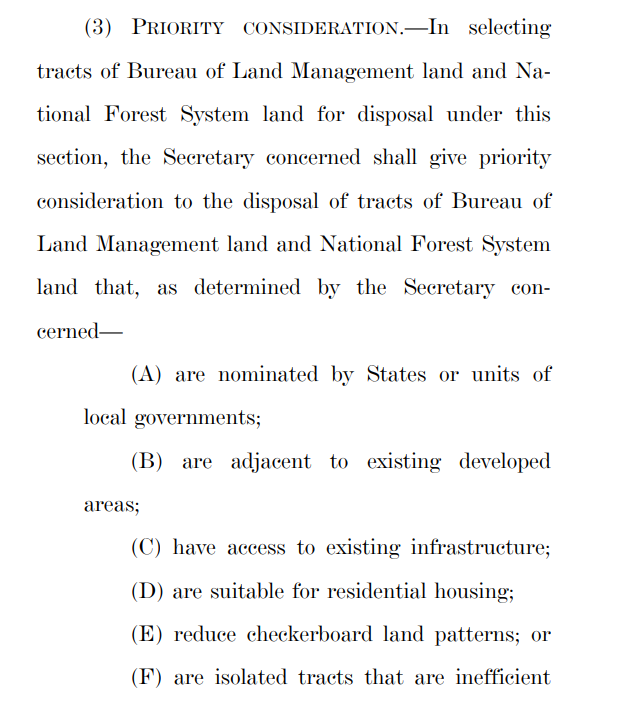 The conservative Mike Lee has a bill that would allow some sales. Great! The only problem with the bill is that it is loaded down with restrictions and qualifications. For example, there is a cap of 0.75% on total sales–that’s right, the land sales are capped at less than 1% of the total Federal land and that is a high cap because most of the rules prohibit any sale. The sales that are allowed have to be nominated by state or local governments, must be adjacent to developed areas and close to infrastructure. Moreover, the land can only be use for housing. Lyman Stone has a thread going into even more detail. The very modest goal–as you can see at right–is to rationalize some checkerboard land patterns.
Even so, the bill is probably doomed. Just mentioning federal land sales triggers a moral panic, as if someone proposed auctioning off Yellowstone. Supposed conservatives like Lomez are fueling this hysteria (e.g. here, here and here). It’s nonsense. Here and here is the type of land we are actually talking about—notice the difference?
As Matt Darling pointed out, this is Everything Bagel Liberalism from Conservatives—a bloated mess of proceduralism that empowers special interests and kneecaps supply.
If we can’t even sell Federal scraps then we’ve abandoned any pretense of governing in the public interest. We should be building entirely new cities–freedom cities!–not whining about fishing and hunting on scraps of scrub. This is exactly the same as urban NIMBYs who lobby to save “historic” parking lots. Pathetic. The federal land monopoly is not sacred. Let it go. This is where the rubber hits the road: if MAGA means anything beyond vibes and grievance, it should mean cutting red tape and unlocking land for Americans to own and build upon.
The anti-abundance agenda?
It looks like a whole new shipping preference law is coming. The House overwhelmingly passed the American Cargo for American Ships Act that would require 100% of transportation project [DOT related] materials to go on US ships, driving up infrastructure costs.
Here is the Judge Glock tweet, here is the legislation itself. Appears to be worse than the Jones Act?
The antitrust case against U.S. higher education
Thirty prestigious independent American institutions of higher education were at some time members of the 568 higher education group (often labeled a cartel). Seventeen of them were sued by the U.S. Government and representative students who alleged that their meetings and deliberations resulted in collusion that caused students to pay higher prices. Twelve of the seventeen institutions subsequently settled their cases and by 2024 collectively had paid $284 million to do so. However, an inspection of these institutions’ pricing reveals that the median 568 Group institution lowered its average real net annual cost to its undergraduate students by 19.07% between 2009 and 2022. Further, this reduction was 1.70 times larger than the average real price reduction granted during the same period by the median institution among a sample of 475 other accredited, non-profit, independent four-year institutions and 11.63 times larger than the median price reduction granted by 78 public flagship state universities. The 568 group’s real price reductions stretched across every one of the five household income categories commonly used by the Government. Thus, there is little empirical support for the allegations that the Government has levied against the representative 568 group institution, and thus multiple members of this group appear to have paid unmerited fines to the Government to settle claims against them.
That is from a new paper by James V. Koch. Via the excellent Kevin Lewis.
The smoking tax Laffer curve: Australia is not exempt from the laws of economics
Over the past decade, the excise rate per cigarette has tripled from 46c to $1.40. The excise now accounts for $28 of the average $40 price for a packet of 20 cigarettes.
For some time a rising tax was associated with the twin benefits of falling smoking rates and rising revenue, but after peaking at $16.3bn in 2019-20, federal excise receipts have plunged.
The March budget forecasts tobacco excise receipts will be just $7.4bn in this financial year – the lowest since 2012-13 – and will continue to fall to $6.7bn by the end of the decade.
Rather than a sudden collapse in smoking rates, experts point to an explosion in the availability of black market tobacco in recent years.
Here is the full story.
No Exit, No Entry
In our textbook, Modern Principles, Tyler and I contrast basic U.S. labor law, at-will employment—where employers may terminate workers for any reason not explicitly illegal (e.g., racial or sexual discrimination), without notice or severance—with Portugal’s “just cause” regime, which requires employers to prove a valid reason, give advance notice, pay severance, and endure extensive regulatory and court involvement before terminating any workers.
Portugal’s laws look pro-worker until you realize that making it more difficult to fire also makes it more difficult to get hired: As we write in MP:
Imagine how difficult it would be to get a date if every date required marriage? In the same way, it’s more difficult to find a job when every job requires a long-term commitment from the employer.
As a result, European unemployment rates—especially for youth and high-risk groups (minorities, immigrants, the less-educated)—tend to exceed those in the U.S. and dynamism is lower.
Like Portugal, India makes it very difficult to fire workers, especially for firms with more than 100 employees. As a result, Indian firms are too small to succeed. Rajagopalan and Shah write:
India’s business regulatory framework consists of an overwhelming 1,536 laws, 69,233 compliance requirements, and 6,632 filings at the Union and state levels cumulatively, which Manish Sabharwal has dubbed India’s “regulatory cholesterol.” This regulatory cholesterol incentivizes firms to limit their size or operate in the informal sector to avoid compliance costs, thereby bifurcating the labor market into a small formal workforce and a large group left vulnerable in the informal sector. India’s labor laws are among the most rigid, contributing to jobless growth and increasing informality.
High hiring/firing costs aren’t the only exit barriers. British/American bankruptcy law, for example, aims to reduce the transaction costs of bankruptcy–quickly and efficiently shifting ownership to creditors, for example–in order to maximize the “scrap value” of a firm. Bankruptcy law in other countries often aims to discourage liquidation. Until ~2017, India had no well-specified bankruptcy law. Even today, the bankruptcy law is honored more in the breach as politicians and judges interfere in large bankruptcy proceedings. Thus, it can take more than 4 years to close a firm in India, if all goes well, and much longer if there are intervening factors. As a result, India has a very high percentage of “dormant firms,” firms–often with employees–but zero output.
In No Country for Dying Firms: Evidence from India, Chatterjee, Krishna, Padmakumar, and Zhao use firm‐level data and a structural model to estimate various exit costs and their effects. Their findings: exit barriers reduce entry, investment, and aggregate productivity.
Three points stand out. First, a simple but often overlooked point. Exit costs trap resources in unproductive firms, depriving more efficient firms of the inputs they need to grow. Second, governments typically focus on entry—offering tax breaks, land, and subsidies to attract firms—because ribbon-cutting is politically rewarding. But the author’s models suggest it’s more effective to subsidize exit. Picking winners is hard; picking losers is easier. Of course, direct subsidies for exit are unlikely and unwise but reforms like streamlined bankruptcy, faster courts, and lower firing costs achieve the same goal and the losers self-select.
Third, the authors argue that improving bankruptcy law—more broadly, reducing the cost of capital reallocation—should take time-priority over reducing firing costs. Capital reallocation raises employment by moving resources to more productive firms. Once that groundwork is laid, labor law reform is more likely to succeed and endure politically.
Thus, unusually, these economists offer not just policy prescriptions but politically savvy guidance on sequencing reform.
My Conversation with the excellent John Arnold
Here is the audio, video, and transcript. Here is part of the episode summary:
Tyler and John discuss his shift from trading to philanthropy and more, including the specific traits that separate great traders from good ones, the tradeoffs of following an “inch wide, mile deep” trading philosophy, why he attended Vanderbilt, the talent culture at Enron, the growth in solar, the problem with Mexico’s energy system, where Canada’s energy exports will go, the hurdles to next-gen nuclear, how to fix America’s tripartite energy grid, how we’ll power new data centers, what’s best about living in Houston, his approach to collecting art, why trading’s easier than philanthropy, how he’d fix tax the US tax code and primary system, and what Arnold Ventures is focusing on next.
Excerpt:
COWEN: Say there’s a major volcanic event, and there’s a lot of ash in the sky for two or three years. Solar needs a backup. In the meantime, before the volcanic event happens — and of course, that’s quite rare — how much do we need to be up and running with the backup energy infrastructure? What do we need for reserve capacity in case the solar goes down?
ARNOLD: Good question. It would be difficult. It’s doable today. I think as solar continues to grow in market share, both in the US and globally, it will have to be met with some type of battery, a significant battery resource. That’s part of the economics of solar now, that it’s not just sticking it right outside of Phoenix, but it is solar plus transmission or solar plus battery. The question of what happens in that type of event — it would be difficult. The existing energy infrastructure is still largely around.
COWEN: But it will dwindle over time, right?
ARNOLD: It will dwindle over time.
COWEN: Is there some market issue? Say the volcanic event is only once every 150 years, but sooner or later, one happens. In the meantime, you need economic incentives for the gas or the nuclear to be ready. Does our government just keep on paying for those for 149 years in a row until the catastrophe comes?
ARNOLD: It’s a great question, and I think this is why nuclear, and particularly next-gen nuclear, is considered the holy grail, right? You’re not constrained by location. You’re not constrained by, is the wind blowing, is the sun shining? And it’s a clean resource. The problem today is just economics. In order to develop the current generation of nuclear, it’s extraordinarily expensive. Next generation — either small modular fission or fusion — both have a number of technological as well as unclear economics in how they compete.
I do think this question of how do you do this transition in a manner that maintains affordability but continues to get cleaner and lower emissions over time is a complex one, and I think it’s one that the environmentalists probably oversold five years ago in saying that this was going to be an easy transition. It’s certainly not. Just the scale and scope of the energy system is enormous, as you’re pointing to in your question. The need for backup, the need for a diversity of fuels, and how they complement each other is real, and you can’t replace that just with the intermittent resources we have today, plus battery.
And:
COWEN: What’s your most optimistic scenario for the US energy future from an environmental point of view, something that could plausibly happen?
ARNOLD: I think next-gen nuclear, if we can overcome the technical hurdles, if we can overcome the economic hurdles.
COWEN: But isn’t NIMBYism the biggest hurdle? The others I could imagine overcoming pretty readily, but I live in Fairfax County, which builds a fair amount. People there just don’t want nuclear. It’s irrational, but I’m not sure they’ll change their minds. It could be called fusion; it’s still nuclear to them.
ARNOLD: Yes, I’ve been surprised. That was my prior five years ago. I’ve been surprised at the number of jurisdictions that are inviting these next-gen nuclear companies to come. Texas, for instance, just passed a bill creating new incentives for nuclear companies to come and build their first plants and pilot projects in Texas. You see jurisdictions that are choosing to take the economic growth associated with it and that have more of a building culture and say, “Come here.”
I think, as things get proven out, then the question is, will the Fairfax counties of the world see what’s going on and become more agreeable to having that? I think it’s very similar to self-driving cars.
There’re some jurisdictions that say, “Come here. We want you to come, test,” and this is what’s happening in Texas. These companies say, “We want you to come pilot your projects here.” And some jurisdictions are saying, “No, prove it out, and then we’ll talk.”
COWEN: My nightmare is that even Texas becomes NIMBY. You see this in Austin already. Houston, Dallas will become more like the rest of America over time, maybe even San Antonio someday, El Paso with more time.
Interesting throughout, recommended. We also talk about art and art collecting…
Do more laws boost economic growth?
This paper analyzes the conditions under which more legislation contributes to economic growth. In the context of US states, we apply natural language processing tools to measure legislative flows for the years 1965–2012. We implement a novel shift-share design for text data, where the instrument for legislation is leave-one-out legal topic flows interacted with pretreatment legal topic shares. We find that at the margin, higher legislative output causes more economic growth. Consistent with more complete laws reducing ex post holdup, we find that the effect is driven by the use of contingent clauses, is largest in sectors with high relationship-specific investments, and is increasing with local economic uncertainty.
That is from a new issue of the JPE, by Elliott Ash, Massimo Morelli, and Matia Vannoni.
They are solving for the (crypto) equilibrium
Twenty-five people, including six minors, were charged in Paris over a spate of kidnappings and attempted abductions in France’s cryptocurrency world, said the city’s public prosecutor office on Saturday, May 31.
“Eighteen people have been placed in pre-trial detention, three have requested a deferred hearing and four have been placed under judicial supervision,” the public prosecutor said, with the suspects between 16 and 23 years old.
Here is the full story.