Category: Political Science
Why does the United States keep killing #2 in ISIS?
On Friday morning, a US air strike killed Abu Alaa al-Afri, a senior leader in ISIS, whom the US says it considers the organization’s second-ranked leader.
This isn’t the first time that al-Afri has been reported dead — though the US government has allegedly verified his death.
But if (as seems likely) al-Afri is dead, this will be yet another instance in which ISIS’s number two official has been killed. In August of last year, for example, a US airstrike killed Fadhil Ahmad al-Hayali, then identified as the group’s number two.
This continues a trend that news consumers may recognize from counterterrorism efforts against al-Qaeda, in which the group seemed to lose one third-in-command (after Osama bin Laden and Ayman al-Zawahiri) after another.
As some Twitter wags noted, this all hearkens back to a 2006 Onion article, “Eighty Percent Of Al-Qaeda No. 2s Now Dead.”
As Zack mentions, there may be reasons why the #1 is harder to find and kill, but I would suggest a complementary hypothesis. At many points in time there is more than one #2, just as corporations may have a variety of Executive Vice Presidents.
If you a leader of a terror group, do you really want a well-defined #2 who is a focal alternative and who can move to overthrow you? Or do you prefer seven competing #2s, with somewhat unclear status, whom you can play off against each other, or make compete against each other, and offer various sticks and carrots and promotions of influence against each other?
And let’s say that one of these #2’s is killed. How will the United States report this? “One of seven #2’s has been killed”? Or perhaps the easier to communicate and more important sounding “We have taken out number two.”
On Wikipedia, the (a?) previous #2 of ISIS is described as “Deputy leader of ISIL?“, question mark in the original.
Here is one look at the command structure of ISIS (or try this alternative). I cannot vouch for its accuracy, but it is one quick way to see that “#2” is perhaps not always so well-defined:

One concrete implication is this: the more number twos there are, the more likely you can kill one of them. And those are exactly the same circumstances when killing a number two has a low marginal return. Keep in mind that the kill is endogenous, and it could be indicating that one of the stronger #2s has strengthened his hand by betraying one of the weakies and getting the West to do the dirty work. And that kind of competition across subordinates may be precisely what strengthens the hand of the leader.
The one hundredth anniversary of the Irish Easter 1916 uprising
Maria Farrell writes:
The events that precisely triggered the Easter Rising are a little murky. They involve the capture of Roger Casement’s arms shipment, and feature the great hero of the Rising, Padraig Pearse, lying to MacNeill, forging documents and kidnapping and holding his socialist rivals until they acquiesced. Whether the leaders were about to be rounded up and imprisoned is unclear. MacNeill believed it, until he didn’t, but by then it was too late.
How many of you (non-Irish that is, Irish try this) are emotionally stirred by that description, one way or the other? How many of you recall reading about those events at all?
What I find most striking is how little I, as an Irish-American, emotionally identify with any of the sides in this conflict. I recall being asked in New Jersey seventh grade, by another Irish-American, whether my family was Protestant or Catholic in background and I wasn’t even sure (Catholic, it turned out, though my paternal grandparents also had been non-believers).
I was born in Kearny, New Jersey, a working class town full of Irish and Scot atavisms, including bars where they raised money for the IRA, fish and chips, and good soccer teams. My father was more interested in Barry Goldwater, and by the time we moved to the more suburban northern rim of the state all that old country history was forgotten.
On the other side of the water, Ireland is one of the few countries to break through the middle-income trap, and last year it grew at 7.8%, an increasingly embarrassing fact for many “the long run is forever” commentators, not to mention investment up more than 28%.
(Yes, there is fairly rapid post-austerity catch-up growth when institutions are even moderately healthy, and if you are not seeing such growth the economy is probably at its new frontier or structural reforms are required. And to point out that households are not capturing all of those gains — gdp vs. gnp — is to save the pessimistic mood at the expense of the theory. Without a Russian collapse, the Baltics probably would have continued along a similar track.)
Brexit of course would hit both Ireland and Northern Ireland fairly hard; it is strange how the Republic of Ireland has turned out to be the stable political unit in the family.
Here is a BBC piece on how to commemorate 1916. The embarrassing parallel is that the modern IRA cites the 1916 heroes and considers their more recent terror acts to hold comparable status. Somehow the balls must be juggled to avoid this conclusion, especially since there has been a recent uptick in unrest in Northern Ireland.
Various “victim monger” commentators don’t radiate too much sympathy for the Northern Irish republican cause. Is it because the stereotypical representation of the fighters is a little too male, a little too grizzled, too conservative, too white Christian, too chauvinistic, and maybe even too mumbly? I have to listen so closely to those movies to understand at all, and in the end they still bore me. John Lennon’s John Sinclair song never seemed to stick. Yeats too tried his best.
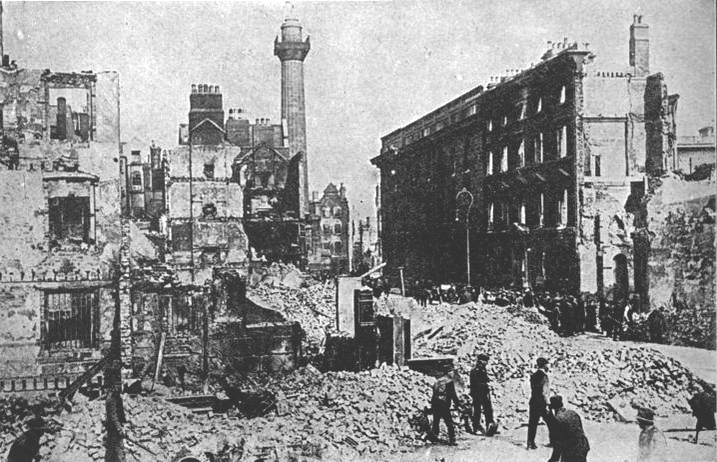
I am struck by how underrepresented this topic is in my Twitter feed.
Claims about candidates
The Trump sector allocation: POSITIVE for consumer discretionary, energy, industrials, information technology (IT), materials, and telecom services; NEGATIVE for consumer staples and healthcare; and NEUTRAL for financial services and utilities. The Clinton sector allocation: POSITIVE for industrials, IT, materials, and utilities; NEGATIVE for consumer discretionary, energy, and telecom services; and NEUTRAL for consumer staples, financials and healthcare. The sectors that benefit regardless: industrials, IT, and materials.
That is from Chris Krueger of Guggenheim Partners, via Politico, via the excellent Kevin Lewis. Caveat emptor, this strikes me as silly rather than instructive, I’ll add that Trump might be good for the media sector if nothing else. Kevin also refers us to this interesting paper by Marty Wattenberg:
This article examines sixty years of data from the American National Election Studies, and finds that the electorate’s focus on candidate attributes has declined substantially. Whereas 80% of respondents had mentioned personal attributes in the past, in recent elections only about 60% have done so. Furthermore, such comments are now more tied to partisan identification and have less of an independent impact on voting behavior. The chances of presidential image makers successfully making a difference by emphasizing a president’s personal character are now much less than in the era of Johnson, Nixon, and Reagan.
Here is the gated link.
Time consistency and the economics of Russian oil
The status quo ex ante seems to be unraveling:
“The oil companies are not investing at all in exploration of new deposits because profits on these projects will only come in 10 years. Nobody will invest in these projects.”
Of course the Russian government may end up resorting to an expropriation. So why invest? But that seems to make the need for an expropriation all the more urgent:
There is little doubt that Russia needs the money now, and that the oil companies provide an enticing target. Because they are paid in dollars but conduct their domestic business in the battered ruble, Russia’s oil majors have lots of cash. While globally most oil companies are deep in the red, cash reserves industrywide in Russia remain at an estimated $90 billion, a deep and tempting pool for the strapped Kremlin.
Yet this is exactly the worst time for trust to collapse:
…oil deposits discovered and developed in Soviet times are nearing depletion. The country’s oil future, like that of the United States, lies in offshore and shale projects that are more expensive to develop.
Do not expect a stellar outcome:
A study leaked from the Ministry of Energy, seen as allied with the oil industry, and published last week in the business daily Vedomosti, presented a doomsday scenario. Russia, the analysis predicted, could cease to be an oil power, with output plummeting to half the current level by 2035.
It is always interesting to look at past history:
It would not be the first time oil entered a spiral of declining volumes and rising demands from the state. Short of cash in an oil price downturn in the late Soviet period, the Kremlin squeezed the oil industry. It was deprived of capital, at the time, for such things as imported machines.
Output in what is today the Russian Federation fell to about 8.8 barrels in 1991 from about 11 million barrels a day in 1988…
Here is the NYT piece by Andrew E. Kramer.
Another look at why the refugee deal does not involve incentive-compatible trades
Under the one in, one out policy, an undefined number of member-states have committed themselves to resettling 72,000 Syrian refugees from Turkey. But the EU’s record in resettling and relocating people is less than impressive: in September 2015, EU member-states agreed to relocate 160,000 asylum-seekers from Greece and Italy (the so-called quota system). So far, they have relocated around 890. Some 600 cases are being held up because of security concerns, in part because of how difficult it is to perform background checks on asylum seekers. Even if the Turkish deal reduces the number of people making the perilous journey from Turkey to Greece, EU member-states would still need to resettle large numbers of Syrians. It is unclear why they would be more willing to do so now, when they have not fulfilled the promises they made six months ago.
That is from Camino Mortera-Martinez, the article has other points of interest.
The Wall Street fear gauge — updated VIX
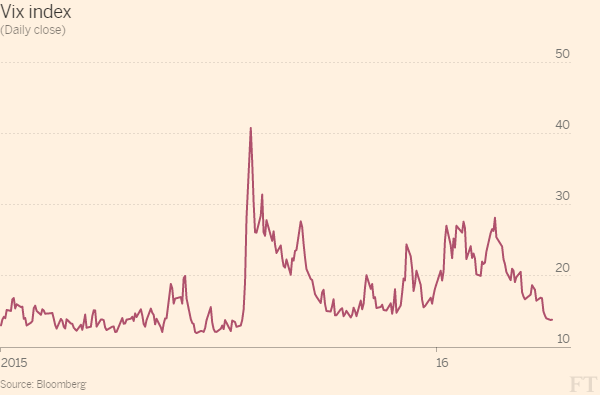
Source and discussion here at the FT.
Humiliation, the soda tax, and deadweight loss
Catherine Rampell’s excellent column considers the case for a soda tax in Britain. Here is one bit:
Why not just target the output, rather than some random subset of inputs? We could tax obesity if we wanted to. Or if we want to seem less punitive, we could award tax credits to obese people who lose weight. A tax directly pegged to reduced obesity would certainly be a much more efficient way to achieve the stated policy goal of reducing obesity.
Of course, “fat taxes,” even when framed as weight-loss tax credits, seem pretty loathsome. Why is . . . unclear.
We tax soda instead, even though that is less effective, for instance because soda drinkers may substitute into other sugary beverages. We are unwilling to humiliate the obese by taxing them directly, and so our chosen policies do less to help…the obese. (That’s assuming that attempting to shift their consumption behavior helps them at all, which is debatable.) As Robin Hanson has told us many times, politics isn’t about policy…
Why can’t Europe police terrorism better?
What Europe does not have is any cross-national agency with the power to carry out its own investigation and make its own arrests.
This means that cross-border policing in the European Union has big holes. It depends heavily on informal cooperation rather than formal institutions with independent authority. Sometimes this works reasonably well. Sometimes this works particularly badly. Belgium is a notorious problem case, because its policing arrangements are heavily localized. In the past, many Belgian policing forces have had difficulty cooperating with each other, let alone with other European forces.
That is from Henry Farrell, there are other points at the link. Here is one bit more:
To take a different example, immigration and refugees present an even bigger and more visible set of challenges to the E.U. than terrorism, yet the E.U. has been unable to agree on reforms that might expand the budget and powers of FRONTEX, the E.U. agency charged with coordinating border control. Creating a European FBI-style institution would be an even bigger lift.
Keep this in mind the next time you are tempted to believe that the EU is doing everything possible to manage the refugees crisis well.
How both sides can believe they are losing
If you read narratives of recent history from the perspective of the left and the right, each side believes it is losing. One could dismiss this as marketing strategy. If our side is winning, then why is it urgent to read my book or donate to my organization?
But I think it is possible for the each side to sincerely believe it is losing.
The left presumes that government can solve problems. We have problems. Therefore, we must be losing!
The right presumes that the government causes problems. We have problems. Therefore, we must be losing!
That is from Arnold Kling.
What should I ask Camille Paglia?
I’ll be doing a Conversations with Tyler with her, Tuesday, April 12. What should I ask her?
Is the Fed favoring seniors?
If low interest rates have posed a challenge for seniors, why then have they done relatively well in terms of consumption and income? I can think of at least four reasons:
- The disappointingly slow wage and employment growth of the past decade has had less impact on seniors than on younger folks.
- Seniors’ social-security income rises with inflation, maintaining their purchasing power. It doesn’t, however, decline when prices fall — a feature from which they profited (modestly) last year.
- Many seniors own annuities or bonds that provide them with fixed payments. Because inflation has been surprisingly low, they’ve gotten more purchasing power from these fixed payments than they could have expected.
- Seniors hold more assets like stocks, bonds, and homes than do younger folks. All of these assets have appreciated a lot over the past seven years, providing seniors with a source of spending money that offsets some of the effect of low interest rates.
That is from Narayana Kocherlakota, there is more at the link. I am pleased to see a commentator make progress on this all-important problem.
Do you know what? Most other government programs favor seniors too.
Trump, the Republican Party, and the logic of bailouts
As the possible nomination of Trump approaches, many Republicans are worried about the Party crashing. That could occur through convention warfare, a Trump nomination and an electoral disaster, or a non-Trump nomination and an electoral disaster. Maybe all of the above!
And what is wrong with the Party crashing? (Please, dear reader, consider this question from a logistic rather than a partisan point of view.) The Party contains information. Relationships. Procedures and processes and established patterns of cooperation. A well-known brand name. Organizational capital is lost if those connections are blown up and then go away. It would cost a good deal to rebuild them, whether through a new third party or through a reconstitution of the Republican Party in some new guise.
Large blocs of voters are in essence needed to help cover those fixed costs. If you tell too many voters to go away, however that might be done, the fixed costs can’t be paid the next time around and a new organization must be created, backed by some other, partially-overlapping group of voters. So during “bad times” Republicans still may wish to keep the Republican Party afloat, especially if they believe it is a viable concern over the longer haul.
This, by the way, is the same logic behind bank and corporate bailouts If the afflicted company is allowed to go under, a lot of organizational capital will be lost in what otherwise might be viable enterprises. (I am not suggesting those bailouts have zero cost, or are necessarily good, only that there is some associated benefit.)
So if you are a Republican, and considering supporting Donald Trump “for the sake of the party.” you are in essence considering whether a bailout of the Party is a good idea. Except instead of bailing out a private company with your taxes, or guaranteed credit, you are bailing out a political party with your …[fill in the blank]…
I believe that many of the people who usually claim to oppose bailouts will favor this one.
Is the refugees deal time consistent?
Just to refresh your memory, part of the deal is that newly arriving refugees in Greece get sent to Turkey, but in return the EU takes a refugee currently in Turkey. The goal is to reduce the incentive to migrate as a refugee, since you end up in Turkey rather than in Europe.
Gideon Rachman writes:
First, will the Greek authorities have the administrative capacity to process and turn around refugees arriving on their islands — as well as the many thousands already stranded in Greece? Second, will Turkey really co-operate — particularly given the fact that the EU is unlikely to deliver on all its promises? (The pledge of visa-free travel for Turks is unpopular in many EU states.) Third, will migrants desperate to get to Europe find alternative routes — perhaps via Libya, which has no properly functioning government?
Kerem Oktem summarizes the deal and makes some excellent points, including this one:
…we know that desperate people cannot be stopped. They will simply resort to new routes that will be more dangerous, more lethal and more expensive, whether it is the land borders between Turkey and Bulgaria, the boat journey from Libya to Italy or a new trajectory through Ukraine and Eastern Europe.
I find it strange that these European governments find it repugnant to allow life-saving trade in human organs, or trading away some of one’s privacy, or for that matter a free labor market. Yet they don’t seem to mind an institutionalized system of trading one refugee for another, with the explicit goal of increasing the number of Syrians who are trapped.
In essence, the wealthier Europeans are arranging for Syria, Greece, and Turkey to pay for building a stronger wall.
Do Americans see trade as an opportunity or a threat?

Opportunity! That is from Justin Wolfers.
Hayek and Freud, *The Viennese Students of Civilization*
Erwin Dekker’s The Viennese Students of Civilization: The Meaning and Context of Austrian Economics Reconsidered is an original and interesting look at the foundations of the Austrian School of Economics, properly situating it in the context of its time. Here is one bit:
In the “Civilization and its Discontents” — as Rosten attempts to point out to Hayek — Freud argues that civilization means constraining ourselves. Freud argues that morality works through a sense of guilt, and that restraint and hence civilization is created and upheld by this sense of guilt. As civilization progresses, this sense of guilt has to be intensified or heightened. This is in line with Hayek’s ideas, as we will see later, but Hayek refuses to acknowledge this.
Dekker also discusses the relevance of Nietzsche, Hermann Broch, and Peter Drucker for the Austrian school, and goes beyond the usual hagiography.