Category: Political Science
The collapse of Schengen
This is between Austria and Germany, two of the “closest” EU economies in terms of trade and similarity:
FREILASSING, Germany — Traffic along one of Europe’s busiest highways, which used to flow unimpeded, now often backs up for miles at a newly installed checkpoint, where a phalanx of German police officers screens trucks and cars for hidden migrants.
At this border crossing, as a result, Austrians who work in Germany have trouble getting to their jobs. Many companies in Germany must wait days longer for deliveries of food, machine parts and other goods. Shoppers who made quick weekend jaunts to Freilassing’s stores now mostly stay away.
“It’s really bad,” said Karl Pichler, the owner of a large gardening center here in Freilassing, whose sales of tulips, rose bushes and other plants has slumped as longtime customers from Austria have stopped coming.
…With 57 million vehicles a year and 1.7 million workers a day crossing Europe’s frontiers, the European Union could face up to 18 billion euros, or $19.6 billion, each year in lost business, steeper freight and commuter costs, interruptions to supply chains, and government outlays for augmented border policing, according to a recent report by the European Commission, the bloc’s administrative arm.
Should the European Union revert to permanent border checks to slow Syrian, Afghan and Iraqi migrants traveling through Greece and the west Balkans toward Northern Europe, the long-term cost could exceed €100 billion, the French government calculated in a separate study.
Here is the full story (NYT), and do note that long-run elasticities are much greater than short-run elasticities. So if this continues, the longer-run effects on cross-border trade, not to mention EU governance, could be quite dire indeed. And right now that is the default scenario.
*Critical Review* symposium on Ilya Somin on democratic ignorance
You’ll find it here, ungated. Ilya’s book, Democracy and Political Ignorance: Why Smaller Government is Smarter, argues we pay a heavy price for democratic ignorance. In this symposium, a variety of academics dissent from his argument. Thomas Christiano’s piece for instance is entitled “Voter Ignorance is Not Necessarily a Problem,” here is one bit:
The second [premise of Somin] is that voter ignorance betokens bad public policy. But there is plenty of evidence to the contrary. How can this be the case? One explanation is that individually ignorant voters are small pieces of a large system that divides intellectual labor through discussions among elites, opinion leaders, and ordinary citizens. This system may entitle voters to trust in the opinions of others, sparing them the need to be well informed.
Here is Benjamin Page:
Ilya Somin’s Democracy and Political Ignorance suffers from the fallacy of composition: It uses individual-level evidence about political behavior to draw inferences about the preferences and actions of the public as a whole. But collective public opinion is more stable, consistent, coherent, and responsive to the best available information, and more reflective of citizens’ underlying values and interests, than are the opinions of most individual citizens.
Let’s ask them again later today!
Here is Ilya’s response to his critics.
The regulatory state and the importance of a non-vindictive President
I hope we always will have non-vindictive Presidents in this country. One reason is because the regulatory branch reports to the Executive. And if you own a large company, it is virtually impossible to be in accordance with all of the regulations all of the time. If there were a President who wished to pursue vendettas, the regulatory state would be the most direct and simplest way for him or her to do so. The usual presumption of “innocent until proven guilty” does not hold in many regulatory matters, nor are there always the usual protections of due process.
I do know that Philip Hamburger’s book Is Administrative Law Unlawful? occasioned some critical reviews. I certainly don’t think the title frames the argument properly and by no means do I agree with everything he said. But these days, the notion that the regulatory state could prove dangerous to individual liberties, and not just to economic growth, needs to be taken more seriously, and he has written the “go to” book on that topic.
I wonder if this is one reason why some of the leaders in the Republican Party have been somewhat reluctant to challenge Donald Trump. Perhaps they fear regulatory reprisal.
I also believe that many of Trump’s strongest critics — often Democrats — are ill-suited to understand or admit this side of the problem. They have plenty of good arguments against Trump, but I haven’t heard this one yet.
Here is an excerpt from the Vermeule review of Hamburger:
One reaction to Hamburger’s book might be that it is interestingly wrong, in an unbalanced sort of way. On that view, the book could be seen as offering a kind of constitutional fiction, an oddly skewed but engagingly dystopian vision of the administrative state — one that illuminates through its very errors and distortions, like a caricature, or the works of Philip K. Dick. The book might then be located in the stream of legalist-libertarian critique of the administrative state, the line running from Dicey, through Hewart and Pound and Hayek, to Richard Epstein. That work is nothing if not interesting, if only because it is so hagridden by anxiety about administrative law.
On further inspection, though, this book is merely disheartening. No, the Federal Trade Commission isn’t much like the Star Chamber, after all. It’s irresponsible to go about making or necessarily implying such lurid comparisons, which tend to feed the tyrannophobia that bubbles unhealthily around the margins of popular culture, and that surfaces in disturbing forms on extremist blogs, in the darker corners of the internet.

Whether you agree with Vermeule or Hamburger or stand somewhere in between, the disturbing reality is that Hamburger’s perspective could become more relevant rather more quickly than many of us had expected.
Read Ben Sasse:
Statements from Trump:
***“We’re going to open up libel laws and we’re going to have people sue you like you’ve never got sued before.”
***“When the students poured into Tiananmen Square, the Chinese government almost blew it. They were vicious, they were horrible, but they put it down with strength. That shows you the power of strength. Our country is right now perceived as weak…”
***Putin, who has killed journalists and is pillaging Ukraine, is a great leader.
***The editor of National Review “should not be allowed on TV and the FCC should fine him.”
***On whether he will use executive orders to end-run Congress, as President Obama has illegally done: “I won’t refuse it. I’m going to do a lot of things.” “I mean, he’s led the way, to be honest with you.”
***“Sixty-eight percent would not leave under any circumstance. I think that means murder. It think it means anything.”
***On the internet: “I would certainly be open to closing areas” of it.
***His lawyers to people selling anti-Trump t-shirts: “Mr. Trump considers this to be a very serious matter and has authorized our legal team to take all necessary and appropriate actions to bring an immediate halt…”
***Similar threatening legal letters to competing campaigns running ads about his record.And on it goes…
Is fear of regulatory reprisal from a Trump administration so unrealistic? I don’t think so.
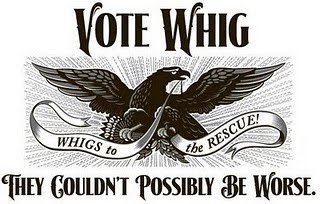
Why did the Whig Party collapse?
The Whigs were also badly hurt by the short-lived Native American or Know-Nothing party, which was primarily anti-immigrant and anti-Catholic.
That is just part of the answer of course. Here is another account, again too simplistic:
- For a brief time, many Americans supported the nativist Know-Nothing Party, concerned that the Know-Nothings might represent the only truly national party possible, largely united by a general fear of Catholic immigrants.
- But in the end, the issue over slavery proved stronger than fears over non-protestant immigrants, and southerners lined up behind the Democratic party and northerners behind the Republican party.
- Sectional party systems replaced a national party.
This seems to be the definitive detailed account. Try this book too. Most of the time, however, parties do not collapse but rather party members fall in line, fearing the costs of the alternatives, including the costs to their careers.
Here is my previous post Why did the Federalist Party collapse?
Why did the Federalist Party collapse?
I am not sure what prompted me to read up on this topic, but here is part of one of the dizzying answers I found:
When the votes were counted, Jefferson and his running mate Aaron Burr had both received seventy-three electoral votes; John Adams had obtained sixty-five, while Pinckney, his running mate, had sixty-four. The one remaining vote had gone to John Jay. The Federalists had denied one vote to Pinckney to insure that he would not obtain the presidency instead of Adams. The Republicans, however, had blundered in this respect. The Constitution provided merely that the candidate with the largest number of electoral votes should become President. As it was, Jefferson and Burr were tied. The election went into the House of Representatives where the Constitution provided that a state’s vote would be cast by a majority decision of its representatives. Since the Federalists controlled six states and had divided control in two states, they could prevent the election of either Republican – and over the bitter opposition of Hamilton they contemplated throwing their support behind Burr. They hoped to break the Republican ranks and secure themselves from “the fangs of Jefferson.” Hamilton pressed for the election of Jefferson, his old rival, insisting that Burr had the inclinations of a Caesar whereas Jefferson, despite his democratic fanaticism, would conserve the established order. But the Federalists, ignoring the urgent protests of Hamilton, persisted in a course that threatened to complete the Federalist debacle. Hamilton saw himself in “the awkward situation of a man who continues sober after the company are drunk.” Burr did nothing to simplify their task, to cooperate by private word or deed.
And that is only part of the story. Here is a simpler and indeed too simplistic account:
The Federalist party had the perception of favoring the upper class, and as a result they began to lose support of the general population. The Democratic and Republican parties started focusing on issues that appealed more to the “common man”, and as a result began to sway voters away from the Federalist party until it finally ceased to exist.
I’ll let you know what else I learn about this topic.
The (refugee) problem with the Coase theorem
The EU’s agreed a €3bn deal with Turkey in order to help keep more migrants in the country, and reduce the influx of migrants. There’s been a lot of squabbling over how much each EU member state would pay, and the commitments have finally been agreed. The cash has not yet been delivered with concrete details yet to be ironed out. This has not been helped with the Turkish President Recep Tayyip Erdoğan threatening to send buses of migrants over the borders. The deal is sweetened for Turkey with a renewed commitment to talk about possible EU accession, and visa-liberalisation for Turkish citizens into the Schengen Area.
Perhaps the last part of that deal would not prove so popular with many EU citizens. Elsewhere:
…Tsipras has upped the ante again: warning parliament in Athens that he will not allow Greece to become, “a warehouse of souls,” and announcing that if Greece is left alone to deal with the crisis, he would block EU decisions at the next leaders’ summit in Brussels.
The Open Europe post is a good look at how Europe is failing to solve its refugee problems, or even come close.
Do conservatives prefer to use nouns?
The researchers, led by Dr Aleksandra Cichocka of the School of Psychology, also established that conservatives generally, to a greater degree than liberals, tend to refer to things by their names, rather than describing them in terms of their features. An example would be saying someone ‘is an optimist’, rather than ‘is optimistic’.
This use of nouns, rather than adjectives, is seen to preserve stability, familiarity and tradition – all of which appear to be valued more highly by conservatives than liberals.
Because nouns ‘elicit clearer and more definite perceptions of reality than other parts of speech’, they satisfy the desire for ‘structure and certainty’ that is common among social conservatives, the research authors found.
The research was based on studies carried out in three countries – Poland, Lebanon, and the USA. The US study compared presidential speeches delivered by representatives of the two main political parties. The sample included 45 speeches delivered by Republicans, considered to be more conservative, and 56 speeches delivered by then Democrats, considered to be more liberal.
The (gated) paper is here, and for the pointer I thank Charles Klingman.
Jonathan Haidt seeks a hire
From an email, via Dan Klein:
We are seeking a talented and experienced researcher with some tech skills to help run two projects that use social science research to improve major American institutions. Your main job would be research director for HeterodoxAcademy.org, a collaboration of social scientists trying to increase viewpoint diversity in the academy. You would also be part of the team at EthicalSystems.org, a research collaboration that uses behavioral science to “make ethics easy” for businesses.
The ideal candidate will be a recent Ph.D. or ABD in the social sciences with both technological sophistication and excellent writing skills.
To Apply: Send a CV, writing sample, and cover letter explaining why you would be a good fit for the job to Jeremy Willinger, Communications Director, at [email protected].
“Are Choosers Losers?”– the value of control and the propensity to underdelegate
This is one of the more understudied behavioral biases, so I was pleased to see this new paper by Bobadilla-Suarez, Sunstein,and Sharot:
Human beings are often faced with a pervasive problem: whether to make their own decisions or to delegate decision tasks to someone else. Here, we test whether people are inclined to forgo monetary rewards in order to retain agency when faced with choices that could lead to losses and gains. In a simple choice task, we show that even though participants have all the information needed to maximize rewards and minimize losses, they choose to pay in order to control their own payoff. This tendency cannot be explained by participants’ overconfidence in their own ability, as their perceived ability was elicited and accounted for. Rather, the results reflect an intrinsic value for choice, which emerges in the domain of both gains and losses. Moreover, our data indicates that participants are aware that they are making suboptimal choices in the normative sense, but do so anyway, presumably for psychological gains.
I believe this is one reason why individuals can be so tribal, because otherwise they fear losing control to outsiders.
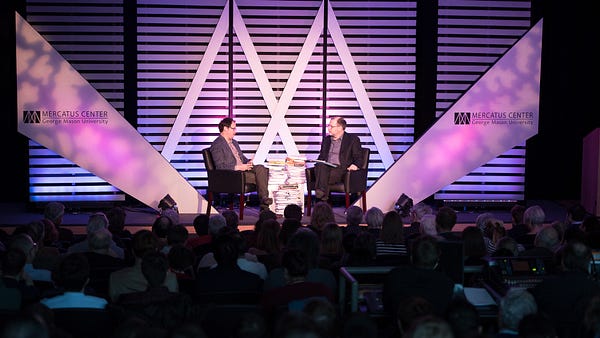
My conversation with Nate Silver
The video, podcast, and transcript are here. Nate of course was excellent, here are just a few bits:
COWEN: What are the differences between forecasting and futurism, and do you have any predictions for the year 2050? They don’t have to be great. They just have to be better than the market. We’ll take a 52 percent prediction and go home and celebrate.
SILVER: I’m mildly pessimistic in some ways.
COWEN: What’s the biggest source of your pessimism?
SILVER: [laughs] There’s probably some survivorship bias in the United States, and thinking about how our way will persevere forever and ever and ever. We were talking backstage about how you go to Asia and I go to Asia — not as often as you. If you want to feel optimistic about civilization, then go there.
And:
COWEN: You’re a fan of baseball, and I’d like to ask you, of all the different baseball records, which is the one that is most impressive to you, or the most a statistical aberration, and try to stay a bit modern. We both know in 1889, Hoss Radbourn won 59 games.
Start with [Owen] Wilson’s — was it 36 triples in 1912? That, and up through the modern age. What’s the most statistically impressive baseball record, and why?
SILVER: I think the biggest outlier is the number of intentional walks that Barry Bonds drew. I forget what year it was, 2001, where he had like 161 intentional walks, and the next closest player is 50?
And:
COWEN: Singapore. Overrated or underrated?
SILVER: Underrated except by you.
There is of course much, much more, including remarks on the candidates and the elections, as well as My Bloody Valentine and more on sports too, prediction markets as well, the weather, and why so few professional athletes have come out as gay. Recommended.
New Hampshire fact of the day
There are several ways of thinking about economic distress. One is inequality. Utah is the most equal state, then Alaska, Wyoming and New Hampshire. In terms of median family income, Maryland is the richest state, then New Hampshire. So the Granite State is in a sweet spot, both very rich and relatively equal. But its drug deaths exceed the national average.
That is from Scott Sumner. And this:
In contrast, the 5 states with the lowest rate of drug deaths are all in the northern plains area. (Note that the 4 most equal states and the 5 lowest drug deaths states are mostly white, but their drug death rates are vastly different.) Interestingly after the 5 plains states you have Virginia, followed by four very unequal states, with lots of poverty; Texas, New York, Mississippi and Georgia rounding out the top 10 for fewest drug deaths.
Economics isn’t everything, nor is inequality.
Given that Trump is winning, which other views should we update?
I asked this question to Nate Silver, but didn’t myself have a chance to address it. Since most of us have been surprised by the rise of Trump, presumably other, broader views must be updated too. But which ones? I see a few options, which are not for the most part mutually exclusive:
1. Social media are more powerful than we had thought, and more powerful in politics in particular.
2. Republican voters are less conservative, less “Tea Party,” and less libertarian than many people had thought. And the “periphery Republicans” are stronger and more numerous and more easily excited than we had thought.
3. Republican primary voters are more racist than we had thought.
4. Backlash against immigration and immigrants sets in more quickly, when middle class wages are stagnant, than we had thought. And true cosmopolitans are hard to find.
5. The value of commanding and dominating media attention, in a year with no clear front-runner Republican candidate, is higher than we had thought.
6. Trump is more skillful at trolling and pulling levers of public opinion than we had thought.
7. Democracy is less stable than we had thought.
8. New Yorkers are more nationally marketable than we had thought.
Perhaps all of these are true, and yet Trump’s leading role still remains a fundamental surprise. Which other hypotheses am I missing? In any case, it is time for some updating…

Addendum: Stephens-Davidowitz has numerous good thoughts, such as:
The Black Swan view of the world makes even more sense. We wrongly think things that are different are impossible.
Charisma matters more than we thought and is hard to pin down
People REALLY HATE politicians more than we thought …
Something that is off-the-charts entertaining is hard to stop. The media has a huge incentive to keep it going.
Among others.
Will Wilkinson’s liberaltarian case for Bernie Sanders
A number of you have written in and asked for direct commentary on his recent piece and its sequel companion. And here is Vernon Smith on Bernie.
I agree with Megan McArdle that the argument doesn’t work. I would second all or most of Megan’s points about Bernie’s less positive proclivities, including the bone-crunching marginal tax rates and the foreign policy inexperience, while adding another perspective.
One approach is to ask “which of the current slate of candidates should I prefer?”
A second approach, and the one I would suggest here, is “I have a good idea — in this case liberaltarianism — how long should I wait before attaching that idea to a particular candidate?” I say wait!
A Bernie Sanders presidency, if it somehow did manage to connect up to liberaltarianism, probably would do those ideas more harm than good. In my view he is not up to being an effective President. I don’t have the interest in outlining that case at any length, but suffice to say Paul Krugman — admittedly from a different framework — seems to agree.
I enjoyed Megan’s line: “And I have a sneaking fondness for Sanders, who reminds me of any number of folks from my Upper West Side childhood.”
Did it work out for the neoconservatives to attach themselves to Bush 43? I say no. Did it work out for mainstream liberals to attach themselves to Obama? I say mostly yes. So it can go either way. How did the Varoufakis flirtation work out for the anti-austerity movement? In the comments you can debate whether latching on to Ron Paul was good for libertarian ideas, but I don’t think the answer is an obvious yes, to say the least.
It’s not that I want you to support some other candidate in Bernie’s stead, rather I would challenge the view that a candidate needs to be preferred in each and every election cycle. And as I’ve once argued, analysts, pundits, and others might do better in their commentary, and keep a more analytically detached perspective, if at least some they avoid attaching themselves to any candidate at all. We are programmed to be loyal to individual people, and perhaps causes too. While that is often admirable as a personal trait, it also can skew our judgment of policies and platforms.
The political legacy of American slavery
Forthcoming, Journal of Politics, from Avidit Acharya, Matthew Blackwell, and Maya Sen:
We show that contemporary differences in political attitudes across counties in the American South in part trace their origins to slavery’s prevalence more than 150 years ago. Whites who currently live in Southern counties that had high shares of slaves in 1860 are more likely to identify as a Republican, oppose affirmative action, and express racial resentment and colder feelings toward blacks. These results cannot be explained by existing theories, including the theory of contemporary racial threat. To explain these results, we offer evidence for a new theory involving the historical persistence of political and racial attitudes. Following the Civil War, Southern whites faced political and economic incentives to reinforce existing racist norms and institutions to maintain control over the newly free African-American population. This amplified local differences in racially conservative political attitudes, which in turn have been passed down locally across generations. Our results challenge the interpretation of a vast literature on racial attitudes in the American South.
The past still matters…
Livestream for Nate Silver
Nate and I will be chatting at 3:30p.m., as part of Conversations with Tyler. You can find the LiveStream here, here are the questions you all have been suggesting, and the Twitter hashtag is #CowenSilver.