Category: The Arts
The best job market paper I have seen so far this year
From Hyejun Kim at MIT”s Sloan School:
Knitting Community: Human and Social Capital in the Early Transition into Entrepreneurship
The process by which individuals become entrepreneurs is often described as a decisive moment of transition, yet it necessarily involves a series of smaller steps. This study examines how human capital and social capital are accumulated and deployed in the earliest stages of the entrepreneurial transition in the setting of “user entrepreneurship.” Using the unique dataset from Ravelry—the Facebook of knitters—I study why and how some knitters become entrepreneurs. I show that knitters who make the entrepreneurial transition are distinctive in that they have experience in fewer techniques and more product categories. I also show that this transition is facilitated by participation in offline social networks where knitters garner feedback and encouragement. Importantly, social and human capital appear to complement each other with social capital producing the greatest effect on the most skilled users. Broader theoretical implications on user innovation, the role of social capital, and entrepreneurship research are discussed.
Here is part of the concluding summary:
…the critical factor explaining why some creative knitters transition to designers is the feedback and encouragement they receive from fellow knitters and friends. With a carefully matched sample, difference-in-difference analysis verifies that the participation in an offline local networking group increases the likelihood of transition by 25%. Furthermore, the results suggest that social capital effect is largest among those with entrepreneurial human capital, as social capital complements human capital in knitters’ transition to
designers.
I have read through the entire paper and the whole thing is a gem.
Will the decline of galleries reshape art?
Heidi Mitchell reports (NYT):
“The gallery is a format that is struggling,” said the Argentine curator Ximena Caminos, formerly of the Malba museum in Buenos Aires and now chief creative officer of the Honey Lab cultural space in Miami’s Blue Heron hotel and residential project, which is now under development. “It’s transactional; the artist doesn’t have that much creative freedom, and there is a lot of pressure to make money in a short period of time.” Artists, she said, are seeking new places to showcase their work, especially if the pieces are large in scale.
If the number and relevance of galleries were to decline (continue to decline?), how might this affect artistic content? Here are a few hypotheses:
1. More artists will commission pieces for corporate lobbies and condominiums, as the article reports. That will tend to favor mainstream abstract art and disfavor political statements and obscenities.
Erica Samuels notes:
“There is a great responsibility on the real estate developers that maybe they don’t even realize, while at the same time, the stigma of an artist working with a rich developer is fading.”
2. Corporate-owned works are usually less liquid and may not be sold at all, short of bankruptcy or liquidity crunches, when they are sold under panic conditions. Artists therefore will be less likely to have dominant dealers who prop up their prices and cultivate markets for them. That will likely encourage greater artistic output, though also lower quality output, as might be defined by elites. The resulting art will have to appeal to buyers at first glance, as the artist cannot count upon “sophisticated” galleries to persuade or educate potential buyers.
3. Some artists will take their craft directly to the street, as is done in Belfast or Newark, New Jersey. They will paint for local community status, and for the joy of it, and for political self-expression, rather than for pay. They will use cheaper materials, brighter colors, and indulge in themes and images with strong local meaning. Political art and paid art will separate further.
4. Galleries pursue their own coherent reputations, which encourages carried artists to fit into slots which match gallery reputations. So there are “conceptual art galleries,” “Pop Art galleries,” and so on, and artists in turn target those styles, so as to achieve entry to galleries. When galleries are weaker, the slottable categories are created by some other set of intermediaries — might it someday be Instagram hashtags? eBay search terms? Something else? In any case, those new slots or styles might have to be less “you know it when you see it” and more “you can type those words into a search function.”
5. The decline of browsing has hit published books as well, especially fiction, which saw a big decline in sales over 2013-2017: “The most commonly shared view is that it has become extremely difficult to generate exposure for novels. Fiction, more than nonfiction, depends on readers discovering new books by browsing. Now, with the number of physical stores down from five years ago (despite a rise in ABA membership), publishers cannot rely on bricks-and-mortar stores providing customers with access to new books.” It is easier to type the topic of a non-fiction book into a search function. In this world it is harder to develop new authors [artists], and the link directly above, while about books, is a good way to start thinking about the galleries issue.
6. Most galleries, either intentionally or not, create a distinction between what is shown on the floor and what is held in the back room. Non-gallery art is less likely to be bifurcated in the same way, even if some pieces are more prominent on the home page than others. That may make internet-displayed art less “bubbly,” less subject to elite manipulations and prejudices and enlightenments, and also both fuzzier and lower in price.
7. If there are fewer galleries, perhaps more will be bought and sold at auction. The winning bidder will be less likely to be ripped off by say 3x on the price, so it will be easier to experiment with buying unfamiliar styles: “I liked the Persian carpet I saw at Sotheby’s, and figured the winning bid wouldn’t have too much winner’s curse in it.” You can’t say the same when you go to a gallery relatively uninformed.
8. Galleries offer high implicit returns to regular buyers, who end up getting a crack at the best works in advance, even before the show opens. That encourages buyer specialization, whereas internet and auction-based methods of selling do not.
9. What else?
Which comics are accused of joke theft?
Why might observers label one social actor’s questionable act a norm violation even as they seem to excuse similar behavior by others? To answer this question, I use participant-observer data on Los Angeles stand-up comics to explore the phenomenon of joke theft. Informal, community-based systems govern the property rights pertaining to jokes. Most instances of possible joke theft are ambiguous owing to the potential for simultaneous and coincidental discovery. I find that accusations are not strongly coupled to jokes’ similarity, and enforcement depends mainly on the extent to which insiders view the comic in question as being authentic to the community. Comics who are oriented toward external rewards, have a track record of anti-social behavior, and exhibit lackluster on-stage craft are vulnerable to joke theft accusations even in borderline cases because those inauthentic characteristics are typical of transgressors. Vulnerability is greatest for comics who enjoy commercial success despite low peer esteem. Authenticity protects comics because it reflects community-based status, which yields halo effects while encouraging relationships predicated on respect. In exploring accusations of joke theft and their outcomes, this study illustrates how norms function more as framing devices than as hard-and-fast rules, and how authenticity shapes their enforcement.
That is from “No Laughter among Thieves: Authenticity and the Enforcement of Community Norms in Stand-Up Comedy,” by Patrick Reilly, from the American Sociological Review.
For the pointer I thank Siddharth Muthukrishnan.
My Conversation with John Nye, what should I ask him?
Soon I will be having a Conversation with my esteemed colleague John V. Nye, one of the smartest people I know. John is an economic historian but also a polymath with broad-ranging interests, including travel, classical music, chess, education, “institutions,” Asian food, the Philippines (his home country), and much more.
So what should I ask him?
Preference for realistic art predicts support for Brexit
Here is part of the abstract from Noah Carl, Lindsay Richards, and Anthony Heath:
Controlling for a range of personal characteristics, we found that respondents who preferred all four realistic paintings were 15–20 percentage points more likely to support Leave than those who preferred zero or one realistic paintings. This effect was comparable to the difference in support between those with a degree and those with no education, and was robust to controlling for the respondent’s party identity.
Via the excellent Kevin Lewis.
Whiners, in this case whiners about Airspace
We could call this strange geography created by technology “AirSpace.” It’s the realm of coffee shops, bars, startup offices, and co-live / work spaces that share the same hallmarks everywhere you go: a profusion of symbols of comfort and quality, at least to a certain connoisseurial mindset. Minimalist furniture. Craft beer and avocado toast. Reclaimed wood. Industrial lighting. Cortados. Fast internet. The homogeneity of these spaces means that traveling between them is frictionless, a value that Silicon Valley prizes and cultural influencers like Schwarzmann take advantage of. Changing places can be as painless as reloading a website. You might not even realize you’re not where you started…
The profusion of generic cafes and Eames chairs and reclaimed wood tables might be a superficial meme of millennial interior decorating that will fade with time. But the anesthetized aesthetic of International Airbnb Style is the symptom of a deeper condition, I think.
Why is AirSpace happening? One answer is that the internet and its progeny — Foursquare, Facebook, Instagram, Airbnb — is to us today what television was in the last century…
That is all from Kyle Chayka at The Verge. I found this article interesting, well-written, and making a valid point. Still, is it not mostly your fault if you are stuck in “Airspace,” as it is called? Northern Virginia has some of the wealthiest counties in the United States, yet most of the terrain still is not Airspace or anything close to it. Nor is most of San Francisco this way, or most of Manhattan, much less the other boroughs. (And might you not prefer Airspace for the NYC subway?) Seoul is a city which has its share of Airspace, but again is hardly dominated by it — the dense, low-slung neighborhoods of small restaurants are fascinating and mostly retro.
I think of Airspace as a 2-3% of our living space condition, yet a 2-3% that you can immerse yourself in if you are so inclined.
Which I am not.
Via edmundogs.
Banksy is the Real Deal
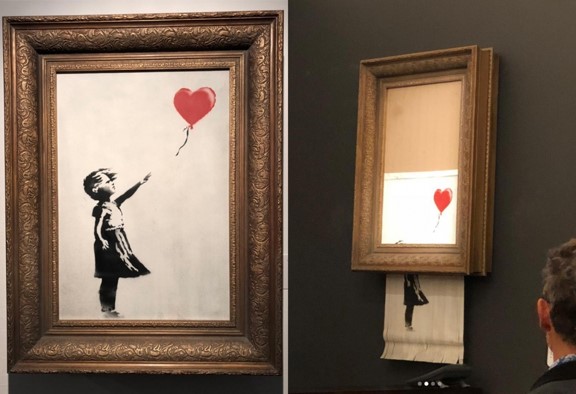
Hyperallergic: A Banksy artwork “self-destructed” at a Friday night Sotheby’s auction in London.
“Girl with a Balloon” (2006) was the final lot of the evening sale at Sotheby’s and ended things off with an impressive final price of £953,829…
Robert Casterline of Casterline Goodman gallery was in attendance and told Hyperallergic what happened next. He explained there was “complete confusion” and an “alarm inside the frame started going off as the gavel went down.”
“[It] sold for over a million dollars and as we sat there…the painting started moving,” he said, and added that the painting’s frame, also made by Banksy, acted as a shredder and started to cut the canvas into strips. “[It was] all out confusion then complete excitement,” he explained.
Anny Shaw of the Art Newspaper spoke to Alex Branczik, the auction house’s head of contemporary art for Europe, who seemed as surprised as anyone.
Banksy is a genius.
Unusual failed Beatle Asimov markets in everything
[Paul] McCartney was still wrestling with the comparison between the two bands [the Beatles and Wings]. A few months earlier he had commissioned veteran sci-fi author Isaac Asimov to write a screenplay. “He had the basic idea for the fantasy, which involved two sets of musical groups,” Asimov recalled, “a real one, and a group of extraterrestrial imposters. The real one would be in pursuit of the imposters and would eventually defeat them, despite the fact that the latter had supernormal powers.” Beyond that framework, McCartney offered Asimov nothing more than “a snatch of dialogue describing the moment when the group realised they were being victimised by imposters.” Asimov set to work and produced a screenplay that he called “suspenseful, realistic and moving.” But McCartney rejected it. As Asimov recalled, “He went back to his one scrap of dialogue out of which he apparently couldn’t move.”
That is from Peter Doggett’s excellent You Never Give Me Your Money: The Beatles After the Breakup.
My Conversation with Bruno Maçães
Here is the audio and transcript, here is the opening summary:
Political scientist Bruno Maçães has built a career out of crossing the globe teaching, advising, writing, and talking to people. His recent book, born out of a six-month journey across Eurasia, is one of Tyler’s favorites.
So how does it feel to face Tyler’s rat-a-tat curiosity about your life’s work? For Bruno, the experience was “like you are a politician under attack and your portfolio is the whole of physical and metaphysical reality.”
Read on to discover how well Bruno defended that expansive portfolio, including what’s missing from liberalism, Obama’s conceptual foreign policy mistake, what economists are most wrong about, how to fall in love with Djibouti, stagnation in Europe, the diversity of Central Asia, Hitchcock’s perfect movie, China as an ever-growing global force, the book everyone under 25 should read, the creativity of Washington, D.C versus Silicon Valley, and more.
Here is one bit:
MAÇÃES: This raises deep philosophical questions and political questions. If you want Turkey to become like Europe, then you have to project European power across Turkey. If Europe no longer has that ability, then you shouldn’t be surprised that Turkey looks elsewhere.
It’s very simple. I think I say in the book that in order to be loved, you also have to be feared. This idea that you find in Europe now, that without projecting any kind of power, other countries will be attracted to the European model, that’s a form of utopianism. I just cannot see that happen.
COWEN: So Europe lacks the spirit of adventure.
MAÇÃES: That is certainly the case. I think you see that. One of the areas where the spirit of adventure today is more relevant and important is technology. You see in Europe the idea that technology’s against us, and we should resist this rather than embrace it. A very negative spirit, which I think is a good example of how adventure has disappeared from the European psyche.
And:
COWEN: Russia. Why is Russia as a world power currently underrated?
MAÇÃES: The most impressive thing about Russia is, in fact, something that you might not think at first: the power of organization. We have this image of Russia as a failed state in many respects.
But in order to keep that empire, in order to keep it together throughout the centuries, in order to develop it to some extent, in order to bring together so many ethnicities, so many religions . . . it’s fair to say that Russia has done a better job of integrating its Muslim population, which is close to 15 percent, than any other country, I would argue — certainly any other major country.
The power of the Russian state, the ability to organize, to dispose, to connect, is one of the great political stories of mankind — to see how the Russian state was able to grow and to extend itself. And that’s still there.
Original and highly recommended. Again, here is Bruno’s book The Dawn of Eurasia: On the Trail of the New World Order.
What is land for Georgist purposes?
Matthew Prewitt wrote this interesting piece “Reimagining Property: A Philosophical Look at Harberger Taxation.” As he defines a Harberger tax, you report the value of your property, pay a tax on that amount, but if you under-report the value someone can buy the property from you at that price. The goal is to encourage turnover of assets, rather than hoarding of assets. Prewitt writes:
Recall that in a world where the natural and artificial components of capital were magically unmixed, we might impose a Harberger tax near the turnover rate on natural capital, and a Harberger tax near zero on artificial capital. But, recognizing that we do not live in such an ideal world, Posner and Weyl propose to set HT rates at varying percentages of the turnover rate for different assets, depending on those assets’ investment elasticities. That is, assets whose value increases more readily with investment should generally enjoy lower HT relative to their turnover rate, to facilitate investment.
…artificial capital is value that emerges in response to incentives…
As time passes, artificial capital starts to resemble natural capital.
Think of a new boat, built yesterday. Now think of the Parthenon. The labor that made the boat can and should be rewarded. It makes sense for the spoils of boat ownership to accrue to its builder. But the labor that made the Parthenon has dissolved into the mists of time. There is no sense rewarding it. We simply find the building in our environment, like an ocean, a mountain, or a nickel deposit. Whoever possess it deserves an incentive for its upkeep, but not a reward for its existence. Any profits from Parthenon ownership ought to be distributed broadly, and not end up in any particular pocket. Thus, unlike the new boat, the Parthenon ought to be treated like natural capital. Yet it is the product of human labor; when erected, it was the very epitome of artificial capital.
Of course there is a decay function in how we treat rights in intellectual property, and this argument suggests there should be a decay function for rights in physical capital as well. After some point in time, that physical capital becomes Georgist land, and thus subject to the efficiencies of the land tax, not to mention possible Harberger taxation.
Prewitt’s conclusion is:
- artificial capital should have a Harberger tax rate near zero
- natural capital should have a Harberger tax near the turnover rate
- artificial capital becomes more like natural capital as more time passes and/or it changes hands more times
More generally, as I suggested about five years ago, the forthcoming fights will be about the taxation of wealth not income.
I wonder, however, if this one shouldn’t be argued in the opposite direction. Let’s say excellence is under-rewarded. If a structure or capital expenditure lasts for a long period of time, maybe that is strongly positive selection and it deserves a subsidy? For one thing, such structures are likely to be iconic brands of a kind, with strong option value and the costs of irreversibility if we let them perish or fall into disrepair. The example of the Parthenon is a useful one, because in fact the monument is endangered by air pollution, and arguably it should receive a larger subsidy for protection, whether for intrinsic reasons or for its economic contribution to Greek tourism.
For the pointer I thank David S.
Ain’t no $20 bills on this Cambridge sidewalk…not any more…
An art installation made up of £1,000 worth of penny coins left in a disused fountain disappeared in just over one day.
The 100,000 pennies were placed in the fountain at Quayside in Cambridge at 08:00 BST on Saturday and were due to be left for 48 hours.
All of the coins were gone by 09:00 BST on Sunday, but the In Your Way project is not treating it as theft.
Artistic director Daniel Pitt said it was “a provocative outcome”.
The work, which used money from an Arts Council England lottery grant, was one of five pieces staged across the city over the weekend.
Cambridge-based artist Anna Brownsted said her fountain piece “was an invitation to respond, a provocation”.
Here is the full story, via Adam, S. Kazan.
What is tragedy? (response to a query)
So what is tragedy?
“A work is a tragedy, Aristotle tells us, only if it arouses pity and fear. Why does he single out these two passions?” That seems wrong to me. For one thing, it is overly subjectivist. Why start with the passions of the audience? What do they know?
I think of a tragic story as embodying a few elements:
1. The downfall represents some kind of principle.
2. Some aspects of the downfall are, in advance, quite expected in the objective sense.
3. The actual story combines both inevitability and surprise in a somewhat contradictory manner. (I reintroduce the subjective ever so slightly here.)
4. The villain probably should have some sympathetic and/or charismatic qualities.
5. There should be a quite particular logic to how the actual events unfold, as they might be related to the above-mentioned principles in #1.
6. A confluence of aesthetic and metaphysical and personality-linked forces should “conspire” to bring about the final outcome. There should be a melding and a consilience to the evolution of the story.
Some near-perfect tragedies are Don Giovanni, The Empire Strikes Back, The Sopranos (evokes nostalgia in me rather than fear or pity), and King Lear, among other works of Shakespeare. Don’t forget Homer, Melville, and the Bible.
Just stay away from Aristotle on this one.
The sixth and final volume of Knausgaard’s *My Struggle*
Remember when Ortega y Gasset wrote: “Within the novel almost anything fits…”? Well, Karl Ove Knausgaard has proven him right in this improbably wonderful conclusion to his ongoing semi-fictionalized autobiographical series My Struggle, the first two volumes of which stand as literary masterworks. It’s not every day that a 1153 pp. rant, outside the author’s main fields of expertise, turns out to be so compelling. But wait…I guess those are his main fields of expertise.
Maybe a third of this book is an intellectual biography of Hitler and an analysis of how the proper readings of Mein Kampf change over the years and decades. “Mein Kampf received terrible reviews,” writes K., and then we learn why they matter. I found that segment to be a masterful take on liberalism and its potential for decline, as Knausgaard tries harder than most to make us understand how Hitler got anywhere at all. Underneath it all is a Vico-esque message of all eras converging, and the past not being so far away from the present as it might seem.
Another third of the book covers various writers, including Dostoyevsky, Handke, Celan, Joyce, Hamsun, and Olav Duun, and why they matter to Knausgaard, and is interesting throughout. There are detailed brilliant takes on Herman Broch’s The Death of Virgil and Rene Girard on Hamlet and then desultory remarks on William Petty’s Political Arithmetick. For those sufficiently familiar with the underlying sources, it absolutely comes off.
The other third of the book, most prominent at the beginning, is a mostly failed and meandering fictional narrative of the author’s own life, unsatisfying if read “straight up” but in context a reminder that all thought processes degenerate, and an account of how and why they do so, and in that regard an ideal introduction to the rest of the work and a meta-move which ties together all six volumes of the series, including the often-unsatisfying volumes 3-5. But it will try your patience.
As for what went wrong with liberalism, here is one relevant bit:
Charisma is one of the two great transcendental forces in the social world: beauty is the other. They are forces seldom talked about, since both issue from the individual, neither may be learned or acquired, and in a democracy, where everyone is meant to be considered equal and where all relationships are meant to be just, such properties cannot be accorded value, though all of us are aware of them and of how much they mean…beauty eclipses everything, bedims all else, it is what we see first and what we consciously or unconsciously seek. Yet this phenomenon is shrouded in silence…driving it out instead by our social mechanisms of expulsion, calling it stupid, immature, or unsophisticated, perhaps even primitive, at the same time as we allow it to flourish in the commercial domain, where it quietly surrounds us whichever way we turn…
I do “get” why the reviews have been so mixed, but I think someone has to have the stones to stand up and call this a masterpiece and that someone is me. With it, Karl Ove Knausgaard has cemented his claim to have produced something truly creative and new, and now instructive as well.
You can pre-order it here, or if you were in a rush as I was, order from the UK.
My Conversation with Claire Lehmann of Quillette
Here is the transcript and audio, definitely recommended. Here is part of the summary:
She and Tyler explore her ideas about the stifling effect of political correctness and more, including why its dominant form may come from the political right, how higher education got screwed up, strands of thought favored by the Internet and Youtube, overrated and underrated Australian cities, Aussie blokes, and more.
Here is an excerpt:
COWEN: When did political correctness become a major issue, or become a major issue again? And why do you think it happened exactly then?
LEHMANN: That’s a good question, and I don’t know if I have the answer. I know that there were lots of debates around political correctness in the early ’90s, for example.
COWEN: Yes, and it seems to fade away and then come back.
LEHMANN: Yeah. That’s when Camille Paglia was talking about PC, and Robert Hughes had a book, The Culture of Complaint.
I’ve noticed in my own life that I started noticing political correctness around 2007. At the time, I thought it had something to do with the business model of Internet publishing.
That was when Gawker and the blog Jezebel was really popular. It was established in 2007, and then it got very popular over the next couple of years. I thought that there were a lot of clickbait kind of articles promoting these really simplistic black-and-white narratives of oppression.
Unless one had reasonable critical thinking skills, I could see how young people could be influenced by that kind of content coming out. I think there’s something to do with the Internet and the way the media has had to adapt to this new business model where you have to drive . . . You have to get lots of views, lots of hits, millions more than you would with the newspapers.
I think it’s something to do with that, but that’s probably just one variable in many other factors.
COWEN: What do you think of the hypothesis that political correctness is a kind of virus that’s hijacked the left? It’s figured out some kind of weak entry point, and it’s come in and taken over parts of it, and it will bring down many victims with it, but actually, it’s crippling the left.
LEHMANN: Yep, yeah.
COWEN: True or false?
LEHMANN: Probably true.
COWEN: If one objects to that argument, we should in a sense encourage more of it, at least if we’re being pure utilitarians, or not?
And:
COWEN: Probably in the media? In general, intellectual life, but if you take, say, the United States as a whole, do you think it’s left-wing or right-wing political correctness that’s stronger and more destructive?
LEHMANN: Yeah, it’s probably right-wing political correctness.
A question from me:
COWEN: I’ve been speaking about the right in aggregate terms, but if you think of the effect of the Internet, which strands of the right do you think are favored, and which do you think are falling away because of Internet discourse? Because it shouldn’t favor it all equally, correct?
We also cover Australia vs. New Zealand, the masculine ethos of Australia and its origins, why PC is different in Australia, the movie Lantana (which we both strongly recommend), and yes Australian fashion.
Pictures of Hyperinflation
These elegant pictures from Reuters illustrate the price of goods in Venezuela as the inflation rate hits 82,700 percent.

This one suggests some obvious substitutions.
