Category: The Arts
Why are antiques now so cheap?
Compared with the heyday of antiques collecting, prices for average pieces are now “80 percent off,” said Colin Stair, the owner of Stair Galleries auction house in Hudson, N.Y. “Your typical Georgian 18th century furniture, chests of drawers, tripod tables, Pembroke tables,” he noted, can all be had for a fraction of what they cost 15 to 20 years ago.
That is from Tim McKeough at the NYT, there is plenty more evidence in the article. I can think of a few hypotheses:
1. eBay and the internet have increased supply more than demand. It is much easier to sell an estate, or the contents of your attic, than before. But the upward potential for demand in the market isn’t nearly as significant. Some people say “well, I would in fact buy and collect antiques if I could get the right 18th century pieces at 40% their current values,” but many more people just aren’t interested at all.
2. The article also demonstrates that many buyers are refocusing their demands on newer pieces. Our attitude toward the past may have changed in some fundamental way, with items before a certain date just not existing in most people’s aesthetic universes. It’s a bit like how people collect Elvis memorabilia, or even just treat Elvis as less iconic than they used to.
For many people today, “an English antique represents something that is kind of sad and tired,” said Thad Hayes, a New York interior designer who has recently been emptying antiques-filled homes and designing new rooms with contemporary pieces for wealthy clients both young and old.
Contemporary design, he said, “represents something that’s a lot more optimistic and positive.”
3. Homes have changed: “More homes have open-concept, casual living spaces rather than formal dining rooms and studies, which reduces the need for stately mahogany dining tables, chairs and cabinets.”
4. The aesthetic of the internet itself has pushed people away from “old and musty.” Just look at the kind of images you see on Instagram.
What else?
My Conversation with Robin Hanson
I am honored to have been able to do this, here is the podcast and transcript. The topics we covered included…the ideas of Robin, most of all: “With Robin, we go meta. Robin, if politics is not about policy, medicine is not about health, laughter is not about jokes, and food is not about nutrition, what are podcasts not about?”
Here is one exchange:
COWEN: Let’s say I’m an introvert, which by definition is someone who’s not so much out there. Why is that signaling? Isn’t that the opposite of signaling? If you’re enough of an introvert, it doesn’t even seem like countersignaling. There’s no one noticing you’re not there.
HANSON: I’ve sometimes been tempted to classify people as egg people and onion people. Onion people have layer after layer after layer. You peel it back, and there’s still more layers. You don’t really know what’s underneath. Whereas egg people, there’s a shell, and you get through it, and you see what’s on the inside.
In some sense, I think of introverts as going for the egg people strategy. They’re trying to show you, “This is who I am. There’s not much more hidden, and you get past my shell, and you can know me and trust me. And there’s a sense in which we can form a stronger bond because I’m not hiding that much more.”
And:
COWEN: Here’s another response to the notion that everything’s about signaling. You could say, “Well, that’s what people actually enjoy.” If signaling is 90 percent of whatever, surely it’s evolved into being parts of our utility functions. It makes us happy to signal. So signaling isn’t just wasteful resources.
What we really want to do is set up a world that caters to the elephant in our brain, so to speak. We just want all policies to pander to signaling as much as possible. Maybe make signals cheaper, but just signals everywhere now and forever. What says you?
HANSON: I think our audience needs a better summary of this thesis that I’m going to defend here. The Elephant in the Brain main thesis is that in many areas of life, perhaps even most, there’s a thing we say that we’re trying to do, like going to school to learn or going to the doctor to get well, and then what we’re really trying to do is often more typically something else that’s more selfish, and a lot of it is showing off.
If that’s true, then we are built to do that. That’s the thing we want to do, and in some sense it’s a great world when we get to do it.
My complaint isn’t really that most people don’t acknowledge this. I accept that people may be just fine leaving the elephant in their brain and not paying attention to it and continuing to pretend one thing while they’re doing another. That may be what makes them happy and that may be OK.
My stronger claim would be that policy analysts and social scientists who claim that they understand the social world well enough to make recommendations for changes—they should understand the elephant in the brain. They should have a better idea of hidden motives because they could think about which institutions that we might choose differently to have better outcomes.
And of course I asked:
COWEN: What offends you deep down? You see it out there. What offends you?
And why exactly does it work to invite your date up to “see my etchings”? And where is “The Great Filter”? And how much will we identify with our “Em” copies of ourselves? There is also quantum computing, Robin on movies, and the limits of Effective Altruism. On top of all that, the first audience question comes from Bryan Caplan.
You should all buy and read Robin’s new book, with Kevin Simler, The Elephant in the Brain: Hidden Motives in Everyday Life.
My Conversation with Matt Levine
Here is the transcript and audio, Matt was in great form. We covered Uber, derivatives, crypto, Horace, Latin and the ancient world, neighborhoods of New York City, whether markets are volatile enough, Buffy the Vampire Slayer, whether IPOs are mispriced, Nabokov and modernist literature, Achilles and Homer, and of course the Matt Levine production function (“panic”).
Here is one excerpt:
LEVINE:
…What I’d like the story to be is that financial markets have gotten smarter and they reacted less to news. So even though the news is noisier, they react less to that noisy news because it turns out not to affect asset prices in as noisy a way as you’d think by watching TV.
I think that there is something compelling to that because we actually have seen smart people build smart things that do a good job of making investing decisions. So you’d expect over time, as people build more rational investing tools, investing would become more rational.
The good counterargument to that is that investing is not a technological problem in the world that can be solved. It’s an interpersonal fight. Trading, in particular, is an attempt to be better than someone else. You can never make trading more rational because as you get better, someone else gets better. The residue will ultimately still be your human biases.
I’m biased towards the view that we have gotten smarter at decoupling our emotional reactions to the news from financial asset prices. Part of that is — whether or not that’s true globally — there’s a local sense in which the first day of Trump’s election everyone panicked. Then he said another crazy thing, and then he said another. Eventually you tune it out. That’s a form of this thing of financial assets reacting less to human reactions to the news.
Here is another:
COWEN: Do you have a single biggest worry [about asset markets], however tiny, tiny, tiny it may be?
LEVINE: I don’t think I do. I don’t think I do. The thing that I find weirdest is the lack of volatility in the face of a very strange and volatile world, but I’ve reconciled myself to that. This is my efficient markets optimism, where I assume that if something bad is happening, it would happen.
COWEN: But efficient markets is also a pessimism, right? It’s harder to make the world better than it already is because you can’t see past what others are seeing very easily.
LEVINE: Sure, it’s an efficient markets conservatism or something.
And finally:
LEVINE: I have an idiosyncratic take on Book 9 of the Iliad. The Iliad is the story of Achilles is the great warrior on the Greek side in the Trojan War. He gets mad at some slight, and he goes back to his tent to sulk, and the Greeks start losing.
So then they send emissaries to his tent to say, “Please come back.” And he says, “No.” Then, the Greeks start losing some more.
Eventually, he comes back, and he gets killed. That’s basically the story of the Iliad. Book 9 is where they send the emissaries to say, “Please come back,” and he says, “No.”
He gives this speech, this response that is weird, where he says, effectively, “The prophecy is that if I go back to fight here, I will die here. My name will be immortal. If I don’t go back to fight, I’ll go home and live a long life and will be forgotten.” He chooses to go back and be forgotten. Then, later, he changes his mind because his friend gets killed.
I think the existential examination of this Greek warrior and this heroic culture that clearly valorizes heroism and deathless fame and everything, and who is, canonically, the most famous heroic warrior and the one with the most deathless fame, he’s the one who says, “Nah, I’d rather go back and live a long life on my farm.”
The forcing of that choice is the central point of the highest work of Greek art, sort of prefigures a lot of existentialist thought in the future, I think.
Do read and listen to the whole thing…
My favorite things Poland
No, I am not there now, but Adam D. emails me and requests this, so here goes:
1. Novel: Stanislaw Lem, Solaris, all about identity and erotic guilt. Next in line would be any number of Isaac Singer novels, I don’t have a favorite offhand. Soon I will try The Family Moskat. Gombrowicz is probably wonderful, but I don’t find that it works for me in translation. Quo Vadis left me cold.
2. Chopin works: The Preludes, there are many fine versions, and then the Ballades. The Etudes excite me the most, the Mazurkas and piano sonatas #2 and #3 are most likely to surprise me at current margins of listening. I find it remarkable how I never tire of Chopin, in spite of his relatively slight output.
3. Painter: This one isn’t as easy as it ought to be.
4. Architect: Daniel Libeskind was born in Poland. But more generally one can cite Krakow, and I suspect the older versions of Gdansk.
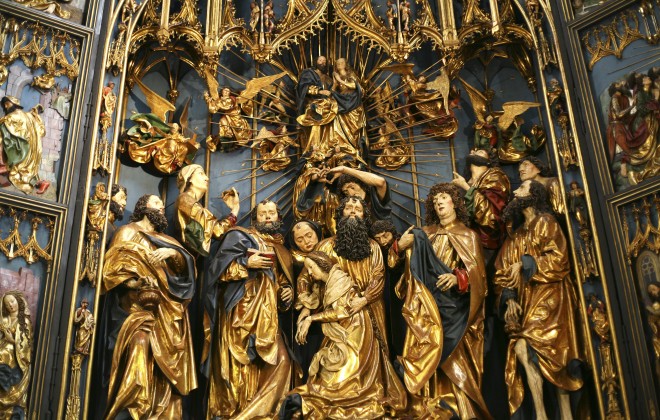
The wooden churches and folk art of southern Poland also deserve mention.
5. Political thinker: Czesław Miłosz, The Captive Mind, about the capitulations of artists to communism, though subtler than just an anti-state polemic. He once stated: ” I have never been a political writer and I worked hard to destroy this image of myself.” I do not feel I can judge his poetry, though last year’s biography of him was a good book.
6. Astronomer and originator of the quantity theory of money: Copernicus.
7. Television show: The Decalogue, perhaps #4 is my favorite. Here is good NPR coverage.
8. Movie: Any of the Andrzej Wajda classics would do, maybe start with Kanal or Ashes and Diamonds. More recently I would opt for Ida. I like Kieślowski’s TV more than his films, and prefer Hollywood Polanski to Polish Polanski.
9. Classical pianist: There are many, but I will cite Kristian Zimerman over Artur Rubinstein. The former plays the piano better. Josef Hofmann deserves mention, but there are dozens of picks here.
10. Jazz musician: Trumpeter Tomasz Stańko.
11. Economists: There is Kalecki, Hurwicz, the now-underrated Oskar Lange (doesn’t Singaporean health care work fine?), and Victor Zarnowitz. I had thought Mises was born in Poland, but upon checking it turned out to be Ukraine.
Overall the big puzzle is why there isn’t more prominence in painting, given Poland’s centrality in European history.
Robin Hanson bleg
Soon I will be having a conversation with Robin Hanson — the Robin Hanson. What should I ask him? The jumping-off point will be his new book with Kevin Simler, but of course we won’t stop there.
*Off the Charts*
As I’ve already mentioned, the author is Ann Hulbert and the subtitle is The Hidden Lives and Lessons of America’s Child Prodigies. This is an excellent book, and so far I am overwhelmed by the high quality and quantity of books coming out this January (in comparison to last year’s near drought). You don”t have to care about prodigies per se, I would recommend this to anyone in Silicon Valley or finance who thinks about how to find and recruit talent, or anyone interested in the history of art, science, or technology.
I had not known that musician Henry Cowell was the protege of Thorstein Vebeln’s ex-wife, Ellen Veblen. Here is just one bit about Henry:
He was in his element. As Clarissa noted, Henry was highly receptive without being unduly impressionable. “Always he has worked mostly alone,” she observed, “browsing for information, when he felt in need of it, whenever a door opened.”
As a child, he quickly outgrew his town’s public library, and was suspected of skimming the books he claimed to have read. He could give a clear and detailed summary of each. He was born in rural Menlo Park, formal schooling never really worked for him, and Irish music remained a touchstone of his composing, albeit supplemented with tone clusters, extreme dissonance, and a variety of rhythmic innovations. To many people at the time, his music sounded like noise.
Here is a short YouTube clip of Cowell playing the piano.
It’s not a “this puts all the pieces together for you book,” but still I am finding it engrossing. I take the overall message to be a) mentorship is very important for prodigies, and b) most mentors have no idea what they are doing.
My Conversation with Ross Douthat
I think Ross, along with Steven Pinker, received the hardest (though never hostile) questions from me, but of course that is a measure of respect. Plus serious questions about God are difficult by their nature. Here is how the summarizers described the ground covered:
…Douthat’s views on religion and theology, but then moves on to more earth-bound concerns, such as his stance on cats, The Wire vs The Sopranos, why Watership Down is the best modern novel for understanding politics, eating tofu before it was cool, journalism as a trade, why he’s open to weird ideas, the importance of Sam’s Club Republicans, the specter of a Buterlian Jihad, and more.
Not to mention Reformicons, CRISPR, Thiel/Girard, Godwin’s Law, euthanasia, what Ross learned his mother, and the dangers of too much smart phone use. Ross responded in fine form, here is the audio and transcript. Here is one excerpt:
DOUTHAT: I suppose that I’m drawn to the idea that the truth about human existence lies in what can seem like paradoxical formulations, and this is of course very Catholic in certain ways. Certainly a G. K. Chestertonian idea, so I’m just stealing it from other people. But the idea that various heresies of Christianity, Calvinism included — with apologies to my Calvinist friends — tend to take one particular element of you that’s supposed to be in synthesis and possibly in tension, and run with it. And therefore the truth about things lies in a place that may seem slightly contradictory.
And I think this is borne out in many ways in everyday experience. This both-and experience of human existence. The idea that you can’t split up grace and works in any kind of meaningful way. It’s connected to larger facts about the nature of human existence. The tension between determinism and free will that persists in any philosophical system. You can get rid of God and stop having these Jansenist Jesuit arguments about predestination and so on, but you’re still stuck with the free will–determinism debate. That debate doesn’t go away.
So, yeah, there’s a point at the intersection of different ideas that is as close to the truth as our limited minds can get and in Christian thought, we call that point orthodoxy. Now, how that is connected to my political views is a really good question.
And:
COWEN: We all know the Marcionite heresy: the view, from early Christianity, that the Old Testament should be abandoned. At times, even Paul seems to subscribe to what later was called the Marcionite heresy. Why is it a heresy? Why is it wrong?
DOUTHAT: It’s wrong because it takes the form . . . It’s wrong for any number of reasons, but in the context of the conversation we’re having, it’s wrong because it tries to basically take one of the things that Christianity is trying to hold in synthesis and run with it to the exclusion of everything else, and essentially to solve problems by cutting things away.
The Marcionite thesis is, basically, if you read the New Testament, Jesus offers you a portrait of God that seems different from the portrait of God offered in Deuteronomy; therefore, these things are in contradiction. Therefore, if you believe that Jesus’s portrait of God is correct, then the Deuteronomic portrait of God must be false; therefore, the God of the Old Testament must be a wicked demiurge, etc., etc. And the next thing you know, you’re ascribing to, again, a kind of . . . What is the Aryan Christianity of the Nazis, if not the Marcionite heresy given form in the 1930s and 1940s?
And so the orthodox Christian says, “No, any seeming tension between the Old Testament and the New, any seeming contradiction, is actually suggesting that we need to look for a kind of synthesis between them, and for a sense in which there is not contradiction, but fulfillment in some way, which —
COWEN: Bringing us back to Hegelian Douthat.
DOUTHAT: Yes, yes.
And:
I think it’s probably fair to say that Chesterton’s Father Brown stories had as much influence on my worldview as his more sort of polemical and argumentative writings. And, again, I think therein lies some important insight that I haven’t thought through, but I think you’re correctly gesturing at, about a particular way of thinking about God and theology that isn’t unique to Christianity, but that is strongly suggested by just the structure of the revelation that we have. Marilynne Robinson has a line, I think in Gilead, about — one of the characters is imagining that this life is like the epic of heaven. That we’re living in the Iliad or the Odyssey of heaven. This is the story that will be told in the streets.
And:
COWEN: When you see how much behavior Islam or some forms of Islam motivate, do you envy it? Do you think, “Well, gee, what is it that they have that we don’t? What do we need to learn from them?” What’s your gut emotional reaction?
On another topic:
I’ve been always disappointed that there hasn’t been a kind of sustained Watership Down revival because it’s such a great book and it’s a book about — essentially, it’s about a founding.
It’s connected, in a sense, to the kind of things that the Straussians are always arguing about and so on. What does the founding mean, and so on? But you have a group of rabbits who go forth and encounter different models of political order, different ways of relating to humankind, that shadow over rabbit-kind at any point.
You have a warren that has essentially surrendered itself to humanity and exists as a kind of breeding farm, and you have a warren that’s run as a fascist dictatorship essentially. And then you have this attempt to form a political community that is somewhere in between the two, getting back to the Hegelian synthesis and so on. And you have sort of this primal narrative where the problem is of course that they don’t have any females, and so there’s this competition, this competition for reproductive power that’s carried out between these different warrens where the rabbits from the good warren have to literally — not kidnap, because the does come willingly — but steal women from the fascist dictatorship, which maintains a ruthless control over reproduction.
So there’s just a lot of fascinating stuff there, and then it’s all interspersed with storytelling. There’s the sort of rabbit folktales that Richard —
COWEN: So, narrative again.
DOUTHAT: Narrative again.
Strongly recommended, and I do thank Ross for putting up with me. Do read or listen to the whole thing.
And I very much enjoyed reading Ross’s forthcoming book To Change the Church: Pope Francis and the Future of Catholicism, which I found totally engrossing.
I, Pencil Revisited
Leonard Read’s essay I, Pencil showed how even simple objects like a pencil were produced only through the cooperation and coordination of many thousands of people all over the world who often knew neither one another nor even what their actions ultimately produced. Milton Friedman made the pencil metaphor famous in Free To Choose when he said that “There’s not a single person in the world who could make this pencil.” Tyler and I illustrate the same idea with a romantic twist in our I, Rose video.
The NYTimes doesn’t seem aware of the history but, as if guided by an invisible hand, has a lovingly produced series of photos from a pencil factory showing that even the proximate steps are charmingly esoteric.



“Queen’s bra fitter Rigby & Peller loses royal warrant”
A company which supplied lingerie to the Queen has lost its royal warrant over a book which revealed details of royal bra fittings.
Rigby & Peller, a luxury underwear firm founded in London, had held the royal warrant since 1960.
It was withdrawn after June Kenton, who fitted bras for the Queen, released a book called ‘Storm in a D-Cup’.
Mrs Kenton said there was “nothing” in the book to “be upset about”, adding that it was an “unbelievable” decision.
Buckingham Palace said it did not “comment on individual companies”.
A statement from Rigby & Peller said it was “deeply saddened” by the decision, adding it was “not able to elaborate further on the cancellation out of respect for her Majesty the Queen and the Royal Warrant Holders Association”.
The Royal Warrants Association says 20 to 40 Royal Warrants are cancelled every year – and a similar number granted.
File under “elsewhere in the cosmos.” And for the pointer I thank M.
*The Elephant in the Brain: Hidden Motives in Everyday Life*
The authors are Kevin Simler and Robin Hanson, and now it is out!
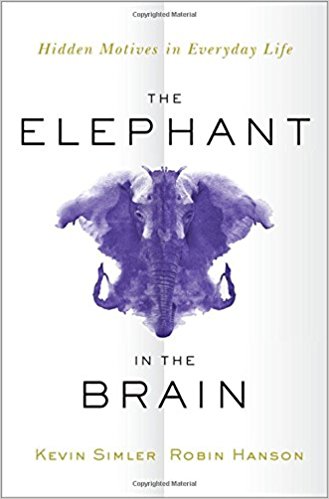
Robin reports:
On press coverage, back in July Publishers Weekly had a paragraph on it, the Boston Globe did an interview of me back then that they just released, Vice interviewed me recently so I expect that out soon, and I’m told that a Wall Street Journal review is forthcoming. Amazon now has 5 reviews, Goodreads has 7, and 2 reviews have appeared on blogs.
I am pleased to be doing a Conversation with Robin about the book, and other matters too. But don’t forget — conversations aren’t about talking!
What explains the formation and decay of clusters of creativity?
Michel Serafinelli and Guido Tabellini have a new paper on that question, here is the abstract:
Creativity is often highly concentrated in time and space, and across different domains. What explains the formation and decay of clusters of creativity? In this paper we match data on thousands of notable individuals born in Europe between the XIth and the XIXth century with historical data on city institutions and population. After documenting several stylized facts, we show that the formation of creative clusters is not preceded by increases in city size. Instead, the emergence of city institutions protecting economic and political freedoms facilitates the attraction and production of creative talent.
Recommended.
My Law and Literature reading list 2018
The New English Bible, Oxford Study Edition [not all of it]
Guantanamo Diary, by Mohamedou Ould Slahi
Petina Gappah, The Book of Memory
Glaspell’s Trifles, available on-line.
Year’s Best SF 9, edited by David G. Hartwell and Kathryn Cramer, used or Kindle edition is recommended
The Metamorphosis, In the Penal Colony, and Other Stories, by Franz Kafka, edited and translated by Joachim Neugroschel.
In the Belly of the Beast, by Jack Henry Abbott.
Sherlock Holmes, The Complete Novels and Stories, Sir Arthur Conan Doyle, volume 1, also on-line.
I, Robot, by Isaac Asimov.
Juan Gabriel Vasquez, Reputations
The Pledge, Friedrich Durrenmatt.
Ian McEwan, The Children Act
Shakespeare, The Tempest, Folger edition
Margaret Atwood, Hag-Seed
Curtis Dawkins, The Graybar Hotel
Movies: To be determined.
Further points on how to understand modern India (from the comments)
Good post.
There are a few other topics that can serve as useful handles to “understand” India.
1. Study the folk history of the popular Indian pilgrimage sites –
For a lot of people, Hinduism is associated with abstruse metaphysics, mysticism, Vedanta, and Yoga. And this obsession with the high falutin theoretical stuff, means that many students of Hinduism don’t pay as much attention to the pop-religion on the ground. And this religion is best understood by actually understanding the few hundred important pilgrimage sites scattered across the country. Each of these sites is ancient and has a “legend” associated with it. (the so-called Sthala Purana). The civilizational unity of India is largely accomplished because of the pan Indian reverence for these pilgrimage sites. Be it Benaras in the North, Kolhapur in the west, Srirangam in the south, or Puri in the East. A nice way to get started on this is Diana Eck’s book – “India – A Sacred Geography” where she makes a strong case for the theory that the idea of one India is one that is primarily stemming out of the pilgrimage experience of Hindus.
This study of pop religion will be messy and frustrating for people from an Abrahamic monotheistic background. But there is no better way to understand what makes Indians tick spiritually, and why every Indian is a millionaire when it comes to Religion.
2. Study of the history of Indian mathematics –
This may seem like an odd handle to understand India. But in my view it is useful, because Indian mathematical tradition that goes back to roughly 700 BCE, is one that is highly empirical, algebraic, and averse to theorizing and rigorous proofs. So it tells you a lot about the Indian mind. Which is very different from the Greek mind, in that it places a very very low premium on “neatness”, and a high premium on “improvisation”.
Unlike the Greeks, Indian mathematics is not that big on geometry. And also not that big on “visualization”. While someone like Euclid leveraged diagrams to make his point, Indian mathematicians like Brahmagupta and Bhaskara I/II, just stated results in 2-line or 4-line verses.
The Indian mathematical tradition is arguably the greatest Indian contribution to human civilization. Particularly the decimal number system, infinite series, and the algebraic orientation in general (markedly different from the Greek emphasis on geometry). The tradition includes Sulba Sutras (700BCE), Aryabhata (400CE), Varahamihira (400CE), Brahmagupta (500-600CE), Bhaskara I (600CE), Bhaskara II (1100-1200 CE), and ofcourse the famed Kerala school of mathematics (14th century). Madhava from the Kerala school approximated Pi to 13 decimal places. In more recent times, the most distinguished mathematical mind is ofcourse Srinivasa Ramanujan, very much a man in the Indian tradition, who disdained proofs and conventional rigor, and instead relied on intuition and heuristics.
3. Study of Indian poetry and music and its emphasis on meter
This is something that is again uniquely Indian – the very very high emphasis on meter. Which is a consequence of the Indian oral tradition and cultural aversion to writing. Which continues to this day. The emphasis on meter and rhyming was partly an aid to memorization and rote learning. And this emphasis begins with the Vedas (the earliest religious literature, preserved orally for some 1500 years before they were written down in the common era) And you see this in Indian poetry and even Indian film music to this day! Bollywood songs are characterized by their metrical style and perfect rhyming, which you don’t always see in western popular music. In that sense, the metrical legacy of the Vedas is still alive in popular culture.
That is from Shrikanthk.
Binge-Worthy and Not Binge-Worthy
Top of my list for binge-worthy over the holiday season is The Marvelous Mrs. Maisel on Amazon Prime. It’s written and directed by Amy Sherman-Palladino and like her previous show, The Gilmore Girls, it features whip-smart women spouting fast-paced dialogue but here decidedly more ribald and foul-mouthed. The show, set in 1958 New York, features Rachel Brosnahan as the eponymous Midge Maisel who, 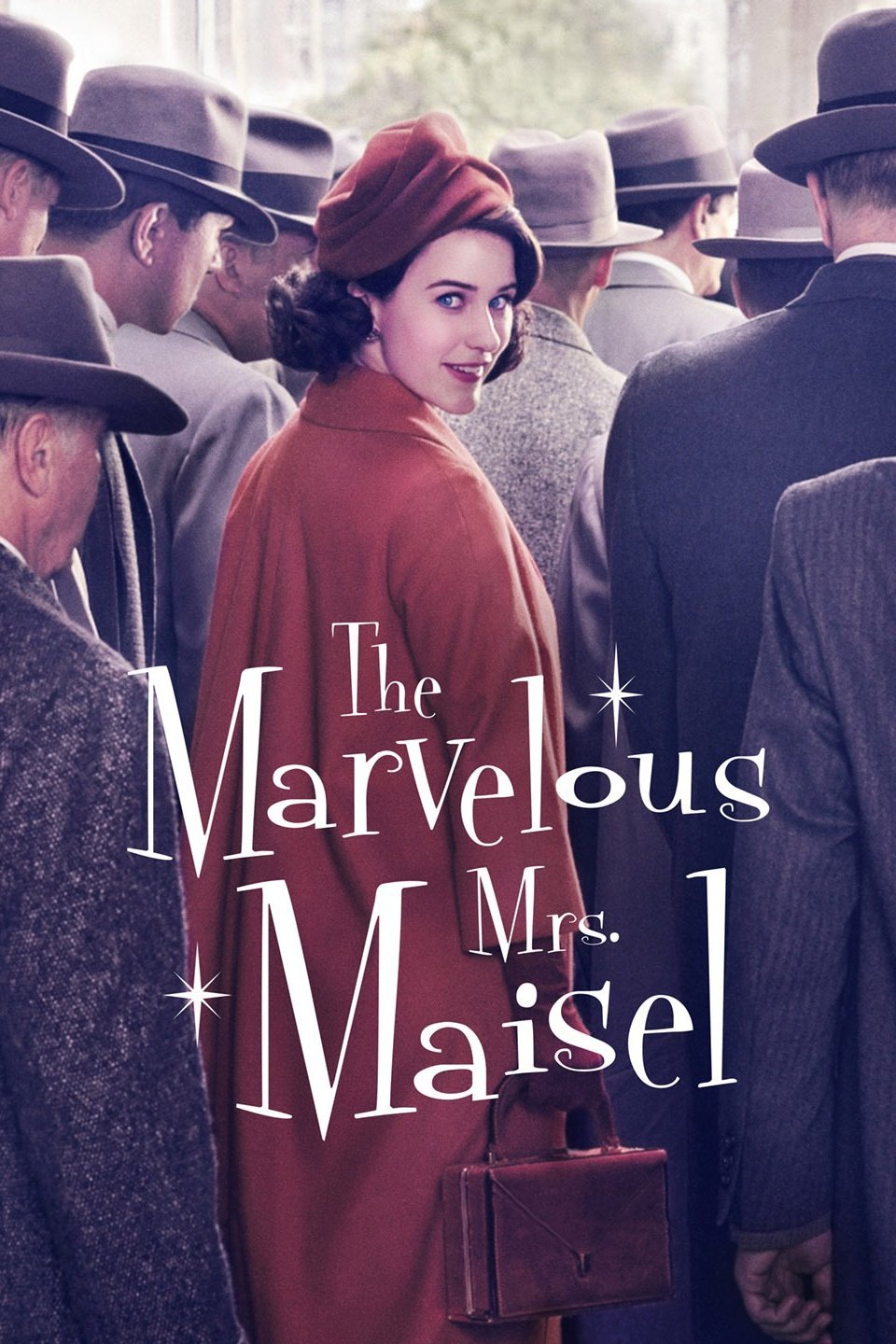 when her husband leaves her for a shiksa, finds unexpected release by explosively ripping into the situation in a public monologue that gets her arrested for indecency alongside comedian Lenny Bruce. Midge is at the center of three New York City Jewish cultures, the intellectual, represented by her father the mathematician Abe Weissman (in an excellent performance by Tony Shalhoub), the Yiddish business culture as represented by her father-in-law, Moishe Maisel played by Kevin Pollak, and the cultural critic represented by Lenny Bruce (played by Luke Kirby). I especially liked the show as a portrait of the young artist, drawing on and combining all three cultures, honing her material, working it out, mastering the process. Brosnahan as Midge is the very definition of winning. Alex Borstein as aspiring agent Susie Myerson gets some of the best lines. The children are mute and faceless, an interesting choice.
Bright, the $90 million “epic” on Netflix is watchable but ho-hum. The premise seems straight out of Hollywood mad libs: orcs+elves+buddy cop movie in modern LA. Let’s get Will Smith! The undertones of “orcs are like gang-banger blacks” was off-putting.
Godless on Netflix was a near miss. It’s a Western and has a great performance by Jeff Daniels as a spiritual, psychopath gang leader. In fact, I liked everyone in it including Michelle Dockery and Scoot McNairy (Gordon Clark from Halt and Catch Fire) but the show has no center. Is it about Dockery’s character, the single mom with an Indian son, trying to make it on the farm? Is it about the town of women who all instantly lost their husbands in a terrifying mining accident? It is about the going-blind Sheriff trying to track  down the killer-gang in one last attempt to win the woman he loves? Or is it about the buffalo cowboys trying to make their way in a white man’s land after the civil war? Any of these stories could have been, indeed would have been, interesting but they are all touched upon and then dropped. Focus goes instead to the “hero,” the bad-guy orphan turned (for reasons we never learn) good. Boring. Oh, and what the hell is going on with the ghost Indian?
Speaking of Halt and Catch Fire it’s on AMC and Netflix and also makes my binge-worthy list. It’s about the rise of the personal computer and the internet. The first season was very good. The second season flagged with a bunch of unnecessary and diverting plots about sex, including a bizarre AIDS subplot. It got back on track in the third season, however, and finishes with the wonderful fourth season and the transcendent Goodwill episode.
The Punisher on Netflix. Binge-worthy! Be forewarned, however, this is the most violent of the Marvel superhero shows. Lots of homage here to Dirty Harry, Goodfellas the infamous eye-ball scene from Casino (NSFW and maybe NSFH). The surface plot, guess who the bad guy is?, was boring and predictable but there’s also lots of interesting commentary on war, the bonding of men (hints of fraternal polyandry) and the pull of amoral familism when society seems to be breaking down.
How to understand modern India
I could just rewrite my post How to understand modern China, but change the examples. But you can do that mental exercise yourself, and besides it is easier to access information about India in the English language. So let me try a very specific recommendation for India:
Study Indian textiles and their history
I found this the single most useful way to get a handle on Indian history, a bit less on contemporary India. Here’s why:
1. The artistic side of textile history gives you a clear sense of regional differences, and also Islamic influence, or lack thereof.
2.. It focuses your attention rather immediately on the role of women and women’s work, and also how this interacted with industrialization.
3. In the early 18th century, India was a world leader at cloth production, but it lost this position by the early 19th century. Studying textiles and cloth production offers an excellent window on their major story of economic decline, and how British import penetration, backed by colonialism, contributed to Indian deindustrialization.
4. Relatively poor and neglected regions of India, such as Bihar and Orissa, have a strong presence in Indian folk textile traditions, and you will learn plenty about them.
5. Books on textiles will explain the accompanying information about Indian history in a clearer way than will actual history books about India.
6. People who write books on textiles tend to be both clear and careful I have found, perhaps because they love and collect something delicate.
7. Studying textiles and cloth also brings you right to Gandhi’s “Swadeshi’ movement.
8. Unless your income is really quite modest, you can afford to buy and regularly view some pretty high-quality Indian textiles. In India I’ve found some excellent pieces for as cheap as $200-$250.
9. Studying textiles also will bring to your attention India’s tribes and indigenous peoples. And it ties in readily to India’s broader cultural influence throughout Southeast Asia.
10. Textile books have many pretty pictures.
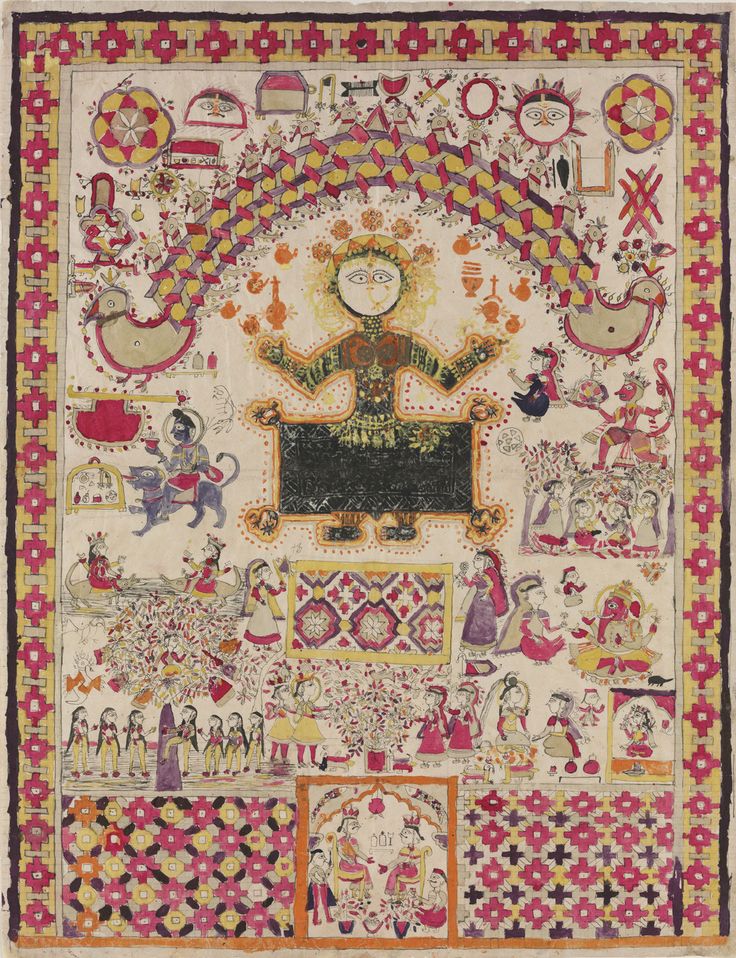
My favorite books on Indian textiles are cited in my discussion of that topic in Creative Destruction: How Globalization is Changing the World’s Cultures. But it’s more a question of reading a bunch of them, rather than picking out a select few. Simple, direct searches will get you to where you need to go.
My favorite collection of Indian textiles is in the Victoria & Albert museum in London. Sadly, I’ve yet to get to the Calico textiles museum in Ahmedabad, though it is very highly regarded.