Category: The Arts
Detroit notes
It remains one of America’s most interesting cities, and now it is seeing a continuing comeback. Downtown remains mostly empty of foot traffic, but I was stunned to see new office buildings and signs of budding prosperity. It did not feel abandoned or hopeless.
Detroit Institute of Art is one of America’s best art museums, showing impeccable taste, though it is notable how much the picture donations simply disappear after some point in time. This is a temple for those are skeptical about modern art, as you will not find it reprensented much here. The American art, the Rembrandt Visitation, the Poussin Holy Family, the Breughel, and the huge Diego Rivera murals are all to die for. The average quality of painting is high as well.
Baobab Fare, not too far from the museum, is a good Burundian (!) restaurant in town.
I was lucky enough to visit the General Motors research and development complex in Cranbrook, mostly designed by Eero Saarinen, due to the ingenuity of Dan Wang (it is mostly not open to the public). Around 20,000 people work there, and it remains a temple of modernist architecture, perhaps anachronistic in effect but beautiful nonetheless. I had not realized how strong the colors were, as that does not come through in the photos.
The Saarinen (papa Saarinen!) house in the Cranbrook Art Museum is perhaps the best Art Deco design I have seen. The museum itself has excellent architecture, sculptures, and gardens, rather than being much of an art museum proper.
Here are good NYT photos of that part of the joy ride.
Overall a trip to the Detroit area is one of the very best American visits you can do, highly recommended, automobile required of course that is why they call it the Motor City.
What makes art great?
That is the title of the new and very stimulating essay by Nabeel Qureshi. It is difficult to summarize, but here is one excerpt:
2. Great art contains multiple overlapping layers of echoes.
This is often harder to spot in verbal artifacts, but it is this feature that I think distinguishes really good works of art from merely ‘ok’ ones.
Most of us are familiar with the surface level ways of doing this: rhyme, for example, knits together different lines of a poem in a semantically irrelevant way that nevertheless makes it feel like part of a unifying whole. Same with assonance and other such effects most of us are familiar with from English class. It is echoes, for example, that make so many verses from the King James Bible so pleasing and beautiful to listen to:
“Arise, shine; for thy light is come, and the glory of the Lord is risen upon thee.” (Isaiah 60:1)
Note the echoing vowel sounds throughout in ‘arise’, ‘shine’, ‘light’, and ‘thy’. Rhyme and assonance are verbal echoes.
In music, the most famous example perhaps is Beethoven’s Fifth, with its famous “ba-ba-ba-BUM“ theme; the short-short-short-long statement in the beginning then echoes through that movement in thousands of ways, sometimes stretched, sometimes slowed down, so that the whole movement feels like an organic thing that has grown from that single seed.
Good art layers these, one on top of another, to build up artifacts of stunning complexity. These are the text equivalents of Gothic cathedrals. Each layer alludes to other layers, too, adding more and more constraints, until you get an artifact where changing any one word does violence to the whole.
To see this density in action, let’s look at Shakespeare’s Sonnet 15…
Do read the whole thing. And here are some comments from Henry Oliver.
Reading bleg
What is the best and most sophisticated defense of architectural modernism, both from an aesthetic and a social point of view?
I thank you all in advance for your wisdom.
The Marcel Duchamp show at MOMA
I know I cannot “talk most of you into Duchamp,” but I will say this is one of the best museum shows I have seen, ever. Putting aside your view of Duchamp as an artist, it is remarkably well-curated and instructive. It shows a large number of works I had not seen before and places them in proper context. They are knockouts, and probably you have not seen them. You might even be too focused on the urinal, and yes that is in the show too, though with proper context.
I also learned a good deal about the history of modern art from the exhibit, and now I appreciate Man Ray, Picabia, and others more as well. I also now better understand the connection of Duchamp’s work to his early representational paintings, how exactly he evolved toward bicycle wheels, how central the “nude descending a staircase” image was to him, his obsessions with boxes, his artistic connections to chess, his connections to pornography, what he did to end his career, and much more.
So if you are at all tempted, you absolutely should go to this exhibit. Supplement it with a visit to the Philadelphia Museum of Art, because a few of his most important works cannot be moved from that site.
Here is a very good NYT review. And here is a more negative review of the show, though perhaps not for the reasons you might be expecting.
Context is that which is scarce!
And here is some context for you.
The Raphael show at the NYC Met
This is self-recommending if there ever was such a thing. What I found so striking is how many mini-exhibits were embedded in the broader show. Those include:
1. The early large pieces from Colonna and Castello — how many of you are going to get there to see them in situ?
2. A mini-exhibit of works from Perugino, Raphael’s teacher and mentor, and a wonderful painter in his own right.
3. A small set of knockout Leonardo drawings.
4. Two Roman sculptures that showed some background influences behind Raphael’s work.
5. Three full-size “derivations” based upon the Vatican tapestries, from 16th century Flemish studios.
6. Plenty of light-sensitive drawings, which are not displayed much or are held in very scattered locales.
It is rare to have so much original content in a single exhibit, and of such high quality, and unrelated to previous exhibits one might have seen. This was an event.
The Alba Madonna, in DC’s National Gallery, still strikes me as Raphael’s best creation.
My main beef: the opening panel of explanation for the show was just plain, flat out stupid, and started by referring to Raphael as “One of the most important influencers of all time…”, followed by nothing of any substance.
This exhibit needs no endorsement from me, but ultimately it did not elevate Raphael into the tier of my very very favorite painters. He is at the top for beauty and charm, but very few of his paintings confound me in say the way that a top Leonardo or Velazquez might. Perhaps the Castiglione portrait from the Louvre would qualify there, but the others not. His was nonetheless a remarkable achievement, and this is very likely the best view of it you will get in this lifetime.
It was crowded, but on a Monday not intolerable and I had good views of the art works most of the time.
EV Arts Patronage Tranche
EV Arts Patronage Tranche
This is a new tranche of ad hoc awards, given out more like prizes, without applications, to writers, creatives, and intellectuals who are not supported by the current system of awards and grants, or who have been failed by such systems.
With advice from Henry Oliver. And a thanks to Patrick Collison for enabling this.
I am pleased to announce that our first winner is Helen DeWitt.
Please do contact me if you are interested in supporting this new effort. Let us debureaucratize the arts and restore justice to worthy creators!
My very interesting Conversation with Arthur C. Brooks
Here is the audio, video, and transcript. Here is part of the episode summary:
Tyler and Arthur cover how scarcity makes savoring possible and why knowing you’ll die young sharpens the mind, what twin studies tell us about the genetics of well-being and why that’s not actually depressing, the four habits of the genuinely happy, the placebo theory of happiness books, curiosity as an evolved positive emotion, the optimal degree of self-deception, why Arthur chose Catholicism rather than Orthodoxy, what the research says about accepting death, how he became an economist via correspondence school, AI’s effect on think tanks, the future of classical music, whether Trumpism or Reaganism is the equilibrium state of American conservatism, whether his views on immigration have changed, what he and Oprah actually agree on, which president from his lifetime he most admires, Barcelona versus Madrid, what 60-year-olds are especially good at, why he’s reading Josef Pieper, how he’ll face death, and much more.
Excerpt:
COWEN: What do you think of the view that books on happiness or the meaning of life, they’re a kind of placebo? They don’t help directly, but you feel you’ve done something to become happier, and the placebo is somewhat effective.
BROOKS: I think that there’s probably something to that, although there’s some pretty interesting new research that shows that the placebo effect is actually not real. Have you seen some of that new research?
COWEN: Yes, but I don’t believe it. Nocebos also seem to work in many situations.
BROOKS: I know. I take your broader point. I take your broader point. I think that the reason for that is that when people read most of the self-improvement literature, not just happiness literature, what happens is that they get a flush of epiphany, a new way of thinking. That feels really good. That feels really inspirational. The problem is it doesn’t take root.
It’s like the seeds that are thrown on a path in the biblical parable. They don’t go through the algorithm that I just talked about, and so not all of these things can be compared. I would not have gotten into this line of research and this line of teaching if I thought that it was just going to add another book to a long line of self-improvement books that make people feel good but don’t ultimately change their lives.
COWEN: Say a person reads a new and different book on happiness once a year at the beginning of the year. Now, under the placebo view, that’s a fine thing to do. It’ll get you a bit happier each year. Under your view, it seems there’s something wrong. Isn’t the placebo view doing a bit better there? You should read a book on happiness every year, a different one. It’ll revitalize you a bit. Whether or not it’s new only matters a little.
BROOKS: Yes. It might remind you of some things that you knew to be the truth that you had fallen away from. One of the things that I like to do is I like to read a good book by one of the church fathers, for example. They’re more or less saying the same thing. It reminds me of something that I learned as a boy and that I’ve forgotten as an adult. It might actually remind me to come back to many of these practices and many of these views.
I think that there are real insights. There’s real value that can come from science-based knowledge about how to live a better life. I think that you and I are both dedicated to science in the public interest and also science in the private interest as well. I think there is some good to be gotten through many of these ideas. Not all. Once again, not all happiness literature is created equal.
And:
COWEN: Why not cram all that contemplation of death into your last three months rather than your last 18 months? Do intertemporal substitution, right? Accelerate it. Ben Sasse probably is facing a pretty short timeline, but he’s done a remarkable job, even publicly, of coming to terms with what’s happening. Isn’t that better than two years of the same?
And:
COWEN: I think it’s fair to say what we call the right wing in America, it’s become much, much more Trumpy. Does this shift you to the left or make you question what the right wing was to begin with, or do you just feel lost and confused, or do you say, that’s great, I’m more Trumpy, too? How have you dealt with that emotionally and intellectually?
BROOKS: Yes. I’ll answer, but you’re going to have to answer after me, will you?
COWEN: Sure.
Interesting throughout.
What should I ask Andrew Graham-Dixon?
He is one of the world’s leading art critics, all of his books are excellent, and he has a new and very good work coming out titled Vermeer: A Life Lost and Found. He also has a well-known book on Caravaggio, on Michelangelo, and I am especially fond of his book on British art.
Here is his Wikipedia page. Here is his home page. So what should I ask him?
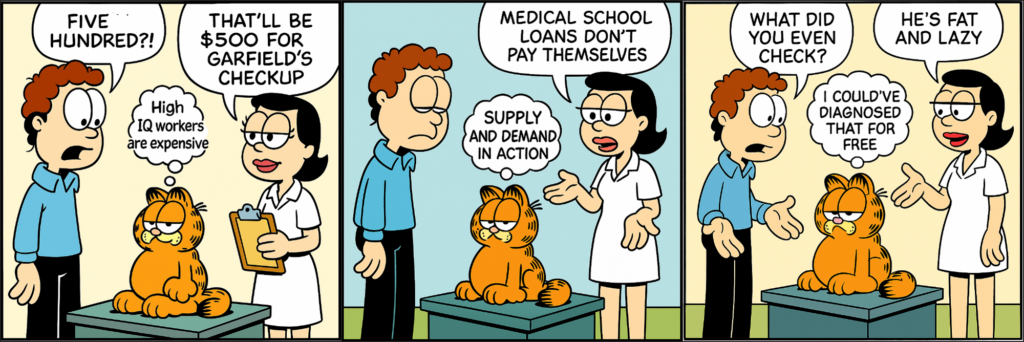
Marginal Garfield
Marginal Garfield generates an original Garfield cartoon every day based on posts from Marginal Revolution! Here is the first strip. You can guess the post. Is there now any reason to come to MR? What a world.
You can also check out Rationalist Garfield which pulls from Less Wrong.
We thank Tim Hwang.
At the Grand Egyptian Museum
Neal Spencer has a good review at the LRB, excerpt:
Over the past few decades, however, Egyptian museums have pivoted away from Europe and America. The National Museum of Egyptian Civilisation, which opened in 2021, rejected the traditional division of artefacts into pharaonic, Coptic, Greco-Roman and Islamic eras (a framework associated with European academic disciplines). The Grand Egyptian Museum, announced at the height of Hosni Mubarak’s rule and styled ‘the largest museum in the world dedicated to the people, history and culture of Ancient Egypt’, opened in November last year with a lavish ceremony broadcast round the world. It is estimated to have cost more than $1 billion ($300 million of which was a loan from Japan) and sprawls over an area the size of seventy football pitches. The financial crash of 2008, the Arab Spring and Covid meant that its construction took almost twenty years. Much has changed in that time. The last decade of construction took place under the military regime of Abdel Fattah el-Sisi, who installed one of his generals as its head – the first non-Egyptologist to direct a major Egyptian museum.
I saw the museum shortly after the opening and found it pretty spectacular, both the building/setting and the collection. It is worth making a trip to Cairo just to see this, and it now can be considered one of the world’s great museums and history sites (yes I had seen the earlier incarnation of the museum, years ago). The very wise Rasheed Griffith also gave the museum an A+.
*Paul Celan: A Life*, by Anna Arno
I do not think it is crazy to regard Celan as standing in the very top tier of poets, noting the poems must be read in the German language. Who has more important topics at a comparable level of quality? This is an excellent biography of him, from the origins in Romania to his affair with Ingeborg Bachmann to his eventual madness and suicide. Recommended, pre-order it here. Definitely slated for the best non-fiction books of the year list.
Podcast with Salvador Duarte
Salvador is 17, and is an EV winner from Portugal. Here is the transcript. Here is the list of discussed topics:
0:00 – We’re discovering talent quicker than ever 5:14 – Being in San Francisco is more important than ever 8:01 – There is such a thing like a winning organization 11:43 – Talent and conformity on startup and big businesses 19:17 – Giving money to poor people vs talented people 22:18 – EA is fragmenting 25:44 – Longtermism and existential risks 33:24 – Religious conformity is weaker than secular conformity 36:38 – GMU Econ professors religious beliefs 39:34 – The west would be better off with more religion 43:05 – What makes you a philosopher 45:25 – CEOs are becoming more generalists 49:06 – Traveling and eating 53:25 – Technology drives the growth of government? 56:08 – Blogging and writing 58:18 – Takes on @Aella_Girl, @slatestarcodex, @Noahpinion, @mattyglesias, , @tszzl, @razibkhan, @RichardHanania, @SamoBurja, @TheZvi and more 1:02:51 – The future of Portugal 1:06:27 – New aesthetics program with @patrickc.
Self-recommending, here is Salvador’s podcast and Substack more generally.
My excellent Conversation with Brendan Foody
Here is the audio, video, and transcript. Here is the episode summary:
At 22, Brendan Foody is both the youngest Conversations with Tyler guest ever and the youngest unicorn founder on record. His company Mercor hires the experts who train frontier AI models—from poets grading verse to economists building evaluation frameworks—and has become one of the fastest-growing startups in history.
Tyler and Brendan discuss why Mercor pays poets $150 an hour, why AI labs need rubrics more than raw text, whether we should enshrine the aesthetic standards of past eras rather than current ones, how quickly models are improving at economically valuable tasks, how long until AI can stump Cass Sunstein, the coming shift toward knowledge workers building RL environments instead of doing repetitive analysis, how to interview without falling for vibes, why nepotism might make a comeback as AI optimizes everyone’s cover letters, scaling the Thiel Fellowship 100,000X, what his 8th-grade donut empire taught him about driving out competition, the link between dyslexia and entrepreneurship, dining out and dating in San Francisco, Mercor’s next steps, and more.
And an excerpt:
COWEN: Now, I saw an ad online not too long ago from Mercor, and it said $150 an hour for a poet. Why would you pay a poet $150 an hour?
FOODY: That’s a phenomenal place to start. For background on what the company does — we hire all of the experts that teach the leading AI models. When one of the AI labs wants to teach their models how to be better at poetry, we’ll find some of the best poets in the world that can help to measure success via creating evals and examples of how the model should behave.
One of the reasons that we’re able to pay so well to attract the best talent is that when we have these phenomenal poets that teach the models how to do things once, they’re then able to apply those skills and that knowledge across billions of users, hence allowing us to pay $150 an hour for some of the best poets in the world.
COWEN: The poets grade the poetry of the models or they grade the writing? What is it they’re grading?
FOODY: It could be some combination depending on the project. An example might be similar to how a professor in English class would create a rubric to grade an essay or a poem that they might have for the students. We could have a poet that creates a rubric to grade how well is the model creating whatever poetry you would like, and a response that would be desirable to a given user.
COWEN: How do you know when you have a good poet, or a great poet?
FOODY: That’s so much of the challenge of it, especially with these very subjective domains in the liberal arts. So much of it is this question of taste, where you want some degree of consensus of different exceptional people believing that they’re each doing a good job, but you probably don’t want too much consensus because you also want to get all of these edge case scenarios of what are the models doing that might deviate a little bit from what the norm is.
COWEN: So, you want your poet graders to disagree with each other some amount.
FOODY: Some amount, exactly, but still a response that is conducive with what most users would want to see in their model responses.
COWEN: Are you ever tempted to ask the AI models, “How good are the poet graders?”
[laughter]
FOODY: We often are. We do a lot of this. It’s where we’ll have the humans create a rubric or some eval to measure success, and then have the models say their perspective. You actually can get a little bit of signal from that, especially if you have an expert — we have tens of thousands of people that are working on our platform at any given time. Oftentimes, there’ll be someone that is tired or not putting a lot of effort into their work, and the models are able to help us with catching that.
And:
COWEN: Let’s say it’s poetry. Let’s say you can get it for free, grab what you want from the known universe. What’s the data that’s going to make the models, working through your company, better at poetry?
FOODY: I think that it’s people that have phenomenal taste of what would users of the end products, users of these frontier models want to see. Someone that understands that when a prompt is given to the model, what is the type of response that people are going to be amazed with? How we define the characteristics of those responses is imperative.
Probably more than just poets that have spent a lot of time in school, we would want people that know how to write work that gets a lot of traction from readers, that gains broad popularity and interest, drives the impact, so to speak, in whatever dimension that we define it within poetry.
COWEN: But what’s the data you want concretely? Is it a tape of them sitting around a table, students come, bring their poems, the person says, “I like this one, here’s why, here’s why not.” Is it that tape or is it written reports? What’s the thing that would come in the mail when you get your wish?
FOODY: The best analog is a rubric. If you have some —
COWEN: A rubric for how to grade?
FOODY: A rubric for how to grade. If the poem evokes this idea that is inevitably going to come up in this prompt or is a characteristic of a really good response, we’ll reward the model a certain amount. If it says this thing, we’ll penalize the model. If it styles the response in this way, we’ll reward it. Those are the types of things, in many ways, very similar to the way that a professor might create a rubric to grade an essay or a poem.
Poetry is definitely a more difficult one because I feel like it’s very unbounded. With a lot of essays that you might grade from your students, it’s a relatively well-scoped prompt where you can probably create a rubric that’s easy to apply to all of them, versus I can only imagine in poetry classes how difficult it is to both create an accurate rubric as well as apply it. The people that are able to do that the best are certainly extremely valuable and exciting.
COWEN: To get all nerdy here, Immanuel Kant in his third critique, Critique of Judgment, said, in essence, taste is that which cannot be captured in a rubric. If the data you want is a rubric and taste is really important, maybe Kant was wrong, but how do I square that whole picture? Is it, by invoking taste, you’re being circular and wishing for a free lunch that comes from outside the model, in a sense?
FOODY: There are other kinds of data they could do if it can’t be captured in a rubric. Another kind is RLHF, where you could have the model generate two responses similar to what you might see in ChatGPT, and then have these people with a lot of taste choose which response they prefer, and do that many times until the model is able to understand their preferences. That could be one way of going about it as well.
Interesting throughout, and definitely recommended. Note the conversation was recorded in October (we have had a long queue), so a few parts of it sound slightly out of date. And here is Hollis Robbins on LLMs and poetry.
Stories Beyond Demographics
The representation theory of stories, where the protagonist must mirror my gender, race, or sexuality for me to find myself in the story, offers a cramped view of what fiction can do and a shallow account of how it actually works. Stories succeed not through mirroring but by revealing human patterns that cut across identity. Archetypes like Hero, Caregiver, Explorer, and Artist, and structures like Tragedy, Romance, and Quest are available to everyone. That is why a Japanese salaryman can love Star Wars despite never having been to space or met a Wookie and why an American teenager can recognize herself in a nineteenth-century Russian novel.
Tom Bogle makes this point well in a post on Facebook:
I have no issue with people wanting representation of historically marginalized people in stories. I understand that people want to “see themselves” in the story.
But it is more important to see the stories in ourselves than to see ourselves in the stories.
When we focus on the representation model, we recreate a character to be an outward representation of physical traits. Then the internal character traits of that individual become associated with the outward physical appearance of the character and we pigeonhole ourselves into thinking that we are supposed to relate only to the character that looks like us. Movies and TV shows have adopted the Homer Simpson model of the aloof, detached, and even imbecilic father, and I, as a middle-aged cis het white guy with seven kids could easily fall into the trap of thinking that is the only character to whom I can relate. It also forces us to change the stories and their underlying imagery in order to fit our own narrative preferences, which sort of undermines the purpose for retelling an old story in the first place.
The archetypal model, however, shifts our way of thinking. Instead of needing to adapt the story of Little Red-Cap (Red Riding Hood) to my own social and cultural norms so that I can see myself in the story, I am tasked with seeing the story play out in myself. How am I Riding Hood? How am I the Wolf? How does the grandmother figure appear in me from time to time? Who has been the Woodsman in my life? How have I been the Woodsman to myself or others? Even the themes of the story must be applied to my patterns of behavior or belief systems, not simply the characters. This model also enables us to retain the integrity of the versions of these stories that have withstood the test of time.
So if your goal is actually to affect real social change through stories, I would encourage you to consider how the archetypal approach may actually be more effective at accomplishing your aims than the representational approach alone (as they are not necessarily in conflict with one another).
What should I ask Henry Oliver?
Yes, I will be doing a Conversation with him. We will focus on our mutual readings of Shakespearer’s Measure for Measure, with Henry taking the lead. But I also will ask him about the value of literature, Jane Austen, Adam Smith, Bleak House, his book on late bloomers, and more.
Here is Henry’s (free) Substack. Here is Henry on Twitter.
So what should I ask him?