Category: Uncategorized
Saturday assorted links
1. The zero dollar budget movie that topped the box office.
2. Fanta Traore at Fortune covers black economists. Good to see the recognition, but how about Virgil Storr (my colleague, recently promoted, thousands of citations)?
4. George Akerlof essay on the biases in economics.
5. Geoguessr, a new game, an automated version of the old Andrew Sullivan, “view out your window” where is this photo. And what the queen bees really are saying.
6. The success story of Nigerian-Americans.
7. “Median age of COVID-19 patients in Florida was 37 last week, compared to the 60s months ago.”
8. Are the ambidextrous less authoritarian? (speculative)
Get BARDA More Money!
The NYTimes headline is Coronavirus Attacks the Lungs. A Federal Agency Just Halted Funding for New Lung Treatments and they do try their best to make this a scandal:
When the coronavirus kills, it attacks the lungs, filling them with fluid and robbing the body of oxygen. In chest X-rays, clear lungs turn white, a sign of how dangerously sick patients are.
But earlier this month, the Biomedical Advanced Research and Development Authority, or BARDA, a federal health agency, abruptly notified companies and researchers that it was halting funding for treatments for this severe form of Covid-19, the disease caused by the virus.
The new policy highlights how staunchly the Trump administration has placed its bet on vaccines as the way to return American society and the economy to normal in a presidential election year. BARDA has pledged more than $2.2 billion in deals with five vaccine manufacturers for the coronavirus, compared with about $359 million toward potential Covid-19 treatments.
I think diverting funding from lung treatments to vaccines is the right thing to do. Note that we are not talking about reducing spending on patients. BARDA, as the name suggests, funds advanced research and development. Thus, the administration is diverting funding from advanced research and development for lung treatments to vaccines. What’s better a vaccine that prevents a lung treatment from ever being needed or a lung treatment? A billion dollars spent on vaccines looks a lot more productive right now than a billion dollars spent on investigating new lung treatments.
The real scandal is how little we are spending on advanced research for vaccines–$2.2 billion is a pittance, less than a day’s worth of economic loss caused by COVID. Given their limited budget, BARDA is making good investments. Congress, however, has not allocated enough money to BARDA, one of the few agencies that had the foresight to do the right things, such as investing in emergency vaccine capacity, even before the pandemic hit. Congress’s failure to fund BARDA is why the administration is scraping the bottom of the barrel to get them all the funding they can.
We should go big, really big, on vaccines. But when I talk with people in Congress, I tell them that a big plan is ideal but if we can’t do that then at least GET BARDA MORE MONEY!
Addendum: The fact that BARDA can’t get enough funding from Congress in a pandemic is a good example of why we need a Pandemic Trust Fund.
Big tech and universal telecommuting
It has gone great so far, but I don’t think it is socially optimal to be doing this forever. Here is my latest Bloomberg column on that topic, 2x the usual length, excerpt:
If Twitter, Facebook and other tech companies shift toward everyone working from home, it will mean less reliance on esprit de corps and morale to ensure performance, and more management using direct financial incentives and project- and output-based monitoring. Virtual tools can help organize teams, but they simply can’t replicate the intellectual frisson of “gathering the smart people” together, and this could damage performance and innovation.
And:
There is some evidence that when employees work at a distance, they don’t put in extra hours or extend themselves for the benefit of co-workers. That probably means a better work-life balance for many people, but perhaps also inferior performance from a lot of companies over the longer haul.
This move away from workplace morale as a motivator will help self-starter employees, but it may not be good for tech labor overall. In essence, without a local workplace ethos, it is easier to commoditize labor, view workers as interchangeable and fire people. The distinction between protected full-time employees and outsourced, freelance and contract workers weakens. A company can make the offer of, “If you hand in your project, we pay you,” to virtually any worker around the world, many of whom might accept lower wages for remote roles.
Bringing new workers on board is an especially difficult problem for this model. In the short run, of course, that is a minor concern but over time it grows.
I’m so American, I can’t even tell if this British speech is parody
Here is the story, the speech appears in a box in the corner:
A Brexiteer Tory MP has urged the government to let his dogs keep their freedom of movement rights after Britain leaves the EU.
Bob Stewart, the MP for Beckenham, said his “French-speaking” hounds crossed the Channel regularly on their EU “pet passports”.
Millions of Britons are set to lose the ability to live and work freely on the continent at the end of the year as a result of the UK’s departure from the bloc.
I am an advocate of canine cosmopolitanism, rather than canine nationalism. Is everyone?
Speaking in French, Mr Gove added: “We always defend the rights of dogs.”
Is that true? Under the previous pre-Brexit regime, a pet passport was sufficient. But now:
Under the worst case-scenario of a no-deal Brexit, taking a pet to the EU will likely require a four-month advanced process that includes microchipping, a rabies vaccination, a blood test and a three-month wait to travel after the blood test.
Developing…
Friday assorted links
1. Samuel Taylor Coleridge childhood home up for sale. Check out the books.
3. Economics Observatory: coronavirus and the UK economy.
4. “The real question is whether we will be able to rebuild a building culture.”
5. Podcast with John Collison. Can any other tech leader speak so authoritatively about so many non-tech businesses?
6. Alaska removes the Into the Wild bus, as trips there had led to several deaths and needed rescues. Is this a welfare improvement, or decline?
7. Saku substack.
Juneteenth: Celebrate Freedom!
I have long favored a new national holiday so I am delighted that VA has recognized Juneteenth and I look forward to this being a national holiday. Juneteenth is a good bookend to July 4, a second day of independence that helped to fulfill the promise of the first. The National Museum of African American History and Culture notes:
Although the Emancipation Proclamation officially took effect on January 1, 1863, freedom did not immediately come for all enslaved people because Confederate-controlled states refused to implement it. Freedom finally came nationally on June 19, 1865, when some 2,000 Union troops arrived in Galveston Bay, Texas. The army announced that the more than 250,000 enslaved people in the state were free by executive decree. This day came to be known as “Juneteenth” by the newly freed people in Texas.
The museum has an excellent online exhibit and tour.

That was then, this is now
About 55 percent of British servicemen [in World War II] were married.
Furthermore, by mid-1943, British military units were dealing with almost one hundred cases of “family anxiety” a day, with about two-thirds of those being infidelity issues, summing yearly to about 7.5 percent of the married British servicemen in North Africa and the Middle East at that time.
That is from Daniel Todman’s Britain’s War 1942-1947, a book I already have reviewed positively. Reading further, it remains excellent and interesting on every page, is still grossly under-reviewed by MSM, and would make the top five or even top three non-fiction books of the year list since I have started blogging.
The course of Covid-19 in the United States
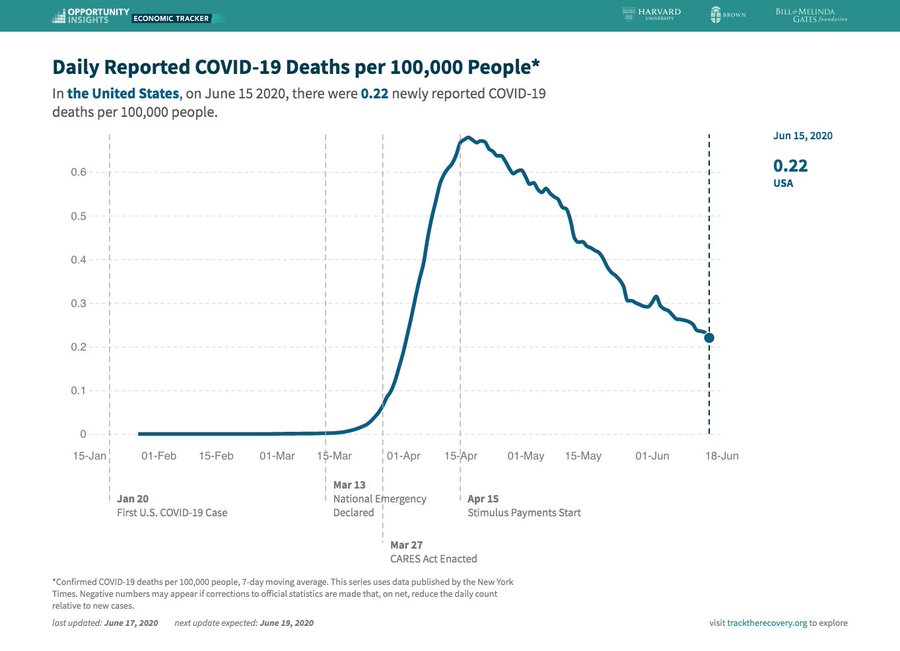 Via Amihai Glazer. And if you wish to verify, here is another (non-smoothed) presentation of the data.
In terms of the delta this picture is not as bad as what you sometimes hear, though data on cases are far worse, with a very long and indeed continuing plateau. And since deaths lag cases by a few weeks, you still might see reason to be alarmed. Nonetheless, the trend we can see is one of improvement, at least for a little over two months.
Do note it is better for everyone if you think the death rate is still rising!
Raj Chetty talk on “The economic impacts of COVID-19: Real-time evidence from private sector data”
I have not yet viewed it, but this talk is receiving rave reviews, here is the link. Or here:
Via the excellent Samir Varma.
Thursday assorted links
1. Can this be true? “The researchers found that several of the foster fathers were high-profile academics.” It gets worse.
2. “Tannehill also stated during the mask discussion that since June 1, four different urgent care clinics in Oxford had reported a total of 162 positive COVID-19 cases from University of Mississippi students who do not live in Lafayette County.” From fraternity events it seems.
4. Is performative entrepreneurship behind the Great Stagnation? And are academics complicit in this?
5. Physical encounters now seem to matter less for virus transmission. That said, in New Jersey 12 percent of nursing home residents have died of Covid-19.
6. Rules for the NBA bubble (NYT).
7. Tenino, Washington prints its own currency.
8. New Marc Andreessen interview, excellent, lots of fresh material, contains lessons about updating as well. By Sriram Krishnan, would get its own blog post if it would let me do “Control C” on the excerpts.
FDA Allows Pooled Tests and a Call for Prizes
The FDA has announced they will no longer forbid pooled testing:
In order to preserve testing resources, many developers are interested in performing their testing using a technique of “pooling” samples. This technique allows a lab to mix several samples together in a “batch” or pooled sample and then test the pooled sample with a diagnostic test. For example, four samples may be tested together, using only the resources needed for a single test. If the pooled sample is negative, it can be deduced that all patients were negative. If the pooled sample comes back positive, then each sample needs to be tested individually to find out which was positive.
…Today, the FDA is taking another step forward by updating templates for test developers that outline the validation expectations for these testing options to help facilitate the preparation, submission, and authorization under an Emergency Use Authorization (EUA).
This is good and will increase the effective number of tests by at least a factor of 2-3 and perhaps more.
In other news, Representative Beyer (D-VA), Representative Gonzalez (R-OH) and Paul Romer have an op-ed calling for more prizes for testing:
Offering a federal prize solves a critical part of that problem: laboratories lack the incentive and the funds for research and development of a rapid diagnostic test that will, in the best-case scenario, be rendered virtually unnecessary in a year.
…We believe in the ability of the American scientific community and economy to respond to the challenge presented by the coronavirus. Congress just has to give them the incentive.
The National Institutes of Health (NIH) have already begun a similar strategy with their $1.4 billion “shark tank,” awarding speedy regulatory approval to five companies that can produce these tests. Expanding the concept to academic labs through a National Institute of Science and Technology (NIST)-sponsored competition has the added benefit ultimately funding more groundbreaking research once the prize money has been awarded.
This is all good but frustrating. I made the case for prizes in Grand Innovation Prizes for Pandemics in March and Tyler and I have been pushing for pooled testing since late March. We were by no means the first to promote these ideas. I am grateful things are happening and relative to normal procedure I know this is fast but in pandemic time it is molasses slow.
Which figures from 1968/1969 look good in retrospect?
Andrew writes to me:
I just wanted to propose a question for your blog, which I’ve read since it launched. Given how the current atmosphere seems a bit like 1968, I was curious who you think comes out of 1968 looking good (or bad) in retrospect. I’m particularly interested in people at universities (my own case), but I’d be curious in general.
A former professor of mine (George Kateb) claimed that my generation (born 1970) was embarrassed by the sixties and I guess particularly by the more radical parts. That’s my impression as well and I assumed that the more radical parts of the sixties and the intellectuals who went along with them would come out looking the worst in retrospect. Is this right? Whose position at the time looks most “correct” today?
It is tough, if only because so many people from both parties then were bad on the Vietnam War issue. Here are a few who, in my judgment, came out of the era looking good, in no particular order:
1. Kareem-Abdul Jabbar (then Lew Alcindor), Billie Jean-King, and Curt Flood.
2. Bob Dylan: pro-civil rights and anti-war, and for all of his phases he never went in for the bad, crazy stuff.
3. Paul McCartney: universalist, anti-war, neoliberal integrationist, and the saner part of the Beatles. Some minus points on the drugs front, however.
4. Julian Bond. And a variety of other civil rights leaders, but MLK not living long enough to “fit” the question as stated.
5. Harry Edwards (who?).
6. Seán Lemass (who?) Elsewhere across the waters there is Raymond Aron.
7. Marshall McLuhan
9. Lucille Ball
9. Gene Roddenberry and the rest of Star Trek, including the script writers.
10. Thomas Pynchon: So many others look bad, at least he knew not to say too much or to hang around for too long.
11. Ayn Rand. With qualifications on a number of fronts, but yes. She was in fact good on the major issues of those years.
12. These people from the Bay Area. They are not public figures, but still they deserve mention.
Who else?
Notes: Marxists, Maoists, and advocates of violence are not going to win. There were plenty of excellent economists back then, but most had a different focus than commenting on the major events of those years, and if memory serves (please correct me if I am wrong) Milton Friedman’s very meritorious anti-draft work came slightly later. I would have to reread the major feminist book authors to pick the best one, but I do mean for at least one to be on the list, I am simply not sure at the moment which one. Ralph Nader too? The astronauts? They knew to keep their mouths shut once they were finished.
Wednesday assorted links
1. The alligator snapping turtle culture that is Lord Fairfax.
2. Die Kinder kommen auch dazu.
3. Racial bias in traffic ticket disparities?
4. David Brooks on the dehumanizing culture of the police.
5. Bergstrom on the new anti-Covid drug.
6. The Invisible College: 50k investments in youth. Run partly by philosophers, including Michael Gibson.
My Conversation with Rachel Harmon
Rachel Harmon is a Professor at University of Virginia Law School, and an expert on policing. Here is the audio and transcript, and here is part of the CWT summary:
She joined Tyler to discuss the best ideas for improving policing, including why good data on policing is so hard to come by, why body cams are not a panacea, the benefits and costs of consolidating police departments, why more female cops won’t necessarily reduce the use of force, how federal programs can sometimes misfire, where changing police selection criteria would and wouldn’t help, whether some policing could be replaced by social workers, the sobering frequency of sexual assaults by police, how a national accreditation system might improve police conduct, what reformers can learn from Camden and elsewhere, and more. They close by discussing the future of law schools, what she learned clerking under Guido Calabresi and Stephen Breyer, why she’s drawn to kickboxing and triathlons, and what two things she looks for in a young legal scholar.
And here is one bit:
COWEN: Should we impose higher educational standards on police forces?
HARMON: There’s mixed evidence on that. Slightly older police officers tend to be better in certain respects, at least, and education is often associated with age. But, again, I don’t think that we can select our way out of problems in policing.
COWEN: But why can’t we? Because different individuals — they behave so differently. They think so differently. Why is it that there’s no change in selection criteria that would get the police to be more the way we want them to be, whatever that might be?
HARMON: I think we could do some things. We could screen out people who have committed misconduct in the past, for example, by decertifying them at the state level and therefore discouraging departments that can’t or don’t care very much about quality of their officers from hiring those officers.
It’s not that we can’t select against problems in policing at all. Sometimes we know that an officer’s problematic, and still he’ll wander around from department to department. I think we should set minimum age standards that are above 18, which many states have as a minimum age standard.
But in terms of education or other more subtle factors, I think the effects can often be subtle, and when we look at what creates problems in policing, departments create officers. The officers don’t preexist a department, really, so what you’re really looking at is the culture of the department, the incentive structures, the supervision, discipline. You can make good officers with imperfect people.
Recommended, interesting throughout, and yes we discuss San Francisco and Singapore too.
Comparative Institutional Failure
The common element to our twin crises is that many of the government agencies we thought were keeping us safe and secure—the CDC, the FDA, the Police–have either failed or, worse, have been revealed to be active creators of danger and insecurity. Alex Tabarrok.
Derek Thompson writing at The Atlantic uses my quote as a jumping off point for a good piece on the failure of American institutions. He does a good job of covering the failures of the CDC, the FDA and the police but most interestingly asks why the FED has acted very differently.
While too many American police are escalating encounters like it’s 1990, and the FDA is slow-playing regulatory approval as if these are normal times, and the CDC is somehow still using fax machines, the Federal Reserve has junked old shibboleths about inflation and deficit spending and embraced a policy that might have scandalized mainstream economists in the 1990s. Rejecting the status-quo bias that plagues so many institutions, this 106-year-old is still changing with the world.
Why haven’t other American institutions done the same? Perhaps America’s dependency on old leadership makes our institutions exquisitely responsive to the anxieties and illusions of old Americans. Perhaps the nature of large bureaucracies is to become lost in the labyrinth of mission-creeping path dependency. Perhaps years of political polarization and right-wing anti-science, anti-expertise sentiments have wrung all of the fast-twitch smarts out of the government. Or perhaps we should just blame Trump, that sub-institutional creature summoned from the bilious id of an electorate that lost faith in elites when elites lost their grip on reality.
Whatever the true cause for our failure, when I look at the twin catastrophes of this annus horribilis, the plague and the police protests, what strikes me is that America’s safekeeping institutions have forgotten how to properly see the threats of the 21st century and move quickly to respond to them. Those who deny history may be doomed to repeat it. But those who deny the present are just doomed.
I see three reasons why the FED may have been different. First, the FED is one of the most independent agencies which may help to explain its faster and more adaptive behavior ala Garett Jones’s 10% Less Democracy. Second, and relatedly, the FED pulls a lot of leadership and staff from academia. That gives FED staff an affiliation goal and clique outside of politics which creates mental independence as well as political independence. Third, the FED was also tested in the last crisis and experience with crises helps as we have also seen in Asia tested by H1N1, SARS and MERS more than the US was.
I am not sure which, if any, of these explanations is the most important but I do think that we have a lot more to learn from comparative institutional analysis not just within the US but across countries as well.